High resolution satellites revolutionize whale spotting from outer space and give hope for imperiled right whale

CNSPhoto-WHALES
New high resolution satellite image processing technology allows researchers to identify and count right whales at the ocean surface or to depths of up to 15 metres — described as a boon to tracking the health of whale populations.

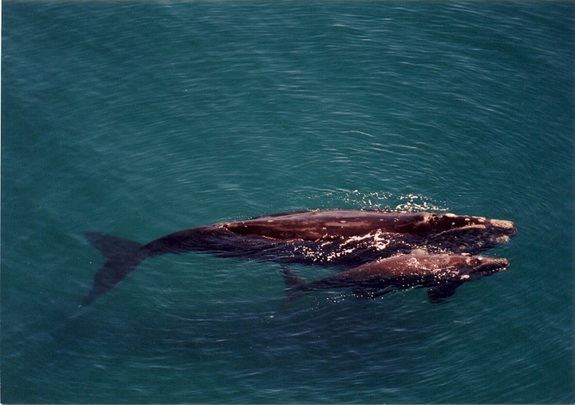
The very trait that pushed southern right whales close to extinction — lolling near the surface of warm waters — is helping to revolutionize the way whales are counted.

New satellite technology has allowed the use of high-resolution photographs and image processing software to detect the crustaceans at the surface or to a depth of 15 metres in shallow waters off Argentina.

High-res satellites are a cost-effective improvement over the way whale populations are currently calculated — narrowly limited counts from shore, a ship or a plane.

Scientists used the most powerful commercial observation platforms available can see surface features as small as 50 centimetres in black and white.

A test of the satellite’s image-recognition capacity, reported in the journal Plos One, detected about 90% of southern right whales swimming in the Golfo Nuevo on the coast of Argentina compared to a manual search of the imagery.

The accuracy surpasses previous attempts at space-borne assessment and could revolutionize the way whale populations are estimated.

“Our study is a proof of principle,” Peter Fretwell of the British Antarctic Survey told the BBC.

“But as the resolution of the satellites increases and our image analysis improves, we should be able to monitor many more species and in other types of location.

“It should be possible to do total population counts and in the future track the trajectory of those populations.”

For this study, Fretwell and his colleagues purchased a single, massive image taken in September 2012 by the WorldView2 satellite. The image covers 113 square kilometres including Golfo Nuevo, a circular gulf off the Argentine coast and an area where southern right whales are known to breed and raise their young from July through November.

By looking at the same image in different wavelengths, including one able to penetrate 15 metres beneath the ocean, the researchers were able to spot 55 probable whales and 22 possible whales in the gulf as well as 13 whale-shapes underwater.

“Satellite imagery provides much more accurate and wider coverage,” Fretwell told the Los Angeles Times. “If this works, we can take it out to many other species as well.”

These animals were driven to near-extinction in the early 20th century. Recognized as slow, shallow swimmers, they were the “right” whales to hunt.

For this reason, their numbers dropped from a pre-whaling population of 55,000-70,000 to just 300 by the 1920s.

“The same reason they are the right whales to catch makes them the right whales to look for by satellite,” said Fretwell.

Their numbers have seen something of a recovery, but without the means to carry out an accurate census, it is hard to know their precise status.

Scientists already have used satellite imagery to count populations of penguins in Antarctica, and Fretwell said similar work was being done with seals. The key to using satellites to track animals is not the size of the animal but how much it stands out from its environment, he said.
http://news.nationalpost.com/2014/02/14/high-resolution-satellites-revolutionize-whale-spotting-and-give-hope-for-imperiled-right-whale/?utm_source=feedburner&utm_medium=feed&utm_campaign=Feed%3A+NPWorld+%28National+Post+-+World%29

Kelp gulls may be responsible for the worst-ever Right Whale die-off

southern-right-whale

Scientists still don’t know why hundreds of baby southern right whales are turning up dead around Patagonia, a decade after observers first saw signs of the worst die-off on record for the species, according to the Wildlife Conservation Society (WCS).

With no evidence of infectious diseases or deadly toxins in whale tissue samples, scientists are scrambling to determine a cause of death. Some are even pointing a finger at blubber-eating birds.

The whales come to the peaceful Atlantic bays around Peninsula Valdes along Argentina’s Patagonian Coast to give birth and raise their young. At least 605 dead right whales have been counted in the region since 2003, WCS officials say. Of those, 538 were newborn calves. Last year, the mortality event was especially severe, with a record-breaking 116 whale deaths, 113 of them calves.

“In 2012 we lost nearly one-third of all calves born at the Peninsula,” said Mariano Sironi, scientific director of the Instituto de Conservacion de Ballenas in Argentina. “Southern right whales have their first calf when they are nine years old on average. This means that it won’t be until a decade from now that we will see a significant reduction in the number of calves born, as all of the female calves that died will not be contributing any new offspring to the population,” Sironi, who is also an advisor to the Southern Right Whale Health Monitoring Program, added in a statement.

Sironi and colleague Vicky Rowntree, who is co-director of the monitoring program, have studied a strange phenomena that could be stressing southern right whales. They say kelp gulls at Peninsula Valdes land on the backs of the cetaceans to eat their skin and blubber.

“The attacks are very painful and cause large, deep lesions, particularly on the backs of young 2-6 week-old calves,” the researchers said in a statement from WCS. “This harassment can last for hours at a time. As a result, right whale mothers and their calves are expending much precious energy during a time of year when mothers are fasting and at a site where little to no food is available to replenish fat reserves.”

The situation is discouraging for a species that had made a significant comeback since its population was depleted by the whaling industry.

“The southern right whale population is still only a small fraction of its original size, and now we have reason to worry about its recovery,” Rowntree said.

Though the southern right whale is not listed as endangered, conservationists warn that the species’ sister populations could go extinct if hit with a mysterious die-off on this scale. For instance, there are thought to be just about 500 North Atlantic right whales remaining.

Thanks to Dr. Lutter for bringing this to the attention of the It’s Interesting community.

http://news.yahoo.com/worst-ever-whale-die-off-continues-puzzle-110222538.html

South African whale driven through streets

beachedwhale1 beachedwhale2 beachedwhale3


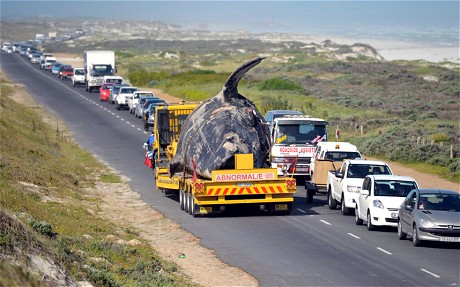
South African council cleaners have used a lorry to move a stranded whale from a beach near Cape Town.  Officials pulled the huge mammal through heavy traffic down a busy road along the city’s False Bay coastline.  Salvage staff needed an industrial digger to move the 30 metre southern Right Whale, which became stranded on Sunday at Cape Town’s Capricorn beach.

City emergency services spokesman Wilfred Solomons-Johannes confirmed the beach had been closed amid fears deadly Great White sharks had entered shallow waters to feed on the carcase.  He said: “The whale was spotted on the beach on Sunday afternoon. “It had become beached and was dead by the time officials could get to it.  The animal had several bits of flesh taken out of it, and it appears it had been bitten by sharks.”  He added: “We called in the city’s specialist marine rescue team, who used diggers and a lorry to remove the whale.

“It was heaved onto the back of a truck and taken to a landfill site for disposal.”

Mr Solomons-Johannes said experts would examine the dead animal to try to establish how it died.  He added: “Samples were taken from the whale and these will be analysed to try to work out what happened to it.  We hope to get the results within the next couple of days, which may help to explain why it died.”

City officials closed several beaches around Cape Town on Sunday after sharks were spotted in waters close to the beached whale.

Mr Solomons-Johannes on Tuesday confirmed some had reopened following the removal of the carcase but said Capricorn beach itself would remain closed until further notice.  He said: “Capricorn beach remains closed for the next few days until the whale blood and oil has dispersed sufficiently.

“The city is appealing to all water users to be vigilant at this time, obey the shark siren, and to take note of the Shark Spotters’ flags and signage for regular updates on shark sightings.  Beach users are advised that the general caution will remain in place until further notice.”

Specialist teams of Shark Spotters were working on several of Cape Town’s beaches to watch for any signs of the deadly animals.  The killer beasts are frequent visitors to the waters around the city and have been responsible for a string of attacks on humans.

British man Michael Cohen, 47, narrowly escaped with his life in September 2011 after he was bitten by a shark on a beach near Cape Town.  The keen swimmer lost his right leg and part of his left foot after being savaged in the False Bay water.

Zimbabwean tourist Lloyd Skinner was eaten alive by sharks in January 2010 as he swam near the town of Fish Hoek.  Shocked holiday-makers watched from the shore as he was pulled underwater, and rescuers later recovered only his goggles.

Southern Right whales are also regularly seen in the sea around Cape Town.

The massive mammals spend most of their time in the deep ocean but move towards the Cape peninsula during winter and spring to mate.

http://www.telegraph.co.uk/earth/wildlife/9596404/South-African-whale-driven-through-streets.html