Japan Tsunami Debris En Route to US

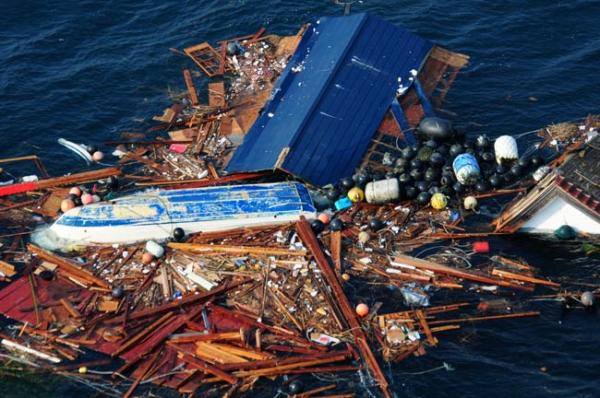
Debris from the devastating tsunami that hit Japan on March 11 has turned up exactly where scientists predicted it would after months of floating across the Pacific Ocean. Finding and confirming where the debris ended up gives them a better idea of where it’s headed next.

The magnitude 9.0 quake and ensuing tsunami that struck off the coast of Tohoku in Japanwas so powerful that it broke off huge icebergs thousands of miles away in the Antarctic, locally altered Earth’s gravity field, and washed millions of tons of debris into the Pacific.

Scientists at the International Pacific Research Center at the University of Hawaii at Manoa have been trying to track the trajectory of this debris, which can threaten small ships and coastlines. The new sightings should help the scientists predict when the debris, which ranges from pieces of fishing vessels to TV sets, will arrive at sensitive locations, such as marine reserves.

Scientists estimate the debris will wash up on the Hawaii Islands in two years and the U.S. West Coast in three.

http://www.msnbc.msn.com/id/44946850/ns/technology_and_science-science/t/japan-tsunami-debris-spotted-course-hit-us/?ocid=ansmsnbc11

Peanut Butter Prices Getting Ready to Soar

Prices are set to spike following one of the worst peanut harvest seasons growers have seen in years.

Prices for a ton of runner peanuts, commonly used to make peanut butter, hit nearly $1,200 this week, according to the U.S. Department of Agriculture. That’s up from just $450 per ton a year ago.

It won’t be long before consumers see this price increase reflected on store shelves.

Kraft will raise prices for its Planters brand peanut butter by 40% starting Oct. 31, while ConAgra expects increases of more than 20% for its Peter Pan brand.

A spokesperson for Unilever, which makes Skippy, would say only that it’s watching the situation “very closely.”

Representatives for J.M. Smucker, which makes Jif, did not respond to a request for comment, though the Associated Press reported that Jif’s wholesale prices are set to rise 30% in November.

What’s to blame for this sticky situation? The intense heat and drought that hit the southern U.S. this year, said John Beasley, a professor of crop physiology and management at the University of Georgia.

“It was just unmerciful, and we had a lot of problems setting the crop,” he said. “I literally walked some fields that had zero yield.”

http://money.cnn.com/2011/10/14/markets/peanut_butter_prices/index.htm?hpt=hp_t2

Tuvalu Island Almost Out of Fresh Water


The tiny Pacific nation of Tuvalu has declared a state of emergency because it has only several days’ worth of fresh water remaining, after being ravaged by an extended drought.  Neighboring New Zealand and Australia have stepped in and offered to provide desalination equipment, which would keep the islands from running dry.  Australia is also sending rehydration packs for use in hospitals, as well as money and fuel for the desalination plants.  Residents are currently rationing water, with those in the capital of Funafuti down to two buckets a day, but the crisis point has already been reached.

Read more: http://ecocentric.blogs.time.com/2011/10/07/tuvalu-goes-dry/#ixzz1aEmS3Ar8

Texas Drought Could Last 9 More Years

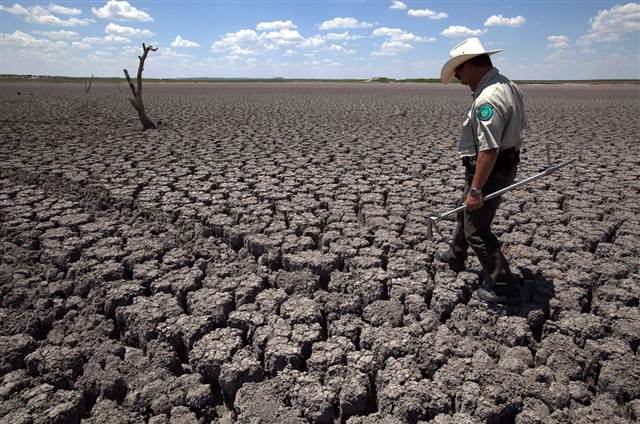
A devastating Texas drought that has browned city lawns and caused more than $5 billion in damages to the state’s farmers and ranchers could continue for another nine years, a state forecaster said on Thursday.

“It is possible that we could be looking at another of these multiyear droughts like we saw in the 1950s, and like the tree rings have shown that the state has experienced over the last several centuries,” State Climatologist John Nielson-Gammon told Reuters.

Some 95 percent of the state is listed as being in either “severe” or “exceptional” drought by the U.S. Department of Agriculture’s Drought Monitor, and Nielson-Gammon said the last 12 months have been the driest one-year period on record in the Lone Star State.

The state’s worst recorded drought lasted from 1950 through 1957 and prompted the creation of artificial lakes all across Texas to supply water to a state that at the time had a population of 15 million – a whopping 10 million fewer than today.

The long-term weather patterns, including La Nina currents in the oceans, mirror records from the early 1950s, Nielsen-Gammon said. The current drought, which he said began in earnest in 2005, could wind up being a 15-year stretch if patterns hold, he said.

“We’re very lucky that we had 2007 and 2010, which were years of plentiful rain,” he said. “2010 was the wettest year in record. Were it not for last year, we would be in much worse shape even than we are today.”

Conditions in Texas now are far from good. The drought has dried up many lakes built after the drought of the 1950s, and more than 23,000 separate wildfires fueled by dried brush and trees have destroyed 3.8 million acres and with that 2,800 homes, according to the Texas Forest Service.

Nielson-Gammon said Texas was now 10 to 20 inches of rainfall behind where it should be at the end of September, usually one of the state’s wettest months.

Rather than being the exception, severe drought could become the rule in Texas going forward, with wet years being more noteworthy.

“We’ve had five of the last seven years in drought, and it looks like it is going to be six out of eight,” he said.

The month is going out the same way it came in, with Texas firefighters on edge. Friday will be another extremely dangerous day for wildfires, with conditions similar to those over the Labor Day weekend when 60 fires erupted across the state, Holly Huffman of the Texas Forest Service said.

On Sept. 4, a gust of wind blew a dead pine tree into power lines east of Austin, sparking the deadly Bastrop Complex Fire. That blaze killed two people, destroyed 1,600 homes, and is now the costliest fire in terms of lost property in Texas history.

The Forest Service this week called in two air tankers from Canada to fight wildfires that continue to burn around Texas, citing a shortage of enough planes to fight the state’s fires.

http://www.msnbc.msn.com/id/44725170

Thousands of bees attack man and shut down California street


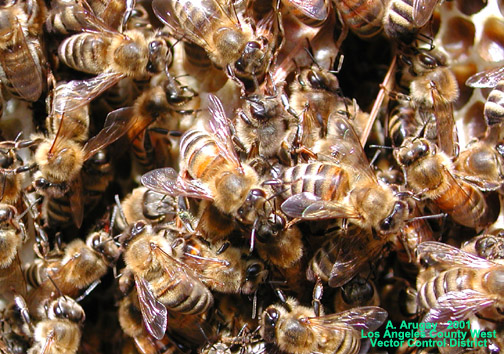
Thousands of angry bees swarmed a man in a wheelchair, sending him and three others who came to his aid to the hospital in the Southern California city of Santa Ana.

The attack also shut down a street and forced the evacuation of several businesses while beekeepers removed the hive, which was estimated to contain 60,000 bees.

The trouble started at a storage yard when a man in a wheelchair apparently disturbed the hive, causing the bees to bombard him, Santa Ana fire Capt. Steven Snyder said.

“He was attacked and stung over 60 times and had fallen out of the wheelchair and was yelling for help,” Snyder said.

The man’s cries attracted the attention of three bystanders who ran to his aid.

The bees were so aggressive that the three men had to retreat initially, but they dove back in and managed to pull the man to safety, Snyder said.

The men were stung dozens of times during the “very impressive” rescue, he said.

All four men had difficulty breathing and suffered rashes, nausea and vomiting.

http://www.msnbc.msn.com/id/44546297/ns/us_news-life/?gt1=43001

Thanks to Mr. C for bringing this to the attention of the It’s Interesting community.

Monster Crocodile


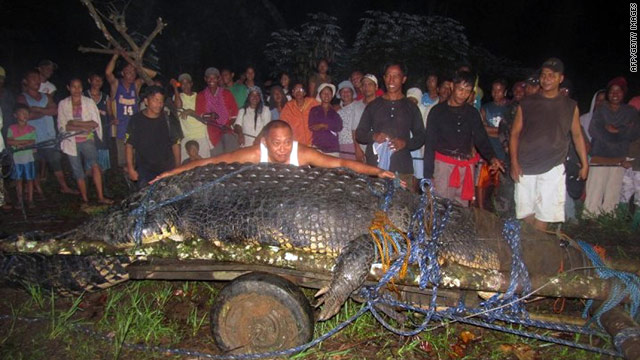
Wildlife authorities in the Philippines have captured a 21-foot-long, 2,370-pound saltwater crocodile, thought to be the largest creature of its kind now in captivity.

The croc was captured in Agusan del Sur marsh on the southern Philippine island of Mindinao.  Hunters had been trying to capture it for 21 days, using meat as bait and an 8 mm cable to snare it.

Edwin Cox Elorde, mayor of the remote town of  Bunawan near where the croc was caught, said the reptile will become the star of a nature park there.

They believe that an even bigger crocodile is still at large in the same area.

The previous largest crocodile in captivity is an 18-footer in Australia, according to Guinness World Records.


http://www.abs-cbnnews.com/nation/regions/09/06/11/bigger-monster-croc-still-large-agusan

Common Bacteria Discovered to be Mind-Altering, Improving Mood and Reducing Anxiety

Hundreds of species of bacteria call the human gut their home. This gut “microbiome” influences our physiology and health in ways that scientists are only beginning to understand. Now, a new study suggests that gut bacteria can even mess with the mind, altering brain chemistry and changing mood and behavior.

John Cryan and colleagues at McMaster University in Canada fed mice a broth containing a benign bacterium, Lactobacillus rhamnosus. The scientists chose this particular bug partly because they had a handy supply and also because related Lactobacillus bacteria are a major ingredient of probiotic supplements and very little is known about their potential side effects, Cryan says.

In this case, the side effects appeared to be beneficial. Mice whose diets were supplemented with L. rhamnosus for 6 weeks exhibited fewer signs of stress and anxiety in standard lab tests, Cryan and colleagues reported yesterday in the Proceedings of the National Academy of Sciences.

http://news.sciencemag.org/sciencenow/2011/08/mind-altering-bugs.html

How do the animals know an earthquake is coming?


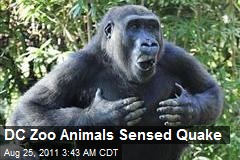
Animals at the National Zoo in Washington, DC, appear to have sensed last Tuesday’s earthquake before humans did. Seconds before the ground began to shake, gorillas and orangutans dropped their food, grabbed their young, and climbed as high as they could. The zoo’s 64 flamingos huddled together, and an elephant made an unusual low-pitched noise just before the earthquake was felt, zookeepers tell the Washington Post.  Red-ruffled lemurs sounded an alarm cry a full 15 minutes before the quake.  The apes and other creatures who sensed the quake coming may have been reacting to the weak primary wave that a quake generates some 15 seconds before the ground shakes, but it is possible that the animals could have reacted to signals still undiscovered by humans.

http://www.washingtonpost.com/national/health-science/zoo-mystery-how-did-apes-and-birds-know-quake-was-coming/2011/08/24/gIQAZrXQcJ_story.html?hpid=z2

Dogs Can Sniff Out Lung Cancer


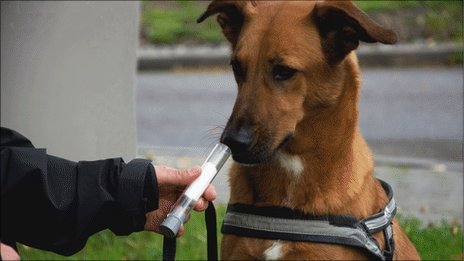
Sniffer dogs can be used to reliably detect lung cancer, according to researchers in Germany.

Writing in the European Respiratory Journal, they found that trained dogs could detect a tumour in 71% of patients.

However, scientists do not know which chemical the dogs are detecting, which is what they say they need to know to develop a screening program.

It was first suggested that dogs could “sniff out” cancer in 1989 and further studies have shown that dogs can detect some cancers such as those of the skin, bladder, bowel and breast.

http://www.bbc.co.uk/news/health-14557224