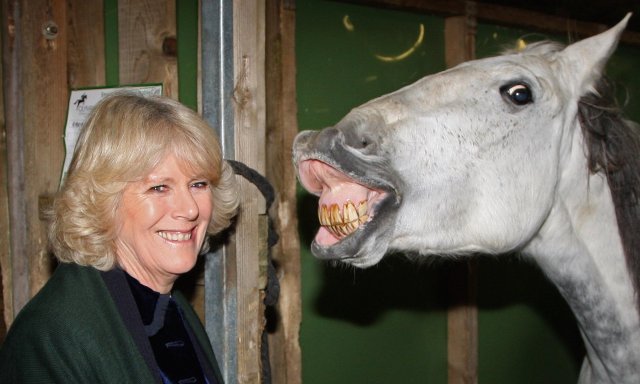
New research shows that horses can recognize human emotion

Psychologists studied how 28 horses reacted to seeing photographs of positive versus negative human facial expressions. When viewing angry faces, horses looked more with their left eye, a behaviour associated with perceiving negative stimuli. Their heart rate also increased more quickly and they showed more stress-related behaviours. The study, published February 10 in Biology Letters, concludes that this response indicates that the horses had a functionally relevant understanding of the angry faces they were seeing. The effect of facial expressions on heart rate has not been seen before in interactions between animals and humans.

Amy Smith, a doctoral student in the Mammal Vocal Communication and Cognition Research Group at the University of Sussex who co-led the research, said: “What’s really interesting about this research is that it shows that horses have the ability to read emotions across the species barrier. We have known for a long time that horses are a socially sophisticated species but this is the first time we have seen that they can distinguish between positive and negative human facial expressions.”

“The reaction to the angry facial expressions was particularly clear — there was a quicker increase in their heart rate, and the horses moved their heads to look at the angry faces with their left eye.”

Research shows that many species view negative events with their left eye due to the right brain hemisphere’s specialisation for processing threatening stimuli (information from the left eye is processed in the right hemisphere).

Amy continued: “It’s interesting to note that the horses had a strong reaction to the negative expressions but less so to the positive. This may be because it is particularly important for animals to recognise threats in their environment. In this context, recognising angry faces may act as a warning system, allowing horses to anticipate negative human behaviour such as rough handling.”

A tendency for viewing negative human facial expressions with the left eye specifically has also been documented in dogs.

Professor Karen McComb, a co-lead author of the research, said: “There are several possible explanations for our findings. Horses may have adapted an ancestral ability for reading emotional cues in other horses to respond appropriately to human facial expressions during their co-evolution. Alternatively, individual horses may have learned to interpret human expressions during their own lifetime. What’s interesting is that accurate assessment of a negative emotion is possible across the species barrier despite the dramatic difference in facial morphology between horses and humans.”

“Emotional awareness is likely to be very important in highly social species like horses — and our ongoing research is examining the relationship between a range of emotional skills and social behaviour.”

The horses were recruited from five riding or livery stables in Sussex and Surrey, UK, between April 2014 and February 2015. They were shown happy and angry photographs of two unfamiliar male faces. The experimental tests examined the horses’ spontaneous reactions to the photos, with no prior training, and the experimenters were not able to see which photographs they were displaying so they could not inadvertently influence the horses.

Journal Reference: Amy Victoria Smith, Leanne Proops, Kate Grounds, Jennifer Wathan and Karen McComb. Functionally relevant responses to human facial expressions of emotion in the domestic horse (Equus caballus). Biology Letters, 2016 DOI: 10.1098/rsbl.2015.0907

https://www.sciencedaily.com/releases/2016/02/160209221158.htm

Goats being used to clear poison ivy and other plants in Boston Hyde Park

The city is renting eight goats to graze on a city-owned golf course and another four at a wild landscape area. They will eat poison ivy, buckthorn, Japanese knotweed and other invasive plant species clogging the land, said Ryan Woods, a spokesman for the Boston Parks and Recreation Department.

“Goats eat everything. It’s one of the natural things that they do, and they’re able to digest these things that are harmful to humans,” Woods said. Plus they’re cheaper and quieter than lawnmowers, he added __ and they drop natural fertilizer along the way.

The goats will be split into herds of four, each of which can clear up to a third of an acre per week. One herd will graze on a wild landscape in the Hyde Park neighborhood for four weeks starting on July 6. Afterward, they’ll join two other herds working at the George Wright Golf Course for six weeks starting on July 20.
The goal is to make overgrown areas more inviting to visitors, Woods said.

The goats will live at those sites until they finish their work, surrounded by solar-powered electric fences that keep them in and predators out. They’ll also be fed hay and water to supplement their diet.

http://boston.cbslocal.com/2015/06/10/boston-hires-goat-crew-to-landscape-weed-choked-city-land/

Thanks to Pete Cuomo for bringing this to the It’s Interesting community.

Dutch police training Eagles to grab drones out of the sky

For hundreds of years in the skies over Asia, people have used eagles to hunt down prey with deadly results.

That tradition has been in decline for decades, but now the bird’s keen eyesight, powerful talons and lethal hunting instincts are being used to take out a new kind of 21st-century vermin: drones.

The animal-vs.-machine moment is brought to you by Guard From Above, which describes itself as “the world’s first company specialized in training birds of prey to intercept hostile drones.”

The Hague-based company’s latest customers are Dutch police, who have been looking for ways to disable illegally operating drones. A police spokesman told Dutch News.nl that the effort remains in a testing phase, but he called the use of birds to combat drones a “very real possibility.”

“It’s a low-tech solution to a high-tech problem,” national police spokesman Dennis Janus told Reuters.

He added: “People sometimes think it’s a hoax, but it’s proving very effective so far.”

The rise of drone technology has been matched in speed by the rise of anti-drone technology, with companies creating radio jammers and “net-wielding interceptor” drones to disable quadcopters, according to the Verge.

“For years, the government has been looking for ways to counter the undesirable use of drones,” Guard From Above’s founder and chief executive, Sjoerd Hoogendoorn, said in a statement. “Sometimes a low-tech solution for a high-tech problem is more obvious than it seems. This is the case with our specially trained birds of prey. By using these birds’ animal instincts, we can offer an effective solution to a new threat.”

A video released on Sunday by Dutch police shows an eagle swooping in at high speed to pluck a DJI Phantom out of the air using its talons. The drone is immediately disabled as the bird carries it off.

“The bird sees the drone as prey and takes it to a safe place, a place where there are no other birds or people,” project spokesman Marc Wiebes told Dutch News.nl. “That is what we are making use of in this project.”

Said Hoogendoorn, according to Reuters: “These birds are used to meeting resistance from animals they hunt in the wild, and they don’t seem to have much trouble with the drones.”

Janus, the police spokesman, told the Associated Press that the birds get a reward if they snag a drone.

Eagles’ talons, as the New York Daily News points out, are known for their powerful grips; it’s unknown whether they could be damaged by a drone’s carbon-fiber propellers.

HawkQuest, a Colorado nonprofit that educates the public about birds of prey, says eagles have enough power to “crush large mammal bones” in animals such as sloths.

“Scientists have tried to measure the gripping strength of eagles,” HawQuest notes. “A Bald Eagle’s grip is believed to be about 10 times stronger than the grip of an adult human hand and can exert upwards of 400 psi or pounds per square inch.”

According to a study cited by Wired in 2009, raptor talons are not merely powerful, but also finely tuned hunting instruments:

“…accipitrids, which include hawks and eagles, have two giant talons on their first and second toes. These give them a secure grip on struggling game that they like to eat alive, ‘so long as it does not protest too vigorously. In this prolonged and bloody scenario, prey eventually succumb to massive blood loss or organ failure, incurred during dismemberment.’”

A handler in the video, the Daily News notes, claims the birds are adequately protected by scales on their feet and legs, but researchers hope to equip the animals with another layer of defense.

The potential impact on the animals’ welfare is the subject of testing by an external scientific research institute.

“The real problem we have is that they destroy a lot of drones,” Hoogendoorn said, according to Reuters. “It’s a major cost of testing.”

The decision about whether to use the eagles is still several months away.

https://www.washingtonpost.com/news/worldviews/wp/2016/02/01/trained-eagle-destroys-drone-in-dutch-police-video/

Scientists bring back animal that resembles the quagga, which went extinct over a century ago

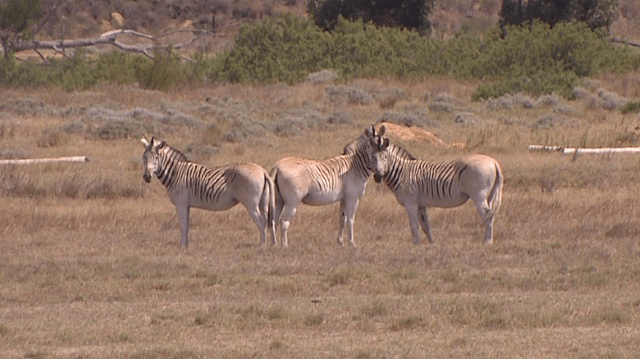
An animal that went extinct over 100 years ago is coming back, thanks to a group of scientists. The creature is called the quagga and while that might not sound familiar, it is a close relative of the zebra.

Just like zebras, the quagga has stripes, but for them they only appear on the front half of their bodies, and they are also brown on the rear half of their bodies. A group of scientists outside of Cape Town, Africa, called The Quagga Project, have bred an animal that looks extremely similar by using DNA and selective breeding.

In the past, the quagga roamed South Africa, but they went extinct around the 1880s after European settlers killed them at an alarming rate. However, CNN reports that after testing remaining quagga skins, which revealed the animal was a sub species of the plains zebra, the scientists hypothesized that the genes which characterized the quagga would be present in zebras and could be manifested through selective breeding.

“The progress of the project has in fact followed that prediction. And in fact we have over the course of 4, 5 generations seen a progressive reduction in striping, and lately an increase in the brown background color showing that our original idea was in fact correct,” Eric Harley, the project’s leader, told CNN.

However not everybody thinks the project was a complete success. There are several critics who believe that the project was all a stunt and that all the scientists did was create a different looking zebra.

“There are a lot of detractors who are saying you can’t possibly put back the same as what was here,” says fellow project leader Mike Gregor to CNN. Adding, “there might have been other genetic characteristics [and] adaptations that we haven’t taken into account.”

The researches say there are only six of the creatures that they now call “Rau quaggas,” (after the project’s originator Reinhold Rau) but when they have 50 of them, they then plan for the herd to live together on one reserve.

Harley tells CNN, “if we can retrieve the animals or retrieve at least the appearance of the quagga, then we can say we’ve righted a wrong.”

http://wtnh.com/2016/01/27/scientists-bring-back-animal-that-went-extinct-over-a-century-ago/

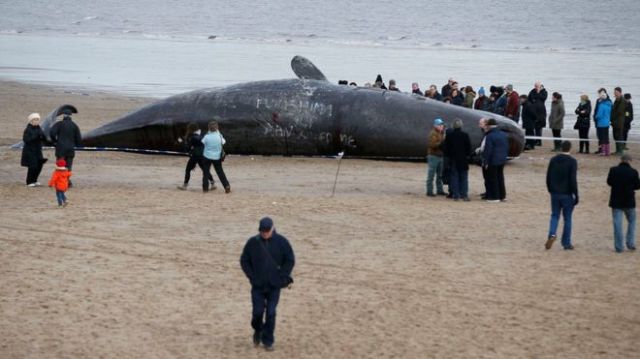
Five sperm whales wash up on the east coast of England

A fifth sperm whale has been washed up on the east coast of England.

It follows the death of a beached whale in Hunstanton, Norfolk, on Friday and the discovery of three carcasses near Skegness over the weekend.

The sperm whales are believed from a pod spotted off the Norfolk coast.

The fifth whale was found at Wainfleet, Lincolnshire, on Monday afternoon, the Maritime and Coastguard Agency reported.

It was found on the site of a former bombing range, and warnings have been issued for people to stay away.

The Lincolnshire Wildlife Trust tweeted: “There is no public access to the area and it is extremely dangerous with tidal creeks and the potential for unexploded ordinance. Many of the lanes to the marshes are private and not accessible.”

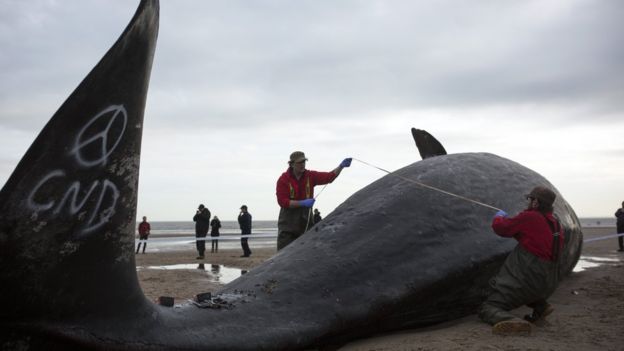
Marine biologists were using a probe to examine one of the Skegness whales earlier on Monday when there was a “huge blast of air”, said BBC reporter David Sykes.

The letters CND had also been spray-painted by someone on the whale’s tail.

CND (Campaign for Nuclear Disarmament) said the action was not carried out by the organisation at a national level.

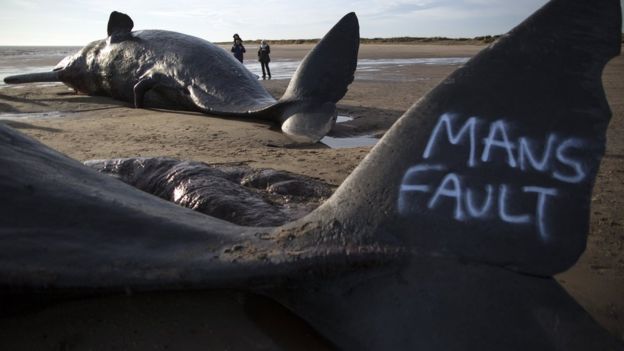
The word “fukushima” – presumably a reference to the stricken Japanese nuclear power station – was also written on the side of the whale’s body.

http://www.bbc.com/news/uk-england-lincolnshire-35400884

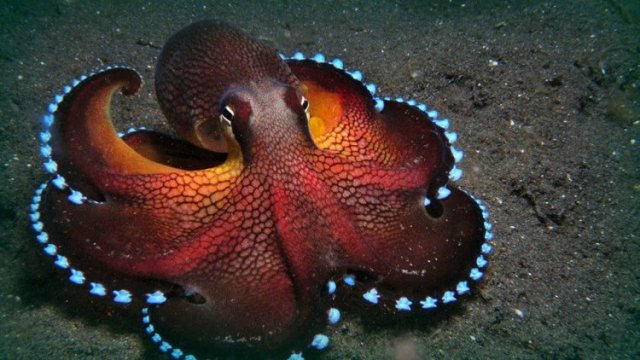
Octopus DNA reveals secrets to intelligence

The elusive octopus genome has finally been untangled, which should allow scientists to discover answers to long-mysterious questions about the animal’s alienlike physiology: How does it camouflage itself so expertly? How does it control—and regenerate—those eight flexible arms and thousands of suckers? And, most vexing: How did a relative of the snail get to be so incredibly smart—able to learn quickly, solve puzzles and even use tools?

The findings, in Nature, reveal a vast, unexplored landscape full of novel genes, unlikely rearrangements—and some evolutionary solutions that look remarkably similar to those found in humans.

With the largest-known genome in the invertebrate world—similar in size to that of a house cat (2.7 billion base pairs) and with more genes (33,000) than humans (20,000 to 25,000)—the octopus sequence has long been known to be large and confusing. Even without a genetic map, these animals and their cephalopod cousins (squids, cuttlefishes and nautiluses) have been common subjects for neurobiology and pharmacology research. But a sequence for this group of mollusks has been “sorely needed,” says Annie Lindgren, a cephalopod researcher at Portland State University who was not involved in the new research. “Think about trying to assemble a puzzle, picture side down,” she says of octopus research to date. “A genome gives us a picture to work with.”

Among the biggest surprises contained within the genome—eliciting exclamation point–ridden e-mails from cephalopod researchers—is that octopuses possess a large group of familiar genes that are involved in developing a complex neural network and have been found to be enriched in other animals, such as mammals, with substantial processing power. Known as protocadherin genes, they “were previously thought to be expanded only in vertebrates,” says Clifton Ragsdale, an associate professor of neurobiology at the University of Chicago and a co-author of the new paper. Such genes join the list of independently evolved features we share with octopuses—including camera-type eyes (with a lens, iris and retina), closed circulatory systems and large brains.

Having followed such a vastly different evolutionary path to intelligence, however, the octopus nervous system is an especially rich subject for study. “For neurobiologists, it’s intriguing to understand how a completely distinct group has developed big, complex brains,” says Joshua Rosenthal of the University of Puerto Rico’s Institute of Neurobiology. “Now with this paper, we can better understand the molecular underpinnings.”

Part of octopuses’ sophisticated wiring system—which extends beyond the brain and is largely distributed throughout the body—controls their blink-of-an-eye camouflage. Researchers have been unsure how octopuses orchestrate their chromatophores, the pigment-filled sacs that expand and contract in milliseconds to alter their overall color and patterning. But with the sequenced genome in hand, scientists can now learn more about how this flashy system works—an enticing insight for neuroscientists and engineers alike.

Also contained in the octopus genome (represented by the California two-spot octopus, Octopus bimaculoides) are numerous previously unknown genes—including novel ones that help the octopus “taste” with its suckers. Researchers can also now peer deeper into the past of this rarely fossilized animal’s evolutionary history—even beyond their divergence with squid some 270 million years ago. In all of that time octopuses have become adept at tweaking their own genetic codes (known as RNA editing, which occurs in humans and other animals but at an extreme rate in octopuses), helping them keep nerves firing on cue at extreme temperatures. The new genetic analysis also found genes that can move around on the genome (known as transposons), which might play a role in boosting learning and memory.

One thing not found in the octopus genome, however, is evidence that its code had undergone wholesale duplication (as the genome of vertebrates had, which allowed the extra genes to acquire new functions). This was a surprise to researchers who had long marveled at the octopus’s complexity—and repeatedly stumbled over large amounts of repeated genetic code in earlier research.

The size of the octopus genome, combined with the large number of repeating sequences and, as Ragsdale describes, a “bizarre lack of interest from many genomicists,” made the task a challenging one. He was among the dozens of researchers who banded together in early 2012 to form the Cephalopod Sequencing Consortium, “to address the pressing need for genome sequencing of cephalopod mollusks,” as they noted in a white paper published later that year in Standards in Genomic Sciences.

The full octopus genome promises to make a splash in fields stretching from neurobiology to evolution to engineering. “This is such an exciting paper and a really significant step forward,” says Lindgren, who studies relationships among octopuses, which have evolved to inhabit all of the world’s oceans—from warm tidal shallows to the freezing Antarctic depths. For her and other cephalopod scientists, “having a whole genome is like suddenly getting a key to the biggest library in the world that previously you could only look into by peeking through partially blocked windows.”

http://www.scientificamerican.com/article/octopus-genome-reveals-secrets-to-complex-intelligence/

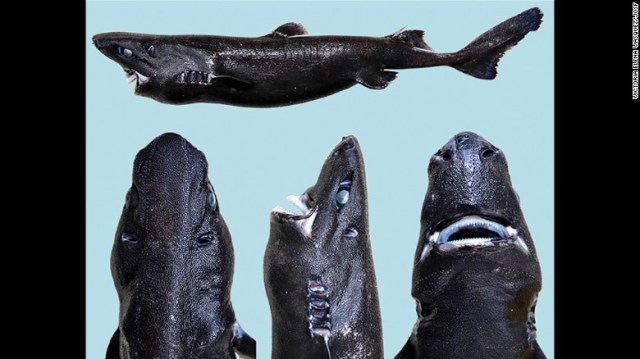
New species, the ninja lanternshark, discovered


By Henry Hanks

It’s not often that someone discovers a new species, especially when it’s been under their nose for years.

A shark collected during a research expedition in 2010 turns out to be a ninja lanternshark, a brand new species of shark, so named because it is all black, which is how a ninja is typically dressed.

The scientific name is Etmopterus benchleyi, a reference to “Jaws” author Peter Benchley.

Grad student Vicky Vasquez and Dr. Douglas J. Long wrote about their findings after being asked to take a closer look at the shark (along with her professor, Dr. David A. Ebert of the Pacific Shark Research Center at Cal State).

“It is also the first lanternshark to ever be discovered off of the central eastern Pacific Ocean near Central America,” Vasquez pointed o

Four children, ages 8 to 14 years old, decided upon the name “ninja lanternshark.”

http://www.cnn.com/2015/12/24/us/shark-discovery-feat/index.html

Alligator eats burglary suspect hiding from cops


Investigators have identified the remains of a suspected burglar who was killed by an alligator. Police say it appears 22-year-old Matthew Riggins was hiding from law enforcement when the incident occurred.

Brevard County deputies have determined that Matthew Riggins, 22, was killed by an alligator in Barefoot Bay lake on Nov. 23 while possibly hiding to avoid law enforcement.

Investigators say that Riggins had told his girlfriend he would be in Barefoot Bay to commit burglaries with another suspect who is now in custody but not cooperating with officials, according to Maj. Tod Goodyear with BCSO.

Deputies responded to calls in Barefoot Bay on Nov. 13 that there were two men dressed in black walking behind area houses, who ran from responding officers. Later that day, Riggins was reported missing to the Palm Bay Police Department.

Police searching the area reported hearing “yelling” but could not determine the source that night, Goodyear said. Ten days later, Riggins’ body was found in the lake.

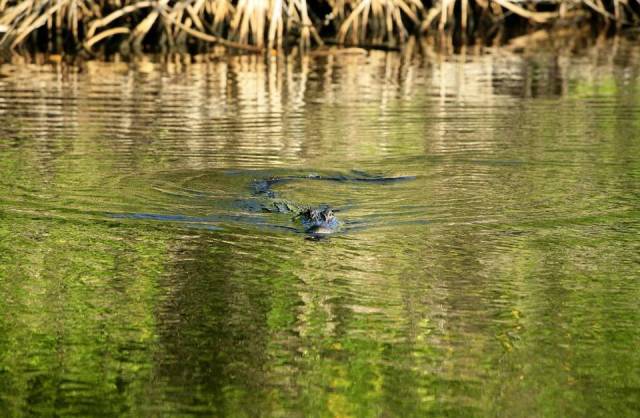
Sheriff’s dive team members encountered an 11-foot alligator behaving aggressively while recovering the body, according to BCSO.

“When the body was found, it had injuries that were consistent with an alligator attack,” Goodyear said. “We had trappers euthanize the gator and when we opened it up, there were some remains inside that were consistent with injuries found on the body.”

Riggins died from drowning and bites were discovered along his legs and body that led investigators to determine he had been dragged underwater by the massive animal.

http://www.usatoday.com/story/news/nation-now/2015/12/08/alligator-kills-florida-burglary-suspect-hiding-cops/76966512/

First ever video of world’s rarest whale

The Omura’s whale is so rare and little-known that there hasn’t been a single confirmed sighting in the wild by scientists… until now.

Researchers working off the coast of Madagascar have captured the first-ever footage of the elusive Omura’s whales, a species so uncommon that scientists have no idea how many there are in the world.

“Over the years, there have been a small handful of possible sightings of Omura’s whales, but nothing that was confirmed,” Salvatore Cerchio of the New England Aquarium and Woods Hole Oceanographic Institution said in a news release. “They appear to occur in remote regions and are difficult to find at sea, because they are small and do not put up a prominent blow.”

The whales are generally between 33 feet and 38 feet in length. That makes them less than half the size of most blue whales, even though the two are cousins — both belonging to the whale family called rorquals.

Until now, the only Omura’s whales that have been found were dead whales, and those were initially mistaken for the larger Bryde’s whales until DNA tests revealed them to be a separate species.

Details about the discovery were recently published in the journal Royal Society Open Science.

Cerchio, who led the research while at the Wildlife Conservation Society, said that when his team first spotted the whales in 2011, they too initially believed them to be Bryde’s whales.

They, however, soon noticed the unique coloring of the head.

“When we clearly saw that the right jaw was white, and the left jaw was black, we knew that we were on to something very special,” said Cerchio. “The only problem was that Omura’s whales were not supposed to be in this part of the Indian Ocean. Rather, they should be in the West Pacific, near Thailand and the Philippines.”

The researchers were able to collect skin samples from the whales, which confirmed the rare find in 2013.

Along with the video footage, Cerchio’s team has used photographs to catalog about 25 individual whales, including four mothers with young calves.

They were also able to record whale vocalizations they believe might indicate reproductive behavior.

Cerchio is planning to return to the area to study the whales further and hopes to be able to tag some so that more can be learned about their behavior.

http://www.huffingtonpost.com/entry/omuras-whale-spotted-first-time_5632f536e4b0c66bae5bf039?utm_hp_ref=science&ir=Science&section=science

Bison Herders Wanted


In an annual roundup on Antelope Island in the Great Salt Lake, about 775 bison are corralled and vaccinated.

The morning sky had turned to pink and it was to time to saddle up, so Benedikt Preisler, 59, strode across this grassy island to make use of the riding boots and cowboy hat he had bought the day before. “The outfit,” said Mr. Preisler, a German tourist standing in a sea of 10-gallon hats, “is necessary.”

It was the annual Antelope Island bison roundup, a Utah tradition that brings together seasoned cowboys and wide-eyed neophytes for a weekend of Western romance. Participants camp out on this island in the Great Salt Lake and spend a day on horseback chasing hundreds of bison toward corrals, where the animals are given vaccinations and about 200 are readied for sale. (The auctioned animals later become burgers, steaks and jerky.)

The event attracts local ranchers toting well-worn bullwhips as well as urban desk workers craving respite from the tyranny of the computer. For some, it is the only opportunity to interact with bison — those iconic, furry, fast-moving ungulates that are often called American buffalo and once numbered in the tens of millions before they were decimated by early settlers.

The annual roundup on Antelope Island has become a draw for seasoned cowboys as well as tourists.

“I’m a surgeon — it’s very boring compared to this,” said Paul Olive, 57, who drove 1,300 miles from Springfield, Mo., for the event. “It is an adrenaline rush to be on a horse, chasing a wild buffalo. Because it can be very dangerous.”

Antelope Island is a rugged, salt-ringed expanse just an hour’s drive from Salt Lake City, and its eastern shore faces the city’s twinkling skyline. The island’s bison are the descendants of 12 animals transported by boat to the island in 1893 by frontiersmen who sought to protect a few of the endangered animals — and turn a profit — by creating a hunting reserve for the wealthy. By 1926, it cost $300 to shoot one of the animals — the equivalent of about $4,000 today.

Today, about 775 bison are on the island, making them one of the oldest and largest publicly owned bison herds in the nation. And the island is now a state park teeming with native creatures, including pronghorn antelope.

Park rangers began the roundup and auction in 1986 to ensure that the animals did not overrun the island. Pulling a move from Tom Sawyer, officials billed the task as entertainment, and began inviting the public to help.

The roundup was added to tourist booklets, and the 1991 movie “City Slickers” — starring Billy Crystal as a New Yorker out West — helped popularize the idea of a cowboy vacation.

This year’s roundup took place on Friday. Standing in a dew-kissed field, Mr. Preisler explained that he had flown from Germany just for the ride after learning about the event during a business trip to Utah last year. His horse, Joe, was a rental.

Nearby, an experienced horseman named Dean Holliday, 83, said he had worked the event since its inception and lived just a few miles away.

“Touch of the old West,” said Mr. Holliday, who had brought two grandsons along. One, a professional photographer, circled the scene with an elaborate camera rig, treating his grandfather — in a neckerchief and a cowboy hat — as if he were the star of a Western epic.

Participants of the roundup spend a day on horseback chasing hundreds of bison toward corrals.

“One of these days I’m going to hang up my spurs,” Mr. Holliday added. “And these guys are going to continue on.”

During a brief orientation, roundup leaders explained that the group would flank nearby clusters of bison and chase them north for several miles. Shouts and skyward whip cracks were appropriate means of coercion. Off limits were guns, iPods and attempts to touch the animals.

Weighing up to 2,000 pounds, bison look like bears but run more like gazelles, reaching speeds of 30 or even 40 miles an hour, and they will occasionally charge at agitators. Horses are occasionally gored.

“These animals are wild, and they don’t do exactly what you want them to,” said Chad Bywater, 40, a longtime participant, explaining that cattle roundups tend to be far tamer.

Twelve bison, also known as American buffalo, were first brought to Antelope Island in 1893 as part of a plan to create a hunting refuge for the wealthy.

A local news team readied a drone to capture video, and the 250 or so riders set off, traveling up steep hills and across plains of yellow grass, galloping behind the bison.

At one point, the animals turned on the riders, forcing a brief retreat. At another, a bison broke from the herd and went careering toward tourists watching from the roadside. Onlookers raced to their minivans, pulling binoculars behind them.

By 1 p.m., the riders had the bison in the corrals, clicking fence doors shut. It was the fastest roundup anyone could remember.

Tyra Canary, 46, a fraud detection analyst from a nearby suburb, called the ride “therapy.” “I watch your credit card for fraud eight hours a day, five days a week,” she said. “It’s really good to just get out in the sun.”

Horses lapped from a trough. Men with chaps and handlebar mustaches recounted the morning’s exploits and planned for the evening campout.

Mr. Preisler, the German visitor, dismounted and declared the ride a success. “You should do it once in a lifetime,” he said.

A night in a tent, however, was not on the itinerary. “No — oh, God, no,” he said, explaining that he had opted for the comfort of a nearby hotel.