The Rat Temple

India Rat Temple Is Home To 15,000 Revered Rodents Worshipped As Reincarnated Family Members

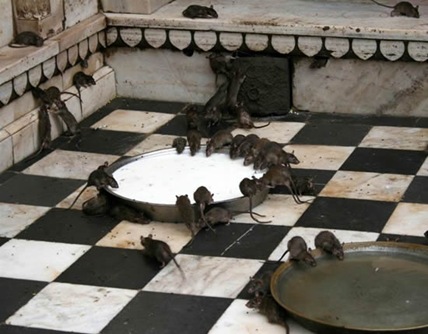
On the surface, this temple in northern India appears like any other. But there’s a main difference: there are 15,000 deities living inside it and they happen to be rats.

Believed by locals to be the reincarnation of former family members, the rats are allowed to run rampant in and around the temple — a notion that would seem impossible to those living in the West.

But if you want to experience these revered rodents, you must remove your shoes and walk and sit among them.

Read the whole story: http://video.nationalgeographic.com/video/places/culture-places/buildings-landmarks/india-rattemple-pp/

New Creatures Discovered in Antarctica

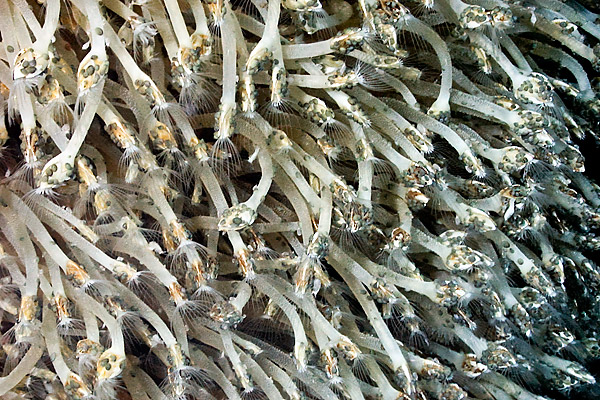
Sea creatures have always held our interest, if only for their odd and other-worldly looks. And the species don’t get any weirder than the critters that cluster around deep sea vents, the earth’s underwater exhaust system. Researchers have discovered a host of new species of crab, barnacles and octopi huddled around the warmth of black smoker vent chimneys emerging from the ocean floor in the Antarctic.Read more: http://www.time.com/time/specials/packages/article/0,28804,2103587_2103586_2103577,00.html #ixzz1ibyd61JV

Meat-Eating Wild Panda Caught on Film

A camera at a Chinese nature reserve has spied a wild panda eating meat.

Pandas spend most of their days eating bamboo.

Staff at the Wanglong Nature Reserve in southwest Sichuan province set up the camera after noticing dead animals with chew marks.

In the footage taken on Nov. 9 by an infrared camera, the giant panda is seen eating a dead gnu. It was not known if the panda had killed the animals.

The Pingwu County forestry bureau says the panda appears to be healthy and strong.

Conservation group WWF says only about 1 percent of a panda’s diet is meat or plants that aren’t bamboo.

Thousand of Migratory Birds Make Crash Landing in Cedar City, Utah


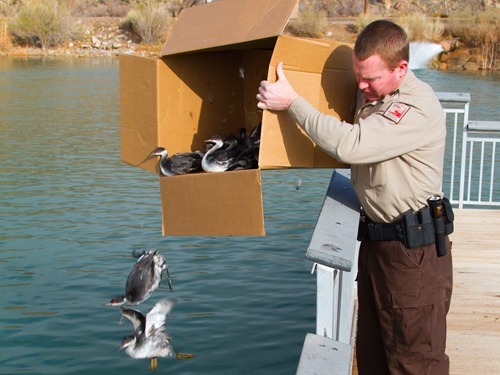
A flock of tens of thousands of Eared Grebes mistook the Utah town of Cedar City for a lake late Monday night and crash landed during a winter snow storm killing hundreds of the migrating birds.

Residents said the sky rained birds in Iron County about 11:30 p.m. Monday as the water-based Eared Grebes slammed into streets and parking lots all over town. “They get down through the clouds and see a lawn that is covered with snow or a parking lot that is covered with snow with lights on it thinking it’s a lake and try to land on it,” said DWR spokesman Lynn Chamberlain.

Apparently, the birds can not survive the cold or on frozen water and came down en masse to find shelter from the storm that hit Cedar City.

“They hit the pavement and many of them are injured or killed and the rest are stranded because they can’t take off from the ground. They have to have a large expanse of water in order to get airborne again,” Chamberlain said.

About 15,000 died on impact. The Division of Wild Life Resources workers and city residents scrambled to rescue the injured birds, taking them about 20 miles south to the warmer waters of Grandpa’s Pond in Washington County, where they can recover, eat insects and continue their southern migration. “Or if they are injured to the point that they can not fly they can actually survive on the pond there for an indefinite period of time,” said Chamberlain.

Chamberlain said these types of bird crashes happen frequently but he has never seen anything like this before.

Wildlife officials said the Cedar City residents did an amazing job to help collect the injured birds and take them to safety and estimate they helped rescued nearly 3,500 Eared Grebes that otherwise would have died.

http://www.abc4.com/content/news/top_stories/story/Thousands-of-migratory-birds-make-crash-landing/tXp0DLouo0aZNlWlolJhIQ.cspx?hpt=hp_c2

Mating Mites Trapped in Amber Reveal Sex Role ReversalPosted on March 1, 2011


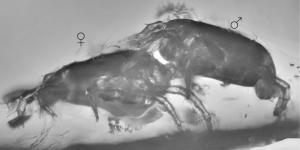
In a paper published March 1 in the Biological Journal of the Linnean Society, researchers Pavel Klimov and Ekaterina Sidorchuk describe an extinct mite species in which the traditional sex roles were reversed.

“In this species, it is the female who has partial or complete control of mating,” said Klimov, an associate research scientist at the U-M Museum of Zoology. “This is in contrast to the present-day reproductive behavior of many mite species where almost all aspects of copulation are controlled by males.”

In mites, as in other animals including humans, the battle of the sexes has been raging throughout evolutionary history. Each gender struggles to get the upper hand to assure that their interests are protected. In the case of mites, males benefit from coercing females to mate and making sure no other males mate with them. Harassing reluctant females, guarding females before and after mating and fighting off competing males are typical behaviors.

Females, on the other hand, gain an evolutionary advantage if they have some control over matters of mating. This allows them to choose superior males to mate with, while rejecting losers (who may be, however, extremely adept at coercing females), and it spares them the wear and tear of being subjected to harassment, guarding and frequent copulation.

In the extinct mite species Glaesacarus rhombeus, the male lacks the specialized organs for clinging to females that are seen in many present-day mites. The female, however, has a pad-like projection on her rear end that allows her to control the clinging. A remarkably preserved copulating pair of mites found in amber gave Klimov and Sidorchuk a glimpse at how the apparatus worked.

Structures found in some living mites also show evidence of female control over mating, Klimov said. “Some lineages have developed female copulatory tubes that function like a penis.”

Klimov’s coauthor, Ekaterina Sidorchuk, is a researcher at the Paleontological Institute of the Russian Academy of Sciences.

The research was funded by the National Science Foundation and the Russian Ministry of Education and Science.

http://earth-climate.science.org/Mating-Mites-Trapped-in-Amber-Reveal-Sex-Role-Reversal.html

New Study Identifies Empathy in Rats

The act of helping others out of empathy has long been associated strictly with humans and other primates, but new research shows that rats exhibit this prosocial behavior as well.
In the new study, laboratory rats repeatedly freed their cage-mates from containers, even though there was no clear reward for doing so. The rodents didn’t bother opening empty containers or those holding stuffed rats.

 
To the researchers’ surprise, when presented with both a rat-holding container and a one containing chocolate — the rats’ favorite snack — the rodents not only chose to open both containers, but also to share the treats they liberated.
 
Peggy Mason, a neuroscientist at the University of Chicago and lead author of the new study, says that the research shows that our empathy and impulse to help others are common across other mammals.
 
“Helping is our evolutionary inheritance,” Mason told LiveScience. “Our study suggests that we don’t have to cognitively decide to help an individual in distress; rather, we just have to let our animal selves express themselves.”
 
Empathetic rats
In previous studies, researchers found that rodents show the simplest form of empathy, called emotional contagion — a phenomenon where one individual’s emotions spread to others nearby. For example, a crying baby will trigger the other babies in a room to cry as well. Likewise, rats will become distressed when they see other rats in distress, or they will display pain behavior if they see other rats in pain.
 
For the new study, Mason and her colleagues wanted to see if rats could go beyond emotional contagion and actively help other rats in distress. To do so, the rats would have to suppress their natural responses to the “emotions” of other rats, the result of emotional contagion. “They have to down-regulate their natural reaction to freeze in fear in order to actively help the other rat,” Mason explained.
 
The researchers began their study by housing rats in pairs for two weeks, allowing the rodents to create a bond with one another. In each test session, they placed a rat pair into a walled arena; one rat was allowed to roam free while the other was locked in a closed, transparent tube that could only be opened from the outside.
 
The free rat was initially wary of the container in the middle of the arena, but once it got over the fear it picked up from its cage-mate, it slowly began to test out the cage. After an average seven days of daily experiments, the free rat learned it could release its friend by nudging the container door open. Over time, the rat began releasing its cage-mate almost immediately after being placed into the arena.
 
“When the free rat opens the door, he knows exactly what he’s doing — he knows that the trapped rat is going to get free,” Mason said. “It’s deliberate, purposeful, helping behavior.”
 
The researchers then conducted other tests to make sure empathy was the driving force in the rats’ behavior. In one experiment, they rigged the container so that opening the door would release the captive rat into a separate arena. The free rat repeatedly set its cage-mate free, even though there was no reward of social interaction afterwards. [Like Humans, Chimps Show Selfless Behaviors]
 
True motivations
While it appears that the rats are empathetic, questions about the rodents’ true motivations still remain.
 
“It is unclear whether the rats sympathize with the distress of their cage-mates, or simply feel better as they alleviate the perceived distress of others,” Jaak Panksepp, a psychologist and neuroscientist at Washington State University, wrote in an article accompanying the study.
 
Mason says they don’t yet know if the free rats are acting to relieve their own distress, the distress of their cage-mates, or a combination of both, but this is definitely a topic for further research. She’s also looking to study if the rats would behave the same way if they weren’t cage-mates, and she would like to tease out the brain areas and genes involved in the behavior.
 
But, she says, “We now have this incredibly controlled, reproducible paradigm.” Other scientists should be able to use the model they developed to see if empathy and prosocial behavior are present in other animals, she said.
 
The study was published today in the journal Science.



Dried-Up Texas Lakes Exposing Graveyards and Old Towns


 Johnny C. Parks died two days before his first birthday more than a century ago. His grave slipped from sight along with the rest of the tiny town of Bluffton when Lake Buchanan was filled 55 years later.

Now, the cracked marble tombstone engraved with the date Oct. 15, 1882, which is normally covered by 20 to 30 feet of water, has been eerily exposed as a yearlong drought shrinks one of Texas’ largest lakes.

Across the state, receding lakes have revealed a prehistoric skull, ancient tools, fossils and a small cemetery that appears to contain the graves of freed slaves. Some of the discoveries have attracted interest from local historians, and looters also have scavenged for pieces of history. More than two dozen looters have been arrested at one site.

“In an odd way, this drought has provided an opportunity to view and document, where appropriate, some of these finds and understand what they consist of,” said Pat Mercado-Allinger, the Texas Historical Commission’s archeological division director. “Most people in Texas probably didn’t realize what was under these lakes.”

read more here:  http://news.yahoo.com/depleted-texas-lakes-expose-ghost-towns-graves-182124788.html

Thanks to Mr. C for bringing this to the attention of the It’s Interesting community.