Dead Bunny


Til, a two-week old earless bunny,seemed destined to become Germany’s newest animal celebrity until a TV cameraman accidentally stepped on the bunny, instantly crushing him to death.

The unidentified cameraman was filming a story on the small zoo in Saxony as it prepared to present the 17-day-old bunny to the world at a press conference.

He says didn’t see Til, who was covered with hay, when he took a step backward, Spiegel Online reports.

“He was immediately dead, he didn’t suffer,” zoo director Uwe Dempewolf tells the website for the magazine Der Spiegel. “It was a direct hit. No one could have foreseen this. Everyone here is upset. The cameraman was distraught.”

Spiegel Online notes that earless rabbits are very rare and Til would have been a media sensation in Germany, which has a history of worshipping furry baby animals.

Til’s body will now be frozen while zoo officials decide whether to have him stuffed.

http://content.usatoday.com/communities/ondeadline/post/2012/03/tv-crew-accidentally-kills-celebrity-bunny–/1

Thanks to Nicole Stricker for bringing this to the It’s Interesting community.

Pudding to the Rescue


Pudding the cat is big. He is orange. He is laid-back. And he’s a lifesaver.

Just ask Amy Jung. The 36-year-old Wisconsin resident credits 21-pound Pudding with saving her from the grip of diabetic seizure mere hours after she adopted him from a local animal shelter.

“If something or someone hadn’t pulled me out of that, I wouldn’t be here,” Jung told the Green Bay Press-Gazette newspaper.

Here’s what happened: On Feb. 8, Jung visited the Door County Humane Society with her son, Ethan. She had no intention of adopting a pet; she and her son just wanted to play with the cats, who are allowed to roam free at the no-kill shelter.

But, as can happen with felines and humans, Pudding and Jung felt a strong and immediate connection.

“He just gravitated to her,” Door County Humane Society Executive Director Carrie Counihan told TODAY.com.

Jung made an on-the-spot decision to bring Pudding home. Always a calm and relaxed guy, Pudding took to his new digs right away, displaying not a hint of skittishness on his first day there.

That evening Jung, who has been living with diabetes since the age of 4, went to bed at about 9:30 p.m. About 90 minutes later, she started to have a diabetic seizure. That’s when, according to the Green Bay Press-Gazette, “Pudding planted his weight on her chest and, when he could not wake her, began swatting her face and biting her nose.”

Dog saves 11-year-old boy from cougar attack

Jung came to her senses enough to yell out to her son for assistance. At that point, Pudding jumped up onto Ethan’s bed and startled him into action. He immediately rushed to get his mom the help she needed.

“Her doctor said she could have gone into a coma and not come out of it if much more time had gone by,” Counihan said. “The fact that Pudding did what he did without knowing her that well is just amazing to me.”

Since the scary Feb. 8 incident, Jung has followed her doctor’s advice to have Pudding registered as a therapy animal.

“I think he’s already made his first trip to Walmart,” Counihan said.

Pudding had been living at the shelter for about a month before Jung took him home. He arrived there in early January with another cat named Wimsy after their owner died. Jung adopted Wimsy, too, because she didn’t want to separate them.

Cat protects couple from deadly gas leak

This wasn’t Pudding’s first stint at the Door County Humane Society. In 2008, a family surrendered him to the shelter because their son was allergic to cats. His name at that time was Starbuck. His last owner, the woman who just passed away, decided to change his name to Pudding.

“Pudding is 8 1/2-ish now — not too old,” Counihan said. “And Wimsy is 3 years old. Maybe he’ll pick up some of Pudding’s powers.”

Roast Beef the penguin charms nursing-home residents

http://today.msnbc.msn.com/id/46504285/ns/today-good_news/


Thanks to the future Dr. Goldman for bringing this to the attention of the It’s Interesting community.




Genetically Engineered Stomach Microbe Converts Seaweed into Ethanol

Seaweed may well be an ideal plant to turn into biofuel. It grows in much of the two thirds of the planet that is underwater, so it wouldn’t crowd out food crops the way corn for ethanol does. Because it draws its own nutrients and water from the sea, it requires no fertilizer or irrigation. Most importantly for would-be biofuel-makers, it contains no lignin—a strong strand of complex sugars that stiffens plant stalks and poses a big obstacle to turning land-based plants such as switchgrass into biofuel.

Researchers at Bio Architecture Lab, Inc., (BAL) and the University of Washington in Seattle have now taken the first step to exploit the natural advantages of seaweed. They have built a microbe capable of digesting it and converting it into ethanol or other fuels or chemicals. Synthetic biologist Yasuo Yoshikuni, a co-founder of BAL, and his colleagues took Escherichia coli, a gut bacterium most famous as a food contaminant, and made some genetic modifications that give it the ability to turn the sugars in an edible kelp called kombu into fuel. They report their findings in the January 20 issue of the journal Science.

To get his E. coli to digest kombu, Yoshikuni turned to nature—specifically, he looked into the genetics of natural microbes that can break down alginate, the predominant sugar molecule in the brown seaweed. “The form of the sugar inside the seaweed is very exotic,” Yoshikuni told Scientific American. “There is no industrial microbe to break down alginate and convert it into fuels and chemical compounds.”

Once he and his colleagues had isolated the genes that would confer the required traits, they used a fosmid—a carrier for a small chunk of genetic code—to place the DNA into the E. coli cells, where it took its place in the microbe’s own genetic instruction set. To test the new genetically engineered bacterium, the researchers ground up some kombu, mixed it with water and added the altered E. coli. Before two days had gone by the solution contained about 5 percent ethanol and water. It also did this at (relatively) low temperatures between 25 and 30 degrees Celsius, both of which mean that the engineered microbe can turn seaweed to fuel without requiring the use of additional energy for the process.

An analysis from the Pacific Northwest National Laboratory (pdf) suggests that the U.S. could supply 1 percent of its annual gasoline needs by growing such seaweed for harvest in slightly less than 1 percent of the nation’s territorial waters. Humans already grow and harvest some 15 million metric tons of kombu and other seaweeds to eat. And there’s no reason to fear the newly engineered E. coli escaping into the wild and consuming the seaweed already out there, Yoshikuni argues. “E. coli loves the human gut, it doesn’t like the ocean environment,” he says. “I can hardly imagine it would do something. It would just be dead.”

The microbe could turn out to be useful for making molecules other than ethanol, such as isobutanol or even the precursors of plastics, Yoshikuni says. “Consider the microbe as the chassis with engineered functional modules,” or pathways to produce a specific molecule, Yoshikuni says. “If we integrate other pathways instead of the ethanol pathway, this microbe can be a platform for converting sugar into a variety of molecules.”

The fact that such a one-stop industrial microbe can turn seaweed into a variety of molecules has attracted the attention of outfits such as the U.S. Department of Energy’s Advanced Research Projects Agency–Energy, or ARPA–e, which has funded BAL work with DuPont to produce other molecules from such engineered microbes. “Because seaweed grows naturally in the ocean, it uses the two thirds of the planet that we don’t use for agriculture,” ARPA–e program director Jonathan Burbaum wrote in an e-mail. “ARPA–e is directing a small portion of the remaining funding toward an aquafarm experiment to measure area productivity and harvest efficiency.”
http://www.scientificamerican.com/article.cfm?id=genetically-engineered-stomach-microbe-turns-seaweed-into-ethanol&WT.mc_id=MND_20120216

Man in Big Black Bunny Suit Terrorized Idaho Town

These picture are dramatizations, as the story decscribes William Falkingham as wearing a black bunny suit.  Still, you get the picture.

___________________________________________________________________________________________

An Idaho Falls man has been told not to wear his bunny suit in public anymore after neighbors complained that he was frightening small children.

The Idaho Falls Police Department received calls on Monday of a man in a black bunny suit that was being a public nuisance and scaring children in a neighborhood.  Police responded to the 400 block of Third Street where they advised 34-year-old William Falkingham not to wear his bunny suit costume in public.

According to reports, a resident told authorities that her son had been frightened by Falkingham who was wearing a black bunny suit and hiding behind a tree.  The neighbor also told police that the 34-year-old male pointed his finger like a gun at her son.

Officers also spoke to other neighbors who expressed that they were greatly disturbed by Falkingham and his bunny suit.  Neighbors also reported that the 34-year-old occasionally wears a tutu with the costume.

Falkingham told authorities that he enjoys wearing the suit, but understands the neighbors’ concerns and complaints.

http://www.kpvi.com/mostpopular/story/Idaho-Falls-Police-Investigate-Man-in-Bunny-Suit/li9tE-AVQkegDSsOT6mRgA.cspx

Champis the Sheep Herding Bunny

Champis the bunny doesn’t only hop — he also knows how to herd his masters’ flock of sheep, possibly having picked up the skill after watching trained dogs do the job.

The 5-year old pet rabbit from the small village of Kal in northern Sweden shot to online fame last week, garnering more than 700,000 YouTube hits, after a clip of his sheepherding skills surfaced on a blog.

The June video shows a persistent Champis running back and forth on the farm, trying to keep Nils-Erik and Greta Vigren’s sheep together.

Greta Vigren said she first noted his talent last spring when they let out the sheep to graze for the first time after the long Swedish winter.

“He just started to behave like a sheepdog,” she recalled, adding that while he likes to round up the sheep, he is consistent about leaving the farm’s hens alone, treating them more gently.

“He’s like a king for the whole group. He thinks he rules over both the sheep and the hens. He has a very big ego.”

Dan Westman, a sheepdog breeder who shot and posted the video of his friends’ remarkable bunny, said he was in awe when he first witnessed the phenomenon, noting Champis does the job even better than most dogs would.

“It’s really incredible, it’s a herding rabbit,” he said. “He rounds them up, and if they get close to escaping through the gate he sometimes stops them,” he said.

“I mean I work with sheepdogs and know how hard this is. There are very few dogs that could do what this rabbit does.”

Westman, who’s known both Champis and it’s owners for years, said the beige little mix-breed bunny had never been trained for the job but seemed to have learned the ropes all on his own.

“He’s probably picked some of it up from watching the dogs,” he said.

Despite his tiny size, Westman said the sheep seem to pay their minder a world of respect, letting him herd them around when he feels they need some moving.

Read more: http://www.sfgate.com/cgi-bin/article.cgi?f=/n/a/2012/02/03/international/i041253S76.DTL#ixzz1nMLD3IOZ

How Scientists Ressurected a 30,000 Year Old Flower


After successfully growing samples of an ancient flower, scientists dream of applying the same technique to the re-creation of a woolly mammoth.


A few years ago in northeastern Siberia, Russian scientists uncovered a rare trove of immaculately frozen Arctic squirrel burrows dating back to the Ice Age. Inside they found buried seeds, including the fruit of a flower called the narrow-leafed campion. Now, after 30,000 years, they’ve brought the original flower back to life. Here’s what you should know:

Did they grow the flower from frozen seeds?
Not exactly. Efforts to resurrect ancient plants from seeds found “wonderfully preserved by the cold, dry environment” fell short, says Sharon Levy at Scientific American, including attempts to sprout sedge, alpine bearberry, and the narrow-leafed campion (known scientifically as Silene stenophylla). “Those seeds did begin to germinate, but then faltered and died back.” Instead, the scientists, led by David Gilichinsky of the Russian Academy of Sciences, looked to tissue samples from S. stenophylla fruit — specifically, they turned to the plant’s placenta (think of the white meat inside a bell pepper), which produces its seeds.

Then what did they do?
After thawing out the organic material, they placed cells taken from the placenta into petri dishes. Scientists were delighted when these specimens grew into “whole plants,” and were able to use those seeds to farm a second generation of flowers. The team was able to grow 36 narrow-leafed campion plants in all, and the specimens “appeared identical to the present day narrow-leafed campion until they flowered,” says Nicholas Wade at The New York Times, “when they produced narrower and more splayed-out petals.” 

How were the frozen seeds able to survive for so long?
Researchers think it may have something to do with the “special circumstances” of the campion’s deep freeze. Squirrels bury their finds next to icy permafrost “to keep seeds cool during the arctic summers,” meaning the fruit was frozen early on, notes Wade. Plus, the placentas contain “high levels of sucrose and phenols, which are good antifreeze agents.” 

Are these the oldest plants ever grown?
By far. The sediments surrounding the frozen seeds date back roughly 30,000 to 32,000 years. That “trounces the previous record held be a date palm from a 2,000-year-old seed recovered from Masada, Israel,” says Tristin Hopper at National Post

What’s next?
Scientists will use the techniques to produce more plants found in the Siberian burrows, but the same techniques could potentially be applied to woolly mammoths or saber tooth tigers. “We find partially preserved mammoth carcasses in the Siberian tundra that are 30,000 years old,” says paleontologist Grant Zazula. “This raises the potential that you could have viable sperm cells and eggs cells within some of these animals.”


Thanks to P.C. and Kebmodee for bringing this to the attention of the It’s Interesting community. 

http://kebmodee.blogspot.com/

http://theweek.com/article/index/224689/how-scientists-resurrected-a-30000-year-old-flower

http://www.nytimes.com/2012/02/21/science/new-life-from-an-arctic-flower-that-died-32000-years-ago.html?_r=1

300 Million Year Old Chinese Tropical Forest Discovered Buried Under Volcanic Ash


About 300 million years ago, volcanic ash buried a tropical forest located in what is now Inner Mongolia, much like it did the ancient Roman city of Pompeii.

This preserved forest has given researchers the unusual opportunity to examine an ecosystem essentially frozen in place by a natural disaster, giving them a detailed look at ancient plant communities and a glimpse at the ancient climate.

This ancient, tropical forest created peat, or moist, acidic, decaying plant matter. Over geologic time, the peat deposits were subjected to high pressure and became coal, which is found in the area.   

The volcano appears to have left a layer of ash that was originally 39 inches (100 centimeters) thick.

“This ash-fall buried and killed the plants, broke off twigs and leaves, toppled trees, and preserved the forest remains in place within the ash layer,” the authors, led by Jun Wang of the Nanjing Institute of Geology and Palaeontology in China, wrote in an article published Monday (Feb. 20) in the journal Proceedings of the National Academy of Sciences.  

The ash layer dated to about 298 million years ago, early in the Permian Period, when the supercontinent Pangea was coming together.

The researchers examined three sites with a total area of 10,764 square feet (1,000 square meters) near Wuda, China. At these sites, they counted and mapped the fossilized plants. The tallest trees that formed the upper canopy — species in the genera Sigillaria and Cordaites — grew to 82 feet (25 meters) or more. Lower down, tree ferns formed another canopy. A group of now-extinct, spore-producing trees called Noeggerathiales and palm-like cycads grew below these, they found. [Image Gallery: A Petrified Forest]

“It’s marvelously preserved,” University of Pennsylvania paleobotanist and study researcher Hermann Pfefferkorn said in a press release issued by the university. “We can stand there and find a branch with the leaves attached, and then we find the next branch and the next branch and the next branch. And then we find the stump from the same tree. That’s really exciting.”

http://www.csmonitor.com/Science/2012/0221/300-million-year-old-Chinese-Pompeii-found-buried-under-volcanic-ash


Thank to P.C. for bringing this to the attention of the It’s Interesting community.
New Legless Amphibian Discovered in India


Since before the age of dinosaurs it has burrowed unbothered beneath the monsoon-soaked soils of remote northeast India — unknown to science and mistaken by villagers as a deadly, miniature snake.

But this legless amphibian’s time in obscurity has ended, thanks to an intrepid team of biologists led by University of Delhi professor Sathyabhama Das Biju. Over five years of digging through forest beds in the rain, the team has identified an entirely new family of amphibians — called chikilidae — endemic to the region but with ancient links to Africa.

Their discovery was published Wednesday in a journal of the Royal Society of London. 

The chikilidae’s discovery, made along with co-researchers from London’s Natural History Museum and Vrije University in Brussels, brings the number of known caecilian families in the world to 10. Three are in India and others are spread across the tropics in Southeast Asia, Africa and South America. There is debate about the classifications, however, and some scientists count even fewer caecilian families.

Because they live hidden underground, and race off at the slightest vibration, much less is known about them than their more famous — and vocal — amphibious cousins, the frogs. Only 186 of the world’s known amphibious species are caecilians, compared with more than 6,000 frog species — a third of which are considered endangered or threatened.

Even people living in northeast Indians misunderstand the caecilians, and rare sightings can inspire terror and revulsion, with farmers and villagers chopping them in half out of the mistaken belief that they are poisonous snakes.

In fact, the chikilidae is harmless, and may even be the farmer’s best friend — feasting on worms and insects that might harm crops, and churning the soil as it moves underground.

Much remains to be discovered in further study, Biju said, as many questions remain about how the creatures live.

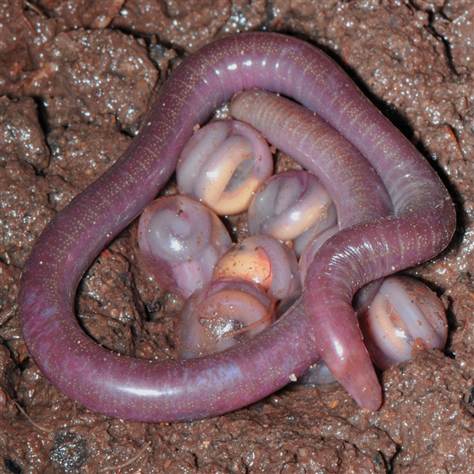
So far, Biju’s team has determined that an adult chikilidae will remain with its eggs until they hatch, forgoing food for some 50 days. When the eggs hatch, the young emerge as tiny adults and squirm away.

They grow to about 4 inches (10 centimeters), and can ram their hard skulls through some of the region’s tougher soils, shooting off quickly at the slightest vibration. “It’s like a rocket,” Biju said. “If you miss it the first try, you’ll never catch it again.”

A possibly superfluous set of eyes is shielded under a layer of skin, and may help the chikilidae gauge light from dark as in other caecilian species.

DNA testing suggests that the chikilidae’s closest relative is in Africa — with the two evolutionary paths splitting 140 million years ago when dinosaurs roamed what was then a southern supercontinent called Gondwana, since separated into today’s continents of Africa, Antarctica, Australia, South America and the Indian subcontinent.

http://www.msnbc.msn.com/id/46474242/ns/technology_and_science-science/

Beyonce Fly

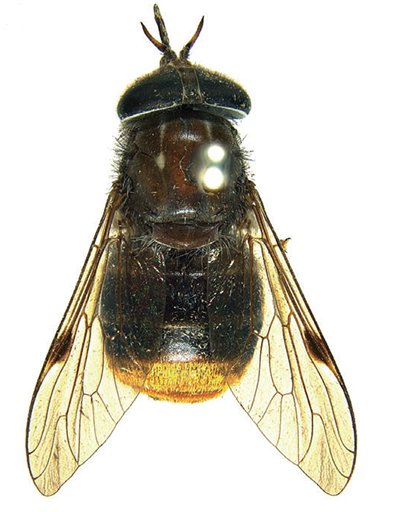
A newly discovered horse fly in Australia was so “bootylicious” with its golden-haired bum, there was only one name worthy of its beauty: Beyonce.

Previously published results from Bryan Lessard, a 24-year-old researcher at Australia’s Commonwealth Scientific and Industrial Research Organization, were recently announced on the species that had been sitting in a fly collection since it was captured in 1981 — the same year pop diva Beyonce was born.

He says he wanted to pay respect to the insect’s beauty by naming it Scaptia (Plinthina) beyonceae.

Lessard said Beyonce would be “in the nature history books forever” and that the fly now bearing her name is “pretty bootylicious” with its golden backside.

“Bootylicious” was the title of a song by Beyonce’s previous group, Destiny’s Child.

It’s unknown if the rare species is a bloodsucker like many female horse flies. Lessard says he was unable to find any live specimens when he went looking in 2010 in northeast Queensland’s Atherton Tablelands, where it was captured three decades ago. However, at least one member of the public has alerted him that he was recently bitten by what’s locally called the “gold bum fly.”

The description of the fly was earlier published in the Australian Journal of Entomology, but the results were announced last week.

Lessard says he hasn’t heard from Beyonce, who recently gave birth to her first child, but he is a fan and hopes she will take his scientific gesture as a compliment. He also said the name was picked to help draw attention to the importance of his field and the need for more researchers to catalog and study insects.

Horse flies are “vital pollinators of native plants, not just in Australia, but all over the world,” Lessard said. “It’s extremely important to name all the undescribed species so we can measure our human impact on the environment and hopefully protect it for future generations to enjoy.”

Read more: http://www.sfgate.com/cgi-bin/article.cgi?f=/n/a/2012/01/16/international/i010548S37.DTL#ixzz1mDfuvlej

Massive Alaskan Volcano May Erupt and Disrupt Air Travel


Officials are monitoring a remote Alaska volcano that could launch an ash cloud, potentially threatening intercontinental flights.

“Eruptive activity” of Cleveland Volcano was detected in satellite data, according to the Alaska Volcano Observatory.

The volcano, also known as Mount Cleveland, is on the Aleutian Islands, southwest of mainland Alaska.

“A new lava dome has been observed in the summit crater,” the observatory said Tuesday. “There have been no observations of ash emissions or explosive activity during this current lava eruption.”

But the volcanic activity could heighten and affect air travel, said Steve McNutt, a scientist at the University of Alaska Fairbanks.

McNutt said 90% of air freight from Asia to Europe and North America flies over Alaska air space, and hundreds of flights — including more than 20,000 passengers — fly through Anchorage’s air space daily.

“If there is an explosion and (ash) reaches high altitudes, it will causes flights to be rerouted and ultimately canceled,” McNutt said.

The volcano’s most recent significant eruption took place in 2001. It produced three explosions that led to ash clouds as high as 7.5 miles (12 kilometers) above sea level, according to the volcano observatory.

“The 2001 eruption also produced a rubbly lava flow and hot avalanche that reached the sea,” the observatory said.

Last year, volcanic ash spewing from Iceland’s Grimsvotn volcano forced the cancellation of hundreds of flights across Europe.

The Grimsvotn eruption came about 13 months after Iceland’s Eyjafjallajokull volcano belched smoke and ash into the skies, forcing the cancellation of thousands of flights per day at the peak of the problem.

http://www.cnn.com/2012/02/01/us/alaska-volcano/index.html