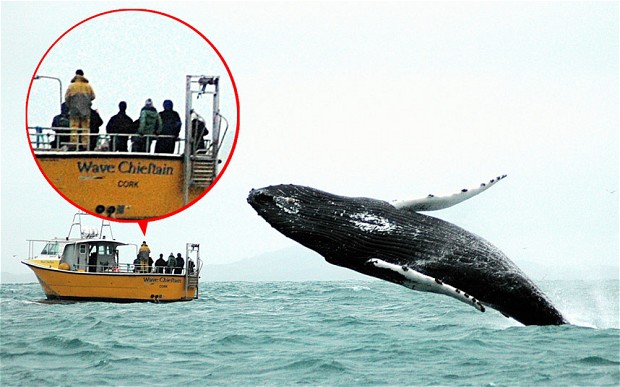
Whale watchers look the wrong way as huge humpback leaps out of ocean

whale_2416552b

A 45-foot humpback whale leapt above the waves as group of nature lovers gazed the wrong way this past weekend off the Atlantic coast of Ireland.

A cameraman caught the “whale ahoy” moment off Baltimore in west Cork where marine enthusiasts have been cruising the waters hoping to sight a group of five humpbacks that have been feeding on local shoals of sprat and herring for the last two weeks.

The presence of the humpbacks, breaching the waves with their 30-tonne bodies in pursuit of fish, has triggered a mini-tourism boom as people flock to the village to charter local boats in search of the whales.

Simon Duggan, 44, a local photographer and RNLI Lifeboat crew member, took a series of photographs of the humpbacks “bubble feeding” – the hunting technique where whales dive under a shoal of fish, releasing air bubbles to confuse their prey and bunch them together.

After herding and confusing the fish, the whales use their powerful bodies to surge upwards through the shoal with their mouths wide open to scoop up as many sprat or herring as possible.

After taking the picture of the humpback fully breaching the water after hoovering up its prey, a rare and spectacular display of the cetacean’s hunting prowess, Mr Duggan noticed that another boat of whale watchers had missed their moment.

“It happened so fast – the adrenalin was going,” he said. “When I looked at the photo I realised everyone else was looking the wrong way.”

http://www.telegraph.co.uk/earth/wildlife/9719020/Whale-watchers-look-the-wrong-way-as-huge-humpback-leaps-out-of-ocean.html

Cape Town baboons get paintballed

baboon_2396823b


Baboons in Cape Town are being paintballed to drive them out of residential suburbs and stop them from pillaging homes and cars on brazen food raids.

The animals are shot by monitors who shadow the city’s several primate troops, which are notorious for causing havoc in areas bordering their natural mountain habitat.

“It does work, it’s actually fantastic,” said city veterinary scientist Elzette Jordan.

“They hate it so much, so when they just see you with it and you shake it and they hear the paintballs rattling inside, then they move off already, and you don’t actually have to shoot.”

The paintballs are being used alongside other aversion techniques while a baboon management road map is drawn up.

Paintballing is the most common technique and its success is attributed to the apes not liking projectiles being hurled at them.

However, some streetwise animals have learned to spot white paint and duck when it is fired, forcing monitors to use more colourful options.

Cape Town’s mountainous peninsula is home to several protected Chacma baboon troops and bold plunders are frequent. People have been injured in some instances.

“Our current strategy is to get them 100 per cent out of urban space,” Jordan told AFP.

“We want to push them back into the natural space and for us to do that, we have to teach them that they can never be quite sure and feel safe inside the urban space and that’s why we’re using aversion conditioning techniques.”

http://www.telegraph.co.uk/earth/wildlife/9674445/Cape-Town-baboons-get-paintballed.html

Mother-Child Connection: Scientists Discover Children’s Cells Living in Mothers’ Brains, Including Male Cells Living in the Female Brain for Decades

scientists-discover-childrens-cells-living-in-mothers-brain_1


The link between a mother and child is profound, and new research suggests a physical connection even deeper than anyone thought. The profound psychological and physical bonds shared by the mother and her child begin during gestation when the mother is everything for the developing fetus, supplying warmth and sustenance, while her heartbeat provides a soothing constant rhythm.

The physical connection between mother and fetus is provided by the placenta, an organ, built of cells from both the mother and fetus, which serves as a conduit for the exchange of nutrients, gasses, and wastes. Cells may migrate through the placenta between the mother and the fetus, taking up residence in many organs of the body including the lung, thyroid muscle, liver, heart, kidney and skin. These may have a broad range of impacts, from tissue repair and cancer prevention to sparking immune disorders.

It is remarkable that it is so common for cells from one individual to integrate into the tissues of another distinct person. We are accustomed to thinking of ourselves as singular autonomous individuals, and these foreign cells seem to belie that notion, and suggest that most people carry remnants of other individuals. As remarkable as this may be, stunning results from a new study show that cells from other individuals are also found in the brain. In this study, male cells were found in the brains of women and had been living there, in some cases, for several decades. What impact they may have had is now only a guess, but this study revealed that these cells were less common in the brains of women who had Alzheimer’s disease, suggesting they may be related to the health of the brain.

We all consider our bodies to be our own unique being, so the notion that we may harbor cells from other people in our bodies seems strange. Even stranger is the thought that, although we certainly consider our actions and decisions as originating in the activity of our own individual brains, cells from other individuals are living and functioning in that complex structure. However, the mixing of cells from genetically distinct individuals is not at all uncommon. This condition is called chimerism after the fire-breathing Chimera from Greek mythology, a creature that was part serpent part lion and part goat. Naturally occurring chimeras are far less ominous though, and include such creatures as the slime mold and corals.

 Microchimerism is the persistent presence of a few genetically distinct cells in an organism. This was first noticed in humans many years ago when cells containing the male “Y” chromosome were found circulating in the blood of women after pregnancy. Since these cells are genetically male, they could not have been the women’s own, but most likely came from their babies during gestation.

In this new study, scientists observed that microchimeric cells are not only found circulating in the blood, they are also embedded in the brain. They examined the brains of deceased women for the presence of cells containing the male “Y” chromosome. They found such cells in more than 60 percent of the brains and in multiple brain regions. Since Alzheimer’s disease is more common in women who have had multiple pregnancies, they suspected that the number of fetal cells would be greater in women with AD compared to those who had no evidence for neurological disease. The results were precisely the opposite: there were fewer fetal-derived cells in women with Alzheimer’s. The reasons are unclear.

Microchimerism most commonly results from the exchange of cells across the placenta during pregnancy, however there is also evidence that cells may be transferred from mother to infant through nursing. In addition to exchange between mother and fetus, there may be exchange of cells between twins in utero, and there is also the possibility that cells from an older sibling residing in the mother may find their way back across the placenta to a younger sibling during the latter’s gestation. Women may have microchimeric cells both from their mother as well as from their own pregnancies, and there is even evidence for competition between cells from grandmother and infant within the mother.

What it is that fetal microchimeric cells do in the mother’s body is unclear, although there are some intriguing possibilities. For example, fetal microchimeric cells are similar to stem cells in that they are able to become a variety of different tissues and may aid in tissue repair. One research group investigating this possibility followed the activity of fetal microchimeric cells in a mother rat after the maternal heart was injured: they discovered that the fetal cells migrated to the maternal heart and differentiated into heart cells helping to repair the damage. In animal studies, microchimeric cells were found in maternal brains where they became nerve cells, suggesting they might be functionally integrated in the brain. It is possible that the same may true of such cells in the human brain.

These microchimeric cells may also influence the immune system. A fetal microchimeric cell from a pregnancy is recognized by the mother’s immune system partly as belonging to the mother, since the fetus is genetically half identical to the mother, but partly foreign, due to the father’s genetic contribution. This may “prime” the immune system to be alert for cells that are similar to the self, but with some genetic differences. Cancer cells which arise due to genetic mutations are just such cells, and there are studies which suggest that microchimeric cells may stimulate the immune system to stem the growth of tumors. Many more microchimeric cells are found in the blood of healthy women compared to those with breast cancer, for example, suggesting that microchimeric cells can somehow prevent tumor formation. In other circumstances, the immune system turns against the self, causing significant damage. Microchimerism is more common in patients suffering from Multiple Sclerosis than in their healthy siblings, suggesting chimeric cells may have a detrimental role in this disease, perhaps by setting off an autoimmune attack.

This is a burgeoning new field of inquiry with tremendous potential for novel findings as well as for practical applications. But it is also a reminder of our interconnectedness.

http://www.scientificamerican.com/article.cfm?id=scientists-discover-childrens-cells-living-in-mothers-brain

Sexually-deprived fruitflies drink more alcohol

drinking_drosophila

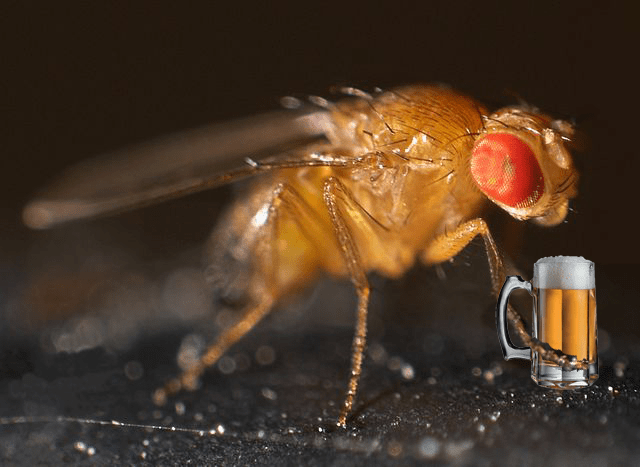
Rejection stinks. It literally hurts. But worse, it has an immediate and negative impact on our brains, producing withdrawal symptoms as if we’re quitting a serious addiction cold turkey. It’s no wonder, then, that we are tempted to turn to drugs to makeourselves feel better. But we’re not the only species that drowns our sorrows when we’re lonely – as a new study in Science reveals, rejected Drosophila do, too. Scientists have found not only will these sexually frustrated flies choose to consume more alcohol than their happily mated peers, sex and alcohol consumption activate the same neurological pathway in their brains.

Drosophila melanogaster males sure know how to woo a lady. When placed in the same container as a potential mate, a male fly will play her a delicate love song by vibrating one wing, caress her rear end, and gently nuzzle her most private of parts with his proboiscis to convince her that he is one heck of a lover. But even the most romantic fly can’t convince an already mated female Drosophila to give up the goods, so scientists were able to use the girls’ steely resolve to see how rejection affects fly drinking behavior.

“Alcohol is one of the most widely used and abused drugs in the world,” explains lead author Galit Shohat-Ophir. “The fruit fly Drosophila melanogaster is an ideal model organism to study how the social environment modulates behavior.” Previous studies have found that Drosophila melanogaster exhibit complex addiction-like behaviors. So in the controlled setting of Ulrike Heberlein’s lab at the University of California San Francisco, researchers paired male fruit flies with three types of females: 1) unmated females, which were willing and happy to mate; 2) mated females, which actively rejected the men; and 3) decapitated females, which didn’t actively reject the guys but, well, weren’t exactly willing partners either. After the flies were satisfied or frustrated, they were offered regular food and food spiked with ethanol, and the researchers measured which type they preferred to see if there was any connection between sex and drinking.

The flies that were rejected drank significantly more than their satisfied peers, but so did the ones paired with incapacitated girls, suggesting that it wasn’t the social aspect of rejection but sexual deprivation that drives male flies to increase their ethanol consumption (see the video at the end!). This alcoholic behavior was very directly related to the guy fly ever getting laid, for even after days of blue balls, if he was allowed to spend some time with a willing woman, he no longer preferred the spiked food.

What the scientists really wanted to understand, though, was why. What drives a frustrated fly to the flask? So to look at the underlying mechanism of this phenomenon, the scientists examined the flies’ brains. A body of scientific literature has connected one particular neurotransmitter, neuropeptide F (NPF), to ethanol-related behaviors in Drosophila, so it was a logical place to start. A very similar neurotransmitter in our brains, called neuropeptide Y (NPY), is linked to alcoholism.

Increased expression of NPF in mated male brains, as shown through immunochemistry.

The team found that sexual frustration caused an immediate decrease in the expression of NPF, while sex increased expression. Furthermore, when they used genetics to artificially knock down NPF levels in the satisfied flies, they drank as much as their not-so-satisfied friends. Similarly, when the researchers artificially increased NPF levels, flies stayed sober. This is the first time NPF levels have connected sexual activity to drinking. Clearly, NPF levels controlled the flies’ desire to drink, so the team further explored how NPF works in the fly’s brain.

Many animals, including ourselves, possess a neurological reward system which reinforces good behavior. Through this system, we ascribe pleasure or positive feelings to things we do that are necessary for species survival, including sex, eating, and social interaction. Drugs tap into this system, stimulating pleasure which can lead to addiction. Previous studies have shown that flies find intoxication rewarding, so the researchers hypothesized that NPF may play a role in the reward system.

Preference tests showed that artificially increasing NPF levels in the absence of sex or ethanol was rewarding to the flies, confirming the scientists’ hypothesis. This was further supported by the discovery that constantly activating NPF abolished the flies’ tendency to consider ethanol rewarding.

“NPF is a currency of reward” explains Shohat-Ophir. High NPF levels signal good behavior in Drosophila brains, thus reinforcing any activities which led to that state. This is a truly novel discovery, for while NPF and the mammal version, NPY, have been linked to alcohol consumption, no animal model has ever placed NPF/NPY in the reward system.

Understanding the role of NPF in reward-seeking behaviors may lead to better treatments for addicts. “In mammals, including humans, NPY may have a similar role [as NPF],” says Shohat-Ophir. “If so, one could argue that activating the NPY system in the proper brain regions might reverse the detrimental effects of traumatic and stressful experiences, which often lead to drug abuse.” Already, NPY and drugs that affect the function of its receptors are in clinical trials for anxiety, PTSD, mood disorders and obesity. This study suggests that perhaps they should be tested as treatment for alcoholism, too, as well as other reward-based addictions.

Research: Shohat-Ophir, G, KR Kaun & R Azanchi (2012). Sexual Deprivation Increases Ethanol Intake in Drosophila. Science 335: 1351-1355.

Click  http://blogs.scientificamerican.com/science-sushi/2012/03/15/flies-drink-upon-rejection/

to view a sequence of  three videos that show a male fly courting and successfully mating with a female fly, another male fly being rejected by a female, and a male choosing to consume an alcohol-infused solution over a non-alcohol solution. Video © Science/AAAS

New research shows that homicide spreads through a city like infectious disease

crime-scene-1


Homicide moves through a city in a process similar to infectious disease, according to a new study that may give police a new tool in tracking and ultimately preventing murders.

Using Newark, N.J., as a pilot case, a team of Michigan State University researchers led by April Zeoli successfully applied public health tracking methods to the city’s 2,366 homicides between 1982 and 2008. They found the killings were not randomly located but instead followed a pattern, evolving from the city’s center and moving southward and westward over time.

Like a flu bug that spreads to susceptible groups such as children and the elderly, homicide clusters in Newark — often fueled by gangs and guns — spread to areas consisting largely of poor and minority residents. Over time, the concentration of homicides effectively disappeared from one area and settled in another.

“By using the principles of infectious disease control, we may be able to predict the spread of homicide and reduce the incidence of this crime,” said Zeoli, public health researcher in MSU’s School of Criminal Justice.

The study is one of the first to use analytic software from the field of medical geography to track long-term homicide trends. Zeoli said the method can be done in real time which would allow police to identify emerging hotspots.

The researchers also identified areas of Newark that had no homicide clusters during the 26-year time frame of the study, despite being surrounded by deadly violence.

“If we could discover why some of those communities are resistant,” Zeoli said, “we could work on increasing the resistance of our communities that are more susceptible to homicide.”

Joining Zeoli on the study were criminal justice researchers Jesenia Pizarro and Christopher Melde and medical geographer Sue Grady.

The study is published in Justice Quarterly, a research journal.

http://www.sciencedaily.com/releases/2012/11/121129103541.htm

Musicians’ Brains Synchronize During Duets

brain-generic-101221-02

The brain waves of two musicians synchronize when they are performing duet, a new study found, suggesting that there’s a neural blueprint for coordinating actions with others.

A team of scientists at the Max Planck Institute for Human Development in Berlin used electrodes to record the brain waves of 16 pairs of guitarists while they played a sequence from “Sonata in G Major” by Christian Gottlieb Scheidler. In each pair, the two musicians played different voices of the piece. One guitarist was responsible for beginning the song and setting the tempo while the other was instructed to follow.

In 60 trials each, the pairs of musicians showed coordinated brain oscillations — or matching rhythms of neural activity — in regions of the brain associated with social cognition and music production, the researchers said.

“When people coordinate their own actions, small networks between brain regions are formed,” study researcher Johanna Sänger said in a statement. “But we also observed similar network properties between the brains of the individual players, especially when mutual coordination is very important; for example at the joint onset of a piece of music.”

Sänger added that the internal synchronization of the lead guitarists’ brain waves was present, and actually stronger, before the duet began.

“This could be a reflection of the leading player’s decision to begin playing at a certain moment in time,” she explained.

Another Max Planck researcher involved in the study, Ulman Lindenberger, led a similar set of experiments in 2009. But in that study, which was published in the journal BMC Neuroscience, the pairs of guitarists played a song in unison, rather than a duet. Lindenberger and his team at the time observed the same type of coordinated brain oscillations, but noted that the synchronization could have been the result of the similarities of the actions performed by the pairs of musicians.

As the new study involved guitarists who were performing different parts of a song, the researchers say their results provide stronger evidence that there is a neural basis for interpersonal coordination. The team believes people’s brain waves might also synchronize during other types of actions, such as during sports games.

The study was published online Nov. 29 in the journal Frontiers in Human Neuroscience.

http://www.livescience.com/25117-musicians-brains-sync-up-during-duet.html

2 tons of pigeon droppings found in Swedish church tower

The property manager of the Heliga Trefaldighets Kyrka in Gavle, Sweden, explained Thursday, November 22, 2012, how their church tower came to hold 2 tons of pigeon droppings. Yahoo! News had the very disgusting details:

“Lennart Helzenius said on Thursday that church staff had been shocked by the sheer number of bags of excrement cleaners were removing from the tower. He says the droppings filled 80 bags in the first round of cleaning, and then just as many in the second round.

Helzenius says the hatch had probably been left open since the 1980s.”

Histoplasmosis and cryptococcosis are both lung diseases that are contacted by breathing the fungus spores from pigeon excrement. You can read more about the dangers and guidelines regarding the cleanup of pigeon droppings in the work place or home here on Animal.Discovery.com.

http://www.examiner.com/article/a-swedish-church-finds-2-tons-of-pigeon-poop-the-tower

Water Ice and Possible Organic Materials Discovered at Mercury’s North Pole


It’s time to add Mercury to the list of worlds where you can go ice-skating. Confirming decades of suspicion, a NASA spacecraft has spotted vast deposits of water ice on the planet closest to the sun.

Temperatures on Mercury can reach 800 degrees Fahrenheit (427 degrees Celsius), but around the north pole, in areas permanently shielded from the sun’s heat, NASA’s Messenger spacecraft found a mix of frozen water and possible organic materials.

Evidence of big pockets of ice is visible from a latitude of 85 degrees north up to the pole, with smaller deposits scattered as far away as 65 degrees north.

The find is so enticing that NASA will direct Messenger’s observation toward that area in the coming months — when the angle of the sun allows — to get a better look, said Gregory Neumann, a Messenger instrument scientist at NASA’s Goddard Space Flight Center in Maryland. [Latest Mercury Photos from Messenger]

“There is an ongoing campaign, when the spacecraft permits, to look further northward,” said Neumann, the lead author of one of three Mercury studies published online in the Nov. 29 edition of the journal Science.

Researchers also believe the south pole has ice, but Messenger’s orbit has not allowed them to obtain extensive measurements of that region yet.

Messenger will spiral closer to the planet in 2014 and 2015 as it runs out of fuel and is perturbed by the sun’s and Mercury’s gravity. This will let researchers peer closer at the water ice as they figure out how much is there.

Speculation about water ice on Mercury dates back more than 20 years.

In 1991, Earth-bound astronomers fired radar signals to Mercury and received results showing there could be ice at both poles. This was reinforced by 1999 measurements using the more powerful Arecibo Observatory microwave beam in Puerto Rico. Radar pictures beamed back to New Mexico’s Very Large Array showed white areas that researchers suspected was water ice.

A closer view, however, required a spacecraft. Messenger settled into Mercury’s orbit in March 2011, after a few flybys.  Almost immediately, NASA used a laser altimeter to probe the poles. The laser is weak — about the strength of a flashlight — but just powerful enough to distinguish bright icy areas from the darker, surrounding Mercury regolith.

Neumann said the result was “curious”: There were few bright spots inside craters.

Team member John Cavanaugh was pretty sure of what they were finding, Neumann recalled. Cavanaugh had been a part of NASA’s Lunar Reconnaissance Orbiter team, and he had seen a similar strange pattern on Earth’s moon when LRO found ice at the lunar poles in 2009.

Flash heating on Mercury would mix nearly all of its ice with the surrounding regolith – as well as with possible organic material borne to the planet by comets and ice-rich asteroids.

“So what you’re seeing is the fact that water ice can’t survive indefinitely in these locations because the temperatures apparently spike up,” Neumann said.

The team expected to find water ice on Mercury. Indeed, Messenger already drew a link this year between permanently shadowed areas on the planet and the “radar bright” spots seen from Earth.

All researchers needed to do was point their instruments in the right spot, seek out bright areas and then measure the temperature and composition.

Messenger’s neutron spectrometer spotted hydrogen, which is a large component of water ice. But the temperature profile unexpectedly showed that dark, volatile materials – consistent with climes in which organics survive – are mixing in with the ice.

“This was very exciting. You are looking for bright stuff, and you see dark stuff – gee, it’s something new,” Neumann said.

Organic materials are life’s ingredients, though they do not necessarily lead to life itself. While some scientists think organics-bearing comets sparkedlife on Earth, the presence of organics is also suspected on airless, distant worlds such as Pluto. Scientists say comets carrying organic bits smashed into other planets frequently during the solar system’s history.

Researchers are now working to determine if they indeed saw organics on Mercury. So far, they suspect Mercury’s water ice is coated with a 4-inch (10 centimeters) blanket of “thermally insulating material,” according to Neumann’s paper.

It will take further study to figure out exactly what this material is, but Neumann said the early temperature curves could show organic materials such as amino acids.

http://www.livescience.com/25132-water-ice-mercury-messager-discovery.html

Monster Black Hole Is Biggest Ever Found

galaxy-ngc-1277-giant-black-hole


Astronomers have discovered what may be the most massive black hole ever known in a small galaxy about 250 million light-years from Earth, scientists say.

The supermassive black hole has a mass equivalent to 17 billion suns and is located inside the galaxy NGC 1277 in the constellation Perseus. It makes up about 14 percent of its host galaxy’s mass, compared with the 0.1 percent a normal black hole would represent, scientists said.

“This is a really oddball galaxy,” said study team member Karl Gebhardt of the University of Texas at Austin in a statement. “It’s almost all black hole. This could be the first object in a new class of galaxy-black hole systems.”

The giant black hole is about 11 times as wide as the orbit of Neptune around our sun, researchers said. The mass is so far above normal that the scientists took a year to double-check and submit their research paper for publication, according to the study’s lead author, Remco van den Bosch.

“The first time I calculated it, I thought I must have done something wrong. We tried it again with the same instrument, then a different instrument,” van den Bosch, an astronomer at Germany’s Max Planck Institute for Astronomy, told SPACE.com. “Then I thought, ‘Maybe something else is happening.'” [Strangest Black Holes in the Universe]

The finding may have implications for our understanding of how giant black holesevolve  in the center of galaxies.

Astronomers typically believe that the size of the central part of a galaxy, and the black hole inside of it, are linked. But the vastly different proportions seen in NGC 1277 are calling that into question.

NGC 1277’s black hole could be many times more massive than its largest known competitor, which is estimated but not confirmed to be between 6 billion and 37 billion solar masses in size.It makes up about 59 percent of its host galaxy’s central mass – the bulge of stars at the core. The object’s closest competitor is in the galaxy NGC 4486B, whose black hole takes up 11 percent of that galaxy’s central bulge mass.  

 However, van den Bosch’s team says it has also spotted five other galaxies near NGC 1277 that look about the same, and may also harbor gigantic black holes inside of them.

“You always expect to find one sort [of a phenomenon], but now we have six of them,” van den Bosch said. “We didn’t expect them, because we do expect the black holes and the galaxies to influence each other.”

The research is detailed in the Nov. 29 edition of the journal Nature.

http://www.livescience.com/25101-biggest-black-hole-discovery.html

Blue whales perform underwater acrobatics to attack their prey from below


The massive mammals are known for lunge-feeding; gulping up to 100 tonnes of krill-filled water in less than 10 seconds.

Using suction cup tags, US researchers have recorded the surprising manoeuvrability of the giants.

They found that the whales roll 360 degrees in order to orientate themselves for a surprise attack.

The results are published in the Royal Society journal Biology Letters by Dr Jeremy Goldbogen and colleagues for the Cascadia Research Collective based in Washington, US.

“Despite being the largest animals to have ever lived, blue whales still show an impressive capacity to perform complex manoeuvres that are required to efficiently exploit patches of krill,” said Dr Goldbogen.

Blue whales feed exclusively on krill: small crustaceans that have excellent escape responses, requiring the mammals to have efficient foraging strategies to be able to meet their energy demands.

To understand how these giants manage to capture prey, despite their size reducing their mobility, Dr Goldbogen and his team tagged a group of animals off the coast of southern California, US.

Using suction cups to safely attach the acoustic recording tags without harming the animals, the team were able to track the whales’ movements with the help of underwater microphones.

Results revealed that the whales were executing impressive spins below the waves in order to access large patches of krill.

“As the blue whale approaches the krill patch, the whale uses its flippers and flukes to spin 180 degrees so that the body and jaws are just beneath the krill patch,” explained Dr Goldbogen.

“At about 180 degrees, the mouth just begins to open so that the blue whale can engulf the krill patch from below.

As the blue whale engulfs the prey-laden water, it continues to roll in the same direction and completes a full 360 roll and becomes horizontal again ready to target and attack the next krill patch.”

The researchers were able to record video footage of the impressive acrobatics using a video camera worn by another animal to capture natural behaviour.

“We did not expect to see these types of manoeuvres in blue whales and it was truly extraordinary to discover,” said Mr Goldbogen.

Previous research has identified similar behaviour in other rorqual whale species such as humpback whales, but these animals rarely exceed 150 degree turns.

In these smaller whale species the ability to twist and turn was attributed to long fins and tail flukes.

For blue whales however, scientists suggest the extra effort of turning rewards the massive mammals with enormous meals.

They also propose that the acrobatics optimise the animals’ field of view.

“As in all cetaceans, [blue whales’] eyes are positioned laterally, and thus rolling the body should enhance panoramic vision in multiple dimensions,” the study reported.

Dr Goldbogen commented that the results will fuel further research into the complex behaviour of whales, especially regarding predator-prey interactions.

“This extraordinary ability is only a glimpse into the diverse repertoire of manoeuvring behaviours performed by foraging animals,” he told BBC Nature.

“Future tagging work has the potential to reveal many more unique insights into the daily lives of animals in their natural environment.”

http://www.bbc.co.uk/nature/20509831