New research shows that orangutans formulate and share future plans with others in their troop.

Very few animals have revealed an ability to consciously think about the future—behaviors such as storing food for the winter are often viewed as a function of instinct. Now a team of anthropologists at the University of Zurich has evidence that wild orangutans have the capacity to perceive the future, prepare for it and communicate those future plans to other orangutans.

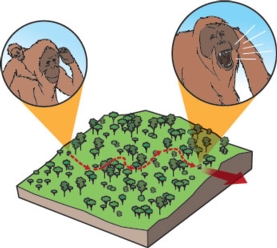
The researchers observed 15 dominant male orangutans in Sumatra for several years. These males roam through immense swaths of dense jungle, emitting loud yells every couple of hours so that the females they mate with and protect can locate and follow them. The shouts also warn away any lesser males that might be in the vicinity. These vocalizations had been observed by primatologists before, but the new data reveal that the apes’ last daily call, an especially long howl, is aimed in the direction they will travel in the morning—and the other apes take note. The females stop moving when they hear this special 80-second call, bed down for the night, and in the morning begin traveling in the direction indicated the evening before.

The scientists believe that the dominant apes are planning their route in advance and communicating it to other orangutans in the area. They acknowledge, however, that the dominant males might not intend their long calls to have such an effect on their followers. Karin Isler, a Zurich anthropologist who co-authored the study in PLOS ONE last fall, explains, “We don’t know whether the apes are conscious. This planning does not have to be conscious. But it is also more and more difficult to argue that they [do not have] some sort of mind of their own.”
BRAINY BEASTS
1 Capuchin monkeys appear to have a sense of fairness, insisting on receiving as good a food reward as their peers for performing the same job.

2 Scrub jays can relocate food that has been hidden for months and may even remember how long it has been stored. The jays also anticipate potential thefts and will relocate their food if they think another jay has spotted it.

3 Rhesus macaques will not pull a chain that brings them food if they think it will harm a fellow monkey.

4 Male voles may be able to predict when a female will be most fertile and, at the opportune time, revisit the location where she was last seen.

5 Bonobos and orangutans can use tools to retrieve food and then save their tools for later use.

http://www.scientificamerican.com/article/orangutans-share-their-future-plans-with-others/

Fossil Whale Offers Clues to Origins of ‘Seeing With Sound’

When you’re trying to track a fish in the murky ocean, forget about using your eyes—use your ears. Dolphins, orcas, and other toothed whales—known as odontocetes—pinpoint their prey by producing high-frequency sounds that bounce around their marine environment and reveal exactly where tricky fish are trying to hide. But when did whales evolve this sonarlike ability, known as echolocation? A newly named, 28-million-year-old whale may hold the answer.

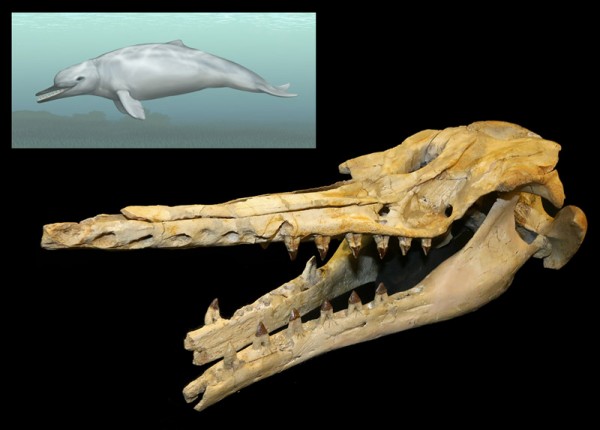
Found in South Carolina among rocks dating back to the Oligocene epoch and christened Cotylocara macei, the fossil whale is named after Mace Brown, a curator at the College of Charleston’s Mace Brown Natural History Museum in South Carolina who acquired the specimen for his private collection about a decade ago. It was in that private accumulation of fossils that Jonathan Geisler, a paleontologist at the New York Institute of Technology College of Osteopathic Medicine in Old Westbury, first saw the skull. “I knew it was special then,” he says.

The only known specimen of the early odontocete includes a nearly complete skull and jaw, three neck vertebrae, and fragments of seven ribs. It’s the skull that makes Cotylocara so remarkable. While the whale’s soft tissue rotted away long ago, the skull bones show several features—such as a downturned snout and a slight asymmetry of the skull—that suggest Cotylocara was one of the earliest whales to use echolocation, Geisler’s team reports online today in Nature.

The strongest pieces of evidence for this hypothesis, Geisler explains, are cavities at the base of the snout and on top of the skull that probably held air sinuses. “These air sinuses are thought to have important roles in the production of high-frequency vocalizations that living odontocetes use for echolocation,” Geisler says, possibly helping direct returning sound waves or store air that can be used to make continuous sound.

“I think the authors have a good case for inferring that Cotylocara had some ability to produce some sound from its forehead, just as living toothed whales do today,” says Nicholas Pyenson, a marine mammal paleontologist at the Smithsonian Institution’s National Museum of Natural History in Washington, D.C. But even if Cotylocara made those sounds, could it have heard them? Living whales have specialized ear bones that let them hear the high-frequency sounds bouncing off their prey. The only known skull of Cotylocara doesn’t have well-preserved ear bones, and, therefore, knowing whether the whale could have actually used echolocation for hunting is unclear. “Overall, the description of Cotylocara underscores the need to investigate the inner ear of fossil Oligocene cetaceans in much more detail, because that’s where the answer will be,” Pyenson says.

Nevertheless, the whale’s probable sound-producing abilities give Cotylocara an important place in whale evolution. Whale’s biological sonar is thought to have evolved only once along the ancestral line leading to today’s toothed whales, Geisler notes. Cotylocara lies along that evolutionary stem, as do other Oligocene fossil whales that have already been found. The skull features that allowed Cotylocara to create sound, Geisler says, “can now be investigated in other fossil whales to more fully understand the evolution of echolocation.” For now, the evolutionary epic of whale echolocation is only just beginning to be heard.

http://news.sciencemag.org/paleontology/2014/03/fossil-whale-offers-clues-origins-seeing-sound

Thanks to Dr. Rajadhyaksha for bringing this to the attention of the It’s Interesting community.

New research shows that whales and dolphins can’t taste anything except salt

Tastes are a privilege. The oral sensations not only satisfy foodies, but also on a primal level, protect animals from toxic substances. Yet cetaceans—whales and dolphins—may lack this crucial ability, according to a new study. Mutations in a cetacean ancestor obliterated their basic machinery for four of the five primary tastes, making them the first group of mammals to have lost the majority of this sensory system.

The five primary tastes are sweet, bitter, umami (savory), sour, and salty. These flavors are recognized by taste receptors—proteins that coat neurons embedded in the tongue. For the most part, taste receptor genes present across all vertebrates.

Except, it seems, cetaceans. Researchers uncovered a massive loss of taste receptors in these animals by screening the genomes of 15 species. The investigation spanned the two major lineages of cetaceans: Krill-loving baleen whales—such as bowheads and minkes—were surveyed along with those with teeth, like bottlenose dolphins and sperm whales.

The taste genes weren’t gone per se, but were irreparably damaged by mutations, the team reports online this month in Genome Biology and Evolution. Genes encode proteins, which in turn execute certain functions in cells. Certain errors in the code can derail protein production—at which point the gene becomes a “pseudogene” or a lingering shell of a trait forgotten. Identical pseudogene corpses were discovered across the different cetacean species for sweet, bitter, umami, and sour taste receptors. Salty tastes were the only exception.

“The loss of bitter taste is a complete surprise, because natural toxins typically taste bitter,” says zoologist Huabin Zhao of Wuhan University in China who led the study. All whales likely descend from raccoon-esque raoellids, a group of herbivorous land mammals that transitioned to the sea where they became fish eaters. Plants range in flavors—from sugary apples to tart, poisonous rhubarb leaves—and to survive, primitive animals learned the taste cues that signal whether food is delicious or dangerous. Based on the findings, taste dissipated after this common ancestor became fully aquatic—53 million years ago—but before the group split 36 million years ago into toothed and baleen whales.

“Pseudogenes arise when a trait is no longer needed,” says evolutionary biologist Jianzhi Zhang of the University of Michigan, Ann Arbor, who was not involved in the study. “So it still raises the question as to why whales could afford to lose four of the five primary tastes.” The retention of salty taste receptors suggests that they have other vital roles, such as maintaining sodium levels and blood pressure.

But dulled taste perception might be dangerous if noxious substances spill into the water. Orcas have unwittingly migrated into oil spills, while algal toxins created by fertilizer runoff consistently seep into the fish prey of dolphins living off the Florida coast.

“When you have a sense of taste, it dictates whether you swallow or not,” says Danielle Reed, a geneticist at the Monell Chemical Senses Center in Philadelphia, Pennsylvania. She was not involved with the current work, but co-authored a 2012 paper that found the first genetic inklings that umami and sweet taste receptors were missing in cetaceans, albeit in only one species—bottlenose dolphins.

Flavors are typically released by chewing, but cetaceans tend to swallow their food whole. “The message seems clear. If you don’t chew your food and prefer swallowing food whole, then taste really becomes irrelevant,” Reed says.

http://news.sciencemag.org/biology/2014/05/whales-cant-taste-anything-salt

Thanks to Dr. Rajadhyaksha for bringing this to the attention of the It’s Interesting community.

Recently Spotted 103-Year-Old Orca Is Bad News For SeaWorld

1216x700

SeaWorld could be in trouble because of “Granny,” the world’s oldest known living orca. The 103-year-old whale (also known as J2) was recently spotted off Canada’s western coast with her pod — her children, grandchildren and great-grandchildren. But while the Granny sighting is thrilling for us, it’s problematic for SeaWorld.

First of all, SeaWorld has claimed that “no one knows for sure how long killer whales live,” when simple figures or even living and thriving examples — like Granny — can give us a pretty good idea. The Whale and Dolphin Conservation project estimates that whales born in captivity only live to 4.5 years old, on average; many of SeaWorld’s orcas die before they reach their 20s. Perhaps because of their reduced lifespans, the whales are forced to breed continuously and at perilously young ages, which could also diminish their overall health.

Another key aspect of an orca’s life — which is missing in captivity — is the ability to swim up to 100 miles per day. When Granny was spotted earlier this week, she had just finished an 800-mile trek from northern California along with her pod. According to animal welfare advocates, long-distance swimming is integral to orcas’ psychological health and well-being; SeaWorld, however, has gone on record claiming that orcas do not need to swim hundreds of miles regularly, ostensibly to defend the parks’ cruel practice of keeping massive, powerful orcas confined to cramped tanks.

Since Granny was first spotted (as early as the 1930s), she’s believed to have mothered two calves, who in turn have had calves of their own. (One of her grandchildren, Canuck, reportedly died at the age of 4 after being captured and held at SeaWorld). As her pod has grown, Granny has kept up with them — without being separated through human intervention — and traveled astonishing distances with her pod annually. Orcas at SeaWorld are routinely separated from their pods, which has been known to cause huge mental and emotional strain and can prevent calves from developing normally.

Granny doesn’t simply represent an impressive feat of nature; she embodies what’s wrong with SeaWorld by being a living example of what’s right in the wild. While it’s true that most wild orcas don’t live as long as Granny has, their lifespans are still dramatically longer than those of SeaWorld’s whales (the NOAA estimates that wild female orcas, like Granny, live an average of 50 to 60 years). Their lives are also filled with much more swimming, exploration, variety and bonding with family.

https://www.thedodo.com/recently-spotted-103-year-old–547381307.html#recently-spotted-103-year-old–547381307.html

Rare Diamond Reveals Earth’s Interior is All Wet

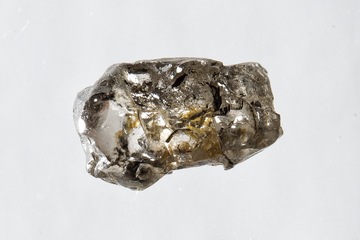
A battered diamond that survived a trip from “hell” confirms a long-held theory: Earth’s mantle holds an ocean’s worth of water.

“It’s actually the confirmation that there is a very, very large amount of water that’s trapped in a really distinct layer in the deep Earth,” said Graham Pearson, lead study author and a geochemist at the University of Alberta in Canada. The findings were recently published in the journal Nature.

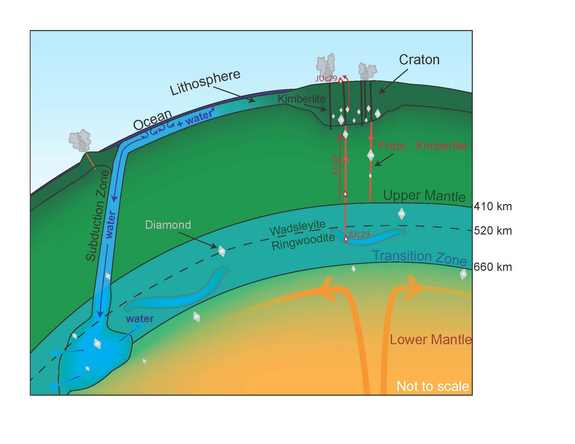
The worthless-looking diamond encloses a tiny piece of an olivine mineral called ringwoodite, and it’s the first time the mineral has been found on Earth’s surface in anything other than meteorites or laboratories. Ringwoodite only forms under extreme pressure, such as the crushing load about 320 miles (515 kilometers) deep in the mantle.

Most of Earth’s volume is mantle, the hot rock layer between the crust and the core. Too deep to drill, the mantle’s composition is a mystery leavened by two clues: meteorites, and hunks of rock heaved up by volcanoes. First, scientists think the composition of the Earth’s mantle is similar to that of meteorites called chondrites, which are chiefly made of olivine. Second, lava belched by volcanoes sometimes taps the mantle, bringing up chunks of odd minerals that hint at the intense heat and pressure olivine endures in the bowels of the Earth.

In recent decades, researchers have also recreated mantle settings in laboratories, zapping olivine with lasers, shooting minerals with massive guns and squeezing rocks between diamond anvils to mimic the Earth’s interior.

These laboratory studies suggest that olivine morphs into a variety of forms corresponding to the depth at which it is found. The new forms of crystal accommodate the increasing pressures. Changes in the speed of earthquake waves also support this model. Seismic waves suddenly speed up or slow down at certain depths in the mantle. Researcher think these speed zones arise from olivine’s changing configurations. For example, 323 to 410 miles (520 to 660 km) deep, between two sharp speed breaks, olivine is thought to become ringwoodite. But until now, no one had direct evidence that olivine was actually ringwoodite at this depth.

“Most people (including me) never expected to see such a sample. Samples from the transition zone and lower mantle are exceedingly rare and are only found in a few, unusual diamonds,” Hans Keppler, a geochemist at the University of Bayreuth in Germany, wrote in a commentary also published in Nature.

The diamond from Brazil confirms that the models are correct: Olivine is ringwoodite at this depth, a layer called the mantle transition zone. And it resolves a long-running debate about water in the mantle transition zone. The ringwoodite is 1.5 percent water, present not as a liquid but as hydroxide ions (oxygen and hydrogen atoms bound together). The results suggest there could be a vast store of water in the mantle transition zone, which stretches from 254 to 410 miles (410 to 660 km) deep.

“It translates into a very, very large mass of water, approaching the sort of mass of water that’s present in all the world’s ocean,” Pearson told Live Science’s Our Amazing Planet.

Plate tectonics recycles Earth’s crust by pushing and pulling slabs of oceanic crust into subduction zones, where it sinks into the mantle. This crust, soaked by the ocean, ferries water into the mantle. Many of these slabs end up stuck in the mantle transition zone. “We think that a significant portion of the water in the mantle transition zone is from the emplacement of these slabs,” Pearson said. “The transition zone seems to be a graveyard of subducted slabs.”

Keppler noted that it’s possible the volcanic eruption that brought the deep diamond to Earth’s surface may have sampled an unusually water-rich part of the mantle, and that not all of the transition-zone layer may be as wet as indicated by the ringwoodite.

“If the source of the magma is an unusual mantle reservoir, there is the possibility that, at other places in the transition zone, ringwoodite contains less water than the sample found by Pearson and colleagues,” Keppler wrote. “However, in light of this sample, models with anhydrous, or water-poor, transition zones seem rather unlikely.”

A violent volcanic eruption called a kimberlite quickly carried this particular diamond from deep in the mantle. “The eruption of a kimberlite is analogous to dropping a Mentos mint into a bottle of soda,” Pearson said. “It’s a very energetic, gas-charged reaction that blasts its way to Earth’s surface.”

The tiny, green crystal, scarred from its 325-mile (525 km) trip to the surface, was bought from diamond miners in Juína, Brazil. The mine’s ultradeep diamonds are misshapen and beaten up by their long journey. “They literally look like they’ve been to hell and back,” Pearson said. The diamonds are usually discarded because they carry no commercial value, he said, but for geoscientists, the gems provide a rare peek into Earth’s innards.

The ringwoodite discovery was accidental, as Pearson and his co-authors were actually searching for a means of dating the diamonds. The researchers think careful sample preparation is the key to finding more ringwoodite, because heating ultradeep diamonds, as happens when scientists polish crystals for analysis, causes the olivine to change shape.

“We think it’s possible ringwoodite may have been found by other researchers before, but the way they prepared their samples caused it to change back to a lower-pressure form,” Pearson said.

http://www.livescience.com/44057-diamond-inclusions-mantle-water-earth.html

Last Supper: Centipede Dies Eating Way Out of Snake Belly

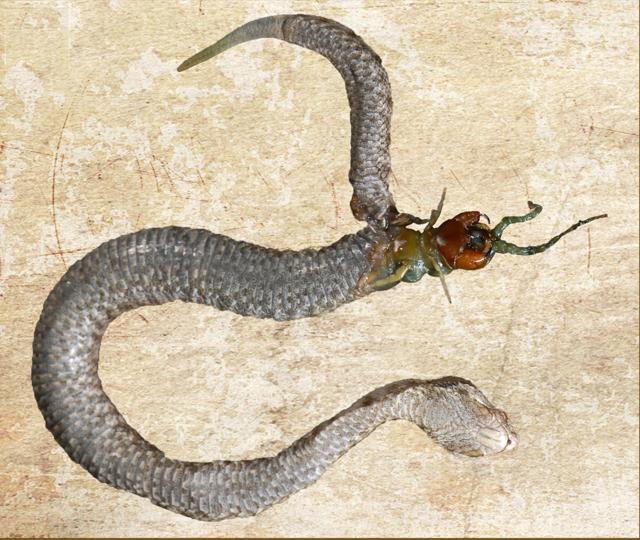
A Serbian herpetologist was out snake-tagging in Macedonia when she came across a bizarre find: A young viper, with a centipede’s head poking out of its abdomen.

It took Ljiljana Tomovic 10 seconds to figure out what it was: The snake had swallowed the centipede, which had then tried to cut a path to freedom … by eating its way out.

Some time during its violent dash, the centipede died. Perhaps the snake’s venom kicked in — that’s Tomovic’s best guess.

The island of Golem Grad in Macedonia’s Lake Prespa, where the pair were found, is also known as “Snake Island” and for good reason: it’s crawling with snakes, lizards and tortoises. Adult vipers chow down on small rodents, leaving the younger crowd to snack on centipedes.

It seems this time “the young snake gravely underestimated the size and strength of the centipede,” Tomovic, biology professor at the University of Belgrade, and her colleagues write in a brief report.

After dissolving (or digesting) the snake’s bones and gut the centipede was wearing its skin like a cloak. “We found that only the snake’s body wall remained — the entire volume of its body was occupied by the centipede,” Tomovic and co. write in Ecologica Montenegrina.

Some centipede species are equally cavalier and ferocious. They’ll lunge into battle with animals many times their size like mice and snakes. The foot-long Amazonian giant centipede hunts and eats bats.

Tomovic doesn’t know of any other centipede that has eaten its way out. “It’s possible that this situation is not so uncommon, just we did not have opportunity to see it until now,” she told NBC News via Skype.

http://www.nbcnews.com/science/weird-science/last-supper-centipede-dies-eating-way-out-snake-belly-n80071

Thanks to Pete Cuomo for bringing this to the attention of the It’s Interesting community.

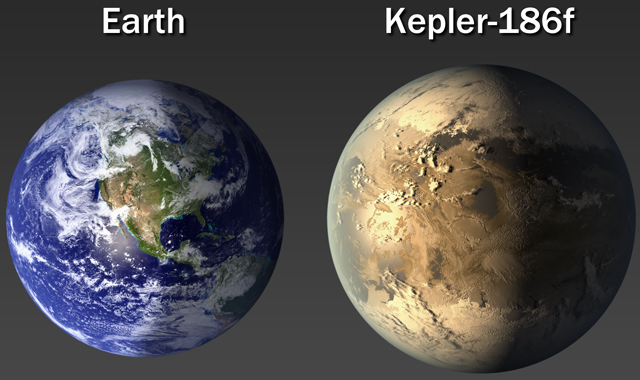
NASA discovers Kepler-186f, Earth-sized world in orbit that could support life

For the first time, scientists have found an Earth-sized world orbiting in a life-friendly zone around a distant star.

The discovery, announced on Thursday, is the closest scientists have come so far to finding a true Earth twin. The star, known as Kepler-186 and located about 500 light years away in the constellation Cygnus, is smaller and redder than the sun.

The star’s outermost planet, designated Kepler-186f, receives about one-third the radiation from its parent star as Earth gets from the sun, meaning that high noon on this world would be roughly akin to Earth an hour before sunset, said astronomer Thomas Barclay, with NASA’s Ames Research Center in Moffett Field, California.

The planet is the right distance from its host star for water — if any exists — to be liquid on the surface, a condition that scientists suspect is necessary for life.

“This planet is an Earth cousin, not an Earth twin,” said Barclay, who is among a team of scientists reporting on the discovery in the journal Science this week.

NASA launched its Kepler space telescope in 2009 to search about 150,000 target stars for signs of any planets passing by, or transiting, relative to the telescope’s point of view. Kepler was sidelined by a positioning system failure last year.

Analysis of archived Kepler data continues. From Kepler’s observational perch, a planet about the size and location of Earth orbiting a sun-like star would blot out only about 80 to 100 photons out of every million as it transits.

The pattern is repeated every 365 days and at least three transits would be needed to rule out other possibilities, so the search takes time.

“It’s very challenging to find Earth analogs,” Barclay said. “Most candidates don’t pan out, but things change as we get more measurements.”

Scientists don’t know anything about the atmosphere of Kepler-186f, but it will be a target for future telescopes that can scan for telltale chemicals that may be linked to life.

“This planet is in the habitable zone, but that’s doesn’t mean it is habitable,” Barclay said.

So far, scientists have found nearly 1,800 planets beyond the solar system.

“The past year has seen a lot of progress in the search for Earth-like planets. Kepler-168f is significant because it is the first exoplanet that is the same temperature and is (almost) the same size as Earth,” astronomer David Charbonneau, with the Harvard-Smithsonian Center for Astrophysics, wrote in an email.

“For me the impact is to prove that yes, such planets really do exist,” Charbonneau said. “Now we can point to a star and say, “There lies an Earth-like planet.'”

http://in.mobile.reuters.com/article/idINBREA3G1XI20140417?irpc=932

Thanks to Da Brayn for bringing this to the attention of the It’s Interesting community.

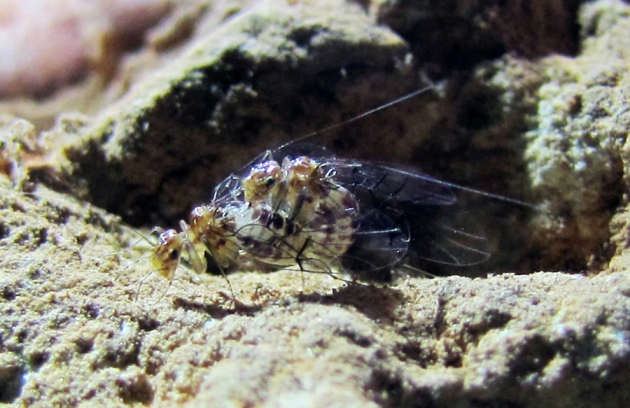
Female insect uses spiky penis to extract nourishment from male in marathon-long mating sessions

In desolate caves throughout Brazil live insects that copulate for days, the female’s penetrating erectile organ sticking fast in a reluctant male’s genital chamber until he offers a gift of nutritious semen. Neotrogla seems to be unique among species with reversed sex roles — with choosy males and aggressive, promiscuous females — in also having swapped anatomy, researchers report.

Not all animal species have a male penis, but because the evolution of body parts usually works through slow modification of existing structures, there would need to be a good reason for a female to develop a penetrating organ, says entomologist Kazunori Yoshizawa of Hokkaido University in Japan, a co-author of the study.

Yoshizawa and his colleagues think that they have found that reason in Neotrogla, which was first described in 2012. The insects were originally spotted in Brazilian caves by ecologist Rodrigo Ferreira from the Federal University of Lavras in Brazil. Entomologist Charles Lienhard at the Geneva Museum of Natural History in Switzerland recognized them as a new genus — and also as possessing unusual genitalia. The team’s work describing the reproductive practices of four separate species of Neotrogla is published today in Current Biology.

When the flea-sized winged insects mate, the female mounts the male and penetrates deep into a thin genital opening in his back. Membranes in her organ swell to lock her in, and multiple spiky spines act as grappling hooks to anchor her tightly to the male. (When researchers tried to pull apart two mating insects, the female was gripping so tightly that the male was accidentally ripped in half, leaving his genitalia still attached to the female.) The tip of the female’s penis fits neatly into the male’s genitalia to allow her to receive a large, teardrop-shaped sperm capsule over their 40–70 hours of copulation.

The key to the anatomy and role reversal might be simple hunger. Neotrogla species live in extremely dry caves, says Ferreira, where there is not much in the way of food, save for bat guano and the occasional dead bat. A female needs enough nourishment to make eggs and reproduce, though, so she likely found another source of nutrition, Yoshizawa says: her mate’s semen capsule. In some other insects, males expend personal resources to create highly sought-after ‘nuptial gifts’ of sperm and nutrients that they bestow upon their mate during copulation. Although it’s not clear whether Neotrogla couples do likewise, the females accept seminal gifts and drain them even when they’re too young to reproduce, Yoshizawa says, so it’s obvious they’re using the sperm capsules for more than mere reproduction.

If Neotrogla males need to spend valuable resources producing their sperm packets, it’s likely they would be choosy about their mates, Yoshizawa says, which would help explain why the females have evolved a penis well designed to hold down reluctant mates long enough to wring out all their gifts. This might be a combination unique to Neotrogla, he says: Although other animals have swapped sex roles where the female is the promiscuous aggressor (the scorpion fly, for example), and others have swapped anatomy where the female penetrates the male (seahorses, for example), none appears to have developed both reversed sex roles and a female penis with grappling hooks.

The authors make a “convincing case” that this female penis is associated with sex-role reversal where males are choosy, as would be expected under sexual-selection theory, says William Eberhard, an evolutionary biologist at the University of Costa Rica in San Pedro.

If Neotrogla can be observed in captivity, they might be good models for studying how and why male and female roles and anatomy can get switched around during copulation, he adds.

Yoshizawa and his colleagues are now working to establish a healthy population in the lab, but the biggest challenge will be finding a suitable food to replace the cave-bat droppings, Yoshizawa says. Flour, yeast and skimmed milk are all under consideration. to replace the cave-bat droppings.

http://www.nature.com/news/female-insect-uses-spiky-penis-to-take-charge-1.15064

Thanks to Dr. Lutter for bringing this to the attention of the It’s Interesting community.

Columbian Mammoth becomes South Carolina’s state fossil, with official language in the State Bill of it’s creation by God on the Sixth Day

<img src="https://its-interesting.com/wp-content/uploads/2014/04

The Columbian Mammoth is about to become an official state symbol of South Carolina, but its path to the limelight was long and fraught with controversy.

Here's the text of the bill that made it official:

Section 1-1-712A. The Columbian Mammoth, which was created on the Sixth Day with the other beasts of the field, is designated as the official State Fossil of South Carolina and must be officially referred to as the ‘Columbian Mammoth’, which was created on the Sixth Day with the other beasts of the field.

This is actually the watered-down version of the bill; one version, proposed earlier, made even more explicit references to the role of a divine creator in the mammoth’s history.

This all started when an 8-year-old suggested that the Columbian mammoth become South Carolina’s state fossil. Olivia McConnell had some good reasoning behind her suggestion: Mammoth teeth found in a South Carolina swamp in 1725 were the first vertebrate fossils identified in North America.

Her submission became a bill. The original draft was simple enough: “Section 1-1-691. The Wooly Mammoth is designated as the official State Fossil of South Carolina.” But almost immediately the proposal ran into trouble. On a practical level: Senate Majority Leader Harvey Peeler objected strenuously to having any new state symbols enacted in a state that already has a state spider, state beverage and a state hospitality beverage among many others. On a philosophical level: proclaiming a state fossil in a state where there is still intense debate over teaching evolution as fact creates some problems.

From USA Today:

State Sen. Mike Fair, a Greenville Republican who serves on the panel that will decide the science standards, said that natural selection should be taught as theory rather than as scientific fact. He argues that natural selection can make biological changes within species but it can’t explain the whole progression from microbes to humans.

“This whole subject should be taught as a pro and con,” he said.

Last week, Fair had raised his own objection that temporarily killed Olivia’s bill but withdrew it after another senator told him the story of the Lake City girl’s campaign to get an official state fossil.

Fair wasn’t the only one who had objections. Another State Senator, Kevin Bryant started a pushing a change that would add some biblical flair to the otherwise direct language. The New York Times:

But then Senator Kevin Bryant proposed an amendment rooted in the Book of Genesis, imputing God as the creator of the woolly mammoth: “And God made the beast of the earth after his kind, the cattle after their kind, and everything that creepeth upon the earth after his kind: and God saw that it was good.”
Bryant’s version was struck down, but the final version of the bill did include that language about the Mammoth being created on the sixth day.

There was one other addition, too. Frustrated by the amount of time spent discussing state symbols instead of governing, legislators also added an amendment to the bill prohibiting the General Assembly from enacting any new state symbols “until such time as the General Assembly directly by legislative enactment removes this moratorium.”

Read more: http://www.smithsonianmag.com/smart-news/south-carolinas-state-fossil-creation-controversy-180950474/#4mOTlJmLsprzxrmM.99

Thanks to Kebmodee for bringing this to the attention of the It’s Interesting community.

Beaked Whales Smash Deep-Dive Record

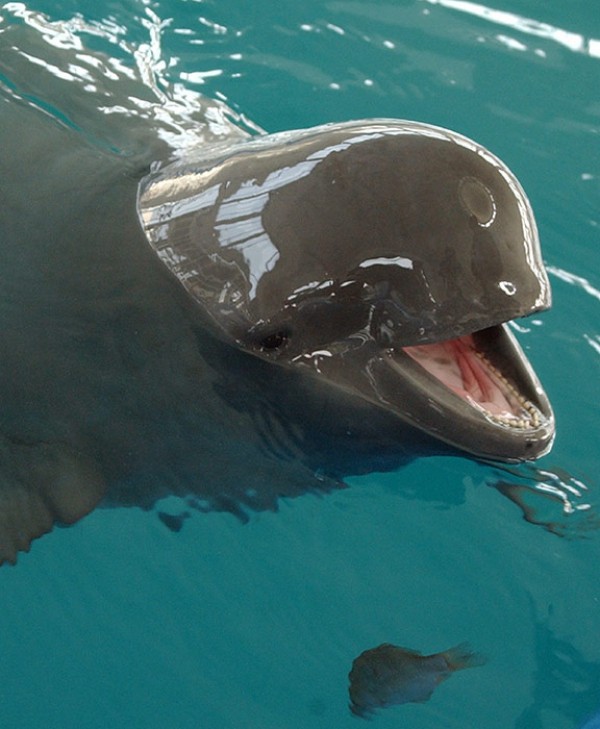
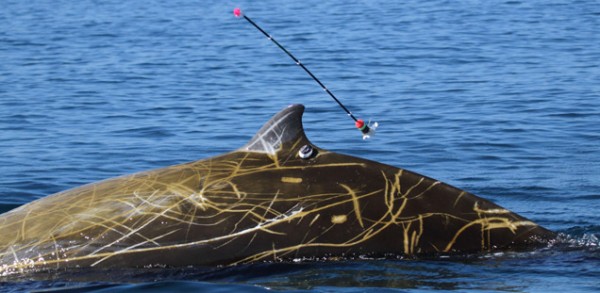
Cuvier’s beaked whales (Ziphius cavirostris) just shattered their own deep-diving record—as well as that of elephant seals, which were the previous record-holders. The little-known species of beaked whales, cigar-shaped cetaceans with prominent snouts and which range from tropical to northern temperate seas, has long been considered one of the most extreme divers in the ocean, capable of reaching a depth of 1888 meters and staying below for 95 minutes. But a new study that tracked eight individuals off the coast of southern California via satellite tags, as in the photo above, shows they can do much more. (Male Cuvier’s beaked whales have tusks, and the scars on the back of the male in the photo are from fighting with other males.) One whale dove to 2992 meters below the surface, breaking the deep-dive record of a southern elephant seal that was tracked to 2388 meters. Another Cuvier’s beaked whale in the study remained below the surface for 2 hours and 17 minutes. Unlike elephant seals and deep-diving sperm whales, which remain at the surface for an extended period after their dives, the beaked whales headed back into the depths less than 2 minutes later, the scientists report online today in PLOS ONE. The beaked whales in the study made their deep dives about seven times a day, foraging for squid and fish; they spent more time at the surface at night. By better understanding this species’ diving behaviors, the scientists hope to solve an ongoing mystery: Why are Cuvier’s beaked whales particularly sensitive to military sonar operations? Sixty-nine percent of all recorded strandings of marine mammals that were associated with such operations involved this species. Yet these eight whales were tagged and followed on a U.S. Navy sonar training range, leading the scientists to suggest that Cuvier’s beaked whales in this area may have adapted to human noise—perhaps, in part, by becoming the most extreme of extreme divers.

http://news.sciencemag.org/plants-animals/2014/03/scienceshot-beaked-whales-smash-deep-dive-record

Thanks to Dr. Rajadhyaksha for bringing this to the attention of the It’s Interesting community.