Scientists in China grow soft teeth from urine

teeth2

Scientists have grown rudimentary teeth out of the most unlikely of sources, human urine.

The results, published in Cell Regeneration Journal, showed that urine could be used as a source of stem cells that in turn could be grown into tiny tooth-like structures.

The team from China hopes the technique could be developed into a way of replacing lost teeth.

Other stem cell researchers caution that that goal faces many challenges.

Teams of researchers around the world are looking for ways of growing new teeth to replace those lost with age and poor dental hygiene.

Stem cells – the master cells which can grow into any type of tissue – are a popular area of research.

The group at the Guangzhou Institutes of Biomedicine and Health used urine as the starting point.

Cells which are normally passed from the body, such as those from the lining of the body’s waterworks, are harvested in the laboratory. These collected cells are then coaxed into becoming stem cells.

A mix of these cells and other material from a mouse was implanted into the animals.

The researchers said that after three weeks the bundle of cells started to resemble a tooth: “The tooth-like structure contained dental pulp, dentin, enamel space and enamel organ.”

However, the “teeth” were not as hard as natural teeth.

This piece of research is not immediately going to lead to new options for the dentist, but the researchers say it could lead to further studies towards “the final dream of total regeneration of human teeth for clinical therapy”.

Prof Chris Mason, a stem cell scientist at University College London, said urine was a poor starting point.

“It is probably one of the worst sources, there are very few cells in the first place and the efficiency of turning them into stem cells is very low.

“You just wouldn’t do it in this way.”

He also warned that the risk of contamination, such as through bacteria, was much higher than with other sources of cells.

Prof Mason added: “The big challenge here is the teeth have got a pulp with nerve and blood vessels which have to make sure they integrate to get permanent teeth.”

http://www.bbc.co.uk/news/health-23492425

Thanks to Kebmodee for bringing this to the attention of the It’s Interesting community.

New research on adult neurogenesis shows that about 1,400 new brain cells are born every day, and about 80% of human brain cells in the dentate gyrus of the hippocampus undergo renewal in adulthood

ooold-neurons

bomb

by Leonie Welberg

The question of whether adult neurogenesis occurs in the human hippocampus has been a hotly debated topic in neuroscience. In a study published in Cell, Frisén and colleagues now settle the debate by providing evidence that around 1,400 dentate gyrus cells are born in the human brain every day.

The authors made use of a birth-dating method that is based on the principle that 14C in the atmosphere is taken up by plants and — because humans eat plants and animals that eat plants — eventually also by humans. As 14C is incorporated into DNA during cell division, the 14C content of a cell is thought to reflect 14C levels in the atmosphere at the time of the birth of the cell. Importantly, atomic bomb testing in the 1950s and 1960s resulted in a spike in atmospheric 14C levels, and levels declined after 1963; this means that the level of 14C in cellular DNA can be used as a relatively precise marker of a cell’s birth date.

The authors applied the 14C birth-dating method to whole hippocampi dissected from post-mortem brains donated by individuals who were born in different years in the twentieth century. They separated neurons from non-neuronal hippocampal cells, purified the neuronal DNA and determined 14C levels. Neuronal 14C levels did not match atmospheric 14C levels in the individual’s birth year but were either higher (for people born before 1950) or lower (for people born after 1963), suggesting that at least some of the hippocampal cells were born after the year in which an individual was born.

Computer modelling of the data revealed that the best-fit model was one in which 35% of hippocampal cells showed such turnover, whereas the majority did not (that is, they were born during development). Assuming that, in humans, adult neurogenesis would take place in the dentate gyrus rather than in other hippocampal areas (as it does in rodents), and as the dentate gyrus contains about 44% of all hippocampal neurons, this model suggests that about 80% of human dentate gyrus cells undergo renewal in adulthood. This is in striking contrast to the scenario in mice, in which only ~10% of adult dentate gyrus neurons undergo renewal. The study further showed that there is very little decline in the level of hippocampal neurogenesis with ageing in humans, which is again in contrast to rodents.

It is now well established that adult-born neurons have a functional role in the mouse and rat dentate gyrus and olfactory bulb. A previous study using the same neuronal birth-dating method established that no adult neurogenesis takes place in the olfactory bulb and cortex in humans, but the new study has elegantly shown that the situation is different in the dentate gyrus. Whether the adult-born neurons have functional implications in humans remains a topic for future investigation.

http://www.nature.com/nrn/journal/v14/n8/full/nrn3548.html?WT.ec_id=NRN-201308

Thanks to Kebmodee for bringing this to the attention of the It’s Interesting community.

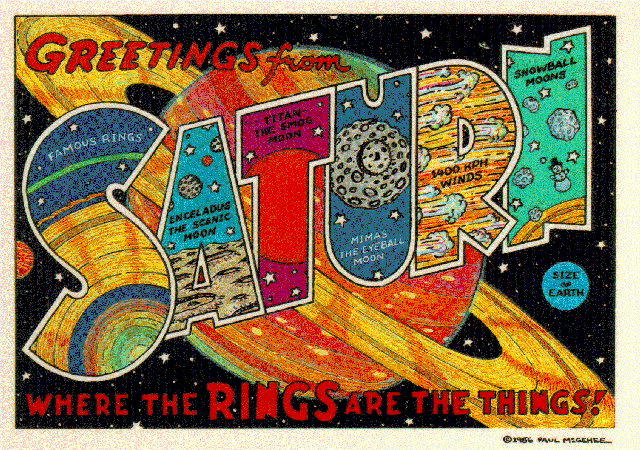
July 19: A Chance to See Saturn, For the First Time in 7 Years

Saturn

In July, you will have the photo opp of a lifetime.

According to the Cassini Solstice Mission website, the sun will backlight Saturn on July 19, allowing you to clearly see the planet’s rings, photograph them and observe the changes over the past seven years, since Saturn was last photographed.

The positioning of the planets against the sun will also allow for a clear photo of Earth from 898 million miles away. This shot of the Earth will be only the third of its kind in the history of U.S. space travel. The first was taken from the Voyager in 1990, from 4 billion miles away; the second from Cassini in 2006, from 926 million miles away.

NASA posted directions on its website for waving at Saturn on July 19. Since the picture of Earth will be tiny, NASA is encouraging people to capture their own photos of Saturn and send them in, which they will then compile into a collage and post on its website.

NASA is promoting Wave at Saturn with a Flickr group, Facebook event page and a #waveatsaturn Twitter hashtag.

The Cassini portrait session of Earth is expected to last around 15 minutes, beginning at 5:27 p.m. ET on July 19.

Thanks to Kebmodee for bringing this to the attention of the It’s Interesting community.

http://mashable.com/2013/06/25/saturn-photo/

Soaring sales for George Orwell’s ‘1984’ with recent news of U.S. government spying and surveillance on its citizens

1984

With news of government spying and surveillance dominating the headlines, sales of Orwell’s classic novel have shot up more than 3,000 percent on Amazon.com. The book currently comes in at No. 5 on the site’s Movers and Shakers list of the biggest sales gainers of the day, and had been as high as No. 4 earlier in the day. Sales of the book began to jump on Monday, when it rose to No. 19.

In “1984,” English author Orwell presents a dystopian future with a totalitarian, tyrannical government where “Big Brother is watching you.”

Separately, a dual edition of “1984” and Orwell’s other classic, “Animal Farm,” comes in at No. 11 on Amazon’s list.

Orwell died in 1950, just a year after “1984” was published.

http://news.msn.com/pop-culture/sales-of-george-orwells-1984-surge-on-amazon

Thanks to Kebmodee for bringing this to the attention of the It’s Interesting community.

Ancient Irish texts show volcanic link to cold weather

irish volcano

By Matt McGrath

Environment correspondent, BBC News

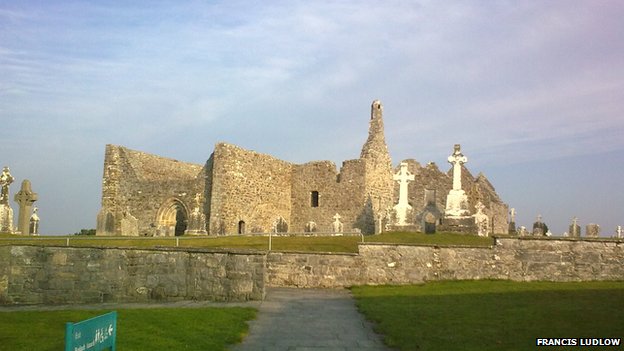
Researchers have been able to trace the impact of volcanic eruptions on the climate over a 1200 year period by assessing ancient Irish texts.

The international team compared entries in these medieval annals with ice core data indicating volcanic eruptions.

Of 38 volcanic events, 37 were associated with directly observed cold weather extremes recorded in the chronicles.

The report is published in the journal Environmental Research Letters.

In the dim light of the Dark Ages, the Irish literary tradition stands out like a beacon.

At monastic centres across the island, scribes recorded significant events such as feast days, obituaries and descriptions of extreme cold and heat.

These chronicles are generally known as the Irish Annals and in this report, scientists and historians have looked at 40,000 entries in the texts dating from AD431 to 1649.

The researchers also looked at the Greenland Ice Sheet Project (GISP2) ice-core data.

When volcanoes erupt, they produce sulphate aerosol particles which down the centuries have been deposited on and frozen in ice sheets, leaving an extremely accurate temporal record of the event.

Scientists say these particles reflect incoming sunlight and can cause a temporary cooling of the Earth’s surface. In a country with a mild maritime climate like Ireland, these colder events would have a significant impact.

When the weather that is cold enough to allow you to walk over a lake in Ireland, it is pretty unusual,” lead author Dr Francis Ludlow, from Harvard University, told BBC News.

“When it happened, it was remarkable enough to be recorded pretty consistently.”

The scientists in the team identified 48 volcanic eruptions in the time period spanning 1,219 years. Of these, 38 were associated closely in time with extreme weather events identified in the Irish texts.

“These eruptions occur and they override existing climate patterns for a period of two or three years,” said Dr Ludlow.

“And it is clear from the sources that they cause a lot of devastation among societies at the time – whether it was the mass mortality of domestic animals or humans, or indirectly by causing harvest failure.”

The research team believe the texts are accurate as the annals also record solar and lunar eclipses which can be compared with other contemporary sources.

The keen recording of weather though had another motivation.

“A lot of these scribes are working in monasteries, in some time periods they are interpreting these weather events as divine omens or portents as signals of the coming of the last days,” said Dr Ludlow.

“That was one of their motivations so we are able to use the records that were created for a completely different purpose that the scribes would never have conceived.”

The researchers say that one expected effect of volcanic eruptions that occur in tropical regions is to make for milder winters in northern latitudes.

But in this study, they found several instances of these type of eruptions causing extremely cold winters in Ireland. The team believes their work shows the complex nature of volcanic impacts on climate, and they say there are lessons for the future in the ancient texts.

“That tells us a lot about what sort of weather we might expect in the British Isles when the next big eruption goes off,” said Dr Ludlow.

“We might want to buy a bit more salt for the roads.”

http://www.bbc.co.uk/news/science-environment-22786179

Thanks to Kebmodee for bringing this to the attention of the It’s Interesting community.

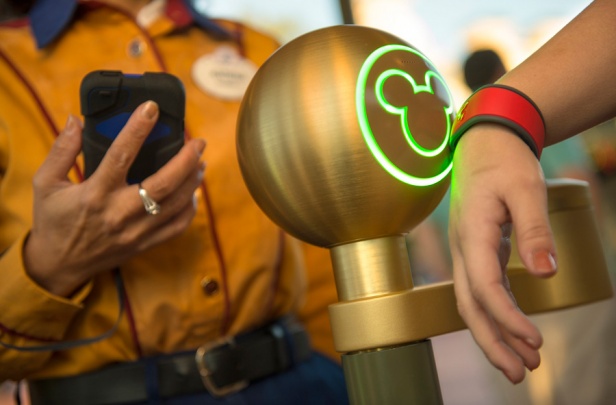
Disney’s Electronic Wristband Illustrates Why Big Companies Push Contactless Wallets

disney

Disney just announced an electronic wristband for visitors to its theme parks that neatly illustrates why companies like Google and cellphone networks are pushing the idea of using contactless technology in phones for payments, tickets, boarding passes and more. The short answer? They want data.

Disney’s MagicBand, an ID tag that uses Bluetooth and contactless NFC technology, is being introduced at Walt Disney World in Florida. It replaces a person’s ticket and can be used to tag into rides and other attractions at the park. It can also be used to open a guest’s hotel door, and to pay in stores at the resort. In the future, the Bluetooth link will make it possible for you to wander up to an attraction or Disney character and be greeted using your first name.

To sum up, a person opting to use a MagicBand could find their stay much more convenient, and perhaps even leave their wallet back at their hotel. It’s a very similar pitch to that made by companies including Google, and the consortium of major cellphone networks, Isis, for contactless “wallets” based on near field communication chips (NFC) built into phones.

However, Disney’s MagicBand program has significant benefits to the company, too. The MagicBand collects valuable data each time it is tagged or used to buy something, providing a new perspective on what Disney’s customers are doing at the resort. It becomes possible to do things like look for relationships between the attractions and rides a person visits, or the characters they meet, and what they spend money on in the gift shop. Disney could look for signs of the social dynamics of groups of people that arrive at the park together.

Disney has plans to install devices that use Bluetooth to log any MagicBand that passes by, said Thomas Staggs, chairman of Walt Disney Theme Parks and Resorts, Wednesday. People will be able to opt out of that part of the data collection he said, but whether data logged when a person actively tags a band would be treated in the same way wasn’t mentioned.

Using a contactless wallet app on your phone could provide similar data harvesting opportunities. A person using one might get to leave their wallet at home, and could pay for stuff or provide tickets and boarding passes with a tap of their phone. The provider of the wallet app would get a detailed feed on where its users went, what they were doing and what they spent money on.

Some people will be wary of such data collection, many more probably won’t care. Putting that issue aside, though, Disney’s MagicBand sounds like it is genuinely useful and thanks to the company’s ability to ensure everything inside its resorts works with the technology, could make your stay at Disney’s resort go more smoothly. The stuttering progress of NFC wallets and the like outside the magic kingdom – despite the hype – is to a large degree because the real world is a much messier place. Neither Google nor the cellphone carriers or other companies pushing their own MagicBand-style wallets can yet offer something that works in every store, with every bank and in every place. For now, the benefits of contactless wallets are much clearer to the providers of them than to consumers.

Thanks to Kebmodee for bringing this to the attention of the It’s Interesting community.

Catholic television channel TV2000 reports that Pope Francis performed exorcism Sunday – denied by The Vatican

pope
Pope Francis appears to have performed an exorcism on a wheelchair-bound young man who believers in the practice claim was possessed by evil.

According to TV2000, a Catholic television channel, the act was carried out in St Peter’s Square after Mass on Sunday.

Smiling broadly, the Pope initially shook the man’s hand, but the South American pontiff’s expression changed dramatically after a priest from the Legionaries of Christ, a conservative order, leaned in close and spoke a few words to him.

With a more serious expression on his face, Francis placed both hands on the man’s head for 15 seconds. The pilgrim, said to be a 43-year old married man from Mexico called Angelo, then convulsed briefly and emitted a long sigh. His body went limp and his mouth dropped open.

“Exorcists who have seen the footage have no doubt – this was a prayer for liberation from Evil, an actual exorcism,” said TV2000, which is owned by the Italian Bishops Conference.

The station gathered a panel of clergy specialising in exorcisms who scrutinised the footage and concluded that the pope had performed an exorcism.

The Vatican downplayed the incident, although it used ambiguous language that did not deny altogether that Francis had tried to rid the man of evil. “The Holy Father did not intend to carry out any exorcism,” said Father Federico Lombardi, the Vatican spokesman.

“Instead, as he often does for sick and suffering people, he simply intended to pray for a person who was presented to him.”

Leading exorcists insisted that the Pope had indeed taken on the forces of evil.

“The Pope is also the Bishop of Rome, and like any bishop he is also an exorcist,” Father Gabriele Amorth, the Catholic Church’s best known exorcist and the head of the International Association of Exorcists, told La Repubblica newspaper.

“It was a real exorcism,” he said. “If the Vatican has denied this, it shows that they understand nothing”, said Father Amorth who claimed that the Mexican was “possessed by four demons”.

The Rev. Giulio Maspero, a Rome-based systematic theologian who has witnessed or participated in more than a dozen exorcisms, said he was certain that Francis’ prayer on Sunday was either a full-fledged exorcism or a prayer to “liberate” the young man from a demonic possession. He noted that the placement of the pope’s hands on the man’s head was the “typical position” for an exorcist to use.

“When you witness something like that – for me it was shocking – I could feel the power of prayer,” he said in a phone interview, speaking of his own experiences.

Fr Maspero said it was particularly symbolic that Francis’ purported exorcism occurred on Pentecost, an important feast day for the church when the faithful believe Jesus’ apostles received the fullness of the Holy Spirit.

“The Holy Spirit is connected to the exorcism because … it is the manifestation of how God is present among us and in our world,” he said.

There was now, more than ever, a need for exorcists to combat people possessed by “sorcerers” and “Satanists”, Father Amorth said.

“We live in an age in which God has been forgotten. And wherever God is not present, the Devil reigns.”

He acknowledged that many people, even Catholics, regarded exorcism as mumbo-jumbo but insisted they were mistaken. “Those who don’t believe should read the Gospels. Jesus continually performed exorcisms.

“Today, unfortunately, bishops appoint too few exorcists. We need many more. I hope that Rome will send out directives to bishops around the world calling on them to appoint more exorcists.”

He said John Paul II had carried out many exorcisms during his pontificate, but that Benedict XVI had not performed any, instead leaving it to bishops and priests.

“John Paul II fought many times against Satan,” Father Amorth said. “Those battles continue, even though he is dead. In fact he is present today in many exorcisms. If you cite his name during an exorcism, the person who is possessed literally froths at the mouth in fury.”

Francis has made repeated references to the Devil since he was chosen as Benedict’s successor during a secret conclave in March.

At his first Mass, which was held in the Sistine Chapel, where he had been elected by his brother cardinals, he warned: “If we do not confess, if we do not pray to the Lord, we are praying to the Devil. When you do not confess to Jesus Christ, you are confessing to the worldliness of the Devil.”

People possessed by evil are said to display certain symptoms, from extraordinary physical strength to speaking “in tongues” and vomiting nails and bits of glass.

Catholic priests who have trained as exorcists have to follow a ritual known as “De exorcismis et supplicationibus quibusdam”, or “Of exorcisms and certain supplications”, according to guidelines laid down by the Church.

The 84-page document was drawn up in 1998 and is an update on an exorcism rite which was compiled in 1614.

Thanks to Kebmodee for bringing this to the attention of the It’s Interesting community.

http://www.telegraph.co.uk/news/religion/the-pope/10070991/Pope-Francis-performs-first-exorcism.html

Marine, dog reunited in surprise ceremony

dog

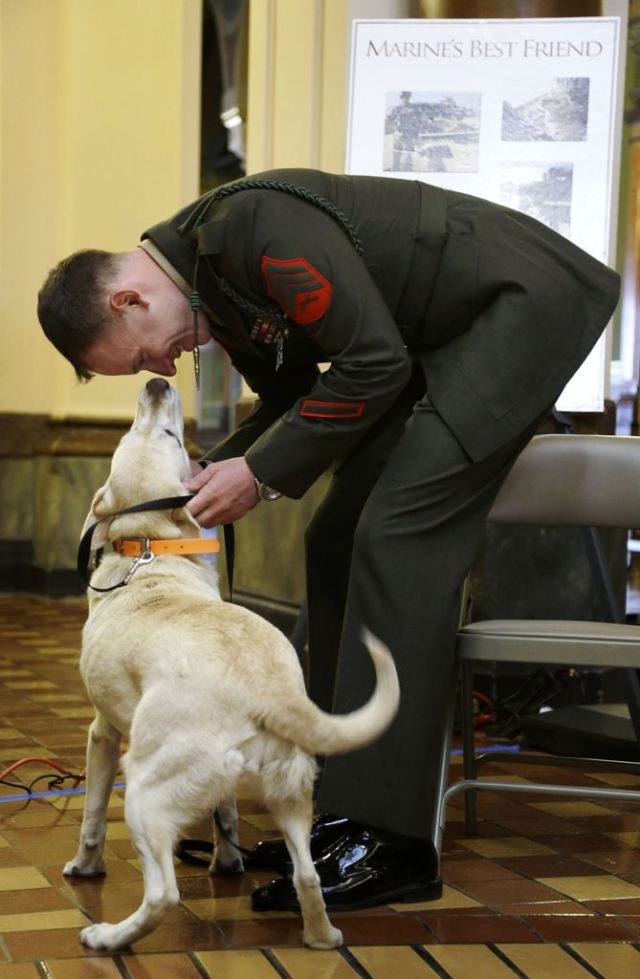
When Marine Sgt. Ross Gundlach served as a dog handler in Afghanistan, he told the yellow lab who was his constant companion that he’d look her up when he returned home. “I promised her if we made it out of alive, I’d do whatever it took to find her,” Gundlach said.

On Friday, he made good on that vow with help from some sentimental state officials in Iowa who know how to pull off a surprise. Since leaving active duty to take classes at the University of Wisconsin this summer, Gundlach, of Madison, Wis., had been seeking to adopt 4-year-old Casey.

The 25-year-old learned Casey had finished her military service and had been sent to the Iowa State Fire Marshal’s Office, where she was used to detect explosives. Gundlach wrote to State Fire Marshal Director Ray Reynolds, explaining the connection he felt with the dog. He even has a tattoo on his right forearm depicting Casey with angel wings and a halo, sitting at the foot of a Marine.

“He’s been putting a case together for the last two months, sending me pictures … it just tugged on your heart,” Reynolds said.

Reynolds decided to arrange a surprise. First, he got in touch with the Iowa Elk’s Association, which agreed to donate $8,500 to buy another dog for the agency.

“We have a motto in our association that as long as there are veterans, the Elks will strive to help them,” Iowa Elks Association president Tom Maher said. Then, Reynolds came up with a ruse to get Gundlach to Des Moines, telling Gundlach he needed to come to the state Capitol to plead his case in front of a “bureaucratic oversight committee.”

When Gundlach arrived with his parents, Reynolds told them the meeting had been delayed and invited them to join an Armed Services Day celebration in the rotunda. There, hundreds of law enforcement officers, military personnel and civilians were seated, keeping the secret — until they brought out Casey. When Gundlach saw Casey, he put his head in his hands and cried. She licked his face, wagging her tail furiously.

“It was a total surprise,” he said. “I owe her. I’ll just try to give her the best life I can.”

His father, Glen Gundlach, seemed just as surprised. “It’s unbelievable … the state of Iowa, I love ’em,” he said.

Gov. Terry Branstad officially retired Casey from active duty during Friday’s ceremony, thanking the dog for a “job well done.”

During the 150 missions they performed together, Gundlach said Casey never missed an explosive — she caught three before they could be detonated. He credits her for making it back home safely.

“I wouldn’t be here … any kids I ever had wouldn’t exist if Casey hadn’t been here,” he said.

http://news.yahoo.com/marine-dog-reunited-surprise-ceremony-205112134.html;_ylt=Ar.ysfGFUOy8ZQpyv.IgyQMavMB_;_ylu=X3oDMTIzNzg2dm04BG1pdANIQ01PTCBvbiBhcnRpY2xlIHJpZ2h0IHJhaWwEcGtnA2lkLTMyNzU4MjUEcG9zAzUEc2VjA2hjbQR2ZXIDMTI-;_ylg=X3oDMTBhYWM1a2sxBGxhbmcDZW4tVVM-;_ylv=3

Thank to Kebmnodee for bringing this to the attention of the It’s Intereresting community.

Bear eats monkey when forced to ride bike at Shanghai Wild Animal Park

A monkey was mauled by a bear after a disturbing circus stunt went wrong.

A video has emerged online of two monkeys and a black bear being forced to ride bicycles around a track in front of a large crowd.

After two laps of the track, one of the monkeys crash and the bear then attacks it as it lies stuck under the bicycle.

The video is believed to have been shot at the Shanghai Wild Animal Park, in China, which has hit the headlines in the past for its ‘Wild Animal Olympics’.

In the video, the audience can be heard cheering and laughing as the animals are sent riding around the small arena.

Circus workers holding sticks push the small bikes off but after a few seconds one monkey and the bear crash.

Staff can be seen desperately trying to force the bear off as it grabs the small monkey in its mouth.

At one stage three workers, dressed in brightly coloured costumes, try to wrestle the bear away, while another leads the second monkey away.

Campaign group Animals Asia said it has previously documented cheetahs, lions, tigers, bears, chimpanzees and an elephant being forced to perform in the ‘Wild Animal Olympics’.

It is not clear when the latest video was taken but Shanghai Wild Animal Park said in 2006 that the Olympic event had been scrapped following complaints and ‘out of consideration for the safety of our visitors.’

Stunts in the show had included making bears box one another and ride bicycles, kangaroos boxing humans and monkeys lifting weights.

Visitors to the park can also pay to have their picture taken with the big cats and other animals.

Animals Asia said some of the creatures had also been declawed.

China Tour Online’s website said the park ‘offers animal performances, showing the charm and skill of the animals and their gift in performing.’

Thanks to Kebmodee for bringing this to the attention of the It’s Interesting community.

Read more: http://www.dailymail.co.uk/news/article-2320745/Bear-forced-ride-bike-sick-circus-stunt-crashes-mauls-monkey-large-crowd.html#ixzz2T1OBSdWz
Follow us: @MailOnline on Twitter | DailyMail on Facebook