Isao Hashimoto time lapse video of every nuclear explosion on Earth between 1945 – 1998

Japanese artist Isao Hashimoto has created a beautiful, undeniably scary time-lapse map of the 2053 nuclear explosions which have taken place between 1945 and 1998, beginning with the Manhattan Project’s “Trinity” test near Los Alamos and concluding with Pakistan’s nuclear tests in May of 1998. This leaves out North Korea’s two alleged nuclear tests in this past decade (the legitimacy of both of which is not 100% clear).

Each nation gets a blip and a flashing dot on the map whenever they detonate a nuclear weapon, with a running tally kept on the top and bottom bars of the screen. Hashimoto, who began the project in 2003, says that he created it with the goal of showing”the fear and folly of nuclear weapons.” It starts really slow — if you want to see real action, skip ahead to 1962 or so — but the buildup becomes overwhelming.

http://memolition.com/2013/10/16/time-lapse-map-of-every-nuclear-explosion-ever-on-earth/

Thanks to Jody Troupe for bringing this to the attention of the It’s Interesting community.

Super typhoon Haiyan just broke all scientific intensity scales

With sustained winds of 190mph (305km/h) and staggering gusts of 230mph (370km/h), its “intensity has actually ticked slightly above the maximum to 8.1 on an 8.0 scale.” Update: It broke 235mph.

Holthaus says that Yolanda—its Filipino name—beats “Wilma (2005) in intensity by 5mph—that was the strongest storm ever in the Atlantic,” which makes it a member of the select club of Worst Storms Ever in the Planet. Only three other storms since 1969 have reached this intensity.

Thanks to Jody Troupe for bringing this to the attention of the It’s Interesting community.

First mechanical gear discovered in a living creature

mechanical gear 2

mechanical gear 1

With two diminutive legs locked into a leap-ready position, the tiny jumper bends its body taut like an archer drawing a bow. At the top of its legs, a minuscule pair of gears engage—their strange, shark-fin teeth interlocking cleanly like a zipper. And then, faster than you can blink, think, or see with the naked eye, the entire thing is gone. In 2 milliseconds it has bulleted skyward, accelerating at nearly 400 g’s—a rate more than 20 times what a human body can withstand. At top speed the jumper breaks 8 mph—quite a feat considering its body is less than one-tenth of an inch long.

This miniature marvel is an adolescent issus, a kind of planthopper insect and one of the fastest accelerators in the animal kingdom. As a duo of researchers in the U.K. reported recently in the journal Science, the issus also the first living creature ever discovered to sport a functioning gear. “Jumping is one of the most rapid and powerful things an animal can do,” says Malcolm Burrows, a zoologist at the University of Cambridge and the lead author of the paper, “and that leads to all sorts of crazy specializations.”

The researchers believe that the issus—which lives chiefly on European climbing ivy—evolved its acrobatic prowess because it needs to flee dangerous situations. Although they’re not exactly sure if the rapid jump evolved to escape hungry birds, parasitizing wasps, or the careless mouths of large grazing animals, “there’s been enormous evolutionary pressure to become faster and faster, and jump further and further away,” Burrows says. But gaining this high acceleration has put incredible demands on the reaction time of insect’s body parts, and that’s where the gears—which “you can imagine being at the top of the thigh bone in a human,” Burrows says—come in.

“As the legs unfurl to power the jump,” Burrows says, “both have to move at exactly the same time. If they didn’t, the animal would start to spiral out of control.” Larger animals, whether kangaroos or NBA players, rely on their nervous system to keep their legs in sync when pushing off to jump—using a constant loop of adjustment and feedback. But for the issus, their legs outpace their nervous system. By the time the insect has sent a signal from its legs to its brain and back again, roughly 5 or 6 milliseconds, the launch has long since happened. Instead, the gears, which engage before the jump, let the issus lock its legs together—synchronizing their movements to a precision of 1/300,000 of a second.

The gears themselves are an oddity. With gear teeth shaped like cresting waves, they look nothing like what you’d find in your car or in a fancy watch. (The style that you’re most likely familiar with is called an involute gear, and it was designed by the Swiss mathematician Leonhard Euler in the 18th century.) There could be two reasons for this. Through a mathematical oddity, there is a limitless number of ways to design intermeshing gears. So, either nature evolved one solution at random, or, as Gregory Sutton, coauthor of the paper and insect researcher at the University of Bristol, suspects, the shape of the issus’s gear is particularly apt for the job it does. It’s built for “high precision and speed in one direction,” he says. “It’s a prototype for a new type of gear.”

Another odd thing about this discovery is that although there are many jumping insects like the issus—including ones that are even faster and better jumpers—the issus is apparently the only one with natural gears. Most other bugs synchronize the quick jolt of their leaping legs through friction, using bumpy or grippy surfaces to press the top of their legs together, says Duke University biomechanics expert Steve Vogel, who was not involved in this study. Like gears, this ensures the legs move at the same rate, but without requiring a complicated interlocking mechanism. “There are a lot of friction pads around, and they accomplish pretty much of the same thing,” he says. “So I wonder what extra capacity these gears confer. They’re rather specialized, and there are lots of other jumpers that don’t have them, so there must be some kind of advantage.”

Even stranger is that the issus doesn’t keep these gears throughout its life cycle. As the adolescent insect grows, it molts half a dozen times, upgrading its exoskeleton (gears included) for larger and larger versions. But after its final molt into adulthood—poof, the gears are gone. The adult syncs its legs by friction like all the other planthoppers. “I’m gobsmacked,” says Sutton. “We have a hypothesis as to why this is the case, but we can’t tell you for sure.”

Their idea: If one of the gear teeth were to slip and break in an adult (the researchers observed this in adolescent bugs), its jumping ability would be hindered forever. With no more molts, it would have no chance to grow more gears. And with every bound, “the whole system might slip, accelerating damage to the rest of the gear teeth,” Sutton says. “Just like if your car has a gear train missing a tooth. Every time you get to that missing tooth, the gear train jerks.”

Read more: http://www.popularmechanics.com/science/environment/the-first-gear-discovered-in-nature-15916433?click=pm_latest

Thanks to Jody Troupe for bringing this to the attention of the It’s Interesting community.

German law change to recognize third sex

herm

Germans will soon be legally divided into three genders – those born as hermaphrodites have the right to not identify as male or female. It has been described as a revolution, effectively creating legal recognition of a third sex.

The Süddeutsche Zeitung reported on Friday that a change due to come into effect in November would give legal recognition to the fact that intersexual people were not clearly either male or female.

Although the law change stops short of actually creating a third sex, it will allow birth certificates to be left blank and for those concerned to make a decision later whether to identify as male, female or neither.

“If the child cannot be identified as female or male, the personal gender is to be left blank and to be so entered into the births register,” the new law due to take effect in November states, the Süddeutsche Zeitung said.

This small but crucial difference in the law will have knock-on effects in a whole range of other registration rules such as those for ID cards and passports, the paper said. Currently passports have to carry an F for female or an M for male.

Having nothing could create difficulties for intersexual people travelling to some countries, the Magazine for Family Law (FamRZ) said, suggesting that an X be used, as was decided in Australia earlier this year.

The background to the German law change is a ruling from the Federal Constitutional Court which said the “deeply felt and lived” gender was a function of personal rights and must apply to unclear gender.

The new law will apply to intersexuals, or hermaphrodites – people born with gender-indeterminate bodies, rather than transsexuals, who are born with a specific sex but feel they are members of the other gender.

Brussels-based lawyer Wolf Sieberich told the FamRZ transsexuals should also get the right to determine their own legally recognized gender.

Marriage law may also have to be altered as a result he said. Currently a marriage in Germany is only allowed between a man and a woman and a legally recognized life partnership is allowed for members of the same gender. Sieberich questioned what that would mean for someone whose gender is not specified.

Justice Minister Sabine Leuthheusser-Schnarrenberger told the Süddeutsche Zeitung “comprehensive reform” would be necessary.

http://www.thelocal.de/society/20130816-51439.html

Thanks to Jody Troupe for bringing this to the attention of the It’s Interesting community.

Electricity-Generating, Transparent Solar Cell Windows

ucla-transparent-solar-windows-537x373

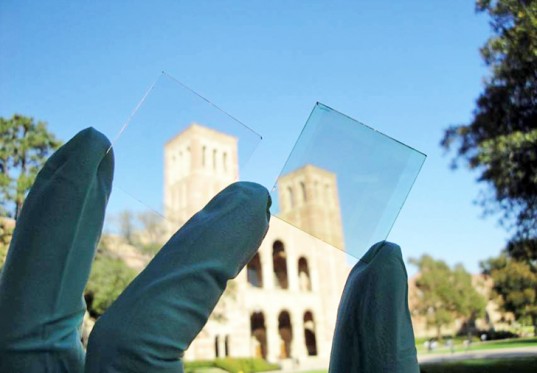
A team from UCLA has developed a new transparent solar cell that has the ability to generate electricity while still allowing people to see outside. In short, they’ve created a solar power-generating window! Described as “a new kind of polymer solar cell (PSC)” that produces energy by absorbing mainly infrared light instead of traditional visible light, the photoactive plastic cell is nearly 70% transparent to the human eye—so you can look through it like a traditional window.

“These results open the potential for visibly transparent polymer solar cells as add-on components of portable electronics, smart windows and building-integrated photovoltaics and in other applications,” said study leader Yang Yang, a UCLA professor of materials science and engineering and also director of the Nano Renewable Energy Center at California NanoSystems Institute (CNSI). “Our new PSCs are made from plastic-like materials and are lightweight and flexible. More importantly, they can be produced in high volume at low cost.”

There are also other advantages to polymer solar cells over more traditional solar cell technologies, such as building-integrated photovoltaics and integrated PV chargers for portable electronics. In the past, visibly transparent or semitransparent PSCs have suffered low visible light transparency and/or low device efficiency because suitable polymeric PV materials and efficient transparent conductors were not well deployed in device design and fabrication. However that was something the UCLA team wished to address.

By using high-performance, solution-processed, visibly transparent polymer solar cells and incorporating near-infrared light-sensitive polymer and silver nanowire composite films as the top transparent electrode, the UCLA team found that the near-infrared photoactive polymer absorbed more near-infrared light but was less sensitive to visible light. This, in essence, created a perfect balance between solar cell performance and transparency in the visible wavelength region.

UCLA Develops Electricity-Generating, Transparent Solar Cell Windows

Thanks to Jody Troupe for bringing this to the attention of the It’s Interesting community.
Clip-Air reimagines travel with modular mass transit aircraft

Clipair

Unless you happen to live right next to an airport, chances are hopping on an airplane isn’t the first step in your travel day. First there’s getting to the airport, which either means leaving your car in an expensive parking lot or hopping on a train.

And that’s what got the minds at Switzerland’s École Polytechnique Fédérale de Lausanne (EPFL) thinking. They surmised that most mass transit options are really just modules into which people are crammed. Train cars look a lot like the fuselage of an aircraft, for instance.

And so the Clip-Air concept was born. In theory, high-capacity Clip-Air train cars, each a self-contained fuselage, can be plucked from the tracks and snapped onto a set of wings. Customers would only have to board and pass through security once — at their local train depot. Once the plane lands, the whole process happens in reverse, dropping off passengers along a train route close to their final destination.

What’s more, Clip-Air is designed to fit up to three standard fuselages under a single set of wings, reducing the number of planes in the air. If only two of the three fuselages are booked by passengers, Clip-Air planes can snap on a cargo plane to keep efficiency up.

Clip-Air has been under development since 2009 and is described by its designers as “quite a long-term project.” However, EPFL has completed some encouraging studies which prove that their designs would indeed fly. And they’ll be showcasing a model of their modular design at the Paris Air Show later this month. So, while there are still plenty of hurdles to clear before we see the ease of travel Clip-Air promises, this mega-project is already inching closer to being part of tomorrow’s reality.

Thanks to Jody Troupe for bringing this to the attention of the It’s Interesting community.

http://www.dvice.com/2013-6-12/clip-air-reimagines-travel-modular-mass-transit-aircraft