Nomophobia


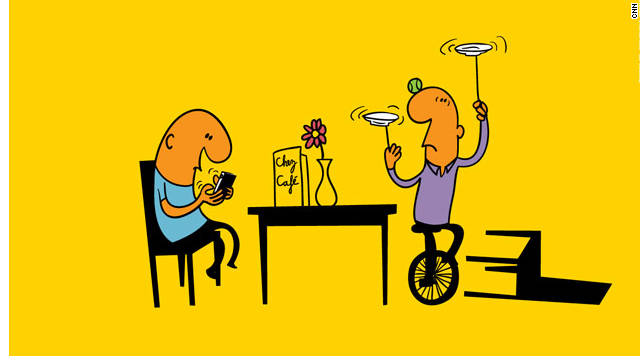
According to recent research sponsored by SecurEnvoy, an internet security firm, more people feel anxious and tense when they are out of reach of their phone — and the younger they are, the more likely the stress.

Known as “nomophobia,” or “no mobile-phone phobia,” a recent online survey of 1,000 people in the UK found that almost two thirds (66%) of respondents were afflicted, a rise of 11% when compared to a similar study four years ago.

“Some people get panic attacks when they are not with their phones,” said Michael Carr-Gregg, an adolescent psychologist working in Melbourne.

“Others become very anxious and make all endeavors to locate the mobile phone. I have clients who abstain from school or their part-time jobs to look for their phones when they cannot find them in the morning.”

CNN Photos: De-Vice: Our mobile addiction

According to the survey, the younger you are, the more prone you are to nomophobia. The youngest age group (18 -24) tops the nomophobic list at 77%, which is 11% more than that of the next group — those aged 25-34.

“This is the most tribal generation of young people,” said Carr-Gregg. “Adolescents want to be with their friends on a 24-hour basis.”

Women are also more likely to be unnerved by cell phone separation, with 70% of respondents reporting the malady compared to 61% of men. Andy Kemshall, the CTO and co founder of secure Envoy, believes that may be because men are more likely to have two phones and are less likely to misplace both — 47% of men carry two phones, compared to only 33% of women.

Major drivers of nomophobia include boredom, loneliness, and insecurity, said Carr-Gregg, while some young nomophobes cannot bear solitude. “Many of my clients go to bed with their mobile phones while sleeping just like how one will have the teddy bear in the old days,” he said.

“While teddy doesn’t communicate, the phone does,” said Carr-Gregg, adding insomnia to the list of potential problems.

“This reduced the amount of time to reflect,” he said. “Some kids cannot entertain themselves. The phone has become our digital security blanket.”

As smartphone penetration spreads across the globe, so does nomophobia. On a visit to Singapore in February this year, Carr-Gregg spoke to students from a peer support group at the United World College and identified similar problems.

“There is no doubt that nomophobia is international,” he said. “[But] without phones, there will not be nomophobia.”

Meanwhile, Indian researchers have also evaluated mobile phone dependence among students at M.G.M. Medical College and the associated hospital of central India. India, after China, is the second largest mobile phone market in the world. The Telecom Regulatory Authority of India (TRAI) reported that there were 884.37 million mobile connections in India as of November, while China had 963.68 million.

The cross-sectional study, published by the Indian Journal of Community Medicine three years ago, recruited 200 medical students and scholars. About one in five students were nomophobic, results showed. The study claimed that the mobile phone has become “a necessity because of the countless perks that a mobile phone provides like personal diary, email dispatcher, calculator, video game player, camera and music player.”

“There is an increase in the nomophobic population in India because the number of mobile phone users has increased,” said Dr. Sanjay Dixit, one the researchers and the head of the Indian Journal of Community Medicine. “We are currently doing another research on mobile phone dependency, it’s not published yet, but analysis shows that about 45% of the Indian population, not just medical students, is nomophobic.”

With the augmented ownership and usage of smartphones among adolescents, Dixit says the young population is more at risk, partly because they can access the Internet through phones more easily, increasing the time spent on phones.

“We found out that people who use mobile phones for more than three hours a day have a higher chance of getting nomophobia,” he said, warning this can pose potential dangers.

Accidents lurk while nomophobes fix their attention on phones. According to Dixit, up to 25% nomophobes reported accidents while messaging or talking on the phone, which includes minor road accidents, falling while going upstairs or downstairs and stumbling while walking. More than 20% also reported pain in the thumbs due to excessive texting.

“One could look at this as a form of addiction to the phone,” said Eric Yu Hai Chen, a psychiatrist and professor at The University of Hong Kong. “The fear is part of the addiction. The use of hand phone has some features that predispose this activity to addiction, similar to video games, naming, easy access.”

To tackle anxiety and accidents induced by phones, Dixit suggests switching off the phone, especially while driving. “People can also carry a charger all the time,” he said. “Our study shows that the no-battery-situation upsets nomophobes the most.

“People can also prepay phone cards for emergency calls and credit balance in phones to ensure a constant and functioning network,” he said. Other solutions include supplying friends with an alternate contact number and storing important phone numbers somewhere else as backups.

“Enforcing a period when handset is turned off can help loosen its hold over everyday life,” said Dixit. Sometimes, the problem can even be the cure.

“One of my clients actually makes use mobile phone apps to deal with anxiety,” said Carr-Gregg. “It’s called iCounselor Anxiety.”

The launch of the app presents users with a scale to rate their anxiety levels from 1 to 10, where 10 is “panicked.” After choosing the level, ten recommendations of calming activities will be suggested, followed by instructions to change the user’s thoughts, so to change subsequent feelings.

“It is almost like having a psychologist in your phone,” said Carr-Gregg.

Prevalent it may be, nomophobia, however, is not yet a qualified phobia.

“Nomophobia is not included in the DSM [Diagnostic and Statistical Manual of Mental Disorders] yet,” said Dixit. “But it is an up coming problem. For the first time on this continent [India], we are trying to make it more scientific,” he added, referring to his undergoing research on nomophobic India.

http://www.cnn.com/2012/03/06/tech/mobile/nomophobia-mobile-addiction/index.html?hpt=hp_c4

Interviews Before Execution: Chinese Reality Television Show

With her silk scarves and immaculate make-up, Ding Yu looks every inch the modern television presenter. Indeed, for the past five years she has hosted a hugely successful prime-time show in China which has a devoted following of 40 million viewers every Saturday night.

But while in Britain the weekend evening entertainment will be The X Factor or Strictly Come Dancing, Ms Ding’s show features harrowing – some would say voyeuristic – footage of prisoners confessing their crimes and begging forgiveness before being led away to their executions.

The scenes are recorded sometimes minutes before the prisoners are put to death, or in other cases when only days of their life remain.

The glamorous Ms Ding conducts face-to-face interviews with the prisoners, who have often committed especially gruesome crimes. Her subjects sit in handcuffs and leg chains, guarded by warders. She warms up with anodyne questions about favourite films or music, but then hectors the prisoners about the violent details of their crimes and eventually wrings apologies out of them.

She promises to relay final messages to family members, who are usually not allowed to visit them on death row. The cameras keep rolling as the condemned say a farewell message and are led away to be killed by firing squad or lethal injection.

Having begun life five years ago on a TV channel in Henan province in central China, Interviews Before Execution quickly became a hit with viewers and was given a prime-time Saturday night slot.

Scenes from the series will be shown in Britain for the first time next week in a BBC 2 documentary. The BBC describes the Chinese series as an ‘extraordinary chat show’ which has made Ms Ding a national celebrity.

Ms Ding has covered more than 250 cases in Interviews Before Execution. She told a child killer: ‘Everyone should hate you.’ Her interviewees also included a jealous divorcé who stabbed his ex-wife in front of her parents.

In one scene, a prisoner in his 20s falls to his knees before his parents, who have been allowed to see him. He pleads: ‘Father, I was wrong. I’m sorry.’

Moments later, his parents see him about to be led away to his death. His distraught mother apologises for beating him once as a child and implores her son: ‘Go peacefully. It’s following government’s orders.’

Prison officers then push her aside and drag him away.

In another scene, a firing squad of about 20 men is briefed by a senior officer before executing condemned prisoners. ‘Some criminals will be very tough and difficult. That means they’ll be dangerous,’ the officer tells them.

Officials in the ruling Communist Party regard the series as a propaganda tool to warn citizens of the  consequences of crime.

Inmates are selected for Ms Ding by judiciary officials who pick out what they consider suitable cases to ‘educate the public’. So far, the show’s makers claim, only five condemned prisoners who were asked have refused to be interviewed.

Convicted criminals in China can be put to death for 55 capital crimes, ranging from theft to crimes against the state. However, the show focuses exclusively on murder cases, conspicuously avoiding any crimes that might have political elements.

The case that has drawn the largest number of viewers so far is that of Bao Rongting, an openly gay man who was condemned to death for murdering his mother and then violating her dead body.

Three extra episodes were devoted to his story as viewing figures soared. Homosexuality is still regarded as taboo in most of China, and the sensational trailers described his interviews as ‘shining a light on a mysterious group of people in our country’.

When Bao was executed, no family members turned up to say farewell. His final conversation before being led to his death was on camera with a decidedly wary Ms Ding, who admitted to being unsettled by his sexuality. In a remarkable scene, he asks if she will do him a last favour by shaking his hand before he dies. She hesitates, before lightly touching his hand with her finger and then pulling it away.

She later confessed to being unsure if she should have shaken his hand, saying with obvious distaste: ‘There was a lot of dirt under his nails. For a long time there was a feeling in this finger. I can’t describe that feeling.’

The series has made a household name of Ms Ding, who is married and has a young son. She is often recognised in the street while doing her shopping with her family.

Denying her show is exploitative, she said: ‘Some viewers might consider it cruel to ask a criminal to do an interview when they are about to be executed. On the contrary, they want to be heard.

‘When I am face-to-face with them I feel sorry and regretful for them. But I don’t sympathise with them, for they should pay a heavy price for their wrongdoing. They deserve it.’

However, she admits to being haunted by those she has interviewed. She once woke on a train in the middle of the night and, looking out of her  window, saw a vision of the executed prisoners she had interviewed standing in a line beside her carriage.

‘Their faces were so real and all of them were standing there looking at me,’ she said. ‘I was horrified – I have heard so many cases. It is really not good for me at all. I have too much rubbish in my heart.’

Lu Peijin, the boss of TV Legal Channel in Henan province, said Ms Ding came up with the concept for the show and he agreed immediately, but that getting approval from officials was a long process.

‘I thought it was a great idea right away,’ said Mr Lu, who said that the stated aim of the show was not to entertain but to ‘inform and educate according to government policy’.

‘We want the audience to be warned,’ he said. ‘If they are warned, tragedies might be averted. That is good for society.’

China is believed to kill more prisoners every year than the rest of the world combined, and the communist state has been widely criticised over its use of the death penalty.

There is no presumption of innocence under Chinese law. The condemned are often put to death as little as seven days after their convictions are confirmed by the Supreme Court.

The exact number of executions is a state secret, but it has been estimated that about 2,000 prisoners a year are executed in China, although rates are believed to have fallen in recent years.

Read more: http://www.dailymail.co.uk/news/article-2109756/The-Execution-Factor-Interviews-death-row-Chinas-new-TV-hit.html#ixzz1oK3J1hdA

Washed up Human Feet Mystery Solved


A grim mystery has been baffling Washington state and British Columbia, Canada: Why do all these disembodied human feet keep washing up on our beaches? The appearance of 12 feet in rubber soled shoes in five years, with six surfacing in a six-month period, made officials worry that something fishy was afoot. Theories ranged from a serial killer to an aircraft crash. According to London’s Daily Mail, British Columbia coroner Stephen Fonseca, who has been studying the phenomenon for years, says the source is a bridge over Vancouver’s Fraser River, and most of the feet belonged to suicide victims.

College Student Kicked Out for Writing ‘Hot For Teacher’ Essay


An Oakland University student says he’s considering legal action after he was kicked out of an English class for writing a “Hot for Teacher” essay.

Joe Corlett, 56, of Lake Orion, Mich., admits his writings during a fall 2011 Advanced Critical Writing class contain sexual fantasies about the instructor.

And his handwritten entry, which is now in the hands of a free-speech activist group, uses the title “Hot for Teacher” — a reference to a song on Van Halen’s 1984 album about a student fantasizing about a racy teacher.

“Then there’s Miss (teacher), English 380,” Corlett wrote, explaining his thoughts of dropping the class. “She walks in and I say to myself, ‘Drop, (expletive), drop.’ Kee-rist, I’ll never learn a thing. Tall, blonde, stacked, skirt, heels, fingernails, smart, articulate, smile. I’m toast but I’ll stay. I’ll (screw) up my whole Tuesday-Thursday class thing if I drop. I’ll search for something unattractive about her. No luck yet.”

Corlett said the entries were part of a diary-type assignment with no limitations.

“I asked and she said, ‘No, no topical restrictions,’ ” Corlett said.

Corlett said university officials banned him from campus for 2012’s spring, summer and fall semesters. He was allowed to enroll in two online courses this semester.

He’s waiting to hear whether he’ll be able to continue his education online, he said.

Oakland University spokesman Ted Montgomery said the school could not comment on the matter because it involves student conduct. The instructor could not be reached.

Corlett now has an “incomplete” grade for that class. A university student conduct committee also found him guilty in January of sexual harassment and intimidation charges after a hearing with four professors and two students. He wants that decision reversed.

Corlett has enlisted the help of the Foundation for Individual Rights in Education, a nonprofit education foundation based in Philadelphia that defends individual rights on campus.

“I want to be reinstated,” Corlett said. “I want my lawyer fees paid. I want to be made whole.”

Corlett’s lawyer, Brian Vincent of Lansing, Mich., said the situation comes down to the right to free speech.

“Obviously he’s got a wild sexual imagination in some instances, but it’s not harmful,” Vincent said.

http://www.usatoday.com/news/education/story/2012-02-15/hot-for-teacher-essay-michigan-oakland/53106370/1?csp=obnetwork

Florida Man Adopts His Adult Girlfriend As His Daughter

A wealthy polo club owner in Florida has legally adopted his longtime adult girlfriend as his daughter in a legal maneuver that critics say is an attempt to shield his assets ahead of a civil lawsuit over a deadly car crash, The Palm Beach Post reports.

John Goodman, 48, is being sued by the parents of Scott Wilson, 23, who was killed in a traffic accident last February. The newspaper, quoting a sheriff’s report, says Goodman ran a stop sign and hit Wilson’s car in Wellington, Fla.

Wilson’s parents have sued Goodman. The trial is set for March 27.

The newspaper says Goodman also faces a criminal trial on March 6 on charges of DUI manslaughter, vehicular homicide and leaving the scene of a crash. He could face up to 30 years in prison, the Post says.

Goodman, founder of the International Polo Club Palm Beach, legally adopted Laruso Hutchins, 42, as his daughter on Oct. 13 in Miami-Dade County, according to court documents, the Post reports.

West Palm Beach Judge Glenn Kelley wrote in a court order that the legal twists in the case “border on the surreal and take the Court into a legal twilight zone.”

In a previous ruling, Kelley said a trust set up for Goodman’s two minor children could not be considered as part of his financial worth if a jury awarded damages to the Wilsons. According to the adoption papers, Hutchins is immediately entitled to at least a third of the trust’s assets as his legal daughter since she is over the age of 35, the Post reports.

Attorneys for the Wilsons tell the Post that the adoption is an attempt by Goodman to shield assets from potential lawsuit damages.

Dan Bachi, Goodman’s civil attorney, says the adoption was done to ensure the future stability of his children and family investments and has nothing to do with the lawsuit.

http://content.usatoday.com/communities/ondeadline/post/2012/02/wealthy-florida-man-adopts-adult-girlfriend-as-his-daughter/1?csp=34news&utm_source=dlvr.it&utm_medium=twitter#.T02CVyM2GRB

Man Survives Being Impaled with Garden Shears Through Eye Socket

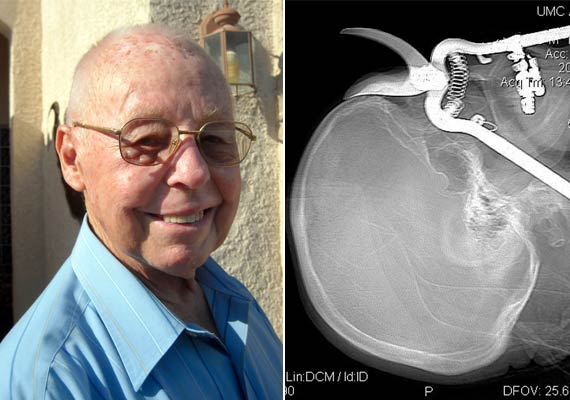
An 86-year-old Arizona man is lucky to have his eyesight — and luckier to be alive — after doctors extracted a pair of pruning shears from his head.

Even the doctors who treated him are amazed at the lack of permanent damage.

Leroy Luetscher was treated at University Medical Center in Tucson, the same center credited with saving Giffords’ life in January. The Arizona congresswoman had been shot in the head by a gunman as she met with constituents outside a supermarket.

Here’s what happened in the latest incident, according to details revealed at a Tuesday news conference and by the hospital:

Luetscher was gardening in the backyard, trimming some plants, when he dropped his pruning shears, point side down. As Luetscher leaned over to grab the shears that had lodged in the dirt, he fell on them, face first. One of the handles shot through his right eye socket and lodged itself in his head.

“I couldn’t believe it. I just could not believe it. I sort of pulled on them -– it seemed real solid — so I just left it alone,” he said during the news conference to discuss the injury.

Luetscher said the searing pain actually helped him keep his wits about him. He said he put a T-shirt over the wound to help stop the bleeding and told his long-time live-in girlfriend to call an ambulance.

Today, the Green Valley resident has swelling to his eyelids, and some double vision, but is otherwise fine. He expressed gratitude to University Medical Center and the team of trauma surgeons and specialists who helped him, including Drs. Julie Wynne, Lynn Polonski and Kay Goshima.

Polonski, an ophthalmologist, said the team made incisions underneath Luetscher’s right upper lip and his sinus wall, allowing medical workers to loosen the handle of the pruning shears with their fingers. “Once we were able to loosen it up, it went fairly easily,” he said.

Doctors rebuilt Luetscher’s orbital floor with metal mesh, and managed to save his eye.

“You wouldn’t believe your eyes,” Wynne said. “Half of the pruning shears was sticking out and the other half was in his head.”

“You just wonder how the handle of the pruning shears got there. The handle was actually resting on the external carotid artery in his neck,” Polonski added. “We are so happy that Mr. Luetscher did not lose his eye or any vital structures.”

Doctors said so many things could have gone wrong — a ruptured eyeball, a severed artery, a fatal infection.

“You know, if it went a little bit in a different direction, it basically could have killed him or he could have had a stroke,” Polonski said.

http://latimesblogs.latimes.com/nationnow/2011/08/86-year-old-man-spears-himself-in-the-eye-has-full-recovery.html

Man Killed by Heat Generated by his Home Cannabis Farm


Luke Holmes, 28, grew huge quantities of marijuana in three-foiled lined tents, with each one containing rows of powerful halogen lights.

The heat they generated sent temperatures soaring to dangerous levels, with police nearly fainting from heat when they entered the house last June, according to a report in The Sun.

Holmes passed away in his sleep in his Halifax, West Yorks, property. He was found by friends three days later when they broke in, concerned that they hadn’t heard from him.

Holmes’ death was declared accidental by an inquest, which ruled that he died from hyperthermia, or excessive heat.

Read more: http://www.metro.co.uk/news/826522-heat-from-cannabis-farm-lamps-kills-drug-user#ixzz1npbGaQB7

Death Sentence Protocol in Japan

At a glance the room looks like it would not be out of place in a Japanese company building. A small room, where one might entertain guests, or where the sales team might meet to crunch figures. Several things give the death chamber away: the pulley on the roof, the rings on the wall where the prisoner will be shackled prior to receiving his or her sentence, and the clearly demarcated trapdoor in the center of the room.

Tokyo’s death chamber has been opened to the media for the first time in Japan’s history. As a staunch opponent of the death penalty, the country’s Justice Minister, Keiko Chiba, hopes to draw people’s attention to what goes on there. She faces an uphill struggle as the vast majority of the Japanese public support the death penalty or at least see it as unavoidable.

While prisoners are aware that they have been sentenced to death, the date of the execution is seldom fixed. In theory, it is supposed to be carried out within six months of the sentence, but this rarely happens and the prisoner will only learn of his or her execution date on the day that it will happen. The prisoner will be given a few hours to get their affairs in order, a final meal and then be taken to the death chamber. After meeting with a priest the prisoner will be taken to the death room and shackled to the wall. At the appointed time, the prisoner will be led to the red square in the center of the room where the noose will be drawn around his or her neck.

Behind the curtain, three guards will each press a button. None of them will know whose button activated the trapdoor beneath the prisoner’s feet. If the hanging goes smoothly, the neck will be fractured at either the 2nd and 3rd or 4th and 5th cervical vertebrae. Death may not be instantaneous, in fact it may take as long as fifteen minutes, but unconsciousness usually is. After death, the body’s sphincters relax, causing the release of urine and feces. Approximately one-third of male prisoners will experience a death erection.

Death Sentence in Japan for Killer Curry

Masumi Hayashi, 47, of Wakayama, Japan has been sentenced to death for a mass poisoning that occurred at a summer festival in 1998. The Court found that Hayashi, angry after a dispute with her neighbors, had laced the community curry with arsenic. Four people died and 60 were sickened in the incident.

The Japanese Supreme Court rarely applies the death penalty, reserving it for cases that revolt the public conscience. Once sentenced, inmates are likely to remain on death row for years while all of the avenues for appeal are exhausted.

http://www.reuters.com/article/2009/04/21/us-japan-murder-curry-idUSTRE53K3IN20090421?feedType=nl&feedName=usoddlyenough

Australian Woman Facing Court Charges for Scamming Nigerian Email Scammers

A BRISBANE woman fleeced Nigerian scam artists by stealing more than $30,000 from their internet car sales racket, a court has been told.

Sarah Jane Cochrane-Ramsey, 23, was employed by the Nigerians as an “agent” in March 2010 but was unaware they were scam artists, the Brisbane District Court heard today.

Her job was to provide an Australian bank account through which they could funnel any payments they received through their dodgy account on a popular car sales website.

Cochrane-Ramsey was to keep eight per cent of all money paid into her account and forward the rest to the Nigerian scammers.

However, the court heard she kept the two payments she received – totalling $33,350 – and spent most of it on herself.

The car buyers who were ripped off reported the matter to police, who traced the account to Cochrane-Ramsey.

Police inquiries found her employers were based in Nigeria but had been using a web server in New York to run their dodgy car sales listings.

Cochrane-Ramsey pleaded guilty to one count of aggravated fraud on Thursday.

Judge Terry Martin described her as having a “dishonest bent” after hearing she had a history of stealing and property offences.

He adjourned the sentence to allow her time to provide further details of money she claimed was in a bank account that would allow her to make some repayments.

Cochrane-Ramsey will be sentenced next month.

She was allowed bail until then.

Read more: http://www.news.com.au/business/aussie-woman-scammed-nigerians-court/story-e6frfm1i-1226279659427#ixzz1nVLBVpGn