Paul Hayward: Neighbor From Hell


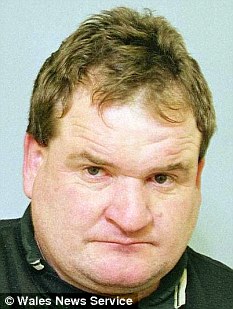
A neighbour from hell has been jailed after he spent a decade ordering hundreds of unwanted taxis, takeaways and two tons of coal to the homes of his victims.

Paul Hayward’s campaign of harassment saw him throw mud, food and rubbish into their gardens and plague them with more than 150 silent phone calls.

His former neighbours spoke of their relief as he was sentenced to 14 months in prison after he breached an anti-social behaviour order on 19 occasions.

Patricia Jones and Jim and Jill Thomas told Newport Crown Court how the 49-year-old father of two made their lives a misery.

Hayward’s house in Machen, South Wales, was sold last month, marking the end of his neighbours’ ordeal.

Ms Jones, 67, said: ‘It was ten years of hell. We couldn’t relax, we were constantly waiting and thinking “what is he going to do next?”

‘Now he has gone, we are no longer thinking “is it because he’s spying on us?” when it’s quiet.’

She looked after Hayward’s two children when he moved in ten years ago and believes the problems started after she was unable to continue.

He began banging and scratching her walls, she said, throwing stones on her roof and constantly watching her.

Ms Jones said: ‘It wasn’t one week here, one week there – it was constant.’

She also believes he was behind more than 100 unwanted taxis and Chinese meals being ordered to her house over a ten-year period.

Mr Thomas, 71, and Mrs Thomas, 65, said Hayward began picking on their 43-year-old daughter Rachel – who suffers from cerebral palsy – using his car and wheelie bin to block her access.

He would play loud music and bombard them with abuse, they added.

Mr Thomas said Hayward also threw mud, eggs, stones and food at their property and installed cameras and mirrors in his garden so he could watch them.

He added: ‘Now he’s gone, we can at last have a family life here.’

On Friday Hayward was given 12 months for making persistent silent phone calls to the Thomases – with the court hearing 100 of these were made over a 24-hour period last December.

He was sentenced to a further four months, to run concurrently, for ordering two tons of coal and a taxi to Ms Jones’ address in January, and two months for making hoax calls to Gwent Police last November, to run consecutively.

In mitigation, Hayward’s counsel Jeff Jones said his client wanted to cause stress to his victims, not fear, and has made a fresh start since moving to a different address.

The offences amount to a total of 19 breaches of an ASBO imposed in July 2007, preventing Hayward from obstructing his neighbours, assaulting or threatening them or using abusive language. He has been jailed for previous breaches.

Sentencing Hayward, Judge David Morris said he had caused stress to his neighbours.
Read more: http://www.dailymail.co.uk/news/article-2133860/Neighbour-hell-ordered-hundreds-taxis-takeaways-coal-victims-house.html#ixzz1sy4RgjT4

Museum of Racism Set to Open in Michigan

The objects displayed in Michigan’s newest museum range from the ordinary, such as simple ashtrays and fishing lures, to the grotesque – a full-size replica of a lynching tree. But all are united by a common theme: They are steeped in racism so intense that it makes visitors cringe.

That’s the idea behind the Jim Crow Museum of Racist Memorabilia, which says it has amassed the nation’s largest public collection of artifacts spanning the segregation era, from Reconstruction until the civil rights movement, and beyond.

The museum in a gleaming new exhibit hall at Ferris State University “is all about teaching, not a shrine to racism,” said David Pilgrim, the founder and curator who started building the collection as a teenager.

Pilgrim, who is black, makes no apologies for the provocative exhibits. The goal of the $1.3 million gallery, he explained, is “to get people to think deeply.”

The displays are startling. The n-word is prevalent throughout, and many items portray black men as lazy, violent or inarticulate. Black women are shown as kerchief-wearing mammies, sexually charged Jezebels or other stereotypes.

The shocking images exact an emotional cost.

“There’s parts in that room – the main room – where it’s quite gut-wrenching,” said Nancy Mettlach, a student conduct specialist at Ferris. “And the thought that was going through my mind was: ‘How can one human being do this to another human being?'”

Pilgrim, a former sociology professor at Ferris State, started the collection in the 1970s in Alabama. Along the way, he “spent more time in antique and flea markets than the people who work there.” His quest for more examples was boundless.

“At some point, the collecting becomes the thing,” he said. “It became the way I relaxed.” He spent most of his free time and money on acquisitions.

In 1996, Pilgrim donated his 2,000-piece collection to the school after concluding that it “needed a real home.”

The collection spent the next 15 years housed in a single room and could be seen only by appointment. Thanks to the financial support of the university and donors – notably from the charitable arm of Detroit utility DTE Energy – Pilgrim’s collection now has a permanent home, which will have a grand opening ceremony April 26. Admission is free.

Today, the school has 9,000 pieces that depict African-Americans in stereotypical ways and, in some cases, glorify violence against them.

Not all of the museum’s holdings are on display, but the 3,500-square-foot space in the lower level of the university library is packed with items that demonstrate how racist ideas and anti-black images dominated American culture for decades.

Visitors can forget about touring the exhibits and retiring untroubled to a cafe or gift shop. Some leave angry or offended. Most feel a kind of “reflective sadness,” Pilgrim said.

But that’s not enough. If the museum “stayed at that, then we failed,” he said. “The only real value of the museum has ever been to really engage people in a dialogue.”

So Pilgrim designed the tour to give visitors a last stop in a “room of dialogue,” where they’re encouraged to discuss what they’ve seen and how the objects might be used to promote tolerance and social justice.

Some of the objects in the museum are a century old. Others were made as recently as this year.

Ferris State sophomore Nehemiah Israel was particularly troubled by a series of items about President Barack Obama.

One T-shirt on display reads: “Any White Guy 2012.” Another shirt that says “Obama ’08” is accompanied by a cartoon monkey holding a banana. A mouse pad shows robe-wearing Ku Klux Klan members chasing an Obama caricature above the words, “Run Obama Run.”

“I was like, ‘Wow. People still think this. This is crazy,'” Israel said.

One of the first rooms in the museum features a full-size replica of a tree with a lynching noose hanging from it. Several feet away, a television screen shows a video of racist images through the years.

The location of the museum – in the shadow of university founder Woodbridge Ferris’ statue – also catches some by surprise. The mostly white college town of Big Rapids is 150 miles from Detroit, the state’s largest predominantly black city.

Ferris, who later served as Michigan governor and as a U.S. senator, founded the school more than a century ago. He once said Americans should work to provide an “education for all children, all men and all women.”

Pilgrim, who is also Ferris State’s vice president for diversity and inclusion, initially considered giving his collection to a historically black college, but he wanted to be “near it enough to make sure it was taken care of.”

Most of the objects “are anti-black caricatures, everyday objects or they are segregationist memorabilia,” he said. Because they represent a cruel, inflammatory past, they “should either be in a garbage can or a museum.”

Virginia Teacher Arrested for Firing Blanks at Students

A Kingsport man who teaches at a vocational school in Abingdon, Va., has been arrested after allegedly pulling a blank firing gun on his students, pointing it their direction and firing multiple times.

The incident occurred April 4 at William H. Neff Center. Manuael Ernest Dillow, 60, of 840 Liberty Drive, Kingsport, was arrested Wednesday for the alleged incident and charged with 12 felony counts of brandishing a firearm on school property.

The Washington County Sheriffs Office reports the charges are class 6 felonies, with each count punishable up to five years incarceration and a $2,500 fine.

Washington County Sheriff Fred Newman reports School Superintendent Jim Sullivan notified the Sheriff’s Office of the incident. An investigation reportedly discovered Dillow “gathered” the attention of the 12 students in his welding class and lined them up near a garage door in the shop.

“He then pulled a ‘blank firing handgun,’ black in color, from the back waistband of his pants and discharged the weapon between four and ten shots in the direction of the line of the students,” states a Wednesday afternoon press release. “The ‘report’ of the firearm was similar to that of a firearm that fires a projectile, thus placing the students in fear, according to statements. No students were physically injured as a result of the incident.”

Dillow was released on a $20,000 unsecured bond with a hearing date scheduled for May 7.

http://www.timesnews.net/article/9045481#.T5AkBV2xufw.twitter

Kuwait Death Penalty for Cursing God

Kuwait’s parliament on Thursday provisionally passed amendments to the Gulf state’s penal code stipulating the death penalty for those who curse God, Islam’s Prophet Mohammed or his wives.

Forty-six MPs, including cabinet ministers, voted for the key amendments that will come into effect only after another round of voting and government approval. The second and final vote will take place in two weeks.

Four Shiite MPs voted against the law, a pro-Shiite Sunni lawmaker abstained, while two MPs refused to vote.

Shiite MPs have demanded that the new amendments also enforce the death penalty for anyone who curses their sect’s 12 revered Imams, but the Sunni- dominated parliament rejected their requests.

The move to stiffen penalties for religious crimes came after authorities last month arrested a Shiite tweeter for allegedly cursing the Prophet Mohammed, his wife and some companions.

The suspect, Hamad al-Naqi, is being detained pending further interrogation and trial.

Sectarian tensions have flared in Kuwait between the Sunni majority and Shiites, who form about a third of the native population of 1.17 million, reflecting rising regional tensions between the two Islamic sects.

http://www.france24.com/en/20120412-kuwait-mps-okay-death-penalty-cursing-god

Economists determine that US would save billions of dollars by legalizing marijuana


Where there’s pot, there’s gold. So conclude more than 300 economists who say that the government — if it got out of the business of enforcing marijuana laws — could save a whopping $7.7 billion annually. Harvard economist Jeffrey Miron also figures there’s another $6 billion to be mined each year by taxing the drug at rates similar to booze and tobacco. The economists, who have signed a petition, don’t exactly go as far as Miron in suggesting pot be legalized but maintain that it’s high time, so to speak, for an “open and honest debate.”

http://now.msn.com/money/0417-billions-saved-by-legalizing-weed.aspx


Malawi man arrested for selling freshly cut penis

Police in Malawi have arrested a 24 year old man after he tried to sell the freshly cut penis from a 45 year old. Officers in the central Lakeshore District of Salima say they responded to a report of a man lying bleeding and unconscious next to railway tracks on Tuesday.

But when the man was admitted to hospital, doctors were shocked to discover his penis was missing, local media reported. Salima police chief Foster Mangani said hours later, police were called to a local motel where the owner reported a guest had tried to sell her a penis for US$360.

“We rushed to the lodge and arrested the suspect. We also recovered the private parts,” Mangani was quoted as saying by the Nyasa Times newspaper. Police have named the suspect as Samuel Banda, whose picture was published in the newspaper along with what looked like a severed penis wrapped in white paper.

Police said Banda had admitted selling “many body parts to well known business personalities”. Many locals believe human parts can bring riches, and unscrupulous businessmen and witchdoctors pay thousands of kwachas to poor locals to kill people and mutilate their bodies.

The Nyasa Times reports that the victim was intercepted by Banda as he walked home after a drinking bender. His condition is described as “serious” by staff at the local hospital.

Click here for more pictures involving this crime:  http://nehandaradio.com/2012/04/05/police-arrest-man-selling-freshly-cut-penis/

Shooter Mistakes Mohawk for a Bird

Derrill Rockwell told police he grabbed his rifle, the .22-caliber he kept handy to kill rodents around the house, about 5 a.m. Oct. 5 and walked outside to confront it.

The bird.

Possibly, he told police, the same fowl he suspected of harassing his cats recently around his home near Orchard Mesa Cemetery.

It was red, sitting at the top of a hill about 90 feet away from Rockwell.

“His intent was to spook it away,” Deputy District Attorney Jason Conley told District Judge Richard Gurley on Friday.

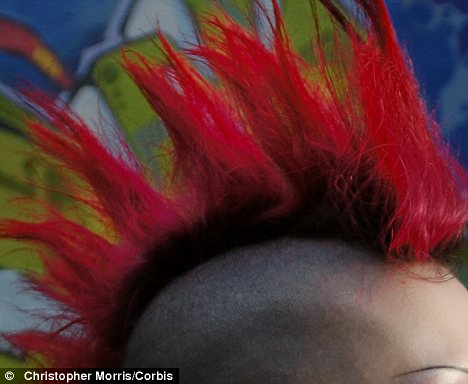
Rockwell shot once but said he didn’t see the bird fly away. Soon after, he heard a woman’s voice, moaning in pain. Rockwell discovered a 23-year-old woman, with a large red mohawk, with a gunshot wound to the head.

“In 15 years in law enforcement, this was one of the more interesting cases I’ve worked,” Grand Junction Police Department detective Sean Crocker told the judge Friday.

Rockwell, 49, was sentenced to serve five years probation after pleading guilty to felony possession of a weapon by a prior offender.

The District Attorney’s Office dismissed remaining charges, including tampering with evidence, reckless endangerment, disorderly conduct and false reporting. He was ordered to pay more than $10,000 in restitution.

Rockwell initially misled the investigation, authorities said. Conley told the judge that Rockwell offered a wet towel for the woman’s head injury and drove her to the emergency room at St. Mary’s Hospital after the shooting, leaving his name and phone number with doctors.

“She got out of the truck on her own accord,” Conley told the judge.

Rockwell told a nurse he heard noises outside his home, went outside and found a woman bleeding from the head. Conley said Rockwell later explained he went home, gathered the rifle and drove to the Redlands Roller Dam, where he tossed the weapon into the Colorado River.

Six days after the shooting, Rockwell told another story to police detectives, acknowledging he fired the weapon after confusing the woman’s red mohawk hairstyle for a distant bird.

Stephan Schweissing, Rockwell’s attorney, said Rockwell’s interview with police Oct. 11 went against his advice to his client. Had Rockwell not voluntarily spoken with detectives, he likely wouldn’t have been charged by the District Attorney’s Office in the matter, Schweissing said.

“He just couldn’t live with himself, knowing what he knew,” the attorney said.

Police detectives had few clues in the investigation, which early on had centered around the victim’s possible transient lifestyle at the time and her associates, Crocker told the judge.

“(Rockwell) gave a full, detailed confession,” the detective told the judge.

Crocker said police conducted a comprehensive investigation into Rockwell’s account, searching his property while returning there to re-enact the shooting scenario Rockwell had described. The woman was believed to be in a crouched position at the top of the hill — with her red mohawk exposed roughly 90 feet away — when she was shot, according to testimony Friday.

Conley told the judge the woman may have been passed out from intoxication prior to being shot, and officers found a small bag of suspected methamphetamine in the area where she was found.

The District Attorney’s Office ultimately found nothing to dispute Rockwell’s account, Conley told the judge.

Rockwell had been prohibited from owning a firearm after a 1995 conviction for attempted burglary.

“This was a tragic accident, and I’m truly sorry,” he told the judge.

http://www.gjsentinel.com/news/articles/shooter-mistakes-mohawk-for-fowl-runs-afoul-of-the

Baboons Can Learn to Identify Printed Words

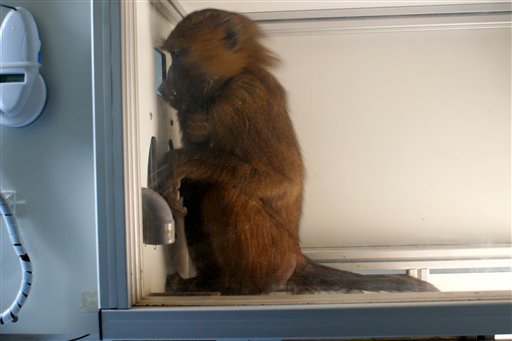
Dan the baboon sits in front of a computer screen. The letters BRRU pop up.  With a quick and almost dismissive tap, the monkey signals it’s not a word. Correct. Next comes, ITCS. Again, not a word. Finally KITE comes up.

He pauses and hits a green oval to show it’s a word. In the space of just a few seconds, Dan has demonstrated a mastery of what some experts say is a form of pre-reading and walks away rewarded with a treat of dried wheat.

Dan is part of new research that shows baboons are able to pick up the first step in reading – identifying recurring patterns and determining which four-letter combinations are words and which are just gobbledygook.

The study shows that reading’s early steps are far more instinctive than scientists first thought and it also indicates that non-human primates may be smarter than we give them credit for.

“They’ve got the hang of this thing,” said Jonathan Grainger, a French scientist and lead author of the research.

Baboons and other monkeys are good pattern finders and what they are doing may be what we first do in recognizing words.

It’s still a far cry from real reading. They don’t understand what these words mean, and are just breaking them down into parts, said Grainger, a cognitive psychologist at the Aix-Marseille University in France.

In 300,000 tests, the six baboons distinguished between real and fake words about three-out-of-four times, according to the study published in Thursday’s journal Science.

The 4-year-old Dan, the star of the bunch and about the equivalent age of a human teenager, got 80 percent of the words right and learned 308 four-letter words.

The baboons are rewarded with food when they press the right spot on the screen: A blue plus sign for bogus combos or a green oval for real words.

Even though the experiments were done in France, the researchers used English words because it is the language of science, Grainger said.

The key is that these animals not only learned by trial and error which letter combinations were correct, but they also noticed which letters tend to go together to form real words, such as SH but not FX, said Grainger. So even when new words were sprung on them, they did a better job at figuring out which were real.

Grainger said a pre-existing capacity in the brain may allow them to recognize patterns and objects, and perhaps that’s how we humans also first learn to read.

The study’s results were called “extraordinarily exciting” by another language researcher, psychology professor Stanislas Dehaene at the College of France, who wasn’t part of this study. He said Grainger’s finding makes sense. Dehaene’s earlier work says a distinct part of the brain visually recognizes the forms of words. The new work indicates this is also likely in a non-human primate.

This new study also tells us a lot about our distant primate relatives.

“They have shown repeatedly amazing cognitive abilities,” said study co-author Joel Fagot, a researcher at the French National Center for Scientific Research.

Bill Hopkins, a professor of psychology at the Yerkes Primate Center in Atlanta, isn’t surprised.

“We tend to underestimate what their capacities are,” said Hopkins, who wasn’t part of the French research team. “Non-human primates are really specialized in the visual domain and this is an example of that.”

This raises interesting questions about how the complex primate mind works without language or what we think of as language, Hopkins said. While we use language to solve problems in our heads, such as deciphering words, it seems that baboons use a “remarkably sophisticated” method to attack problems without language, he said.

Key to the success of the experiment was a change in the testing technique, the researchers said. The baboons weren’t put in the computer stations and forced to take the test. Instead, they could choose when they wanted to work, going to one of the 10 computer booths at any time, even in the middle of the night.

The most ambitious baboons test 3,000 times a day; the laziest only 400.

The advantage of this type of experiment setup, which can be considered more humane, is that researchers get far more trials in a shorter time period, he said.

“They come because they want to,” Fagot said. “What do they want? They want some food. They want to solve some task.”

New scientific study shows that low-effort thought promotes political conservatism.

IT may be what left-wingers have always suspected but a study has linked “low-effort thought” to political conservatism.

Psychologist and co-author Scott Eidelman, from the University of Arkansas, said the paper showed subjects swung right when put on the spot.

“People endorse conservative ideology more when they have to give a first or fast response,” Dr Eidelman said.

“This low-effort thinking seems to favour political conservatism, suggesting that it may be our default ideology. To be clear, we are not saying that conservatives think lightly.”

Dr Eidelman clarified this further when asked by The Huffington Post, saying: “Our research shows that low-effort thought promotes political conservatism, not that political conservatives use low-effort thinking.”

The study tested subjects in two settings – a bar and a laboratory.

In the bar the drunker people became, the more conservative they became. However, this was not because of the alcohol, say the authors.

A similar test in a laboratory found subjects began to give similarly conservative responses when put on the spot or asked to respond quickly and under pressure.

The latest study follows one published in February in the journal Psychological Science which showed children who scored low on intelligence tests gravitated towards conservative politics as adults.

Read more: http://www.news.com.au/technology/sci-tech/study-in-psychological-science-journal-connects-conservatism-with-low-intelligence/story-fn5fsgyc-1226322977357#ixzz1rkRDITEN

New Zealand Hokitika Wildfoods Festival

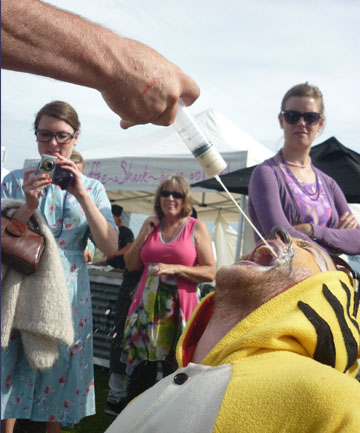
The main attraction at the Hokitika Wildfoods Festival this Saturday was horse semen.

The event has gained notoriety over the last two years after it started offering shots of horse semen to festival-goers and surprisingly the stall has become one of the most popular.

Even the mayor of Hokitika, Maureen Pugh, didn’t shy away from the stallion juice.

Mr Walsh, a vineyard worker in Blenheim, was attending his third Hokitika Wildfoods Festival on Saturday.

The protein shot was definitely the craziest thing yet, the 24-year-old said.

“I don’t like calling it horse semen. I just call it milkshake because that’s what it tastes like.”

Mr Walsh, originally from Palmerston North, hadn’t planned on trying the equestrian smoothie, he said.

“It was a blend of people urging me to do it and the girls I was with paying for it. Then the guy [stall holder] said `take a knee’ so I did.”

The taste wasn’t that bad, he said. “I thought it would be creamy and curdled. The grossest part was it hitting me in the face.”

The stall had a microscope so punters could see the live semen, he said.

“I didn’t look in,” he said. “That would have freaked me out.”

The 23rd Wildfoods Festival had other delicacies on offer, including mountain oysters (sheep’s testicles), live huhu grubs and grasshoppers.

http://www.stuff.co.nz/marlborough-express/news/6564102/Don-t-ask-what-hes-drinking

http://www.wildfoods.co.nz/index.cfm/1,51,0,0,html