Stephanie Pappas, LiveScience Senior Writer
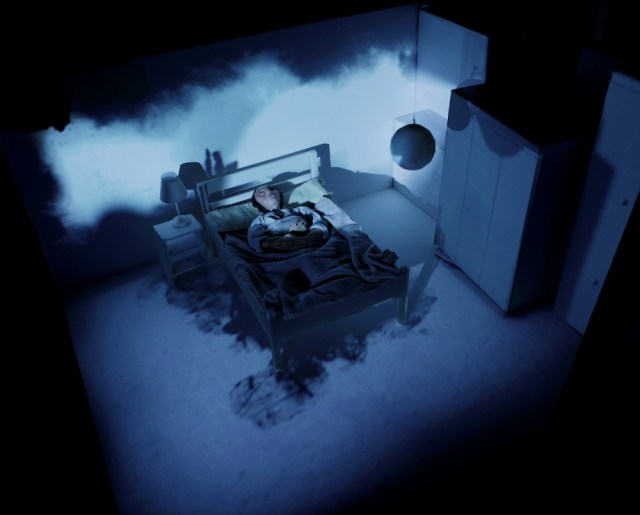
When filmmaker Carla MacKinnon started waking up several times a week unable to move, with the sense that a disturbing presence was in the room with her, she didn’t call up her local ghost hunter. She got researching. Now, that research is becoming a short film and multiplatform art project exploring the strange and spooky phenomenon of sleep paralysis. The film, supported by the Wellcome Trust and set to screen at the Royal College of Arts in London, will debut in May.
Sleep paralysis happens when people become conscious while their muscles remain in the ultra-relaxed state that prevents them from acting out their dreams. The experience can be quite terrifying, with many people hallucinating a malevolent presence nearby, or even an attacker suffocating them. Surveys put the number of sleep paralysis sufferers between about 5 percent and 60 percent of the population. “I was getting quite a lot of sleep paralysis over the summer, quite frequently, and I became quite interested in what was happening, what medically or scientifically, it was all about,” MacKinnon said.
Her questions led her to talk with psychologists and scientists, as well as to people who experience the phenomenon. Myths and legends about sleep paralysis persist all over the globe, from the incubus and succubus (male and female demons, respectively) of European tales to a pink dolphin-turned-nighttime seducer in Brazil. Some of the stories MacKinnon uncovered reveal why these myths are so chilling.
One man told her about his frequent sleep paralysis episodes, during which he’d experience extremely realistic hallucinations of a young child, skipping around the bed and singing nursery rhymes. Sometimes, the child would sit on his pillow and talk to him. One night, the tot asked the man a personal question. When he refused to answer, the child transformed into a “horrendous demon,” MacKinnon said.
For another man, who had the sleep disorder narcolepsy (which can make sleep paralysis more common), his dream world clashed with the real world in a horrifying way. His sleep paralysis episodes typically included hallucinations that someone else was in his house or his room — he’d hear voices or banging around. One night, he awoke in a paralyzed state and saw a figure in his room as usual. “He suddenly realizes something is different,” MacKinnon said. “He suddenly realizes that he is in sleep paralysis, and his eyes are open, but the person who is in the room is in his room in real life.” The figure was no dream demon, but an actual burglar.
Sleep paralysis experiences are almost certainly behind the myths of the incubus and succubus, demons thought to have sex with unsuspecting humans in their sleep. In many cases, MacKinnon said, the science of sleep paralysis explains these myths. The feeling of suffocating or someone pushing down on the chest that often occurs during sleep paralysis may be a result of the automatic breathing pattern people fall into during sleep. When they become conscious while still in this breathing pattern, people may try to bring their breathing under voluntary control, leading to the feeling of suffocating. Add to that the hallucinations that seem to seep in from the dream world, and it’s no surprise that interpretations lend themselves to demons, ghosts or even alien abduction, MacKinnon said.
What’s more, MacKinnon said, sleep paralysis is more likely when your sleep is disrupted in some way — perhaps because you’ve been traveling, you’re too hot or too cold, or you’re sleeping in an unfamiliar or spooky place. Those tendencies may make it more likely that a person will experience sleep paralysis when already vulnerable to thoughts of ghosts and ghouls. “It’s interesting seeing how these scientific narratives and the more psychoanalytical or psychological narratives can support each other rather than conflict,” MacKinnon said.
Since working on the project, MacKinnon has been able to bring her own sleep paralysis episodes under control — or at least learned to calm herself during them. The trick, she said, is to use episodes like a form of research, by paying attention to details like how her hands feel and what position she’s in. This sort of mindfulness tends to make scary hallucinations blink away, she said. “Rationalizing it is incredibly counterintuitive,” she said. “It took me a really long time to stop believing that it was real, because it feels so incredibly real.”
http://www.livescience.com/28325-spooky-film-explores-sleep-paralysis.html

 It's Interesting