
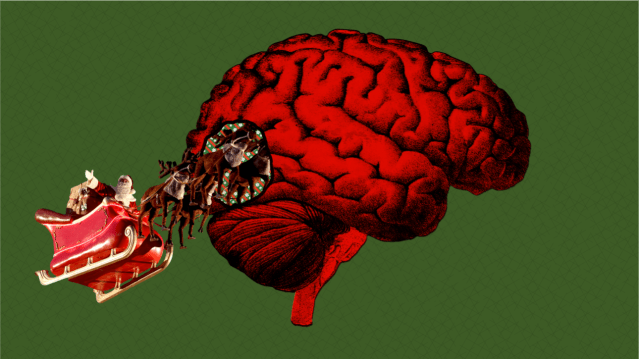
It being a widespread phenomenon, researchers were interested to determine where in the human body holiday people find their penchant for “merriment, gifts, delightful smells, and copious amounts of good food.” They recruited 26 participants to undergo functional magnetic resonance imaging (fMRI), given this technology has long been used to locate emotional and functional centers in the human brain; feelings such as joy, sorrow, and disgust.
Participants watched a series of images through video goggles as they were being scanned. It was a continual series of 84 images, where each one was displayed for two seconds each and were organized in a way that after six consecutive images of all things Christmas, there were then six everyday images with similar form and features. Afterward, participants answered questionnaires about their Christmas traditions (if any), feelings associated with Christmas, and ethnicity.
Based on their answers, 10 were put into the “Christmas group,” 10 were put into the “non-Christmas group,” and six ended up being excluded for either too strong a spirit or non-positive associations with Christmas. The Christmas group was comprised entirely of ethnic Danes, while the non-Christmas group consisted of people from Pakistan, India, Iraq, and Turkey.
The scans showed an increase of brain activity in the primary visual cortex of both groups when the images were Christmas-themed compared to everyday images. The Christmas group, however, also experienced increased activity in the somatosensory cortex. When comparing brain activation maps of both groups, researchers found five areas with more neural activity among the Christmas group responding to Christmas images than those in the non-Christmas group.
After the primary visual and somatosensory cortex, the left primary motor and premotor cortex, right inferior/superior parietal lobe, and bilateral primary somatosensory cortex were also activated. These parts of the brain have been associated with spirituality, somatic sense, and recognizing facial emotional.
“There is a cerebral response when people view Christmas images, and there are differences in this response between people who celebrate Christmas compared with those with no Christmas traditions,” researchers wrote. “Cerebral perfusion was similar between the two groups, despite the Christmas group’s yearly yuletide feast.”
Researchers propose the Christmas spirit is a functional neurological network, which they realize their colleagues may not agree with. They anticipate the argument that “studies such as the present one overemphasize the importance of localized brain activity and that attempts to localize complex emotions in the brain contribute little to the understanding of these emotions.” But, they added, “with the good spirit of the holiday they reject these negative perspectives.”
“We generally believe that fMRI is an outstanding technology for exploring the brain, but that any fMRI experiment is only as good as its hypothesis, design, and interpretation,” they explained. “While celebrating the current results at a subsequent Christmas party, we discussed some limitations of the study.”
They continued: “For instance, the study design doesn’t distinguish whether the observed activation is Christmas specific or the result of any combination of joyful, festive, or nostalgic emotions in general. The paired Christmas/non-Christmas pictures might have been systematically different in a way that we were not aware of — for example, the ‘Christmas pictures’ containing more red color. Maybe the groups were different in other ways apart from the obvious cultural difference.”
But even they can acknowledge further research into this topic is necessary to identify the factors affecting one’s response to Christmas. Understanding how this spirit works as a neurological network could “be an important first step in transcultural neuroscience and the associations humans have with their festive traditions.”
Source: Haddock BT et al. Evidence of a Christmas spirit network in the brain: functional MRI study. BMJ Open. 2015.
http://www.medicaldaily.com/lack-christmas-spirit-may-be-traced-back-brain-bah-humbug-365468
 It's Interesting