
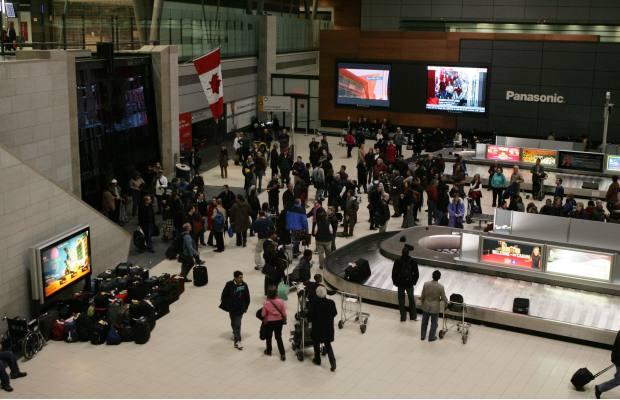
Sections of the Ottawa airport are now wired with microphones that can eavesdrop on travellers’ conversations.
The Canada Border Services Agency (CBSA) is nearing completion of a $500,000 upgrade of old video cameras used to monitor its new “customs controlled areas,” including the primary inspection area for arriving international passengers.
As part of the work, the agency is introducing audio-monitoring equipment as well.
“It is important to note that even though audio technology is installed, no audio is recorded at this time. It will become functional at a later date,” CBSA spokesman Chris Kealey said in a written statement.
But whenever that occurs, the technology, “will record conversations,” the agency said in a separate statement in response to Citizen questions.
Meanwhile, as many as 88 of the new high-definition video cameras are to be ready this summer.
Once the Ottawa equipment is activated, signs will be posted referring passersby to a “privacy notice” that will be posted on the CBSA website, and to a separate help line explaining how the recordings will be used, stored, disclosed and retained.
Already, though, the union representing about 45 CBSA employees at the Ottawa airport is concerned personal workplace conversations and remarks could be captured and become part of employees’ official record, Jean-Pierre Fortin, national president of the Custom and Immigration Union, said Friday. He added that the union only learned of the audio-recording development this week, after the Citizen began making inquiries.
The CBSA statement said that audio-video monitoring and recording is already in place at other unidentified CBSA sites at airports and border points of entry as part of an effort to enhance “border integrity, infrastructure and asset security and health and safety.”
That recording equipment may also be linked to a federal initiative to help CBSA combat organized crime and internal smuggling conspiracies at big Canadian airports.
A 2008 RCMP report said at least 58 crime groups were believed active at major airports, typically by corrupting airport employees or placing criminal associates in airport jobs to move narcotics and other contraband to and from planes.
The Customs Act was amended in 2009 to allow for the creation of “customs controlled areas” within airports, starting with those in Toronto, Montreal and Vancouver, followed by Ottawa and other international Canadian aerodromes.
A crucial aspect of the change are proposed regulations giving border services officers expanded powers to question, examine and search airport workers and travellers, both domestic and international, within the designated areas.
The controlled areas at Macdonald-Cartier International include the areas surrounding aircraft that have arrived in or are about to leave Canada; the primary inspection area where all travellers must report to a border services officer; the secondary inspection area where border services officers conduct further examinations of travellers and goods; as well as certain holding and departure areas at the airport.
The Treasury Board requires government departments to conduct a “privacy impact assessment” before establishing any new or substantially modified program or activity involving personal information. The assessment is then reviewed by the Office of the Privacy Commissioner.
The office this week said it is reviewing a CBSA privacy assessment for the customs controlled areas.
But, “we have not received a privacy impact assessment regarding audio-video monitoring at the Ottawa airport,” said spokeswoman Valerie Lawton. “If the CBSA were to introduce audio-video monitoring, our office would expect a full privacy impact Assessment, which we would review and make (non-binding) recommendations as necessary to protect privacy.”
An official with the Ottawa International Airport Authority had no comment on the CBSA installations, saying the two organizations are distinct and separate.
Read more here from Kebmodee: http://kebmodee.blogspot.com/2012/06/ottawa-airport-wired-with-microphones.html?utm_source=feedburner&utm_medium=email&utm_campaign=Feed%3A+Kebmodee+%28kebmodee%29



 It's Interesting