18 Things Highly Creative People Do Differently

Creativity works in mysterious and often paradoxical ways. Creative thinking is a stable, defining characteristic in some personalities, but it may also change based on situation and context. Inspiration and ideas often arise seemingly out of nowhere and then fail to show up when we most need them, and creative thinking requires complex cognition yet is completely distinct from the thinking process.

Neuroscience paints a complicated picture of creativity. As scientists now understand it, creativity is far more complex than the right-left brain distinction would have us think (the theory being that left brain = rational and analytical, right brain = creative and emotional). In fact, creativity is thought to involve a number of cognitive processes, neural pathways and emotions, and we still don’t have the full picture of how the imaginative mind works.

And psychologically speaking, creative personality types are difficult to pin down, largely because they’re complex, paradoxical and tend to avoid habit or routine. And it’s not just a stereotype of the “tortured artist” — artists really may be more complicated people. Research has suggested that creativity involves the coming together of a multitude of traits, behaviors and social influences in a single person.

“It’s actually hard for creative people to know themselves because the creative self is more complex than the non-creative self,” Scott Barry Kaufman, a psychologist at New York University who has spent years researching creativity, told The Huffington Post. “The things that stand out the most are the paradoxes of the creative self … Imaginative people have messier minds.”

While there’s no “typical” creative type, there are some tell-tale characteristics and behaviors of highly creative people. Here are 18 things they do differently.

They daydream.

Creative types know, despite what their third-grade teachers may have said, that daydreaming is anything but a waste of time.

According to Kaufman and psychologist Rebecca L. McMillan, who co-authored a paper titled “Ode To Positive Constructive Daydreaming,” mind-wandering can aid in the process of “creative incubation.” And of course, many of us know from experience that our best ideas come seemingly out of the blue when our minds are elsewhere.

Although daydreaming may seem mindless, a 2012 study suggested it could actually involve a highly engaged brain state — daydreaming can lead to sudden connections and insights because it’s related to our ability to recall information in the face of distractions. Neuroscientists have also found that daydreaming involves the same brain processes associated with imagination and creativity.

They observe everything.

The world is a creative person’s oyster — they see possibilities everywhere and are constantly taking in information that becomes fodder for creative expression. As Henry James is widely quoted, a writer is someone on whom “nothing is lost.”

The writer Joan Didion kept a notebook with her at all times, and said that she wrote down observations about people and events as, ultimately, a way to better understand the complexities and contradictions of her own mind:

“However dutifully we record what we see around us, the common denominator of all we see is always, transparently, shamelessly, the implacable ‘I,'” Didion wrote in her essay On Keeping A Notebook. “We are talking about something private, about bits of the mind’s string too short to use, an indiscriminate and erratic assemblage with meaning only for its marker.”

They work the hours that work for them.

Many great artists have said that they do their best work either very early in the morning or late at night. Vladimir Nabokov started writing immediately after he woke up at 6 or 7 a.m., and Frank Lloyd Wright made a practice of waking up at 3 or 4 a.m. and working for several hours before heading back to bed. No matter when it is, individuals with high creative output will often figure out what time it is that their minds start firing up, and structure their days accordingly.

They take time for solitude.

In order to be open to creativity, one must have the capacity for constructive use of solitude. One must overcome the fear of being alone,” wrote the American existential psychologist Rollo May.

Artists and creatives are often stereotyped as being loners, and while this may not actually be the case, solitude can be the key to producing their best work. For Kaufman, this links back to daydreaming — we need to give ourselves the time alone to simply allow our minds to wander.

“You need to get in touch with that inner monologue to be able to express it,” he says. “It’s hard to find that inner creative voice if you’re … not getting in touch with yourself and reflecting on yourself.”

They turn life’s obstacles around.

Many of the most iconic stories and songs of all time have been inspired by gut-wrenching pain and heartbreak — and the silver lining of these challenges is that they may have been the catalyst to create great art. An emerging field of psychology called post-traumatic growth is suggesting that many people are able to use their hardships and early-life trauma for substantial creative growth. Specifically, researchers have found that trauma can help people to grow in the areas of interpersonal relationships, spirituality, appreciation of life, personal strength, and — most importantly for creativity — seeing new possibilities in life.

“A lot of people are able to use that as the fuel they need to come up with a different perspective on reality,” says Kaufman. “What’s happened is that their view of the world as a safe place, or as a certain type of place, has been shattered at some point in their life, causing them to go on the periphery and see things in a new, fresh light, and that’s very conducive to creativity.”

They seek out new experiences.

Creative people love to expose themselves to new experiences, sensations and states of mind — and this openness is a significant predictor of creative output.

“Openness to experience is consistently the strongest predictor of creative achievement,” says Kaufman. “This consists of lots of different facets, but they’re all related to each other: Intellectual curiosity, thrill seeking, openness to your emotions, openness to fantasy. The thing that brings them all together is a drive for cognitive and behavioral exploration of the world, your inner world and your outer world.”

They “fail up.”

Resilience is practically a prerequisite for creative success, says Kaufman. Doing creative work is often described as a process of failing repeatedly until you find something that sticks, and creatives — at least the successful ones — learn not to take failure so personally.

“Creatives fail and the really good ones fail often,” Forbes contributor Steven Kotler wrote in a piece on Einstein’s creative genius.

They ask the big questions.
Creative people are insatiably curious — they generally opt to live the examined life, and even as they get older, maintain a sense of curiosity about life. Whether through intense conversation or solitary mind-wandering, creatives look at the world around them and want to know why, and how, it is the way it is.

They people-watch.

Observant by nature and curious about the lives of others, creative types often love to people-watch — and they may generate some of their best ideas from it.

“[Marcel] Proust spent almost his whole life people-watching, and he wrote down his observations, and it eventually came out in his books,” says Kaufman. “For a lot of writers, people-watching is very important … They’re keen observers of human nature.”

They take risks.

Part of doing creative work is taking risks, and many creative types thrive off of taking risks in various aspects of their lives.

“There is a deep and meaningful connection between risk taking and creativity and it’s one that’s often overlooked,” contributor Steven Kotler wrote in Forbes. “Creativity is the act of making something from nothing. It requires making public those bets first placed by imagination. This is not a job for the timid. Time wasted, reputation tarnished, money not well spent — these are all by-products of creativity gone awry.”

They view all of life as an opportunity for self-expression.

Nietzsche believed that one’s life and the world should be viewed as a work of art. Creative types may be more likely to see the world this way, and to constantly seek opportunities for self-expression in everyday life.

“Creative expression is self-expression,” says Kaufman. “Creativity is nothing more than an individual expression of your needs, desires and uniqueness.”

They follow their true passions.

Creative people tend to be intrinsically motivated — meaning that they’re motivated to act from some internal desire, rather than a desire for external reward or recognition. Psychologists have shown that creative people are energized by challenging activities, a sign of intrinsic motivation, and the research suggests that simply thinking of intrinsic reasons to perform an activity may be enough to boost creativity.

“Eminent creators choose and become passionately involved in challenging, risky problems that provide a powerful sense of power from the ability to use their talents,” write M.A. Collins and T.M. Amabile in The Handbook of Creativity.

They get out of their own heads.

Kaufman argues that another purpose of daydreaming is to help us to get out of our own limited perspective and explore other ways of thinking, which can be an important asset to creative work.

“Daydreaming has evolved to allow us to let go of the present,” says Kaufman. “The same brain network associated with daydreaming is the brain network associated with theory of mind — I like calling it the ‘imagination brain network’ — it allows you to imagine your future self, but it also allows you to imagine what someone else is thinking.”

Research has also suggested that inducing “psychological distance” — that is, taking another person’s perspective or thinking about a question as if it was unreal or unfamiliar — can boost creative thinking.

They lose track of the time.
Creative types may find that when they’re writing, dancing, painting or expressing themselves in another way, they get “in the zone,” or what’s known as a flow state, which can help them to create at their highest level. Flow is a mental state when an individual transcends conscious thought to reach a heightened state of effortless concentration and calmness. When someone is in this state, they’re practically immune to any internal or external pressures and distractions that could hinder their performance.

You get into the flow state when you’re performing an activity you enjoy that you’re good at, but that also challenges you — as any good creative project does.

“[Creative people] have found the thing they love, but they’ve also built up the skill in it to be able to get into the flow state,” says Kaufman. “The flow state requires a match between your skill set and the task or activity you’re engaging in.”

They surround themselves with beauty.

Creatives tend to have excellent taste, and as a result, they enjoy being surrounded by beauty.

A study recently published in the journal Psychology of Aesthetics, Creativity, and the Arts showed that musicians — including orchestra musicians, music teachers, and soloists — exhibit a high sensitivity and responsiveness to artistic beauty.

They connect the dots.

If there’s one thing that distinguishes highly creative people from others, it’s the ability to see possibilities where other don’t — or, in other words, vision. Many great artists and writers have said that creativity is simply the ability to connect the dots that others might never think to connect.

In the words of Steve Jobs:

“Creativity is just connecting things. When you ask creative people how they did something, they feel a little guilty because they didn’t really do it, they just saw something. It seemed obvious to them after a while. That’s because they were able to connect experiences they’ve had and synthesize new things.”

They constantly shake things up.

Diversity of experience, more than anything else, is critical to creativity, says Kaufman. Creatives like to shake things up, experience new things, and avoid anything that makes life more monotonous or mundane.

“Creative people have more diversity of experiences, and habit is the killer of diversity of experience,” says Kaufman.

They make time for mindfulness.

Creative types understand the value of a clear and focused mind — because their work depends on it. Many artists, entrepreneurs, writers and other creative workers, such as David Lynch, have turned to meditation as a tool for tapping into their most creative state of mind.

And science backs up the idea that mindfulness really can boost your brain power in a number of ways. A 2012 Dutch study suggested that certain meditation techniques can promote creative thinking. And mindfulness practices have been linked with improved memory and focus, better emotional well-being, reduced stress and anxiety, and improved mental clarity — all of which can lead to better creative thought.

http://www.huffingtonpost.com/2014/03/04/creativity-habits_n_4859769.html

Renoir bought for $7 at West Virginia flea market

renoir

A napkin-size Renoir painting bought for $7 at a flea market but valued at up to $100,000 must be returned to the museum it was stolen from in 1951, a federal judge ordered on Friday.

The 1879 Impressionist painting “Paysage Bords de Seine,” dashed off for his mistress by Pierre-Auguste Renoir at a riverside restaurant, has been at the center of a legal tug-of-war between Marcia “Martha” Fuqua, a former physical education teacher from Lovettsville, Virginia, and the Baltimore Museum of Art in Maryland.

Judge Leonie Brinkema, in a hearing in the U.S. District Court for the Eastern District of Virginia, dismissed Fuqua’s claim of ownership, noting that a property title cannot be transferred if it resulted from a theft.

“The museum has put forth an extensive amount of documentary evidence that the painting was stolen,” Brinkema said, citing a 1951 police report and museum records.

“All the evidence is on the Baltimore museum’s side. You still have no evidence – no evidence – that this wasn’t stolen,” said Brinkema to Fuqua’s attorney before ruling in favor of the museum.

Fuqua bought the unsigned “Paysage Bords de Seine,” or “Landscape on the Banks of the Seine,” at a Harpers Ferry, West Virginia, flea market in late 2009 because she liked the frame, she said in a court filing. She paid $7 for the painting, along with a box of trinkets.

Although the frame carried the nameplate “Renoir 1841-1919,” Fuqua was unaware the 5-1/2-by-9-inch oil painting was genuine and stored it in a garbage bag for 2-1/2 years, she said.

Her mother, an art teacher and painter, urged her in July 2012 to get the painting appraised. Fuqua took it to the Potomack Co, an Alexandria, Virginia, auction house, which verified it was as an authentic Renoir.

After media reports about the painting, the Baltimore Museum of Art said in September 2012 it had been stolen while on loan to it. The Federal Bureau of Investigation then took custody of it.

What happened to the painting in the time after the theft in November 1951 and the time it surfaced at a flea market is not known.

Fuqua had contended that “Paysage Bords de Seine” should be returned to her since she was unaware of it having been stolen or of it being genuine.

The Potomack Co had estimated the painting’s value at $75,000 to $100,000, but an appraisal done for the FBI said it was worth about $22,000.

The painting is soiled and “there is a distinct lack of enthusiasm for paintings by Renoir now considered a more old-fashioned taste,” appraiser Ted Cooper said, quoting an art market report.

Renoir painted the work for his mistress on a linen napkin, while at a restaurant near the Seine River, Cooper said, quoting museum curatorial notes.

Questions about its ownership also have diminished the painting’s value, said the appraisal, which is part of court filings.

“Paysage Bords de Seine” came to the Baltimore museum through one of its leading benefactors, collector Saidie May. Her family bought the painting from the Bernheim-Jeune gallery in Paris in 1926 and May lent it, along with other works, to the museum in 1937.

May died in May 1951 and the collection was willed to the museum. As its ownership was going through legal transfer, the painting was stolen while still listed as being on loan.

http://www.reuters.com/article/2014/01/10/us-usa-renoir-idUSBREA0910K20140110

Chinese farmer grows Buddha-shaped pears

pear3
pear2
pear1

Gao Xianzhang has managed to create what some would call the holiest fruits ever, pears shaped like Buddha.

Gao has been working on his pear-growing technique for six years and this season he managed to grow 10,000 Buddha-shaped baby pears.

Each fruit is grown in an intricate Buddha mould and ends up looking like a juicy figurine.

The ingenious farmer says the locals in his home village of Hexia, northern China, have been buying his Buddha pears as soon as he picks them from the trees.

Most of them think they are cute and that they bring good luck.

http://delightmakers.com/news-bleat/chinese-farmer-grows-buddha-shaped-pears/

Thanks to Jody Troupe for bringing this to the attention of the It’s Interesting community.

Nagai Hideyuki – Japanese artist that makes his paintings leap off the page – “anamorphosis”

Nagai Hideyuki 3D Art

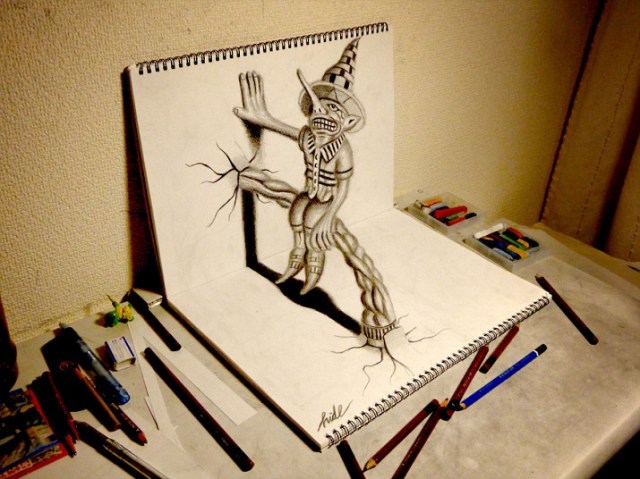
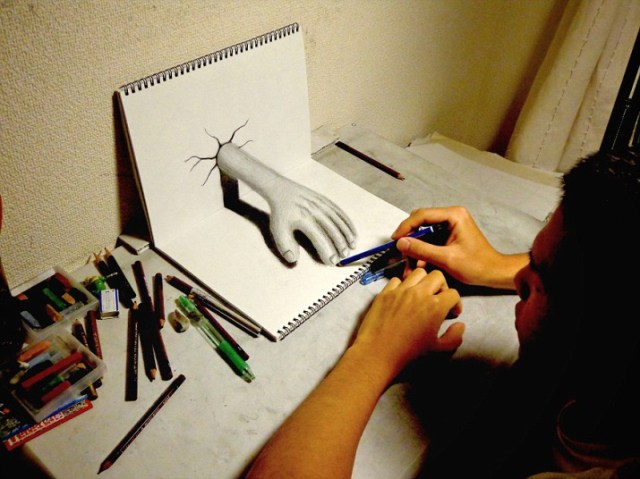
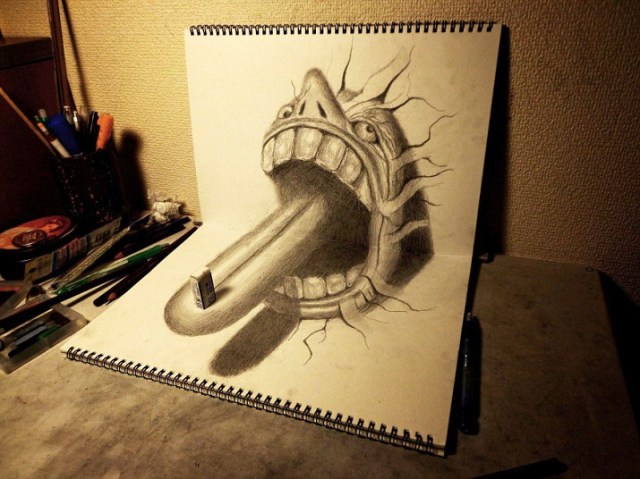
These eye-popping two-dimensional sketches look as though they are about to leap off the page thanks to Japanese artist Nagai Hideyuki’s clever pencil work.

Hideyuki, 21, creates tricks of perspective by playing with where light and shadows would fall if the object really were coming out to meet you.

Once propped against a wall these vivid optical illusions work perfectly to create a 3D effect.

Hideyuki, 21, from Japan, uses just his pencil to conjure up amazing sketches that fool the brain.

His ability to draw so well in three-dimensions came from the restrictions on street artists in Japan. He wanted to work to resemble street art that pops out from walls.

He was inspired by a technique known professionally as anamorphosis as used by British artist Julian Beever who creates similarly elaborate ‘three-dimensional’ work when viewed from the right angle on pavements using chalk.

Because of stricter laws in Japan, Hideyuki has been restricted to the confines of his sketchbook but it has not stopped him making equally impressive artwork, letting his imagination run riot with everything from gremlins to trains to gaping mouths.

Read more: http://www.dailymail.co.uk/news/article-2318339/Nagai-Hideyuki-Artist-makes-drawings-leap-page.html#ixzz2TBDZikzA

Litterbugs Beware: Turning Found DNA Into Portraits

_sample2_face_web

sample4-4

_sample4_face_web

sample6-0

Heather Dewey-Hagborg was sitting in a therapy session a while ago and noticed a painting on the wall. The glass on the frame was cracked, and lodged in the crack was a single hair. She couldn’t take her eyes off it. “I just became obsessed with thinking about whose hair that was, and what they might look like, and what they might be like,” she says.

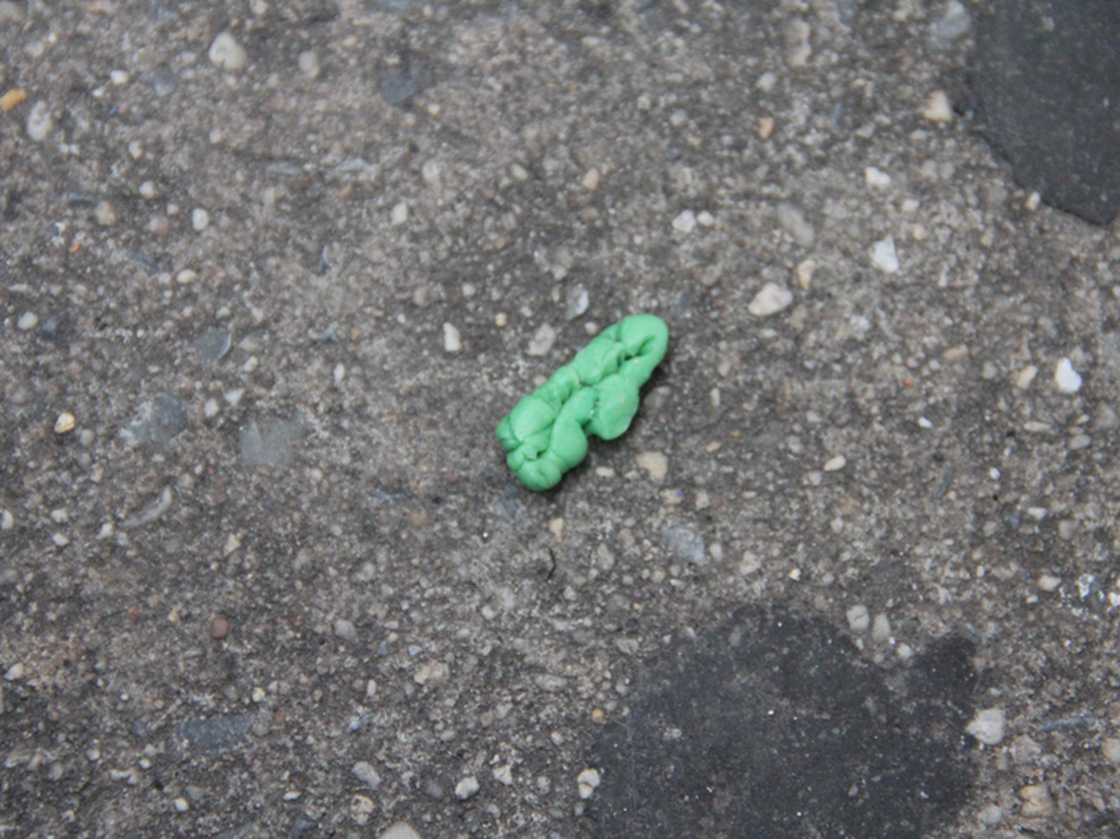
On the subway ride home, she noticed all of the insignificant things people left behind — a dropped cigarette butt, a chewed-up piece of gum. Like the hair stuck in the frame, she wondered how much genetic material might have been tossed away with the trash. So Dewey-Hagborg started collecting these forgotten “artifacts,” as she calls them, and bringing them back to a lab to analyze their embedded genetic material.

Yet it might seem Dewey-Hagborg would be more comfortable in a studio than a laboratory. She’s an artist; a doctoral student in Information Art at Rensselaer Polytechnic Institute in Troy, N.Y. For her most recent project, though, much of the creative process takes place in front of a centrifuge, wearing latex gloves, deep in the map of the human genome.

In short, Dewey-Hagborg extracts DNA from these samples of trash and turns that information from code into life-sized 3-D facial portraits resembling the person who left the sample behind. She can code for eye color, eye and nose width, skin tone, hair color and more. She starts by cutting up her sample, sometimes the end of a cigarette, thin slices of a chewed wad of gum, sometimes hair, and incubates the sample with chemicals to distill it into pure DNA. She then takes that DNA, and matches the code with different traits on the genome related to the way human faces look.

“That’s a very tiny subset of all of the things that we know about the entire mapping of the human genome, ” she says.

Next, she sends the DNA to a sequencing company that sends her back a text file full of A, C, Ts and Gs — the four nucleic acid bases that DNA is made out of. She then reads that information in a program she designed herself, translating the code into traits, then using those traits to build a 3-D model of a face. Dewey-Hagborg can determine ethnicity, gender, even a tendency to be overweight.

But even all of that can’t give her the whole picture. Much of the information is still missing, and Dewey-Hagborg has to fill in the gaps. She compares that part of the work to a sketch artist. “This person is more likely to be overweight, to have pale skin, to have freckles, blue eyes, how do I interpret this?”

People often ask her how accurate the portraits are. Of course, she has no way of knowing. After all, she collects these items from anonymous sources. But she did start off with her own portrait based on her own DNA. She exhibited that at an art and technology space in Chelsea.

“Half of the people would say, ‘Wow! It looks just like you!'” she says. “The other half would say, ‘Wow! It looks nothing like you!” The portraits are subjective in a big way, she acknowledges, but says much of the information is solidly based in data.

Though she started this project in part to “open up the conversation about genetic surveillance,” she says, it’s taken on another purpose. Right now she’s working with the Delaware medical examiner’s office to try to identify a woman in a 20-year-old unsolved case by using some of the victim’s remains to build a 3-D portrait of her. She’s six weeks away from finishing the process, when investigators will, for the first time, have some idea of what the victim looked like before her death.

http://www.npr.org/2013/05/12/183363361/litterbugs-beware-turning-found-dna-into-portraits

Thanks to Dr. Lutter for bringing this to the attention of the It’s Interesting community.

Oldest known portrait in the world discovered from the Ice Age

Ice Age art: The oldest known portrait of a woman

The oldest known portrait of a woman, sculpted from mammoth ivory during the last ice age around 26,000 years ago. Photograph: Graeme Robertson for the Guardian

It’s smaller than your thumb: a little piece of mammoth ivory delicately carved into the shape of a woman’s head. But this miniature sculpture, with one wonky eye and rather elongated, slightly Modigliani-esque proportions, is the oldest known portrait in the world, and is about to go on show to the public for the first time in Britain in a new exhibition at the British Museum, Ice Age Art: Arrival of the Modern Mind.

Some 26,000 years ago, in a valley teeming with game in what is now Moravia, a man or woman carved this little head with skill and not a little persistence, using stone tools to smooth away the recalcitrant, hard ivory.

According to the British Museum’s curator Jill Cook, “The reason we say it is a portrait is because she has absolutely individual characteristics. She has one beautifully engraved eye; on the other, the lid comes over and there’s just a slit. Perhaps she had a stroke, or a palsy, or was injured in some way. In any case, she had a dodgy eye. And she has a little dimple in her chin: this is an image of a real, living woman.”

The exhibition will show that the first figurative art was created in Europe in the shadow of the Ice Age – and that the people making it were capable not only of highly naturalistic images but also of abstract representation. Everything, argues Cook, that we think of as art was already present in the culture of these early people.

“Most people looking at art are looking at the five minutes to midnight – the art of the last 500 years,” she says. “We have been used to separating work like this off by that horrible word ‘prehistory’. It’s a word that tends to bring the shutters down, but this is the deep history of us.”

The works even suggest a nascent art world, she argues – professionals occupying a particular place in society, entrusted with the work of creating art. “Some of the things we have from digs are a bit rubbish; some of them almost look like apprentice pieces. But the best things are masterpieces and would have taken hundreds of hours to produce.”

In one Pyrenean cave, where a number of delicate carvings of horses’ heads were found – boldly likened by Cook to the equine sculptures on the Parthenon frieze – was an area where carvings had clearly been produced over a period of time, like an “atelier”, said Cook. The skill and time required to make the works suggest that “this was a society that valued their producers”.

In fact, Cook is convinced that the urge to make art – including the earlier abstract work made by Homo sapiens in Africa, before the species made its way to Europe – is as old as the frontal cortex itself. “This work is where the executive brain comes from: the ability to think ahead, to collaborate, to compromise, to regulate ourselves,” said Cook.

The profound need for objects that had no practical function, but seem to have been created purely to delight, to entrance, or to inspire awe or reverence, is aptly demonstrated by a small clay sculpture of a woman. She has drooping breasts, a paunchy stomach and, endearingly, carefully incised fat folds, or love handles, on her back. “Gravity is taking over,” said Cook. “I have some sympathy.” This object, between 31,000 and 27,000 years old, is the oldest known object made from clay – not a pot or a vessel, but a sculpture.

The woman’s portrait head from Moravia was excavated in the 1920s in Dolní Věstonice, a valley frequented in the Ice Age by mammoth and reindeer and other huntable beasts travelling between the Polish plains and the Danube valley. A headline in the Illustrated London News called the excavation the “The Stone-age Pompeii” because of the wealth of objects discovered there. But, according to Cook, “in the wake of the second world war and the Iron Curtain people in western Europe almost forgot about the finds.”

The head and other artefacts are a rare loan from the Moravian Museum in Brno – their arrival on British shores having been delayed, as it happens, by the ice and snow at the weekend.

Other artefacts – such as a 32,000-year-old lion-headed man from Hohlenstein-Stadel in Germany, carved with consummate skill from a mammoth tusk – suggest that Ice Age artists were capable of imaginative works. Such fantasies may hint at the existence of myth or story.

At the opposite extreme is what Cook calls a “hyper-real” landscape picture of deer pausing at a stream, scratched into bone about 14,000 years ago. “The artist has carefully chosen the right piece of bone, and prepared the surface, which suggests a preconceived plan,” said Cook. “The figures of the deer occupy just the right amount of space to give you a sense of perspective. The texture and colour of the deer’s coat have been carefully depicted, even its white bottom. These are exactly the considerations that a modern artist would make. The key concepts of drawing are all there.”

http://www.guardian.co.uk/science/2013/jan/24/ice-age-art-british-museum?utm_source=feedburner&utm_medium=feed&utm_campaign=Feed%3A+C2C-InTheNews+%28Feed+-+Coast+to+Coast+-+In+the+News%29

Racism of early Polaroid colour photography explored in art exhibition


Artists spent a month in South Africa taking pictures on decades-old film engineered with only white faces in mind.

Can the camera be racist? The question is explored in an exhibition that reflects on how Polaroid built an efficient tool for South Africa’s apartheid regime to photograph and police black people.

The London-based artists Adam Broomberg and Oliver Chanarin spent a month in South Africa taking pictures on decades-old film that had been engineered with only white faces in mind. They used Polaroid’s vintage ID-2 camera, which had a “boost” button to increase the flash – enabling it to be used to photograph black people for the notorious passbooks, or “dompas”, that allowed the state to control their movements.

The result was raw snaps of some of the country’s most beautiful flora and fauna from regions such as the Garden Route and the Karoo, an attempt by the artists to subvert what they say was the camera’s original, sinister intent.

Broomberg and Chanarin say their work, on show at Johannesburg’s Goodman Gallery, examines “the radical notion that prejudice might be inherent in the medium of photography itself”. They argue that early colour film was predicated on white skin: in 1977, when Jean-Luc Godard was invited on an assignment to Mozambique, he refused to use Kodak film on the grounds that the stock was inherently “racist”.

The light range was so narrow, Broomberg said, that “if you exposed film for a white kid, the black kid sitting next to him would be rendered invisible except for the whites of his eyes and teeth”. It was only when Kodak’s two biggest clients – the confectionary and furniture industries – complained that dark chocolate and dark furniture were losing out that it came up with a solution.

The artists feel certain that the ID-2 camera and its boost button were Polaroid’s answer to South Africa’s very specific need. “Black skin absorbs 42% more light. The button boosts the flash exactly 42%,” Broomberg explained. “It makes me believe it was designed for this purpose.”

In 1970 Caroline Hunter, a young chemist working for Polaroid in America, stumbled upon evidence that the company was effectively supporting apartheid. She and her partner Ken Williams formed the Polaroid Workers Revolutionary Movement and campaigned for a boycott. By 1977 Polaroid had withdrawn from South Africa, spurring an international divestment movement that was crucial to bringing down apartheid.

The title of the exhibition, To Photograph the Details of a Dark Horse in Low Light, refers to the coded phrase used by Kodak to describe a new film stock created in the early 1980s to address the inability of earlier films to accurately render dark skin.

The show also features norm reference cards that always used white women as a standard for measuring and calibrating skin tones when printing photographs. The series of “Kodak Shirleys” were named after the first model featured. Today such cards show multiple races.

Broomberg and Chanarin made two recent trips to Gabon to photograph a series of rare Bwiti initiation rituals using Kodak film stock, scavenged from eBay, that had expired in 1978. Working with outdated chemical processes, they salvaged just a single frame. Broomberg said: “Anything that comes out of that camera is a political document. If I take a shot of the carpet, that’s a political document.”

http://www.guardian.co.uk/artanddesign/2013/jan/25/racism-colour-photography-exhibition

Kate Moss’ Tattoo Inked By Lucian Freud Worth $1 Million Or More


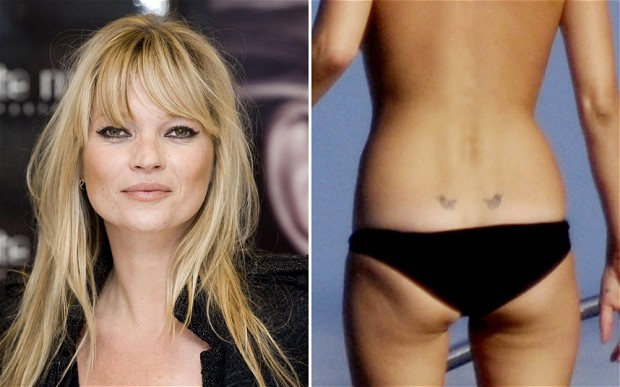
For many people, their body art is priceless. But for Kate Moss, one tatoo could be worth more than $1 million because it was inked by revered German painter Lucian Freud. Freud and Moss met in 2002 and shortly after, he etched swallows at the base of her spine. 

“He told me about when he was in the Navy, when he was 19 or something, and he used to do all of the tattoos for the sailors. And I said, ‘Oh my God, that’s amazing,'” she told Vanity Fair. “And he went, ‘I can do you one. What would you like? Would you like creatures of the animal kingdom?’ 

“I said I liked birds and he replied, I’ve done birds. And he pointed down at a painting of a chicken upside down in a bucket to which I replied, “No, I’m not having that.” We decided to do a flock of birds,” she said.

Moss also admitted she knows the tattoo could be worth a fortune, which many publications, like the (U.K.) Telegraph, have estimated to be over $1 million.

“I mean, it’s an original Freud. I wonder how much a collector would pay for that? A few million? If it all goes horribly wrong I could get a skin graft and sell it! It’s probably the only one on skin that’s still around,” she said.

Moss met Freud in 2002 after admitting he was the person she’d most like to meet. The duo linked up after Moss agreed to pose for a nude painting while pregnant with Lila Grace.

“I went to his house and he started [the nude painting] that night. Couldn’t say no to Lucian. Very persuasive. I phoned Bella [his daughter] the next day and said, ‘How long is it going to take?’ She said: ‘How big is the canvas?’. I said, ‘it’s quite big.’ She said: ‘Oh dear, could take six months to a year.”

The painting ended up taking nine months to finish and went for £3.9 million during an auction in 2005.

Freud died in July 2011 at 88-years-old.

http://www.ibtimes.com/kate-moss-tattoo-inked-lucian-freud-worth-1-million-or-more-photos-889882