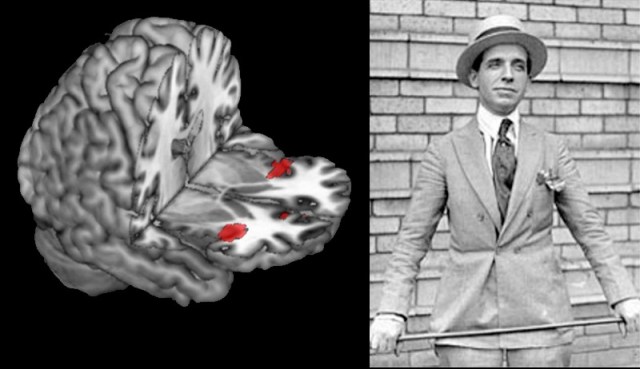
Changes in the anterior insula of hte brain may make us more trusting as we age

sn-trustworthiness

Despite long experience with the ways of the world, older people are especially vulnerable to fraud. According to the Federal Trade Commission (FTC), up to 80% of scam victims are over 65. One explanation may lie in a brain region that serves as a built-in crook detector. Called the anterior insula, this structure—which fires up in response to the face of an unsavory character—is less active in older people, possibly making them less cagey than younger folks, a new study finds.

Both FTC and the Federal Bureau of Investigation have found that older people are easy marks due in part to their tendency to accentuate the positive. According to social neuroscientist Shelley Taylor of the University of California, Los Angeles, research backs up the idea that older people can put a positive spin on things—emotionally charged pictures, for example, and playing virtual games in which they risk the loss of money. “Older people are good at regulating their emotions, seeing things in a positive light, and not overreacting to everyday problems,” she says. But this trait may make them less wary.

To see if older people really are less able to spot a shyster, Taylor and colleagues showed photos of faces considered trustworthy, neutral, or untrustworthy to a group of 119 older adults (ages 55 to 84) and 24 younger adults (ages 20 to 42). Signs of untrustworthiness include averted eyes; an insincere smile that doesn’t reach the eyes; a smug, smirky mouth; and a backward tilt to the head. The participants were asked to rate each face on a scale from -3 (very untrustworthy) to 3 (very trustworthy).

In the study, appearing in the Proceedings of the National Academy of Sciences, the “untrustworthy” faces were perceived as significantly more trustworthy by the older subjects than by the younger ones. The researchers then performed the same test on a different set of volunteers, this time imaging their brains during the process, to look for differences in brain activity between the age groups. In the younger subjects, when asked to judge whether the faces were trustworthy, the anterior insula became active; the activity increased at the sight of an untrustworthy face. The older people, however, showed little or no activation.

Taylor explains that the insula’s job is to collect information not about others but about one’s own body—sensing feelings, including “gut instincts”—and present that information to the rest of the brain. “It’s a warning bell that doesn’t seem to work as well in older people.” By habitually seeing the world in a positive light, older people may be overriding this warning signal, she says. “It looks like the brain is conspiring with what older people do naturally.”

Whether the insula activates in response to non-facial cues, such as telephone scams (a particular problem for older people), remains unclear, says Taylor, since the study was limited to faces.

The new study is the first to show a characteristic pattern of brain activation in a “social” situation involving the assessment of another person’s trustworthiness, says psychologist Lisbeth Nielsen of the National Institute on Aging (NIA) in Bethesda, Maryland. (Though NIA funded the project, Nielsen was not involved in the study.)

A question to be addressed in future research, she says, is whether decreased activity in the insula is the cause or the effect of older peoples’ more positive outlook. “It may be that older people engage with the world in a certain way and this is reflected in the brain activity.”

If so, she adds, older people could work on becoming more cautious. For example, they could be taught to look out for the facial signs of untrustworthiness. “Just because the insula isn’t being activated doesn’t mean it can’t be.”

http://news.sciencemag.org/sciencenow/2012/12/why-old-people-get-scammed.html?ref=hp

Do eunuchs live longer?

Talk about a longevity strategy no man wants to pursue. A recent study published in the journal Current Biology finds that Korean eunuchs — castrated men — lived 14 to 19 years longer than other men, suggesting that male sex hormones play a role in life span.

In the study, the researchers used a genealogy record called the Yang-Se-Gye-Bo that tracked eunuchs who worked in the Korean imperial court during the Chosun Dynasty, which ruled from the 14th to early 20th centuries.

Researchers were able to identify 81 eunuchs, who were castrated as boys, and determined that they lived to an average age of 70, significantly longer than other men of similar social status. Even kings didn’t typically make it to age 50.

Three of the 81 eunuchs lived to 100, a centenarian rate that’s far higher than would be expected in modern society. The current incidence of centenarians is 1 per 3,500 people in Japan, and 1 per 4,400 people in the United States, for instance; thus, the incidence of centenarians among Korean eunuchs was at least 130 times higher than that of present-day developed countries, according to the paper.

TIME.com: Want to live longer? Don’t try caloric restriction

“Our study supports the idea that male sex hormones decrease the lifespan of men,” the authors write.

Based on earlier research, the authors argue that one explanation for this could be that male sex hormones may negatively influence the immune system and “predispose men to adverse cardiovascular attacks.” They note further that the theory helps explain why females — in many species — live longer than males.

But while animal studies have suggested that castration (which removes the testes, the source of male hormones) results in longer lives, studies in humans have been spotty. In one study of castrati singers, there was no difference in lifespan between them and non-castrated singers; in another study of institutionalized, mentally ill men, however, those who were castrated lived some 14 years longer than those who weren’t.

And there are other reasons that women may outlive men, including for example the presence of estrogen, which may help enhance longevity. Also, as ABC News reports:

“Females may have an advantage in longevity because they have a back-up X chromosome, (Dr. L. Stephen Coles, a co-founder of the Los Angeles Gerontology Research Group,) said. A woman’s body is a mixture of cells, half containing an active X chromosome from her mother and the other half from her father, he said. If there is a defect on one X chromosome, half of her cells will be unaffected.”

TIME.com: Health checkup: How to live 100 years

Further, the longevity of the Korean eunuchs could be attributable to lifestyle factors the study didn’t track, like diet, exercise and stress.

The authors think the men’s long lives can’t be chalked up solely to a privileged lifestyle, however. “Except for a few eunuchs, most lived outside the palace and spent time inside the palace only when they were on duty,” study author Kyung-Jin Min of Inha University told Reuters. Meanwhile, they still tended to outlive other royalty who spent their whole lives inside the palace.

Obviously, the study authors don’t advocate becoming a eunuch. There are more sensible and reliable ways to up your chances of a long, healthy life: don’t smoke, eat a healthy diet, get plenty of exercise.

“For better health and longevity, stay away from stresses and learn what you can from women,” the authors said in a statement.

http://www.cnn.com/2012/09/25/health/eunuchs-lifespan/index.html?hpt=hp_bn12

New study offers evidence of ‘old person smell’

The Smell of Age: Perception and Discrimination of Body Odors of Different Ages

“Our natural body odor goes through several stages of age-dependent changes in chemical composition as we grow older. Similar changes have been reported for several animal species and are thought to facilitate age discrimination of an individual based on body odors, alone. We sought to determine whether humans are able to discriminate between body odor of humans of different ages. Body odors were sampled from three distinct age groups: Young (20–30 years old), Middle-age (45–55), and Old-age (75–95) individuals. Perceptual ratings and age discrimination performance were assessed in 41 young participants. There were significant differences in ratings of both intensity and pleasantness, where body odors from the Old-age group were rated as less intense and less unpleasant than body odors originating from Young and Middle-age donors. Participants were able to discriminate between age categories, with body odor from Old-age donors mediating the effect also after removing variance explained by intensity differences. Similarly, participants were able to correctly assign age labels to body odors originating from Old-age donors but not to body odors originating from other age groups. This experiment suggests that, akin to other animals, humans are able to discriminate age based on body odor alone and that this effect is mediated mainly by body odors emitted by individuals of old age.”

http://blogs.discovermagazine.com/discoblog/2012/06/06/ncbi-rofl-study-proves-old-person-smell-is-real/