
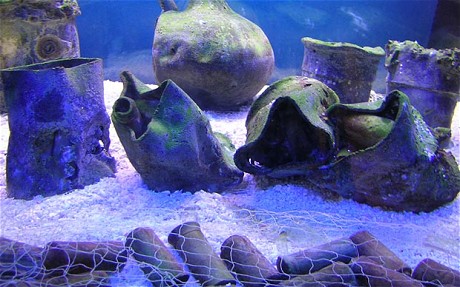
Pills found on board a 2nd century B.C. shipwreck were packed with crushed carrots, parsley, onions, alfalfa, and other vegetable matter, conforming to the recipes contained in ancient medical treatises.
While the texts themselves were discovered long ago, the cache of ancient pharmaceuticals found onboard the sunken ancient vessel is the first time the medicines themselves have been found.
The definite usefulness of the medicines is as yet unknown, but archeologists believe that these pills were likely stored on board as part of an ancient “first aid kit” for use by sailors suffering from a variety of ailments.
“Medicinal plants have been identified before, but not a compound medicine, so this is really something new,” says Alain Touwaide, director of the Institute for the Preservation of Medical Traditions, home to the most extensive database of medical manuscripts in the world.
The vegetable-packed pills were found in 136 tin-lined wooden containers on a 50-foot long trading ship that sank to a depth of about 60 feet sometime around 125 B.C. off the coast of Tuscany. The ruins were discovered in 1974 near the port city of Piombino, which lies on the border between the Ligurian Sea and the Tyrrhenian Sea, in front of Elba Island and at the northern side of Maremma.
The cache of medicine was found some 15 years later, but the technology required to accurately analyze the DNA sequence of the material was only recently developed.
Surprisingly, given the fact that the organic material packed in the pills has been underwater for over two millennia, Dr. Touwaide reports that the small tablets were so well sealed by the ancient chemists who prepared them that there remains sufficient sample to perform the battery of tests being carried out by various organizations, including the Smithsonian, Italy’s Superintendence for Cultural Heritage (based in Tuscany), and Pisa University.
Dr. Touwaide described the methods employed by the ancient apothecaries: “The plants and vegetables were probably crushed with a mortar and pestle — we could still see the fibers in the tablets. They also contained clay, which even today is used to treat gastrointestinal problems.”
Thanks to Kedmobee for brining this to the attention of the It’s Interesting community.
 It's Interesting