
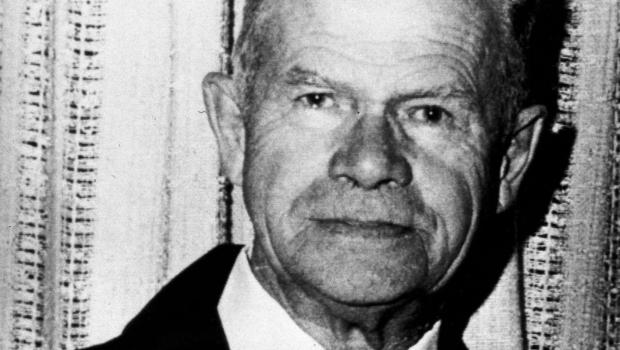
Four decades later, workers enter site of “Atomic Man” accident

Workers have entered one of the most dangerous rooms at the Hanford Nuclear Reservation.

The so-called McCluskey Room in the Plutonium Finishing Plant is named after worker Harold McCluskey.

He was covered with radioactive material in 1976 when a glove box exploded. McCluskey, who was 64 at the time, lived for 11 more years and died from causes not related to the accident. He became known as the Atomic Man.

The room has largely been closed since the accident because of radioactivity. But workers are now proceeding with the final cleanup of the room as they get the Plutonium Finishing Plant ready for demolition.

Hanford, located near Richland, Washington, for decades made plutonium for nuclear weapons. The site is now engaged in cleaning up the resulting radioactive mess.

Cleaning up the McCluskey Room is expected to take a year.

A crew with contractor CH2M HILL Plateau Remediation Co. donned specially designed radiation suits before entering the McCluskey Room earlier this week. One of their first tasks was improving ventilation to better protect workers from airborne contamination as they clean out its equipment.

“This was the first of multiple entries workers will make to clean out processing equipment and get the McCluskey Room ready for demolition along with the rest of the plant,” said Bryan Foley, project director for the Department of Energy. “It has taken a year to prepare for this first entry.”

The room was used to recover americium – a plutonium byproduct – during the Cold War.

McCluskey was working in the room when a chemical reaction caused a glass glove box to explode. He was exposed to the highest dose of radiation from americium ever recorded – 500 times the occupational standard.

Covered with blood, McCluskey was dragged from the room and put into an ambulance headed for the decontamination center. Because he was too hot to handle, he was removed by remote control and transported to a steel-and-concrete isolation tank.

During the next five months, doctors extracted tiny bits of glass and razor-sharp pieces of metal embedded in his skin.

Nurses scrubbed him down three times a day and shaved every inch of his body every day. The radioactive bathwater and thousands of towels became nuclear waste.

McCluskey also received about 600 shots of zinc DTPA, an experimental drug that helped him excrete the radioactive material.

He was placed in isolation in a decontamination facility for five months. Within a year, his body’s radiation count had fallen by about 80 percent and he was allowed to return home.

http://www.cbsnews.com/news/four-decades-later-workers-enter-site-of-atomic-man-accident/?ftag=ACQb72972c

Thanks to B.P. for bringing this to the attention of the It’s Interesting community.
Parkland Hospital Uses Executive Bonus Money to Give Its Workers a Raise

parkland

Parkland Health & Hospital System in Dallas will raise its own minimum wage to $10.25 an hour next month, paying for the increase with money originally devoted to executive bonuses.

The lowest-level employees at the hospital currently make $8.78 an hour, and the increase will give about 230 workers a raise. Those workers were already making more than Texas’s minimum wage, which is the same as the federal $7.25 an hour rate. The move also means that every worker employed by Dallas county, inside and outside the hospital, will make more than $10.25 an hour.

The wage increase will cost the hospital about $350,000 a year. The expense will be covered with money from the upcoming quarter’s bonus pool for the hospital’s 60 vice presidents and top executives. That pool was between $750,000 and $1.2 million in the most recent quarter, and it’s between $3 million and $5 million for the full year.

Dr. Jim Dunn, the hospital’s executive vice president and chief talent officer, told Modern Healthcare that the decision was made in the hopes of improving workers’ morale and to provide a living wage. “We really want, in any way possible, to break down any gaps or anything between the top leaders and those who are closest to our patients,” he said. “We feel like it’s the right thing to do.”

Raising wages can help businesses’ bottom lines, as it can improve efficiency, make it easier to recruit workers and lower turnover. Losing employees to turnover is particularly expensive, as it can cost as much as 20 percent of a workers’ salary to replace an employee. Other companies have voluntarily raised their minimum wages lately, including the retailer Gap, which boosted its lowest pay to $10 an hour.

Funding a raise with executive compensation also makes sense, given the growing disconnect between pay at the top and the bottom. CEO pay is now 295.9 times the pay for their own workers, far higher than the 87.3-to-one ratio in the early 1990s. Average pay for a chief executive last year was $15.2 million, a 21.7 percent increase over 2010, while workers saw their pay fall by 1.3 percent in the same time. Corporate profits have also hit record highs as workers keep increasing their productivity, but they haven’t shared in that growth. If the minimum wage had kept up with rising productivity, it would be nearly $22 an hour, and if it had simply kept up with inflation since the 1960s it would be over $10 an hour.

President Obama and Congressional Democrats have pushed to raise the federal minimum wage to $10.10 an hour, but have been stymied by Republicans. In light of that inaction, some states have taken matters into their own hands, and three have passed a $10.10 minimum wage while Vermont put its at $10.50.

Hospital Uses Executive Bonus Money to Give Its Workers a Raise