Just Stand Inside this Room and it Will Wirelessly Charge Your Phone

Go to any airport and you’ll see wearied travelers huddled around outlets leeching out precious electricity to feed their devices. They aren’t alone in their need for power. With more than 3 billion smartphones alone in circulation in 2016, more people are experiencing the frustration of a phone dying when you’re using maps in an unfamiliar area or just watching the latest viral video.

In response, consumers are increasingly calling for bigger, longer-lasting batteries so that they spend less time looking for anywhere to plug in.

But those days may be coming to an end, thanks to new technology from Disney Research. The company has developed a method for wireless power transmission where the only thing you have to do to charge your phone is be in a specially-designed room.

This means airport outlet mobbing may soon be nothing but an unpleasant memory.

The new method, called quasistatic cavity resonance (QSCR, works by inducing electrical currents inside a room where the walls, floor and ceiling have been metalized. The electrical currents permeate the room with magnetic fields, enabling power to be transmitted to a device’s receiving coils operating at the same resonant frequency.

In the demonstration of QSCR detailed in their paper, researchers built a 16-by-16-foot room with aluminum walls, ceiling and floor bolted to an aluminum frame. The metal floor was covered with insulating carpet, and a capacitor-filled copper pole was placed in the center of the room. A spiral drive coil was used to stimulate the room.

They were able to safely transmit 1.9 kilowatts of power to a receiver at 90 percent efficiency—that’s equivalent to charging 320 phones at once.

As much as wireless charging sounds appealing, concerns about the health risks of electromagnetic fields abound. During their simulations, researchers tracked Specific Absorption Rate, which measures how much power is absorbed by biological tissue, and ensured the value stayed at or below an established threshold.

Though the research is still in early stages, researchers predict they’ll eventually be able to reduce the need for fully-metalized rooms, perhaps by retrofitting existing structures with modular panels or conductive paint. Larger spaces could be accommodated by using multiple copper poles.

“This new innovative method will make it possible for electrical power to become as ubiquitous as WiFi,” said Alanson Sample, associate lab director & principal research scientist at Disney Research.

Besides making our day-to-day lives easier, QSCR could accelerate the progress of electronic devices by reducing our dependence on batteries.

Many of us probably don’t realize that the devices we are carrying around in our purses and pockets are basically big batteries with a chip and a screen attached to them. For an iPhone 7, for example, the battery alone takes up two-thirds of the length, over half the width, and a fifth of the total weight. Our phones are essentially designed around the battery, thus power is a major limiting factor for smartphone technology as a whole.

But what if our devices didn’t need big batteries? How would that change their weight, their design, and their capabilities? Rather than being designed for the battery’s sake, they could be designed for the engagement we want.

Just Stand Inside This Room and It Will Wirelessly Charge Your Phone

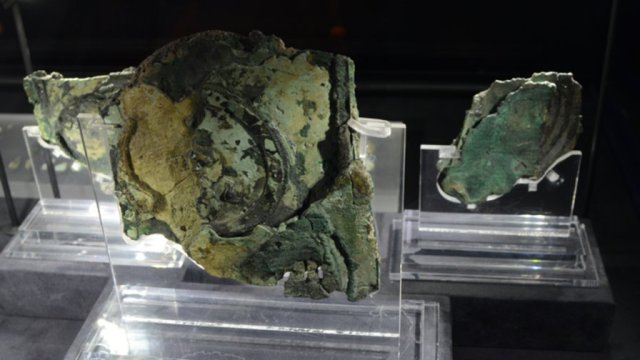
Writing discovered on ancient Greek device gives up its secrets to the Antikythera mechanism

by ROBBY BERMAN

Though it it seemed to be just a corroded lump of some sort when it was found in a shipwreck off the coast of Greece near Antikythera in 1900, in 1902 archaeologist Valerios Stais, looking at the gear embedded in it, guessed that what we now call the “Antikythera mechanism” was some kind of astronomy-based clock. He was in the minority—most agreed that something so sophisticated must have entered the wreck long after its other 2,000-year-old artifacts. Nothing like it was believed to have existed until 1,500 years later.

In 1951, British historian Derek J. de Solla Price began studying the find, and by 1974 he had worked out that it was, in fact, a device from 150 to 100 BC Greece. He realized it used meshing bronze gears connected to a crank to move hands on the device’s face in accordance with the Metonic cycle, the 235-month pattern that ancient astronomers used to predict eclipses.

By 2009, modern imaging technology had identified all 30 of the Antikythera mechanism’s gears, and a virtual model of it was released.

Understanding how the pieces fit goes together confirmed that the Antikythera mechanism was capable of predicting the positions of the planets with which the Greeks were familiar—Mercury, Venus, Mars, Jupiter and Saturn—as well as the sun and moon, and eclipses. It even has a black and white stone that turns to show the phases of the moon. Andrew Carol, an engineer from Apple, built a (much bigger) working model of the device using Legos to demonstrate its operation.

In June of 2016, an international team of experts revealed new information derived from tiny inscriptions on the devices parts in ancient Greek that had been too tiny to read—some of its characters are just 1/20th of an inch wide—until cutting-edge imaging technology allowed it to be more clearly seen. They’ve now read about 35,00 characters explaining the device.

The writing verifies the Antikythera mechanism’s capabilities, with a couple of new wrinkles added: The text refers to upcoming eclipses by color, which may mean they were viewed as having some kind of oracular meaning. Second, it appears the device was built by more than one person on the island of Rhodes, and that it probably wasn’t the only one of its kind. The ancient Greeks were apparently even further ahead in their astronomical understanding and mechanical know-how than we’d imagined.

The ‘Shazam’ For Plants Will Identify Any Plant From A Picture

by Alanna Ketler

An estimated 400,000 flowering plant species exist in the world, and, understandably, it can be difficult to keep track. The vast majority of us can only recognize and name a handful of plants, even if we would like it to be otherwise. If you would like to sharpen your knowledge in the wonderful realm of plant species, I have some good news for you. Like everything else: there’s an app for that.

If you ever walk by a specific plant that you would like to identify, or you have extensive knowledge about plant species that you would like to share, then the PlantNet app is for you. Available for iPhone and Android devices, it is essentially the Shazam for plants. It’s pretty awesome to consider what technology is capable of these days.

The app works by collecting data from a large social network which uploads pictures and information about plants. Scientists from four French research organizations including Cirad, IRA, Inria/IRD, and the Tela Botanica Network developed the app.

The app features visualization software which recognizes many plant species, provided they have been illustrated well enough in the botanical reference base. PlantNet currently works on more than 4,100 species of wild flora of the French territory, and the species list is provided through the application. The number of species included and images used by the application grows as more users contribute.

While only a small percentage of plant species can be identified so far, the more users who join, and the more participants from different countries become involved, the more diverse this app will become. So if this is something that interests you, get the app and start contributing today.

While at the moment it doesn’t focus on edibles, this app lays the frame work for herb collecting and identifying plants in nature that could either be dangerous to you or that you would love to learn more about. The average person these days is enjoying a greater appreciation for nature this app can help them outfit their home and living space with plants they love.

In the future, an edible database could help foragers pick from the wild spread nature has to offer. Not only are wild sources of plants and herbs cleaner and free of pesticides, but they also can be picked fresher and be more nutritious.

At the same time, this app is inevitably going to get people out in nature more as now they can walk about trails and nature with a keen curiosity to learn more about what’s around them.

http://www.collective-evolution.com/2016/03/10/the-shazam-for-plants-will-identify-any-plant-from-a-picture/

iPhone device designed by Snowden and Huang to reveal when your phone is secretly transmitting


A mockup of Edward Snowden and Bunnie Huang’s iPhone modification, showing the SIM card slot through which their hardware add-on would access the phone’s antennae to monitor them for errant signals.

By Andy Greenberg

When Edward Snowden met with reporters in a Hong Kong hotel room to spill the NSA’s secrets, he famously asked them put their phones in the fridge to block any radio signals that might be used to silently activate the devices’ microphones or cameras. So it’s fitting that three years later, he’s returned to that smartphone radio surveillance problem. Now Snowden’s attempting to build a solution that’s far more compact than a hotel mini-bar.

On Thursday at the MIT Media Lab, Snowden and well-known hardware hacker Andrew “Bunnie” Huang plan to present designs for a case-like device that wires into your iPhone’s guts to monitor the electrical signals sent to its internal antennas. The aim of that add-on, Huang and Snowden say, is to offer a constant check on whether your phone’s radios are transmitting. They say it’s an infinitely more trustworthy method of knowing your phone’s radios are off than “airplane mode,” which people have shown can be hacked and spoofed. Snowden and Huang are hoping to offer strong privacy guarantees to smartphone owners who need to shield their phones from government-funded adversaries with advanced hacking and surveillance capabilities—particularly reporters trying to carry their devices into hostile foreign countries without constantly revealing their locations.

“One good journalist in the right place at the right time can change history,” Snowden told the MIT Media Lab crowd via video stream. “This makes them a target, and increasingly tools of their trade are being used against them.”1

“They’re overseas, in Syria or Iraq, and those [governments] have exploits that cause their phones to do things they don’t expect them to do,” Huang elaborated to WIRED in an interview ahead of the MIT presentation. “You can think your phone’s radios are off, and not telling your location to anyone, but actually still be at risk.”

Huang’s and Snowden’s solution to that radio-snitching problem is to build a modification for the iPhone 6 that they describe as an “introspection engine.” Their add-on would appear to be little more than an external battery case with a small mono-color screen. But it would function as a kind of miniature, form-fitting oscilloscope: Tiny probe wires from that external device would snake into the iPhone’s innards through its SIM-card slot to attach to test points on the phone’s circuit board. (The SIM card itself would be moved to the case to offer that entry point.) Those wires would read the electrical signals to the two antennas in the phone that are used by its radios, including GPS, Bluetooth, Wi-Fi and cellular modem. And by identifying the signals that transmit those different forms of radio information, the modified phone would warn you with alert messages or an audible alarm if its radios transmit anything when they’re meant to be off. Huang says it could possibly even flip a “kill switch” to turn off the phone automatically.

“Our approach is: state-level adversaries are powerful, assume the phone is compromised,” Huang says. “Let’s look at hardware-related signals that are extremely difficult to fake. We want to give a you-bet-your-life assurance that the phone actually has its radios off when it says it does.”1

You might think you can achieve the same effect by simply turning your iPhone off with its power button, or placing it in a Faraday bag designed to block all radio signals. But Faraday bags can still leak radio information, Huang says, and clever malware can make an iPhone appear to be switched off when it’s not, as Snowden warned in an NBC interview in 2014. Regardless, Huang says their intention was to allow reporters to reliably disable a phone’s radio signals while still using the device’s other functions, like taking notes and photographs or recording audio and video.

Snowden, who performed the work in his capacity as a director of the Freedom of the Press Foundation, adds that their goal isn’t merely just protection for journalists. It’s also detection of otherwise stealthy attacks on phones, the better to expose governments’ use of hidden smartphone surveillance techniques. “You need to be able to increase the costs of getting caught,” Snowden said in a video call with WIRED following the presentation. “All we have to do is get one or two or three big cases where we catch someone red-handed, and suddenly the targeting policies at these intelligence agencies will start to change.”2

The problem, for Snowden, is personal. He tells WIRED he hasn’t carried a smartphone since he first began leaking NSA documents, for fear that its cellular signals could be used to locate him. (He notes that he still hasn’t “seen any indication” that the U.S. government has been able to determine his exact location in Russia.) “Since 2013, I haven’t been able to have a smartphone like normal people,” he says. “Wireless devices are kind of like kryptonite to me.”

Huang and Snowden’s iPhone modification, for now, is little more than a design. The pair has tested their method of picking up the electrical signals sent to an iPhone 6’s antennae to verify that they can spot its different radio messages. But they have yet to even build a prototype, not to mention a product. But on Thursday they released a detailed paper explaining their technique. They say they hope to develop a prototype over the next year and eventually create a supply chain in China of modified iPhones to offer journalists and newsrooms. To head off any potential mistrust of their Chinese manufacturers, Huang says the device’s code and hardware design will be fully open-source.

Huang, who lives in Singapore but travels monthly to meet with hardware manufacturers in Shenzhen, says that the skills to create and install their hardware add-on are commonplace in mainland China’s thriving iPhone repair and modification markets. “This is definitely something where, if you’re the New York Times and you want to have a pool of four or five of these iPhones and you have a few hundred extra dollars to spent on them, we could do that.” says Huang. “The average [DIY enthusiast] in America would think this is pretty fucking crazy. The average guy who does iPhone modifications in China would see this and think it’s not a problem.”
The two collaborators have never met face-to-face. Snowden says he first met Huang after recommending him to television producers at Vice, who were looking for hardware hacking experts. “He’s one of the hardware researchers I respect the most in the world,” Snowden says. In late 2015, they began talking via the encrypted communications app Signal about Snowden’s idea of building an altered phone to protect journalists from advanced attacks that could compromise their location.

Huang insists that Snowden’s focus for the project from the beginning has been protecting that breed of vulnerable reporters, not from the NSA, but from foreign governments that are increasingly able to buy zero-day vulnerability information necessary to compromise even hard-to-hack targets like the iPhone. As a case study, they point in their paper to the story of Marie Colvin, the recently murdered American war correspondent whose family is suing Syria’s government; Colvin’s family claims she was tracked based on her electronic communications and killed in a targeted bombing by the country’s brutal Assad regime for reporting on civilian casualties.

Huang says he’s tried to develop the most no-frills protection possible that still meets Snowden’s rightfully paranoid standards. “If it wasn’t for the fact that Snowden is involved, I think this would seem pretty mundane,” Huang says almost bashfully. “My solution is simple. But it helps an important group of people.”

https://www.wired.com/2016/07/snowden-designs-device-warn-iphones-radio-snitches/#slide-1

Thanks to Kebmodee for bringing this to the It’s Interesting community.

Smallest hard disk to date writes information atom by atom

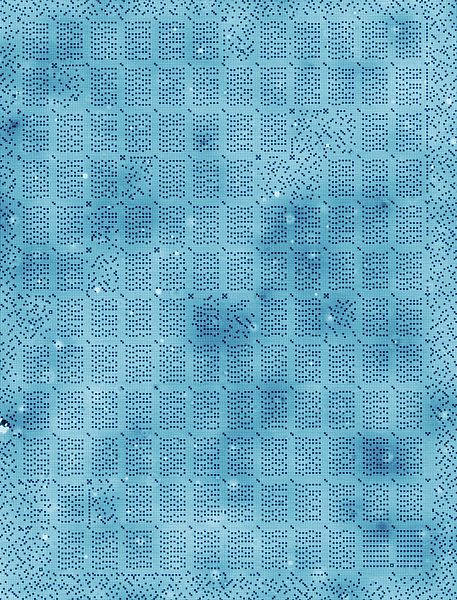
Every day, modern society creates more than a billion gigabytes of new data. To store all this data, it is increasingly important that each single bit occupies as little space as possible. A team of scientists at the Kavli Institute of Nanoscience at Delft University managed to bring this reduction to the ultimate limit: they built a memory of 1 kilobyte (8,000 bits), where each bit is represented by the position of one single chlorine atom.

“In theory, this storage density would allow all books ever created by humans to be written on a single post stamp”, says lead-scientist Sander Otte.

They reached a storage density of 500 Terabits per square inch (Tbpsi), 500 times better than the best commercial hard disk currently available. His team reports on this memory in Nature Nanotechnology on Monday July 18.

Feynman

In 1959, physicist Richard Feynman challenged his colleagues to engineer the world at the smallest possible scale. In his famous lecture There’s Plenty of Room at the Bottom, he speculated that if we had a platform allowing us to arrange individual atoms in an exact orderly pattern, it would be possible to store one piece of information per atom. To honor the visionary Feynman, Otte and his team now coded a section of Feynman’s lecture on an area 100 nanometers wide.


Sliding puzzle

The team used a scanning tunneling microscope (STM), in which a sharp needle probes the atoms of a surface, one by one. With these probes scientists cannot only see the atoms but they can also use them to push the atoms around. “You could compare it to a sliding puzzle”, Otte explains. “Every bit consists of two positions on a surface of copper atoms, and one chlorine atom that we can slide back and forth between these two positions. If the chlorine atom is in the top position, there is a hole beneath it — we call this a 1. If the hole is in the top position and the chlorine atom is therefore on the bottom, then the bit is a 0.” Because the chlorine atoms are surrounded by other chlorine atoms, except near the holes, they keep each other in place. That is why this method with holes is much more stable than methods with loose atoms and more suitable for data storage.

Codes

The researchers from Delft organized their memory in blocks of 8 bytes (64 bits). Each block has a marker, made of the same type of ‘holes’ as the raster of chlorine atoms. Inspired by the pixelated square barcodes (QR codes) often used to scan tickets for airplanes and concerts, these markers work like miniature QR codes that carry information about the precise location of the block on the copper layer. The code will also indicate if a block is damaged, for instance due to some local contaminant or an error in the surface. This allows the memory to be scaled up easily to very big sizes, even if the copper surface is not entirely perfect.

Datacenters

The new approach offers excellent prospects in terms of stability and scalability. Still, this type of memory should not be expected in datacenters soon. Otte: “In its current form the memory can operate only in very clean vacuum conditions and at liquid nitrogen temperature (77 K), so the actual storage of data on an atomic scale is still some way off. But through this achievement we have certainly come a big step closer”.

This research was made possible through support from the Netherlands Organisation for Scientific Research (NOW/FOM). Scientists of the International Iberian Nanotechnology Laboratory (INL) in Portugal performed calculations on the behavior of the chlorine atoms.

For more information, please contact dr. Sander Otte, Kavli Institute of Nanoscience, TU Delft: A.F.Otte@tudelft.nl, +31 15 278 8998

http://www.tudelft.nl/en/current/latest-news/article/detail/kleinste-harddisk-ooit-schrijft-informatie-atoom-voor-atoom/

Thanks to Kebmodee for bringing this to the It’s Interesting community.

Thieves using computers to hack ignition to steal cars

By JEFF BENNETT

Police and car insurers say thieves are using laptop computers to hack into late-model cars’ electronic ignitions to steal the vehicles, raising alarms about the auto industry’s greater use of computer controls.

The discovery follows a recent incident in Houston in which a pair of car thieves were caught on camera using a laptop to start a 2010 Jeep Wrangler and steal it from the owner’s driveway. Police say the same method may have been used in the theft of four other late-model Wranglers and Cherokees in the city. None of the vehicles has been recovered.

“If you are going to hot-wire a car, you don’t bring along a laptop,” said Senior Officer James Woods, who has spent 23 years in the Houston Police Department’s auto antitheft unit. “We don’t know what he is exactly doing with the laptop, but my guess is he is tapping into the car’s computer and marrying it with a key he may already have with him so he can start the car.”

The National Insurance Crime Bureau, an insurance-industry group that tracks car thefts across the U.S., said it recently has begun to see police reports that tie thefts of newer-model cars to what it calls “mystery” electronic devices.

“We think it is becoming the new way of stealing cars,” said NICB Vice President Roger Morris. “The public, law enforcement and the manufacturers need to be aware.”

Fiat Chrysler Automobiles NV said it “takes the safety and security of its customers seriously and incorporates security features in its vehicles that help to reduce the risk of unauthorized and unlawful access to vehicle systems and wireless communications.”

On Wednesday, a Fiat Chrysler official said he believes the Houston thieves “are using dealer tools to marry another key fob to the car.”

Titus Melnyk, the auto maker’s senior manager of security architecture for North America, said an individual with access to a dealer website may have sold the information to a thief. The thief will enter the vehicle identification number on the site and receive a code. The code is entered into the car’s computer triggering the acceptance of the new key.

The recent reports highlight the vulnerabilities created as cars become more computerized and advanced technology finds its way into more vehicles. Fiat Chrysler, General Motors Co. and Tesla Motors Inc. have had to alter their car electronics over the last two years after learning their vehicles could be hacked.

Fiat Chrysler last year recalled 1.4 million vehicles to close a software loophole that allowed two hackers to remotely access a 2014 Jeep Cherokee and take control of the vehicle’s engine, air conditioning, radio and windshield wipers.

Startups and auto-parts makers also are getting involved in cyberprotections for cars.

“In an era where we call our cars computers on wheels, it becomes more and more difficult to stop hacking,” said Yoni Heilbronn, vice president of marketing for Israel-based Argus Cyber Security Ltd., a company developing technologies to stop or detect hackers. “What we now need is multiple layers of protection to make the efforts of carrying out a cyberattack very costly and deter hackers from spending the time and effort.”

San Francisco-based Voyomotive LLC is developing a mobile application that when used with a relay switch installed on the car’s engine can prevent hackers with their own electronic key from starting a vehicle. Its technology also will repeatedly relock a car’s doors if they are accessed by a hacker.

This month, U.S. Secretary of Transportation Anthony Foxx is slated to attend an inaugural global automotive cybersecurity summit in Detroit. General Motors Co. Chief Executive Mary Barra and other industry executives are scheduled to speak.

Automotive industry trade groups are working on a blueprint of best practices for safely introducing new technologies. The Auto-Information Sharing and Analysis Center, created by the Alliance of Automobile Manufacturers and the Global Automakers Association, provides a way to share information on cyberthreats and incorporate cybercrime prevention technologies.

In the Houston car theft, a home-security camera captures a man walking to the Jeep and opening the hood. Officer Woods said he suspects the man is cutting the alarm. About 10 minutes later, after a car door is jimmied open, another man enters the Jeep, works on the laptop and then backs the car out of the driveway.

“We still haven’t received any tips,” the officer said.

The thief, says the NICB’s Mr. Morris, likely used the laptop to manipulate the car’s computer to recognize a signal sent from an electronic key the thief then used to turn on the ignition. The computer reads the signal and allows the key to turn.

“We have no idea how many cars have been broken into using this method,” Mr. Morris said. “We think it is minuscule in the overall car thefts but it does show these hackers will do anything to stay one step ahead.”

http://www.wsj.com/articles/thieves-go-high-tech-to-steal-cars-1467744606

New Real-Time In-Ear Device Translator By Waverly Labs To Be Released Soon

Language barrier will no longer be a problem around the world as an in-ear device will be the answer to this. The device can translate foreign language to the wearer’s native language and it works real time.

A company called Waverly Labs has developed a device called “The Pilot.” that will do a real-time translation while on the wearer’s ears.

A smart phone app will also let the user choose different foreign languages, currently Spanish, French, Italian and English. Additional languages will be available soon after, which include East Asian, Hindi, Semitic, Arabic, Slavic, African, and more.The device also works only with always-on data connection of the wearer’s smartphone.

To use the device, the earpieces can be shared by two people. While talking in different languages, the in-ear device will serve as the wearers’ translators to understand each other.

The device will cost $129.

Massive sculpture relocated because people kept walking into it while texting


The statue by Sophie Ryder had to be moved because people on their phones were bumping into it.

By Sophie Jamieson

A massive 20ft statue of two clasped hands had to be relocated after people texting on their mobile phones kept walking into it.

The sculpture, called ‘The Kiss’, was only put in place last weekend, but within days those in charge of the exhibition noticed walkers on the path were bumping their heads as they walked through the archway underneath.

Artist Sophie Ryder, who designed the sculpture, posted a video of it being moved by a crane on her Facebook page.

The artwork was positioned on a path leading up to Salisbury Cathedral in Wiltshire.

Made from galvanised steel wire, The Kiss had a 6ft 4in gap underneath the two hands that pedestrians could walk through.

But Ms Ryder said people glued to their phones had not seen it coming.

She said on social media: “We had to move ‘the kiss’ because people were walking through texting and said they bumped their heads! Oh well!!”

Her fans voiced their surprise that people could fail to notice the “ginormous” sculpture.

Cindy Billingsley commented: “Oh good grief- they should be looking at the beautiful art instead of texting- so they deserve what they get if they are not watching where they are going.”

Patricia Cunningham said: “If [sic] may have knocked some sense into their heads! We can but hope.”

Another fan, Lisa Wallis-Adams, wrote: “We saw your art in Salisbury at the weekend. We absolutely loved your rabbits and didn’t walk into any of them! Sorry some people are complete numpties.”

Sculptor Sophie Ryder studied at the Royal Academy of Arts and is known for creations of giant mythical figures, like minotaurs.

The sculpture is part of an exhibition that also features Ryder’s large “lady hares” and minotaurs, positioned on the lawn outside the cathedral. The exhibition runs until 3 July.

http://www.telegraph.co.uk/news/uknews/12164922/Massive-sculpture-relocated-because-people-busy-texting-kept-walking-into-it.html

The Largest Air Purifier Ever Built Sucks Up Smog And Turns It Into Gem Stones

air1

by Kelsey Campbell-Dollaghan

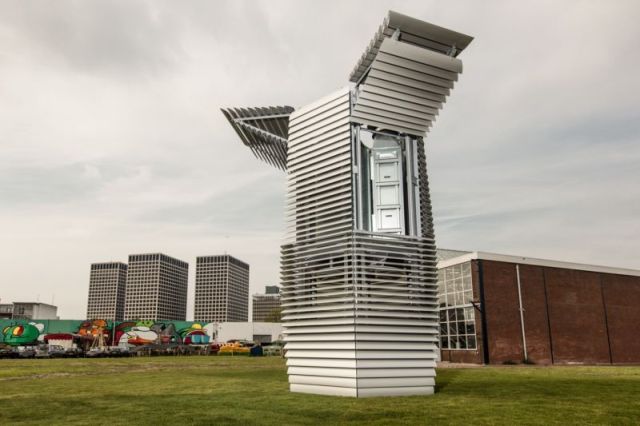
What’s 23 feet tall, eats smog, and makes jewelry for fun?

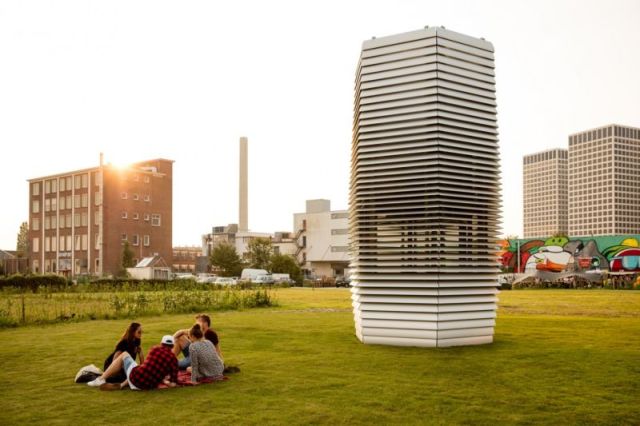
In Rotterdam this week, the designer Daan Roosegaarde is showing off the result of three years of research and development: The largest air purifier ever built. It’s a tower that scrubs the pollution from more than 30,000 cubic meters of air per hour—and then condenses those fine particles of smog into tiny “gem stones” that can be embedded in rings, cufflinks, and more.

Each stone is roughly equivalent to cleaning 1,000 cubic meters of air—so you’re literally wearing the pollution that once hung in the air around Roosegaarde’s so-called Smog Free Tower. In the designer’s words, buying a ring means “you donate a thousand cubic meters of clean air to the city where the Smog Free Tower is.”

The process taking place inside its walls is powered by 1,400 watts of sustainable energy, which is comparable to a water boiler, and the studio says it hopes to one day integrate solar PVs into the design to power the process—which works not so differently than some ionic air purifiers. Roosegaarde explains:

By charging the Smog Free Tower with a small positive current, an electrode will send positive ions into the air. These ions will attach themselves to fine dust particles. A negatively charged surface -the counter electrode- will then draw the positive ions in, together with the fine dust particles. The fine dust that would normally harm us, is collected together with the ions and stored inside of the tower. This technology manages to capture ultra-fine smog particles which regular filter systems fail to do.

http://www.stumbleupon.com/su/6GjtPr/:1R-Rmh@rp:bhW_+Lt$/gizmodo.com/the-largest-air-purifier-ever-built-sucks-up-smog-and-t-1729298355