
Holocaust Museum to visitors: Please stop catching Pokemon here

By Andrea Peterson

Almost everywhere you turn, it seems like people have their eyes glued to smartphone screens playing Pokemon Go. Since its launch last week, the app has quickly become a cultural phenomenon that has fans of all ages hunting around their neighborhoods for collectible digital creatures that appear on players’ screens almost like magic as they explore real-world locations.

But there’s at least one place that would really like to keep Pokemon out: the Holocaust Museum.

The Museum itself, along with many other landmarks, is a “PokeStop” within the game — a place where players can get free in-game items. In fact, there are actually three different PokeStops associated with various parts of the museum.

“Playing the game is not appropriate in the museum, which is a memorial to the victims of Nazism,” Andrew Hollinger, the museum’s communications director, told The Post in an interview. “We are trying to find out if we can get the museum excluded from the game.”

The Holocaust Museum’s plight highlights how apps that layer a digital world on top of the real one, or so-called augmented reality games, can come with unforeseen consequences and raises questions about how much control the physical owner of a space can exert as those two worlds intersect.

One image circulating online appears to show a player encountering an unsettling digital critter inside the museum: a poison gas-type Pokemon called Koffing floating by a sign for the museum’s Helena Rubinstein Auditorium. Clearly, it’s an awkward if not offensive thing to find in a place dedicated to making sure the world never forgets those killed in the gas chambers at Nazi death camps.

The image, which appears to have originated from a now deleted post on the photo-sharing site imgur, might be a hoax: That particular Pokemon didn’t appear nearby when this Post reporter visited the museum Monday afternoon, although the specific Pokemon that appears in each location does vary from time to time. Hollinger said that the museum is aware of and concerned about the potential Koffing appearance.

If a player really did encounter a Koffing inside the museum, it seems unlikely that Niantic Labs— the developers behind the game — would have made it show up there on purpose. But even the specter of that particular Pokemon spawning there raises questions about what sort of controls the game has in place to stop its fantasy world from causing distress in the real world, even if that distress is unintentional.

Niantic did not immediately respond to inquiries about the alleged Koffing sighting or if there was any way to honor the Holocaust Museum’s request to stop Pokemon from popping up inside its building.

Hollinger stressed that the museum is generally pro-technology and encourages visitors to use social media to share how their experiences with the exhibits moved them. “But this game falls very much outside that,” he said. Hollinger added that it seemed disrespectful, especially in more solemn parts of the complex like the Hall of Remembrance.

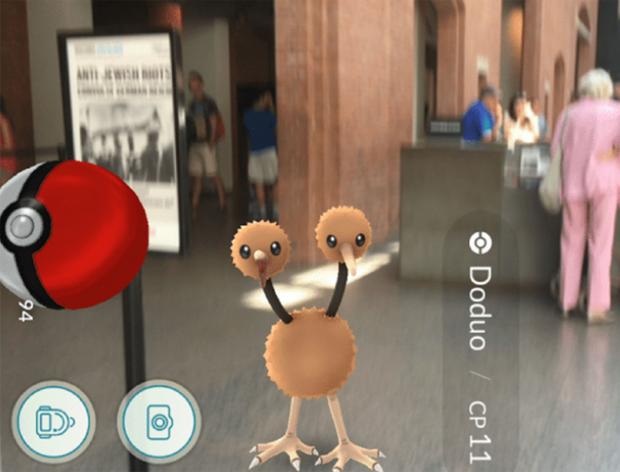
On Monday afternoon, there were plenty of people inside the museum who seemed to be distracted from its haunting exhibits as they tried to “catch ’em all.” A player even used a lure module, a beacon that attracts Pokemon to a specific PokeStop, on the museum’s marker — making double-headed bird-like creatures dubbed Doduos and rodent-like Rattatas practically swarm on users’ screens.

The player behind the lure, a 30-year-old visiting from North Carolina named Dustin who declined to share his last name with The Post for privacy reasons, was excited to catch a crustacean-like Krabby while waiting in the museum’s lobby with a group of friends to pick up tickets for a scheduled tour of the exhibits.

Although the museum is uncomfortable with its Pokemon infestation, most of the players building up their digital critter collection inside the building at least didn’t seem to mean any disrespect.

“It’s not like we came here to play,” said Angie, a 37-year-old member of Dustin’s huddle who also declined to share her last name for privacy reasons, “But gotta catch ’em all.”

https://www.washingtonpost.com/news/the-switch/wp/2016/07/12/holocaust-museum-to-visitors-please-stop-catching-pokemon-here/?campaign_id=A100&campaign_type=Email

The Japanese video game company Nintendo was founded 34 years before the fall of the Ottoman Empire

But if video games weren’t created until the middle part of the twentieth century (most video game historians point to the Cathode Ray Tube Amusement Device, created in 1947, as the first true “video game”), what exactly did Nintendo do in its early years?

The company that would become “Nintendo” was founded in 1889 by entrepreneur Fusajiro Yamauchi as “Nintendo Koppai” (also known as the “Nintendo Playing Card Co. Ltd.,” and was styled as a playing card company that mostly made Japanese playing cards called “Hanafuda.” The so-called “flower cards” have been a part of Japanese gameplay for centuries, and Nintendo had great success in manufacturing and marketing them. The company still makes cards to this day.

Despite the company’s success with playing cards, Yamauchi’s grandson Hiroshi eventually realized that Nintendo had probably gone as far as anyone possibly could with just cards. In 1956, the young go-getter was astonished to see that the massive United States Playing Card Company was run out of a small office. If that’s what they were working with, what could Nintendo possibly aspire to?

First up: character cards. Nintendo (quite sagely) picked up the rights to the Disney cabal of characters, putting them on their cards and driving sales, but that wasn’t quite enough. They needed to think bigger.

The early sixties weren’t too kind to the ever-expanding Nintendo empire. The company, hellbent on mixing things up and pushing past just playing card sales, stretched itself too thin by getting involved with everything. Well, nearly everything.

Between 1963 and 1968, Nintendo began dabbling in such disparate industries as transportation (a taxi company), hospitality (a love hotel chain), and food (they specialized in ramen) under the umbrella of “Nintendo Co., Ltd.” None of these attempts at expanding into different industries worked out, and Nintendo soon needed to find something new to embrace.

After the mixed bag that was the ’50s, Nintendo turned its attentions to toys, including the carnival-like “Love Tester” and the popular “Kousenjuu” light gun games, which paved the way for the company to turn their attentions to more light gun-based gaming. Slowly, the company moved towards more electronics-heavy games and toys, even though they couldn’t initially keep up with big names like Bandai and Tomy.

Nintendo steadily worked their way into the video game realm, but things really changed in 1974, when the company bought the distribution rights for the Magnavox Odyssey video game console. In 1975, the company set about making their own video arcade games, with Genyo Takeda’s “EVR Race.” By 1977, the company was making its very own consoles, originally styled as five different kinds of the “Color TV-Game.” (The first Color-TV Game console is responsible for bringing six different takes on Pong to the world.)

These consoles were partially designed by Shigeru Miyamoto, who would go on to design Donkey Kong for the company in 1981, a game-changer through and through. Once Donkey Kong hit the market—allowing Nintendo to enjoy licensing their own products to other companies—Nintendo had established itself as a force to be reckoned with in the burgeoning video game sector.

Once Nintendo’s dominance in the industry was recognized, the company began churning out inspiring new creations, from the handheld “Game & Watch” game series, to the “Family Computer” for home gaming (eventually launched as the NES outside of Japan), to the smash-hit that was the Game Boy (invented in 1989). The company’s success continued in the late eighties, thanks to the release of the Super Nintendo (SNES), which also helped kick off the infamous battle with rival Sega.

In 1994, Nintendo celebrated the sale of one billion game cartridges (a tenth of them attributed to Mario games alone). A series of missteps marred the rest of the ’90s, including the disappointing Virtual Boy in 1995, but the company quickly rebounded with the Nintendo 64, the Game Boy Pocket, and the Game Boy Color.

The aughts proved to be similarly fraught for the company with the disappointment of machines like GameCube and Game Boy Micro. This was briefly tempered by the success of the Nintendo DS and the New Super Mario Bros. game in 2006.

If there’s one thing that’s really changed things for the company, though, it’s the Wii, first introduced in 2006. The motion-controlled system has proven to be especially successful for Nintendo.

Next up for the company? A heavier reliance on glasses-free 3D displays, an interest in video compression, and games that fold in advanced face and voice recognition.

http://mentalfloss.com/article/59057/brief-history-125-years-nintendo