Why do we sleep? The answer may change right before we turn 3.

By Nicoletta Lanese

Humans spend about a third of our lives sleeping, and scientists have long debated why slumber takes up such a huge slice of our time. Now, a new study hints that our main reason for sleeping starts off as one thing, then changes at a surprisingly specific age.

Two leading theories as to why we sleep focus on the brain: One theory says that the brain uses sleep to reorganize the connections between its cells, building electrical networks that support our memory and ability to learn; the other theory says that the brain needs time to clean up the metabolic waste that accumulates throughout the day. Neuroscientists have quibbled over which of these functions is the main reason for sleep, but the new study reveals that the answer may be different for babies and adults.

In the study, published Sep. 18 in the journal Science Advances, researchers use a mathematical model to show that infants spend most of their sleeping hours in “deep sleep,” also known as random eye movement (REM) sleep, while their brains rapidly build new connections between cells and grow ever larger. Then, just before toddlers reach age 2-and-a-half, their amount of REM sleep dips dramatically as the brain switches into maintenance mode, mostly using sleep time for cleaning and repair.

“It was definitely shocking to us that this transition was so sharp,” from growth mode to maintenance mode, senior author Van Savage, a professor of ecology and evolutionary biology and of computational medicine at the University of California, Los Angeles and the Santa Fe Institute, told Live Science in an email. The researchers also collected data in other mammals — namely rabbits, rats and guinea pigs — and found that their sleep might undergo a similar transformation; however, it’s too soon to tell whether these patterns are consistent across many species.

That said, “I think in actuality, it may not be really so sharp” a transition, said Leila Tarokh, a neuroscientist and Group Leader at the University Hospital of Child and Adolescent Psychiatry and Psychotherapy at the University of Bern, who was not involved in the study. The pace of brain development varies widely between individuals, and the researchers had fairly “sparse” data points between the ages of 2 and 3, she said. If they studied individuals through time as they aged, they might find that the transition is less sudden and more smooth, or the age of transition may vary between individuals, she said.

An emerging hypothesis

In a previous study, published in 2007 in the journal Proceedings of the National Academy of Sciences, Savage and theoretical physicist Geoffrey West found that an animal’s brain size and brain metabolic rate accurately predict the amount of time the animal sleeps — more so than the animal’s overall body size. In general, big animals with big brains and low brain metabolic rates sleep less than small animals with the opposite features.

This rule holds up across different species and between members of the same species; for instance, mice sleep more than elephants, and newborn babies sleep more than adult humans. However, knowing that sleep time decreases as brains get bigger, the authors wondered how quickly that change occurs in different animals, and whether that relates to the function of sleep over time.

To begin answering these questions, the researchers pooled existing data on how much humans sleep, compiling several hundred data points from newborn babies and children up to age 15. They also gathered data on brain size and metabolic rate, the density of connections between brain cells, body size and metabolic rate, and the ratio of time spent in REM sleep versus non-REM sleep at different ages; the researchers drew these data points from more than 60 studies, overall.

Babies sleep about twice as much as adults, and they spend a larger proportion of their sleep time in REM, but there’s been a long-standing question as to what function that serves, Tarokh noted.

The study authors built a mathematical model to track all these shifting data points through time and see what patterns emerged between them. They found that the metabolic rate of the brain was high during infancy when the organ was building many new connections between cells, and this in turn correlated with more time spent in REM sleep. They concluded that the long hours of REM in infancy support rapid remodeling in the brain, as new networks form and babies pick up new skills. Then, between age 2 and 3, “the connections are not changing nearly as quickly,” and the amount of time spent in REM diminishes, Savage said.

At this time, the metabolic rate of cells in the cerebral cortex — the wrinkled surface of the brain — also changes. In infancy, the metabolic rate is proportional to the number of existing connections between brain cells plus the energy needed to fashion new connections in the network. As the rate of construction slows, the relative metabolic rate slows in turn.

“In the first few years of life, you see that the brain is making tons of new connections … it’s blossoming, and that’s why we see all those skills coming on,” Tarokh said. Developmental psychologists refer to this as a “critical period” of neuroplasticity — the ability of the brain to forge new connections between its cells. “It’s not that plasticity goes away” after that critical period, but the construction of new connections slows significantly, as the new mathematical model suggests, Tarokh said. At the same time, the ratio of non-REM to REM sleep increases, supporting the idea that non-REM is more important to brain maintenance than neuroplasticity.

Looking forward, the authors plan to apply their mathematical model of sleep to other animals, to see whether a similar switch from reorganization to repair occurs early in development, Savage said.

“Humans are known to be unusual in the amount of brain development that occurs after birth,” lead author Junyu Cao, an assistant professor in the Department of Information, Risk, and Operations Management at The University of Texas at Austin, told Live Science in an email. (Cao played a key role in compiling data and performing computations for the report.) “Therefore, it is conceivable that the phase transition described here for humans may occur earlier in other species, possibly even before birth.”

In terms of human sleep, Tarokh noted that different patterns of electrical activity, known as oscillations, occur in REM versus non-REM sleep; future studies could reveal whether and how particular oscillations shape the brain as we age, given that the amount of time spent in REM changes, she said. Theoretically, disruptions in these patterns could contribute to developmental disorders that emerge in infancy and early childhood, she added — but again, that’s just a hypothesis.


https://www.livescience.com/why-we-sleep-brain-study.html?utm_source=Selligent&utm_medium=email&utm_campaign=9160&utm_content=LVS_newsletter+&utm_term=3675605&m_i=8UY_jNTynHe_3zcTUUgbNBfsu5EMTsCU43mgi8tOnteS3vPmqAlJk16Q6TSxIHJi1tgAdgnm2Gm4GezgFd85bVdOj8L2hG9inkdIOF888c

MRI scans from more than 800 incarcerated men pinpoint distinct structural features of people who have committed homicide, compared with those who carried out other crimes.

by NICOLETTA LANESE

Kent Kiehl and his research team regularly park their long, white trailer just outside the doors of maximum-security prisons across the US. Inside the vehicle sits the bulky body of a mobile MRI machine. During each visit, people from the prison make their way to and from the vehicle in hourly shifts to have their brains scanned and help to answer an age-old question: What makes a murderer?

“It’s not an uncommon thing for [incarcerated people], while they’re getting a scan, to be like, ‘I’ve always been different. Can you tell me why I’ve always been so different?’” says Kiehl, a neuroscientist at the University of New Mexico and the Albuquerque-based nonprofit Mind Research Network (MRN) who helped design the mobile MRI system back in the early 2000s.


SCAN-MOBILE: Kiehl and his colleagues made more than 75 modifications to a trailer and the MRI system inside to outfit both for the team’s unique research.

The author of The Psychopath Whisperer: The Science of Those Without a Conscience, Kiehl has been fascinated by the criminal mind since he was an undergraduate at the University of California, Davis. Now, as director of mobile imaging at MRN, he oversees efforts to gather brain scans from thousands of people held in US prisons to learn what features, if any, might differ from scans of the general population.

This massive dataset recently allowed Kiehl to examine the brain structures of more than 800 men held in state prisons in New Mexico and Wisconsin in an attempt to distinguish incarcerated people who have committed homicide from those who have committed other crimes.

First, Kiehl and his colleagues laboriously sorted the pool of people who had volunteered for the study into three categories based on their crimes: homicide, violent offenses that were not homicide, or non-violent or minimally violent transgressions. The team relied on official convictions, self-reported homicides, and confidential interviews with participants to determine who attempted or committed murder—both offenses that got a “homicide” label in their dataset.

People charged with felony murder—meaning that they had committed a serious felony that was in some way connected to a person’s death, even though they hadn’t intended to kill the victim—and people whose cases indicated considerable doubt about a judgment of homicide were not counted among murderers. And occasionally, people were moved from another category into the homicide group, Kiehl says. The researchers excluded people with abnormal radiology reports, traumatic brain injury, or diagnosed psychotic disorders from the study.

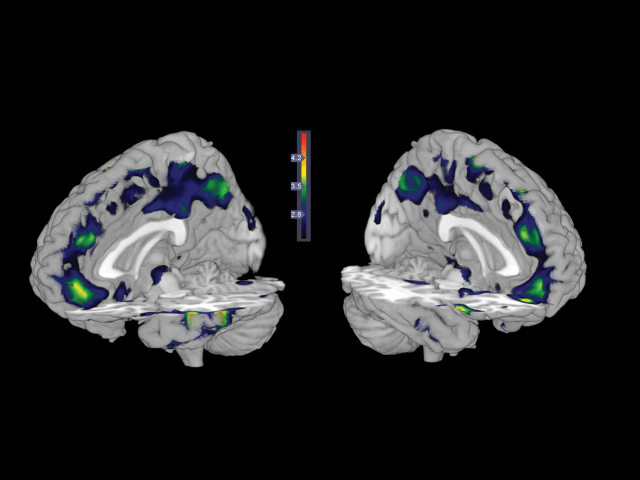
Controlling for substance use severity, time in prison, age, and IQ, the team analyzed the MRI data to look for differences among the study participants. Compared with the other two groups, the 200 men who had committed homicide showed significantly reduced gray matter in several brain regions that play important roles in behavioral control and social cognition.

“I think that the intriguing thing was, first, that they found a difference,” says Hannes Vogel, a neuropathologist at Stanford University Medical Center who was not involved in the work. “And second of all, that it correlates with some of the brain centers that deal with behavior and social interaction.”

Lora Cope, a neuroscientist who studies substance disorders at the University of Michigan, notes in an email to The Scientist that the team’s mobile MRI system has now been used in correctional facilities all over New Mexico and Wisconsin, and “has really revolutionized this area of research.” Indeed, the MRN has now used the equipment to collect roughly 6,500 scans from more than 3,000 research participants since its first outing in 2007.

Although Cope wasn’t involved in the current project, she worked with Kiehl a few years ago while earning her doctorate at the University of New Mexico. After speaking with members of the Avielle Foundation, named for a six-year-old victim of the 2012 Sandy Hook Elementary School shooting, the two researchers spearheaded a study of more than 150 incarcerated young males, 20 of whom had been convicted of homicide, held at a maximum-security detention facility within the state. “Jeremy, [Avielle’s] father, really wanted to know if there was anything neuroscience could tell us about boys who commit homicide,” says Kiehl.

As in the current study, Cope and Kiehl deployed the mobile scanner to collect MRI scans of the incarcerated teens in New Mexico and discovered differences between those who had committed homicide and their imprisoned peers. The homicide offenders “had significantly less gray matter volume in parts of their temporal lobes,” Cope says. When Kiel compared the data from that study with the results of his latest project, he found a high degree of overlap. “Lo and behold . . . we found and replicated every region that was different in the boys and was different in the adult males, and in the same way,” he says.

The latest study’s finding that MRI data can distinguish homicide offenders not only from people who committed non-violent crimes, but also from those who performed other violent crimes, is particularly interesting, says Harold Koenigsberg, a psychiatrist at Icahn School of Medicine at Mount Sinai. “I would have thought there would be more of an overlap between [homicide and violent non-homicide offenders],” he says. “I’m surprised that it was so specific to homicide.”


ANATOMY OF A MURDERER: Homicide offenders exhibited reduced gray matter density compared with other violent offenders in the regions of the brain highlighted blue and green above.

Koenigsberg notes that homicidal violence can itself be split into two categories: impulsive and instrumental. Impulsive violence is born of unbridled emotions and overblown reactions, a brand of behavior linked to poor frontal lobe functioning and abnormal serotonin levels. Instrumental violence, on the other hand, is premeditated and is associated with other brain changes, such as reduced amygdala activation during emotion processing. “These two groups, we think that they have different biologies,” says Koenigsberg. Kiehl’s dataset could be enriched by adding measures of neurotransmitter release and electrical activity, along with related behavioral assessments, he suggests, and with both functional and structural data, psychologists might learn more about what gives rise to these distinct behavioral phenotypes.

Koenigsberg, Vogel, and Kiehl all note that the structural data collected in the current study cannot on its own be used to predict who has committed homicide, let alone who might in the future. Nonetheless, the paper may find its way into the courtroom, says Vogel. If lawyers felt so inclined, they could try to “find an expert on one side who will quote this [paper]” in defense of someone who has committed a homicide, by arguing a client’s actions were due to brain abnormalities and thus out of his or her control. Or, a prosecutor could potentially use the paper to argue that MRI findings should be admissible as evidence that a defendant has committed a homicide, says Vogel, who has served as a consultant for court cases in California and Nevada, and helped investigate the brain of the Route 91 Harvest music festival shooter in 2017. “But then you’re [also] going to find an expert that will tear that [testimony] to pieces.”

Kiehl notes that his MRI study could also someday contribute to new evidence-based measures of homicidal risk. These measures could supplement current measures of violent behavior, such as psychological questionnaires, if future studies demonstrated they carried predictive weight, he says. Beyond courts of law, he also suggests that understanding how violent behavior arises could pave the way to better psychological treatment aimed at both rehabilitation and prevention.

https://www.the-scientist.com/notebook/secrets-in-the-brains-of-people-who-have-committed-murder-66589