New words added to the Oxford English Dictionary

The Oxford English Dictionary is a historical dictionary, which means that when its editors add a phrase such as hot mess to their reference—as they did this week—they add every definition of the word they can find. The editors are like detectives, following phrases back to times when Anglo-Saxons were jabbering about peasants and overlords.

The quarterly update reveals that in the 1800s, for instance, a “hot mess” was a warm meal, particularly one served to a group like troops. In the 1900s, people used hot mess to refer to a difficult or uncomfortable situation. And in the 2000s, one used it to refer to Amy Schumer (or, as they put it, something or someone in extreme confusion or disorder).

Twerk, another new addition, might have been made famous by Miley Cyrus and a foam finger in 2013, but the editors traced its meaning back to 1820, when twirk referred to a twisting or jerking movement. The precise origin of the word is uncertain, the editors say, but it may be a blend of twist or twitch and jerk. Their definition: “To dance to popular music in a sexually provocative manner, using thrusting movements of the bottom and hips while in a low, squatting stance.”

Here is a selection from the hundreds of words OED just added to its ranks, along with the earliest known usage and context provided by TIME.

autotune (v., 1997): to alter or correct the pitch of (a musical or vocal performance) using an auto-tune device, software, etc. The word has meant “to tune automatically” since 1958, when people were tuning radio transmitters rather than hilarious local news interviews.

backronym (n., 1983): a contrived explanation of an existing word’s origin, positing it as an acronym. When some guy tries to say that golf is an acronym of “gentlemen only, ladies forbidden,” that is a backronym (and clever nonsense). It more likely comes from the Dutch word kolf, which describes a stick used in sports.

boiler room (n., 1892): a place used as a center of operations for an election campaign, especially a room equipped for teams of volunteers to make telephone calls soliciting support for a party or candidate. This phrase has been used to describe an actual room that contains boilers, as on a steamship, since 1820.

bridge-and-tunnel (adj., 1977): of or designating a person from the outer boroughs or suburbs of a city, typically characterized as unsophisticated or unfashionable. The phrase was first used by Manhattanites to describe people they thought unworthy of their island.

cisgender (adj., 1999): designating someone whose sense of personal identity corresponds to the sex and gender assigned to him or her at birth. This word exists to serve as an equal and complement to transgender.

FLOTUS (n., 1983): the First Lady of the United States. This is a true acronym, which appears to have been first applied to Nancy Reagan.

fo’ shizzle (phr., 2001): in the language of rap and hip-hop this means “for sure.” Shizzle, as a euphemism for sh-t, dates back to the ’90s. One can also be “the shizzle,” which is the best or most popular thing.

half-ass (v., 1954): to perform (an action or task) poorly or incompetently; to do (something) in a desultory or half-hearted manner. One can also insult someone by calling them an “ass,” referring to the horse-like creature who has appeared in stories as the type who is clumsy or stupid since the time of the Greeks.

koozie (n., 1982): an insulating sleeve that fits over a beverage can or bottle to keep it cold. Fun fact: that little cardboard thing one slips around a cup of coffee to keep it from burning one’s hand is known as a zarf.

Masshole (n., 1989): term of contempt for a native or inhabitant of the state of Massachusetts. This is what is known as a blended word, which Lewis Carroll called portmanteaus, naming them after a suitcase that unfolds into two equal parts.

sext (n., 2001): a sexually explicit or suggestive message or image sent electronically, typically using a mobile phone. Back in the 1500s, when someone referred to a “sext,” they were talking about a Christian worship ritual that involved chanting around midday.

stanky (adj., 1972): having a strong (usually unpleasant) smell. The OED editors offer the comparison to skanky, which means unattractive or offensive, as well as janky, which refers to something that is untrustworthy or of poor quality.

http://time.com/3932402/oxford-dictionary-fo-shizzle-masshole-hot-mess/?xid=newsletter-brief

New research identifies similarity between how pigeons and human children learn equivalent of words

The more scientists study pigeons, the more they learn how their brains—no bigger than the tip of an index finger—operate in ways not so different from our own.

In a new study from the University of Iowa, researchers found that pigeons can categorize and name both natural and manmade objects—and not just a few objects. These birds categorized 128 photographs into 16 categories, and they did so simultaneously.

Ed Wasserman, UI professor of psychology and corresponding author of the study, says the finding suggests a similarity between how pigeons learn the equivalent of words and the way children do.

“Unlike prior attempts to teach words to primates, dogs, and parrots, we used neither elaborate shaping methods nor social cues,” Wasserman says of the study, published online in the journal Cognition. “And our pigeons were trained on all 16 categories simultaneously, a much closer analog of how children learn words and categories.”

For researchers like Wasserman, who has been studying animal intelligence for decades, this latest experiment is further proof that animals—whether primates, birds, or dogs—are smarter than once presumed and have more to teach scientists.

“It is certainly no simple task to investigate animal cognition; But, as our methods have improved, so too have our understanding and appreciation of animal intelligence,” he says. “Differences between humans and animals must indeed exist: many are already known. But, they may be outnumbered by similarities. Our research on categorization in pigeons suggests that those similarities may even extend to how children learn words.”

Wasserman says the pigeon experiment comes from a project published in 1988 and featured in The New York Times in which UI researchers discovered pigeons could distinguish among four categories of objects.

This time, the UI researchers used a computerized version of the “name game” in which three pigeons were shown 128 black-and-white photos of objects from 16 basic categories: baby, bottle, cake, car, cracker, dog, duck, fish, flower, hat, key, pen, phone, plan, shoe, tree. They then had to peck on one of two different symbols: the correct one for that photo and an incorrect one that was randomly chosen from one of the remaining 15 categories. The pigeons not only succeeded in learning the task, but they reliably transferred the learning to four new photos from each of the 16 categories.

Pigeons have long been known to be smarter than your average bird—or many other animals, for that matter. Among their many talents, pigeons have a “homing instinct” that helps them find their way home from hundreds of miles away, even when blindfolded. They have better eyesight than humans and have been trained by the U. S. Coast Guard to spot orange life jackets of people lost at sea. They carried messages for the U.S. Army during World Wars I and II, saving lives and providing vital strategic information.

UI researchers say their expanded experiment represents the first purely associative animal model that captures an essential ingredient of word learning—the many-to-many mapping between stimuli and responses.

“Ours is a computerized task that can be provided to any animal, it doesn’t have to be pigeons,” says UI psychologist Bob McMurray, another author of the study. “These methods can be used with any type of animal that can interact with a computer screen.”

McMurray says the research shows the mechanisms by which children learn words might not be unique to humans.

“Children are confronted with an immense task of learning thousands of words without a lot of background knowledge to go on,” he says. “For a long time, people thought that such learning is special to humans. What this research shows is that the mechanisms by which children solve this huge problem may be mechanisms that are shared with many species.”

Wasserman acknowledges the recent pigeon study is not a direct analogue of word learning in children and more work needs to be done. Nonetheless, the model used in the study could lead to a better understanding of the associative principles involved in children’s word learning.

“That’s the parallel that we’re pursuing,” he says, “but a single project—however innovative it may be—will not suffice to answer such a provocative question.”

http://now.uiowa.edu/2015/02/pigeon-power

Adoptees’ ‘lost language’ from infancy triggers brain response


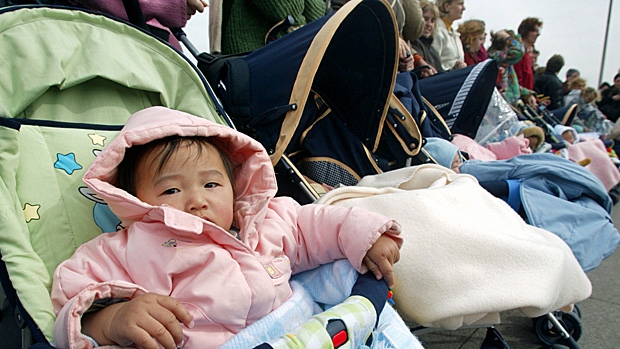
Chinese children are lined up in Tiananmen Square in 2003 for photos with the overseas families adopting them. The children in the new study were adopted from China at an average age of 12.8 months and raised in French-speaking families.

You may not recall any memories from the first year of life, but if you were exposed to a different language at the time, your brain will still respond to it at some level, a new study suggests.

Brain scans show that children adopted from China as babies into families that don’t speak Chinese still unconsciously recognize Chinese sounds as language more than a decade later.

“It was amazing to see evidence that such an early experience continued to have a lasting effect,” said Lara Pierce, lead author of the study just published in the journal Proceedings of the National Academy of Sciences, in an email to CBC News.

The adopted children, who were raised in French-speaking Quebec families, had no conscious memory of hearing Chinese.

“If you actually test these people in Chinese, they don’t actually know it,” said Denise Klein, a researcher at McGill University’s Montreal Neurological Institute who co-authored the paper.

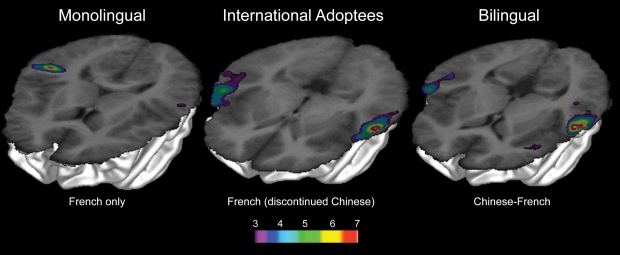
But their brains responded to Chinese language sounds the same way as those of bilingual children raised in Chinese-speaking families.


Children exposed to Chinese as babies display similar brain activation patterns as children with continued exposure to Chinese when hearing Chinese words, fMRI scans show.

“In essence, their pattern still looks like people who’ve been exposed to Chinese all their lives.”

Pierce, a PhD candidate in psychology at McGill University, working with Klein and other collaborators, scanned the brains of 48 girls aged nine to 17. Each participant lay inside a functional magnetic resonance imaging machine while she listened to pairs of three-syllable phrases. The phrases contained either:

■Sounds and tones from Mandarin, the official Chinese dialect.
■Hummed versions of the same tones but no actual words.

Participants were asked to tell if the last syllables of each pair were the same or different. The imaging machine measured what parts of the brain were active as the participants were thinking.

“Everybody can do the task — it’s not a difficult task to do,” Klein said. But the sounds are processed differently by people who recognize Chinese words — in that case, they activate the part of the brain that processes language.

Klein said the 21 children adopted from China who participated in the study might have been expected to show patterns similar to those of the 11 monolingual French-speaking children. After all, the adoptees left China at an average age of 12.8 months, an age when most children can only say a few words. On average, those children had not heard Chinese in more than 12 years.

The fact that their brains still recognized Chinese provides some insight into the importance of language learning during the first year of life, Klein suggested.

Effect on ‘relearning’ language not known

But Klein noted that the study is a preliminary one and the researchers don’t yet know what the results mean.

For example, would adopted children exposed to Chinese in infancy have an easier time relearning Chinese later, compared with monolingual French-speaking children who were learning it for the first time?

Pierce said studies trying to figure that out have had mixed results, but she hopes the findings in this study could generate better ways to tackle that question.

She is also interested in whether the traces of the lost language affect how the brain responds to other languages or other kinds of learning. Being able to speak multiple languages has already been shown to have different effects on the way the brain processes languages and other kinds of information.

http://www.cbc.ca/news/technology/adoptees-lost-language-from-infancy-triggers-brain-response-1.2838001