
Story by Corinne Purtill
Before epilepsy was understood to be a neurological condition, people believed it was caused by the moon, or by phlegm in the brain. They condemned seizures as evidence of witchcraft or demonic possession, and killed or castrated sufferers to prevent them from passing tainted blood to a new generation.
Today we know epilepsy is a disease. By and large, it’s accepted that a person who causes a fatal traffic accident while in the grip of a seizure should not be charged with murder.
That’s good, says Stanford University neurobiologist Robert Sapolsky. That’s progress. But there’s still a long way to go.
After more than 40 years studying humans and other primates, Sapolsky has reached the conclusion that virtually all human behavior is as far beyond our conscious control as the convulsions of a seizure, the division of cells or the beating of our hearts.
This means accepting that a man who shoots into a crowd has no more control over his fate than the victims who happen to be in the wrong place at the wrong time. It means treating drunk drivers who barrel into pedestrians just like drivers who suffer a sudden heart attack and veer out of their lane.
“The world is really screwed up and made much, much more unfair by the fact that we reward people and punish people for things they have no control over,” Sapolsky said. “We’ve got no free will. Stop attributing stuff to us that isn’t there.”
Sapolsky, a MacArthur “genius” grant winner, is extremely aware that this is an out-there position. Most neuroscientists believe humans have at least some degree of free will. So do most philosophers and the vast majority of the general population. Free will is essential to how we see ourselves, fueling the satisfaction of achievement or the shame of failing to do the right thing.
Saying that people have no free will is a great way to start an argument. This is partly why Sapolsky, who describes himself as “majorly averse to interpersonal conflict,” put off writing his new book “Determined: A Science of Life Without Free Will.”
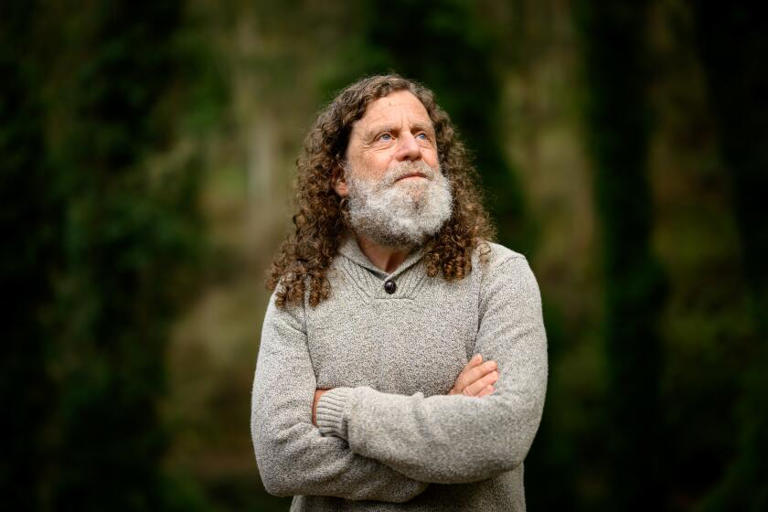
Sapolsky, 66, has a mild demeanor and a Jerry Garcia beard. For more than three decades, he escaped the politics of academia to study baboons in rural Kenya for a few months every year.
“I’m really, really, really trying not to sound like a combative jerk in the book,” he said. “I deal with human complexities by going and living in a tent. So yeah, I’m not up for a lot of brawls about this.”
Analyzing human behavior through the lens of any single discipline leaves room for the possibility that people choose their actions, he says. But after a long cross-disciplinary career, he feels it’s intellectually dishonest to write anything other than what he sees as the unavoidable conclusion: Free will is a myth, and the sooner we accept that, the more just our society will be.
“Determined,” which comes out today, builds on Sapolsky’s 2017 bestseller “Behave: The Biology of Humans at Our Best and Worst,” which won the Los Angeles Times Book Prize and a slew of other accolades.
The book breaks down the neurochemical influences that contribute to human behaviors, analyzing the milliseconds to centuries preceding, say, the pulling of a trigger or the suggestive touch on an arm.
“Determined” goes a step further. If it’s impossible for any single neuron or any single brain to act without influence from factors beyond its control, Sapolsky argues, there can be no logical room for free will.
Many people with even a passing familiarity with human biology can comfortably agree with this — up to a point.
We know we make worse decisions when hungry, stressed or scared. We know our physical makeup is influenced by the genes inherited from distant ancestors and by our mothers’ health during her pregnancy. Abundant evidence indicates that people who grew up in homes marked by chaos and deprivation will perceive the world differently and make different choices than people raised in safe, stable, resource-rich environments. A lot of important things are beyond our control.
But, like — everything? We have no meaningful command over our choice of careers, romantic partners or weekend plans? If you reach out right now and pick up a pen, was even that insignificant action somehow preordained?
Yes, Sapolsky says, both in the book and to the countless students who have asked the same question during his office hours. What the student experiences as a decision to grab the pen is preceded by a jumble of competing impulses beyond his or her conscious control. Maybe their pique is heightened because they skipped lunch; maybe they’re subconsciously triggered by the professor’s resemblance to an irritating relative.
Then look at the forces that brought them to the professor’s office, feeling empowered to challenge a point. They’re more likely to have had parents who themselves were college educated, more likely to hail from an individualistic culture rather than a collective one. All of those influences subtly nudge behavior in predictable ways.
You may have had the uncanny experience of talking about an upcoming camping trip with a friend, only to find yourself served with ads for tents on social media later. Your phone didn’t record your conversation, even if that’s what it feels like. It’s just that the collective record of your likes, clicks, searches and shares paints such a detailed picture of your preferences and decision-making patterns that algorithms can predict — often with unsettling accuracy — what you are going to do.
Something similar happens when you reach for that pen, Sapolsky says. So many factors beyond your conscious awareness brought you to that pen that it’s hard to say how much you “chose” to pick it up at all.
Sapolsky was raised in an Orthodox Jewish household in Brooklyn, the son of immigrants from the former Soviet Union.
Biology called to him early — by grade school he was writing fan letters to primatologists and lingering in front of the taxidermied gorillas at the American Museum of Natural History — but religion shaped life at home.
That all changed on a single night in his early teens, he says. While grappling with questions of faith and identity, he was struck by an epiphany that kept him awake until dawn and reshaped his future: God is not real, there is no free will, and we primates are pretty much on our own.
“That was kind of a big day,” he said with a chuckle, “and it’s been tumultuous since then.”
Skeptics could seize on this to rebut his arguments: If we aren’t free to choose our actions or beliefs, how does a boy from a deeply religious conservative home become a self-professed liberal atheist?
Change is always possible, he argues, but it comes from external stimuli. Sea slugs can learn to reflexively retreat from an electrical shock. Through the same biochemical pathways, humans are changed by exposure to external events in ways we rarely see coming.
Imagine, he offers, a group of friends that goes to see a biopic about an inspiring activist. One applies the next day to join the Peace Corps. One is struck by the beautiful cinematography and signs up for a filmmaking course. The rest are annoyed they didn’t see a Marvel film.
All of the friends were primed to respond as they did when they sat down to watch. Maybe one had heightened adrenaline from a close call with another car on the drive over; maybe another was in a new relationship and awash in oxytocin, the so-called love hormone. They had different levels of dopamine and serotonin in their brains, different cultural backgrounds, different sensitivities to sensory distractions in the theater. None chose how the stimulus of the film would affect them anymore than the sea slug “decided” to wince in response to a jolt.
For fellow adherents of determinism — the belief that it’s impossible for a person in any situation to have acted differently than they did — Sapolsky’s scientific defense of the cause is welcome.
“Who we are and what we do is ultimately the result of factors beyond our control and because of this we are never morally responsible for our actions in the sense that would make us truly deserving of praise and blame, punishment and reward,” said Gregg Caruso, a philosopher at SUNY Corning who read early drafts of the book. “I am in agreement with Sapolsky that life without belief in free will is not only possible but preferable.”
Caruso is co-director of the Justice Without Retribution Network, which advocates for an approach to criminal activity that prioritizes preventing future harm rather than assigning blame. Focusing on the causes of violent or antisocial behavior instead of fulfilling a desire for punishment, he said, “will allow us to adopt more humane and effective practices and policies.”
Theirs is very much a minority viewpoint.
Sapolsky is “a wonderful explainer of complex phenomena,” said Peter U. Tse, a Dartmouth neuroscientist and author of the 2013 book “The Neural Basis of Free Will.” “However, a person can be both brilliant and utterly wrong.”
Neural activity is highly variable, Tse said, with identical inputs often resulting in non-identical responses in individuals and populations. It’s more accurate to think of those inputs as imposing parameters rather than determining specific outcomes. Even if the range of potential outcomes is limited, there’s simply too much variability at play to think of our behavior as predetermined.
What’s more, he said, it’s harmful to do so.
“Those who push the idea that we are nothing but deterministic biochemical puppets are responsible for enhancing psychological suffering and hopelessness in this world,” Tse said.
Even those who believe biology limits our choices are wary of how openly we should embrace that.
Saul Smilansky, a philosopher at the University of Haifa in Israel and author of the book “Free Will and Illusion,” rejects the idea that we can will ourselves to transcend all genetic and environmental constraints. But if we want to live in a just society, we have to believe that we can.
“Losing all belief in free will and moral responsibility would likely be catastrophic,” he said, and encouraging people to do so is “dangerous, even irresponsible.”
A widely cited 2008 study found that people who read passages dismissing the idea of free will were more likely to cheat on a subsequent test. Other studies have found that people who feel less control over their actions care less about making mistakes in their work, and that disbelief in free will leads to more aggression and less helpfulness.
Sapolsky discusses such concerns in his book, ultimately concluding that the effects seen in such experiments are too small and their lack of reproducibility too great to support the idea that civilization will crumble if we think we can’t control our fates.
The more compelling critique, he says, is eloquently articulated in the short story “What’s Expected of Us,” by speculative fiction writer Ted Chiang. The narrator describes a new technology that convinces users their choices are predetermined, a discovery that saps them of their will to live.
“It’s essential that you behave as if your decisions matter,” the narrator warns, “even though you know that they don’t.”
The greatest risk of abandoning free will, Sapolsky concedes, isn’t that we’ll want to do bad things. It’s that, without a sense of personal agency, we won’t want to do anything.
“It may be dangerous to tell people that they don’t have free will,” Sapolsky said. “The vast majority of the time, I really think it’s a hell of a lot more humane.”
Sapolsky knows he won’t persuade most of his readers. It’s hard to convince people who have been harmed that perpetrators deserve less blame because of their history of poverty. It’s even harder to convince the well-off that their accomplishments deserve less praise because of their history of privilege.
“If you have time to be bummed out by that, you’re one of the lucky ones,” he said.
His true hope, he says, is to increase compassion. Maybe if people understand how thoroughly an early history of trauma can rewire a brain, they’ll stop lusting for harsh punishments. Maybe if someone realizes they have a brain condition like depression or ADHD, they’ll stop hating themselves for struggling with tasks that seem easier for others.
Just as previous generations thought seizures were brought on by witchcraft, some of our current beliefs about personal responsibility may eventually be undone by scientific discovery.
We are machines, Sapolsky argues, exceptional in our ability to perceive our own experiences and feel emotions about them. It is pointless to hate a machine for its failures.
There is only one last thread he can’t resolve.
“It is logically indefensible, ludicrous, meaningless to believe that something ‘good’ can happen to a machine,” he writes. “Nonetheless, I am certain that it is good if people feel less pain and more happiness.”
Stanford scientist, after decades of study, concludes: We don’t have free will (msn.com)


 It's Interesting