Deputy fires “1 in a billion” shot into suspect’s gun barrel

Arapahoe County prosecutors on Wednesday, July 13, cleared a Jefferson County sheriff’s deputy in an off-duty shooting stemming from an attempted robbery in January.

Deputy Jose Marquez was shot in the shoulder and abdomen during the Jan. 26 attempted robbery in an apartment parking lot on East Adriatic Drive near Rangeview High School.

One of the suspects fled the scene and has not been identified. The other, Jhalil Meshesha, was wounded in the leg and later arrested, prosecutors said.

In a letter to Jefferson County Sheriff Jeff Shrader and Aurora Police Chief Nick Metz, Arapahoe County Deputy District Attorney Rich Orman said Marquez, who was off duty and not in uniform at the time of the robbery, acted appropriately.

“Deputy Marquez reasonably believed that his life was in danger and acted reasonably in shooting Meshesha, and that he used an appropriate level of physical force. I further find that Deputy Marquez’s actions were justified and he did not violate Colorado law,” the letter said.

Marquez told police he was visiting his girlfriend at her apartment when he went outside to grab something from his car. As he walked back, he saw two young men with masks on their face. One of the men told him to “give it up,” Marquez said, and pulled out a pistol.

Marquez said the two men fired first and he returned fire.


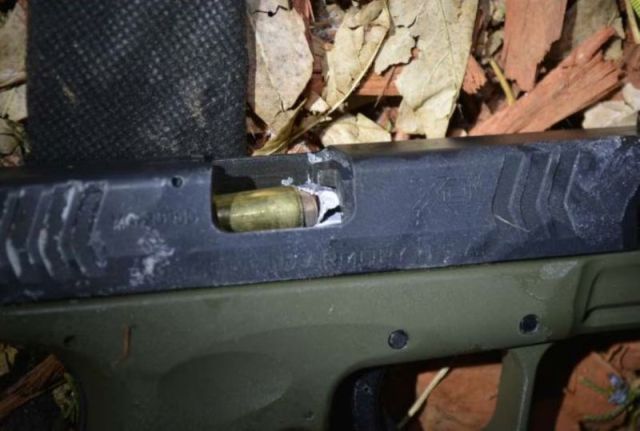
One of Marquez’s bullets struck Meshesha’s pistol, traveling straight down that gun’s barrel and disabling it. Police called the shot “one in a billion.”

http://www.aurorasentinel.com/news/jeffco-deputy-cleared-aurora-shooting/

German police catch suspect after he can’t resist going outside to play Pokemon Go

German police say they’ve arrested an 18-year-old man who was wanted for evading a prison sentence after he ventured out to play the newly launched “Pokemon Go” smartphone game with friends.

Police in Trier, on Germany’s western border, said the group’s “peculiar behavior” as they played the game in the city on Friday prompted officers to check their papers.

The 18-year-old initially gave a false identity but police quickly established that there was an arrest warrant out for him. He was detained and is now serving a six-month prison sentence he had previously avoided serving — police wouldn’t specify for what.

http://bigstory.ap.org/15e655e1560d4f3d9d1a450d9cc61687

Thieves using computers to hack ignition to steal cars

By JEFF BENNETT

Police and car insurers say thieves are using laptop computers to hack into late-model cars’ electronic ignitions to steal the vehicles, raising alarms about the auto industry’s greater use of computer controls.

The discovery follows a recent incident in Houston in which a pair of car thieves were caught on camera using a laptop to start a 2010 Jeep Wrangler and steal it from the owner’s driveway. Police say the same method may have been used in the theft of four other late-model Wranglers and Cherokees in the city. None of the vehicles has been recovered.

“If you are going to hot-wire a car, you don’t bring along a laptop,” said Senior Officer James Woods, who has spent 23 years in the Houston Police Department’s auto antitheft unit. “We don’t know what he is exactly doing with the laptop, but my guess is he is tapping into the car’s computer and marrying it with a key he may already have with him so he can start the car.”

The National Insurance Crime Bureau, an insurance-industry group that tracks car thefts across the U.S., said it recently has begun to see police reports that tie thefts of newer-model cars to what it calls “mystery” electronic devices.

“We think it is becoming the new way of stealing cars,” said NICB Vice President Roger Morris. “The public, law enforcement and the manufacturers need to be aware.”

Fiat Chrysler Automobiles NV said it “takes the safety and security of its customers seriously and incorporates security features in its vehicles that help to reduce the risk of unauthorized and unlawful access to vehicle systems and wireless communications.”

On Wednesday, a Fiat Chrysler official said he believes the Houston thieves “are using dealer tools to marry another key fob to the car.”

Titus Melnyk, the auto maker’s senior manager of security architecture for North America, said an individual with access to a dealer website may have sold the information to a thief. The thief will enter the vehicle identification number on the site and receive a code. The code is entered into the car’s computer triggering the acceptance of the new key.

The recent reports highlight the vulnerabilities created as cars become more computerized and advanced technology finds its way into more vehicles. Fiat Chrysler, General Motors Co. and Tesla Motors Inc. have had to alter their car electronics over the last two years after learning their vehicles could be hacked.

Fiat Chrysler last year recalled 1.4 million vehicles to close a software loophole that allowed two hackers to remotely access a 2014 Jeep Cherokee and take control of the vehicle’s engine, air conditioning, radio and windshield wipers.

Startups and auto-parts makers also are getting involved in cyberprotections for cars.

“In an era where we call our cars computers on wheels, it becomes more and more difficult to stop hacking,” said Yoni Heilbronn, vice president of marketing for Israel-based Argus Cyber Security Ltd., a company developing technologies to stop or detect hackers. “What we now need is multiple layers of protection to make the efforts of carrying out a cyberattack very costly and deter hackers from spending the time and effort.”

San Francisco-based Voyomotive LLC is developing a mobile application that when used with a relay switch installed on the car’s engine can prevent hackers with their own electronic key from starting a vehicle. Its technology also will repeatedly relock a car’s doors if they are accessed by a hacker.

This month, U.S. Secretary of Transportation Anthony Foxx is slated to attend an inaugural global automotive cybersecurity summit in Detroit. General Motors Co. Chief Executive Mary Barra and other industry executives are scheduled to speak.

Automotive industry trade groups are working on a blueprint of best practices for safely introducing new technologies. The Auto-Information Sharing and Analysis Center, created by the Alliance of Automobile Manufacturers and the Global Automakers Association, provides a way to share information on cyberthreats and incorporate cybercrime prevention technologies.

In the Houston car theft, a home-security camera captures a man walking to the Jeep and opening the hood. Officer Woods said he suspects the man is cutting the alarm. About 10 minutes later, after a car door is jimmied open, another man enters the Jeep, works on the laptop and then backs the car out of the driveway.

“We still haven’t received any tips,” the officer said.

The thief, says the NICB’s Mr. Morris, likely used the laptop to manipulate the car’s computer to recognize a signal sent from an electronic key the thief then used to turn on the ignition. The computer reads the signal and allows the key to turn.

“We have no idea how many cars have been broken into using this method,” Mr. Morris said. “We think it is minuscule in the overall car thefts but it does show these hackers will do anything to stay one step ahead.”

http://www.wsj.com/articles/thieves-go-high-tech-to-steal-cars-1467744606

Man chooses to wear ‘I am a thief’ sign over going to jail

thief

An Ohio man chose to wear a sign proclaiming he’s a thief rather than go to jail after trying to steal a 52-inch television.

Greg Davenport, of Liberty Township, pleaded no contest this month to a theft charge for stealing from a Wal-Mart in the township in December.

A judge in Girard gave Davenport, 44, the sentencing option of 30 days in jail or wearing a sign saying, “I am a thief. I stole from WalMart.”

Davenport has to wear the sign in front of the store eight hours a day for 10 days of his choosing.

Wife crashes her own funeral, horrifying her husband, who had paid to have her killed

By Sarah Kaplan

Noela Rukundo sat in a car outside her home in Melbourne, Australia, watching as the last few mourners filed out. They were leaving a funeral — her funeral.

Finally, she spotted the man she’d been waiting for. She stepped out of her car, and her husband put his hands on his head in horror.

“Is it my eyes?” she recalled him saying. “Is it a ghost?”

“Surprise! I’m still alive!” she replied.

Far from being elated, the man looked terrified. Five days earlier, he had ordered a team of hit men to kill Rukundo, his partner of 10 years. And they did — well, they told him they did. They even got him to pay an extra few thousand dollars for carrying out the crime.

Now here was his wife, standing before him. In an interview with the BBC on Thursday, Rukundo recalled how he touched her shoulder to find it unnervingly solid. He jumped. Then he started screaming.

“I’m sorry for everything,” he wailed.

But it was far too late for apologies; Rukundo called the police. The husband, Balenga Kalala, ultimately pleaded guilty and was sentenced to nine years in prison for incitement to murder.

The happy ending — or as happy as can be expected to a saga in which a man tries to have his wife killed — was made possible by three unusually principled hit men, a helpful pastor and one incredibly gutsy woman: Rukundo.

Here is how she pulled it off.

Rukundo’s ordeal began almost exactly a year ago, when she flew from her home in Melbourne with her husband, Kalala, to attend a funeral in her native Burundi. Her stepmother had died, and the service left her saddened and stressed. She retreated to her hotel room in Bujumbura, the capital, early in the evening; despondent after the events of the day, she lay down in bed. Then her husband called.

“He told me to go outside for fresh air,” she told the BBC.

But the minute Rukundo stepped out of her hotel, a man charged forward, pointing a gun right at her.

“Don’t scream,” she recalled him saying. “If you start screaming, I will shoot you. They’re going to catch me, but you? You will already be dead.”

Rukundo, terrified, did as she was told. She was ushered into a car and blindfolded so she couldn’t see where she was being taken. After 30 or 40 minutes, the car came to a stop, and Rukundo was pushed into a building and tied to a chair.

She could hear male voices, she told the ABC. One asked her, “You woman, what did you do for this man to pay us to kill you?”

“What are you talking about?” Rukundo demanded.

“Balenga sent us to kill you.”

They were lying. She told them so. And they laughed.

“You’re a fool,” they told her.

There was the sound of a dial tone, and a male voice coming through a speakerphone. It was her husband’s voice.

“Kill her,” he said.

And Rukundo fainted.

Rukundo had met her husband 11 years earlier, right after she arrived in Australia from Burundi, according to the BBC. He was a recent refugee from Congo, and they had the same social worker at the resettlement agency that helped them get on their feet. Since Kalala already knew English, their social worker often recruited him to translate for Rukundo, who spoke Swahili.

They fell in love, moved in together in the Melbourne suburb of Kings Park, and had three children (Rukundo also had five kids from a previous relationship). She learned more about her husband’s past — he had fled a rebel army that had ransacked his village, killing his wife and young son. She also learned more about his character.

“I knew he was a violent man,” Rukundo told the BBC. “But I didn’t believe he can kill me.”

But, it appeared, he could.

Rukundo came to in the strange building somewhere near Bujumbura. The kidnappers were still there, she told the ABC.

They weren’t going to kill her, the men then explained — they didn’t believe in killing women, and they knew her brother. But they would keep her husband’s money and tell him that she was dead. After two days, they set her free on the side of a road, but not before giving her a cellphone, recordings of their phone conversations with Kalala, and receipts for the $7,000 in Australian dollars they allegedly received in payment, according to Australia’s The Age newspaper.

“We just want you to go back, to tell other stupid women like you what happened,” Rukundo said she was told before the gang members drove away.

Shaken, but alive and doggedly determined, Rukundo began plotting her next move. She sought help from the Kenyan and Belgian embassies to return to Australia, according to The Age. Then she called the pastor of her church in Melbourne, she told the BBC, and explained to him what had happened. Without alerting Kalala, the pastor helped her get back home to her neighborhood near Melbourne.

Meanwhile, her husband had told everyone she had died in a tragic accident and the entire community mourned her at her funeral at the family home. On the night of Feb. 22, 2015, just as the widower Kalala waved goodbye to neighbors who had come to comfort him, Rukundo approached him, the very man whose voice she’d heard over the phone five days earlier, ordering that she be killed.

“I felt like somebody who had risen again,” she told the BBC.

Though Kalala initially denied all involvement, Rukundo got him to confess to the crime during a phone conversation that was secretly recorded by police, according to The Age.

“Sometimes Devil can come into someone, to do something, but after they do it they start thinking, ‘Why I did that thing?’ later,” he said, as he begged her to forgive him.

Kalala eventually pleaded guilty to the scheme. He was sentenced to nine years in prison by a judge in Melbourne.

“Had Ms. Rukundo’s kidnappers completed the job, eight children would have lost their mother,” Chief Justice Marilyn Warren said, according to the ABC. “It was premeditated and motivated by unfounded jealousy, anger and a desire to punish Ms. Rukundo.”

Rukundo said that Kalala tried to kill her because he thought she was going to leave him for another man — an accusation she denies.

But her trials are not yet over. Rukundo told the ABC she’s gotten backlash from Melbourne’s Congolese community for reporting Kalala to the police. Someone left threatening messages for her, and she returned home one day to find her back door broken. She now has eight children to raise alone and has asked the Department of Human Services to help her find a new place to live.

And lying in bed at night, Kalala’s voice still comes to her: “Kill her, kill her,” she told the BBC. “Every night, I see what was happening in those two days with the kidnappers.”

Despite all that, “I will stand up like a strong woman,” she said. “My situation, my past life? That is gone. I’m starting a new life now.”

https://www.washingtonpost.com/news/morning-mix/wp/2016/02/05/wife-crashes-her-own-funeral-horrifying-her-husband-who-had-paid-have-her-killed/

Alligator eats burglary suspect hiding from cops


Investigators have identified the remains of a suspected burglar who was killed by an alligator. Police say it appears 22-year-old Matthew Riggins was hiding from law enforcement when the incident occurred.

Brevard County deputies have determined that Matthew Riggins, 22, was killed by an alligator in Barefoot Bay lake on Nov. 23 while possibly hiding to avoid law enforcement.

Investigators say that Riggins had told his girlfriend he would be in Barefoot Bay to commit burglaries with another suspect who is now in custody but not cooperating with officials, according to Maj. Tod Goodyear with BCSO.

Deputies responded to calls in Barefoot Bay on Nov. 13 that there were two men dressed in black walking behind area houses, who ran from responding officers. Later that day, Riggins was reported missing to the Palm Bay Police Department.

Police searching the area reported hearing “yelling” but could not determine the source that night, Goodyear said. Ten days later, Riggins’ body was found in the lake.

Sheriff’s dive team members encountered an 11-foot alligator behaving aggressively while recovering the body, according to BCSO.

“When the body was found, it had injuries that were consistent with an alligator attack,” Goodyear said. “We had trappers euthanize the gator and when we opened it up, there were some remains inside that were consistent with injuries found on the body.”

Riggins died from drowning and bites were discovered along his legs and body that led investigators to determine he had been dragged underwater by the massive animal.

http://www.usatoday.com/story/news/nation-now/2015/12/08/alligator-kills-florida-burglary-suspect-hiding-cops/76966512/

Man gets married an hour after receiving 40 year prison sentence.

By Rich Cholodofsky

A Monessen man convicted of the robbery and assault of a 91-year-old Rostraver woman was sentenced Thursday to serve up to 40 years in prison. About an hour later, Greg Howard appeared in another Westmoreland County courtroom to marry his girlfriend.

Howard, 47, had nothing to say standing before Judge Rita Hathaway as she ordered that he spend at least 20 years behind bars for the October 2014 home invasion that left Frances Tekavec severely injured and her savings stolen. He was given credit for the time he has served in jail since early November.

“Thank God she is here today and didn’t die in the incident,” Hathaway said.

Howard’s silence was in sharp contrast to his demeanor during the three-day trial in July in which he served as his own lawyer. Howard gave a rambling closing argument during the trial, referencing Santa Claus, the tooth fairy, the Easter bunny and other cultural icons. It took jurors 43 minutes to convict Howard of robbery, aggravated assault and conspiracy.

During the trial, prosecutors said Howard and two other men broke into Tekavec’s home. The men used a Levin’s furniture truck as a ruse to get into the home by asking her to sign a fake delivery receipt, according to trial testimony. Witnesses said they took $13,000 and jewelry and left Tekavec lying on her bed with her ankles and wrists bound.

Tekavec identified Howard as one of her attackers. She made no comment in court on Thursday, but Hathaway read a letter she wrote about the impact of the crime.

In the letter, Tekavec said she is now confined to a wheelchair, and because of the injuries she suffered in the attack, she is in constant pain and is restricted from performing basic personal chores, such as brushing her hair.

“Certainly there are very serious effects she has suffered because of the crime committed against her,” Hathaway said.

Defense attorney Tim Dawson asked that Howard receive concurrent sentences because two other men were more responsible for the violence.

Charges are pending against co-defendants Lamont Dixon, 35, and Branddon Danilchak, 28.

Howard was allowed to wear civilian clothing in court instead of a prison jumpsuit. Deputies said Howard remained shackled during a brief wedding ceremony later in the afternoon presided over by Judge Richard E. McCormick Jr.

The ceremony was attended by five deputies and the bride’s baby, who was born last month.

Read more: http://triblive.com/news/westmoreland/9191589-74/howard-gets-prison#ixzz3nbzLDYFm

German woman who was thought to be a murder victim after a man confessed to killing her decades ago has turned up alive and well.

by Stephanie McNeal

Petra Pazsitka was living in the city of Braunschweig when she disappeared without a trace on July 26, 1984.

According to The Telegraph, who quoted an unnamed friend, Pazsitka was studying computer science and had just finished her thesis paper.

She had gone to the dentist the last day she was seen, and had planned on going to visit her parents afterward. But she never made it there, sparking a huge manhunt, The Telegraph said.

Pazsitka’s disappearance initially stumped investigators, and her case was featured on a German true-crime show called Aktenzeichen XY.

Police suspected that her disappearance was connected to the case of a 14-year-old girl who had been raped and murdered near where Pazsitka vanished, NBC News reported, citing Joachim Grande, a spokesman for the police in Braunschweig.

However, a few years later there was a breakthrough in the case. A 19-year-old man identified as Günter K. confessed to killing the 14-year-old in 1985.

In 1987, he confessed to also killing Pazsitka – and authorities closed the case in 1989. The young woman’s body was never found.

But now, police said, Pazsitka’s “disappearance” appears to have been a carefully orchestrated plot to start a new life.

Pazsitka had been saving money for months before she vanished, and spent the next few decades living in different German cities, police said. She eventually settled in Düsseldorf, where she has been living for 11 years, according to The Telegraph, citing police.

She was able to evade notice because she never opened a bank account or had a social security card, a driver’s license, or a passport.

An official told NBC News the now–55-year-old paid for everything in cash and made money doing “illicit work.”

A woman claimed to be Pazsitka when she reported a burglary at her home and police arrived, according to NBC News.

When first asked who she was, the woman allegedly gave a fake name. But she then claimed to be Pazsitka.

She has remained mum on why she vanished, and said she wants no contact with the public or her living family members.

“We asked her if there was violence or sexual assault in the family, but she has clearly ruled that out,” an official said according to the The Telegraph.

According to NBC News, the woman’s brother and mother were “in shock and tears when they heard the news.”

It is unlikely the woman will face any charges – but if it is determined she is Pazsitka, she will have to be declared to be alive, The Telegraph reported.

http://www.buzzfeed.com/stephaniemcneal/murder-victim-alive#.yclKLwgxq

Woman undergoes surgery to recover stolen 6 carat diamond she swallowed

A Chinese woman who swallowed a six-carat (1.2g) diamond was forced to take laxatives and endure colonoscopy. Jiang Xulian, 39, stole the diamond worth Thb10m (£180,000) diamond from the Bangkok Gems and Jewellery Fair in Nonthaburi, Thailand.

She confessed to her theft to police when an X-ray showed the stone in her large intestine. The woman was later given laxatives before she and her alleged partner-in-crime – identified as Hae Ying, 34 – were held in police custody for legal action.

The couple had been brought to the attention of Thai police by an exhibitor at the fair. CCTV images showed the pair visiting the exhibition stand, where they allegedly switched the six-carat diamond with a fake, after asking to give it a closer inspection while at the jewellery fair.

The stall owner reported Jiang and Hae to the police, and they were detained at Suvarnabhumi airport on Thursday night. The pair tried to evade arrest by claiming they were tourists returning from their holidays, but their tale was proven to be fiction when a scan revealed the precious stone in Jiang’s stomach.

Jiang was given laxatives to speed up the movement of the diamond through her digestive system, but the diamond stayed in place. Jiang finally agreed to have an operation to remove the diamond, after being told that the jewel could cause damage to her digestive system.

The stone was identified as the stolen gemstone by its owner after its removal. The couple face up to three years in prison if convicted of the crime.

https://itsinterestingdotcom.wordpress.com/wp-admin/post-new.php

Netherlands close 8 prisons for lack of criminals

Netherlands is closing eight prisons because of a lack of criminals, the Dutch justice ministry has announced, reports Huffington Post.

Declining crime rates in the Netherlands mean that although the country has the capacity for 14,000 prisoners, there are only 12,000 detainees.

The decrease is expected to continue, the ministry said, with Deputy Justice Minister Nebahat Albayrak saying that natural redundancy and other measures should counter any forced lay-offs.

A report last year on prison overcrowding said that surging populations undermined the rehabilitation of prisoners and risked increasing reoffending in the future.

The Criminal Justice Alliance (CJA), which represents more than 60 organisations, called for the government to urgently limit “the unnecessary use of prison, ensuring it is reserved for serious, persistent and violent offenders for whom no alternative sanction is appropriate”.

It came after Chief Inspector of Prisons Nick Hardwick said the rising pressure on prisons from budget cuts and increasing numbers cannot go on indefinitely.

http://www.thedailystar.net/world/netherlands-close-8-prisons-lack-criminals-97480