

Drinking Coffee in the Morning, but not All-Day, Decreased the Risk of Death

Key takeaways:

  • Morning coffee drinkers had a 16% risk reduction for death from all causes.
  • Morning coffee drinkers who consumed between over two to three or more cups achieved the greatest benefits.

People who drink coffee in the morning have a lower risk for death from all causes compared with those who do not drink coffee at all, results from an observational cohort study published in the European Heart Journal showed.

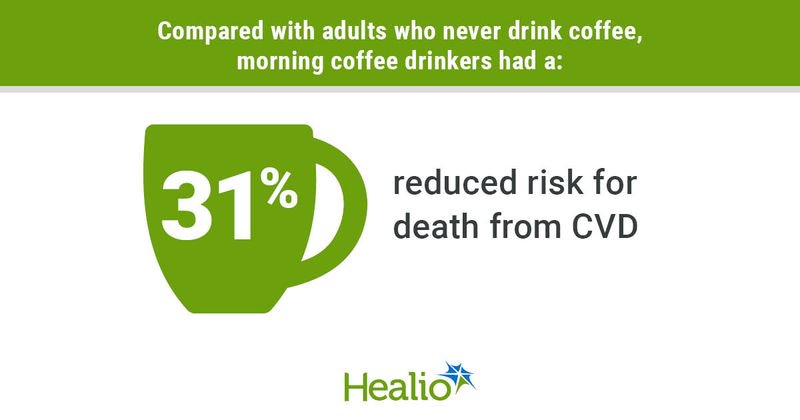
The association between morning coffee consumption and reduced mortality risk appeared especially strong with respect to CVD, according to researchers. Meanwhile, the analysis revealed that those who drank coffee throughout the day did not achieve the same mortality benefits as morning drinkers.
PC0125Qi_Graphic_01_WEB
Data derived from:  Wang X, et al. Eur Heart J. et al. 2025;doi:10.1093/eurheartj/ehae871.

“While moderate coffee drinking has been recommended for the beneficial relations with health based on previous studies, primary care providers [should] be informed that the time of coffee drinking also matters, beyond the amounts consumed,” Lu Qi, MD, PhD, a professor at Tulane University Celia Scott Weatherhead School of Public Health and Tropical Medicine, told Healio.

Current research suggests that coffee consumption “doesn’t raise the risk of cardiovascular disease, and it seems to lower the risk of some chronic diseases, such as type 2 diabetes,” Qi said in a press release.

“Given the effects that caffeine has on our bodies, we wanted to see if the time of day when you drink coffee has any impact on heart health.”

In the study, Qi and colleagues assessed links between mortality and coffee consumption — including the volume and timing — using data from the National Health and Nutrition Examination Survey from 1999 to 2018.

The analysis comprised 40,725 adults who had given dietary data of what they consumed on at least one day. This included a subgroup of 1,463 adults who completed a detailed food and drink diary for an entire week.

Overall, 48% of the cohort did not drink coffee, 36% had a morning-type coffee drinking pattern — primarily drinking from 4 a.m. to 11:59 a.m. — and 16% had an all-day drinking pattern.

The researchers found that, after adjusting for factors like sleep hours and caffeinated and decaffeinated coffee intake amounts, morning coffee drinkers were 16% (HR = 0.84; 95% CI, 0.74-0.95) less likely to die of any cause and 31% (HR = 0.69; 95% CI, 0.55-0.87) less likely to die from CVD compared with those who did not drink coffee.

People who drank coffee all day did not have any risk reductions vs. those who did not drink coffee.

The amount of coffee consumed among morning drinkers also influenced risk reductions, as researchers reported HRs for all-cause mortality of:

  • 0.85 (95% CI, 0.71-1.01) among those who consumed more than zero to one cup;
  • 0.84 (95% CI, 0.73-0.96) among those who consumed more than one to two cups;
  • 0.72 (95% CI, 0.6-0.86) among those who consumed more than two to three cups; and
  • 0.79 (95% CI, 0.65-0.97) among those who consumed more than three cups.

Study results showed similar patterns for mortality from CVD, “but the interaction term was not significant,” Qi and colleagues wrote.

The researchers identified a couple of study limitations. For example, the analysis used self-reported dietary data, opening the potential for recall bias, while they also could not rule out possible residual and unmeasured cofounders.

The study did not explain why morning coffee consumption reduced the risk for death from CVD, Qi said in the release.

“A possible explanation is that consuming coffee in the afternoon or evening may disrupt circadian rhythms and levels of hormones such as melatonin,” he said. “This, in turn, leads to changes in cardiovascular risk factors such as inflammation and [BP].”

Qi told Healio that regarding future research, “more studies are needed to investigate coffee drinking timing with other health outcomes, in different populations, and clinical trials would be helpful to provide evidence for causality.”

References:

Laboratory mouse studies suggest that long-term, low dose caffeine worsens anxiety and emotional and cognitive flexibility in people with Alzheimer’s disease, while providing only little benefit to learning and memory.


The study simulated long-term consumption of three cups of coffee a day.

It is well known that memory problems are the hallmarks of Alzheimer’s disease. However, this dementia is also characterized by neuro-psychiatric symptoms, which may be strongly present already in the first stages of the disorder. Known as Behavioural and Psychological Symptoms of Dementia (BPSD), this array of symptoms — including anxiety, apathy, depression, hallucinations, paranoia and sundowning (or late-day confusion) — are manifested in different manners depending on the individual patient, and are considered the strongest source of distress for patients and caregivers.


Coffee and caffeine: good or bad for dementia?

Caffeine has recently been suggested as a strategy to prevent dementia, both in patients with Alzheimer’s disease and in normal ageing processes. This is due to its action in blocking molecules — adenosine receptors — which may cause dysfunctions and diseases in old age. However, there is some evidence that once cognitive and neuro-psychiatric symptoms develop, caffeine may exert opposite effects.

To investigate this further, researchers from Spain and Sweden conducted a study with normal ageing mice and familial Alzheimer’s models. The research, published in Frontiers in Pharmacology, was conducted from the onset of the disease up to more advanced stages, as well as in healthy age-matched mice.

“The mice develop Alzheimer’s disease in a very close manner to human patients with early-onset form of the disease,” explains first author Raquel Baeta-Corral, from Universitat Autònoma de Barcelona, Spain. “They not only exhibit the typical cognitive problems but also a number of BPSD-like symptoms. This makes them a valuable model to address whether the benefits of caffeine will be able to compensate its putative negative effects.”

“We had previously demonstrated the importance of the adenosine A1 receptor as the cause of some of caffeine’s adverse effects,” explains Dr. Björn Johansson, a researcher and physician at the Karolinska University Hospital, Sweden.

“In this study, we simulated a long oral treatment with a very low dose of caffeine (0.3 mg/mL) — equivalent to three cups of coffee a day for a human — to answer a question which is relevant for patients with Alzheimer’s, but also for the ageing population in general, and that in people would take years to be solved since we would need to wait until the patients were aged.”

Worsened Alzheimer’s symptoms outweigh cognition benefits

The results indicate that caffeine alters the behavior of healthy mice and worsens the neuropsychiatric symptoms of mice with Alzheimer’s disease. The researchers discovered significant effects in the majority of the study variables — and especially in relation to neophobia (a fear of everything new), anxiety-related behaviors, and emotional and cognitive flexibility.

In mice with Alzheimer’s disease, the increase in neophobia and anxiety-related behaviours exacerbates their BPSD-like profile. Learning and memory, strongly influenced by anxiety, got little benefit from caffeine.

“Our observations of adverse caffeine effects in an Alzheimer’s disease model, together with previous clinical observations, suggest that an exacerbation of BPSD-like symptoms may partly interfere with the beneficial cognitive effects of caffeine. These results are relevant when coffee-derived new potential treatments for dementia are to be devised and tested,” says Dr. Lydia Giménez-Llort, researcher from the INc-UAB Department of Psychiatry and Legal Medicine, Universitat Autònoma de Barcelona, and lead researcher of the project.

The results of the study form part of the PhD thesis of Raquel Baeta-Corral, first author of the article, and are the product of a research led by Lydia Giménez-Llort, Director of the Medical Psychology Unit, Department of Psychiatry and Legal Medicine and researcher at the UAB Institute of Neuroscience, together with Dr Björn Johansson, Researcher at the Department of Molecular Medicine and Surgery, Karolinska Institutet and the Department of Geriatrics, Karolinska University Hospital, Sweden, under the framework of the Health Research Fund project of the Institute of Health Carlos III.

Long-term caffeine worsens symptoms associated with Alzheimer’s disease

Caffeine may help protect older women from dementia

In a large group of older women, those who consumed higher amounts of caffeine had lower rates of incident dementia than those who consumed lower amounts over as many as 10 years of follow-up in a study. Researchers published their findings in The Journals of Gerontology.

“The mounting evidence of caffeine consumption as a potentially protective factor against cognitive impairment is exciting given that caffeine is also an easily modifiable dietary factor with very few contraindications,” said study lead author Ira Driscoll, PhD, a professor of psychology at the University of Wisconsin-Milwaukee. “What is unique about this study is that we had an unprecedented opportunity to examine the relationships between caffeine intake and dementia incidence in a large and well-defined, prospectively-studied cohort of women.”

The findings are based on 6467 community-dwelling women age 65 and older who self-reported their daily caffeine consumption upon enrollment in the Women’s Health Initiative Memory Study, which is funded by the National Heart, Lung, and Blood Institute.

Over up to a decade of follow-up, the women received annual assessments of cognitive function, and 388 of them were diagnosed with probable dementia or some form of cognitive impairment.

After adjusting for a number of risk factors including age, hormone therapy, sleep quality, and depression, researchers found that women who consumed above-average levels of caffeine (more than 261 mg per day) were 36% less likely to develop incident dementia. To provide perspective, the study explained that an 8-ounce cup of coffee contains 95 mg of caffeine, 8 ounces of brewed black tea contains 47 mg, and a 12-ounce can of cola contains 33 mg.

“Our findings suggest lower odds of probable dementia or cognitive impairment in older women whose caffeine consumption was above median for this group,” the researchers concluded, “and are consistent with the existing literature showing an inverse association between caffeine intake and age-related cognitive impairment.”

—Jolynn Tumolo

References

Driscoll I, Shumaker SA, Snively BM, et al. Relationships between caffeine intake and risk for probable dementia or global cognitive impairment: the Women’s Health Initiative Memory Study. The Journals of Gerontology. 2016 September 27;[Epub ahead of print].