DARPA Wants to Zap Your Brain to Boost Your Memory

We may go to sleep at night, but our brains don’t. Instead, they spend those quiet hours tidying up, and one of their chores is to lug memories into long-term storage boxes.

Now, a group of scientists may have found a way to give that memory-storing process a boost, by delivering precisely timed electric zaps to the brain at the exact right moments of sleep. These zaps, the researchers found, can improve memory.

And to make matters even more interesting, the team of researchers was funded by the Defense Advanced Research Projects Agency (DARPA), the U.S. agency tasked with developing technology for the military. They reported their findings July 23 in The Journal of Neuroscience.

DARPA Wants to Zap Your Brain to Boost Your Memory
Credit: Shutterstock
We may go to sleep at night, but our brains don’t. Instead, they spend those quiet hours tidying up, and one of their chores is to lug memories into long-term storage boxes.

Now, a group of scientists may have found a way to give that memory-storing process a boost, by delivering precisely timed electric zaps to the brain at the exact right moments of sleep. These zaps, the researchers found, can improve memory.

And to make matters even more interesting, the team of researchers was funded by the Defense Advanced Research Projects Agency (DARPA), the U.S. agency tasked with developing technology for the military. They reported their findings July 23 in The Journal of Neuroscience.

If the findings are confirmed with additional research, the brain zaps could one day be used to help students study for a big exam, assist people at work or even treat patients with memory impairments, including those who experienced a traumatic brain injury in the military, said senior study author Praveen Pilly, a senior scientist at HRL Laboratories, a research facility focused on advancing technology.

The study involved 16 healthy adults from the Albuquerque, New Mexico, area. The first night, no experiments were run; instead, it was simply an opportunity for the participants to get accustomed to spending the night in the sleep lab while wearing the lumpy stimulation cap designed to deliver the tiny zaps to their brains. Indeed, when the researchers started the experiment, “our biggest worry [was] whether our subjects [could] sleep with all those wires,” Pilly told Live Science.

The next night, the experiment began: Before the participants fell asleep, they were shown war-like scenes and were asked to spot the location of certain targets, such as hidden bombs or snipers.

Then, the participants went to sleep, wearing the stimulation cap that not only delivered zaps but also measured brain activity using a device called an electroencephalogram (EEG). On the first night of the experiment, half of the participants received brain zaps, and half did not.

Using measurements from the EEG, the researchers aimed their electric zaps at a specific type of brain activity called “slow-wave oscillations.” These oscillations — which can be thought of as bursts of neuron activity that come and go with regularity — are known to be important for memory consolidation. They take place during two sleep stages: stage 2 (still a “light” sleep, when the heart rate slows down and body temperature drops) and stage 3 (deep sleep).

So, shortly after the participants in the zapping group fell into slow-wave oscillations, the stimulation cap would deliver slight zaps to the brain, in tune with the oscillations. The next morning, all of the participants were shown similar war-zone scenes, and the researchers measured how well they detected targets.

Five days later, the groups were switched for the second night of experiments.

The researchers found that, the mornings after, the participants who received the brain zaps weren’t any better at detecting targets in the same scene they saw the night before, compared with those who slept without zaps. But those who received the zapping were much better at detecting the same targets in novel scenes. For example, if the original scene showed a target under a rock, the “novel” scene might show the same target-rock image, but from a different angle, according to a press release from HRL Laboratories.

Researchers call this “generalization.” Pilly explained it as follows: “If you’re [studying] for a test, you learn a fact, and then, when you’re tested the following morning on the same fact … our intervention may not help you. On the other hand, if you’re tested on some questions related to that fact [but] which require you to generalize or integrate previous information,” the intervention would help you perform better.

This is because people rarely recall events exactly as they happen, Pilly said, referring to what’s known as episodic memory. Rather, people generalize what they learn and access that knowledge when faced with various situations. (For example, we know to stay away from a snake in the city, even if the first time we saw it, it was in the countryside.)

Previous studies have also investigated the effects of brain stimulation on memory. But although they delivered the zaps during the same sleep stage as the new study, the researchers in the previous studies didn’t attempt to match the zaps with the natural oscillations of the brain, Pilly said.

Jan Born, a professor of behavioral neuroscience at the University of Tübingen in Germany who was not part of the study, said the new research showed that, “at least in terms of behavior, [such a] procedure is effective.”

The approaches examined in the study have “huge potential, but we are still in the beginning [of this type of research], so we have to be cautious,” Born told Live Science.

One potential problem is that the stimulation typically hits the whole surface of the brain, Born said. Because the brain is wrinkled, and some neurons hide deep in the folds and others sit atop ridges, the stimulations aren’t very effective at targeting all of the neurons necessary, he said. This may make it difficult to reproduce the results every time, he added.

Pilly said that because the zaps aren’t specialized, they could also, in theory, lead to side effects. But he thinks, if anything, the side effect might simply be better-quality sleep.

https://www.livescience.com/63329-darpa-brain-zapping-memory.html

San Francisco ‘POOP PATROL’ formed to remove human and animal excrement from its streets

San Francisco will launch a “poop patrol” in September in an effort to proactively remove the masses of homeless excrement currently turning the city’s streets brown.

The $750,000 operation is the brainchild of Mayor London Breed and Public Works director Mohammed Nuru, both of whom hope the patrol’s six dedicated staff members and two trucks will be able to locate and remove human feces from the streets before pedestrians call in complaints.

The “poop patrol” will have its work cut out — since the start of 2018, San Francisco’s 311 services received 14,597 calls complaining about piles of human and dog feces on the street, according to KGO-TV. That’s roughly 65 complaints per day.

The patrol will utilize data-driven strategies to proactively get ahead of the mess in particularly sticky areas of the city.

“We have data that shows where most of the complaints are for poop cleanup. So, the goal is to make sure we have a dedicated team and they are focusing on those particular areas where we know it’s most problematic,” Breed told KTVU.

There are about 7,500 homeless people living in San Francisco according to the city, which will spend nearly $280 million this year on housing services for the homeless.

The operation will serve as a compliment to the city’s Pit Stop public toilet program. The city allotted $1.05 million in its most recent budget to construct five additional public toilets, bringing the total Pit Stops in the city to 22. But many of the public toilets are only in operation until the late afternoon, leaving the homeless with few decent options overnight.

Breed, a Democrat who was inaugurated as the San Francisco’s mayor in July, has made frequent unannounced tours of the city’s streets to monitor their condition first-hand.

She praised the city following a tour Monday for making “important investments” in public trash cans, public toilets and expanded street cleaning teams.

But Breed acknowledged there is still much work to be done.

“I just want the city to be clean, and I want to make sure we’re providing the resources so that it can be,” she told the San Francisco Chronicle.

http://dailycaller.com/2018/08/15/san-francisco-poop-patrol/

Elephants Revived a “Zombie” Gene that May Fend Off Cancer

Elephants’ secret to their low rates of cancer might be explained in part by a so-called zombie gene—one that was revived during evolution from a defunct duplicate of another gene. In the face of DNA damage, elephant cells fire up the activity of the zombie gene LIF6 to kill cells, thereby destroying any cancer-causing genetic defects, researchers reported in Cell Reports.

“From an evolutionary biology perspective, it’s completely fascinating,” Joshua Schiffman, a pediatric oncologist at the University of Utah who was not involved in the work, tells National Geographic.

The better-known LIF gene has a number of functions in mammals, including as an extracellular cytokine. In elephants, LIF is duplicated numerous times as pseudogenes, which don’t have the proper sequence to produce functioning transcripts. For the latest study, the researchers wanted to see whether the duplications might have anything to do with elephant cells’ unusual response to DNA damage: indiscriminant destruction.

The team found that one of the pseudogenes, LIF6, evolved after LIF was duplicated in a way that produces a transcript, and that the gene product is controlled by TP53, a tumor suppressor. When the researchers overexpressed LIF6 in elephant cells, the cells underwent apoptosis. The same thing happened with they introduced the gene to Chinese hamster ovary cells, indicating that LIF6 has a role in elephants’ defense against DNA damage.

More work needs to be done to determine whether the LIF6 revival is responsible for elephants’ low cancer rates. There are likely to be other contributors, says coauthor Vincent Lynch, an evolutionary biologist at the University of Chicago, in an interview with The New York Times. “There are lots of stories like LIF6 in the elephant genome, and I want to know them all.”

https://www.the-scientist.com/news-opinion/elephants-revived-a-zombie-gene-that-perhaps-fends-off-cancer-64643

Psychedelic Drug Recreates Near-Death Experiences in the Brain

Near-death experiences, or NDEs, are significant psychological events that occur close to actual or perceived impending death. Commonly reported aspects of NDEs include out of body experiences, feelings of transitioning to another world and of inner peace, many of which are also reported by users taking DMT.

DMT is a potent psychedelic found in certain plants and animals, and is the major psychoactive compound in ayahuasca, the psychedelic brew prepared from vines and used in ceremonies in south and central America.

Researchers from Imperial College London set out to look at the similarities between the DMT experience and reports of NDEs. Their findings, published today in the journal Frontiers in Psychology, reveal a large overlap between those who have had NDEs and healthy volunteers administered DMT.

As part of the trial, the team looked at 13 healthy volunteers over two sessions, who were given intravenous DMT and placebo, receiving one of four doses of the compound. The research was carried out at the NIHR Imperial Clinical Research Facility. All volunteers were screened and overseen by medical staff throughout.

Researchers compared the participants’ experiences against a sample of 67 people who had previously reported actual NDEs and who had completed a standardised questionnaire to try and quantify their experiences. The group were asked a total of 16 questions including ‘Did scenes from your past come back to you?’ and ‘Did you see, or feel surrounded by, a brilliant light?’.

Following each dosing session, the 13 healthy volunteers filled out exactly the same questionnaire to find out what sort of experiences they had whilst on DMT and how this compared to the NDE group.

The team found that all volunteers scored above a given threshold for determining an NDE, showing that DMT could indeed mimic actual near death experiences and to a comparable intensity as those who have actually had an NDE.

Dr Robin Carhart-Harris, who leads the Psychedelic Research Group at Imperial and supervised the study, said: “These findings are important as they remind us that NDE occur because of significant changes in the way the brain is working, not because of something beyond the brain. DMT is a remarkable tool that can enable us to study and thus better understand the psychology and biology of dying.”

Professor David Nutt, Edmond J Safra Chair in Neuropsychopharmacology at Imperial, said: “These data suggest that the well-recognised life-changing effects of both DMT and NDE might have the same neuroscientific basis.”

PhD candidate Chris Timmermann, a member of the Psychedelic Research Group at Imperial and first author of the study, said: “Our findings show a striking similarity between the types of experiences people are having when they take DMT and people who have reported a near-death experience.”

The researchers note some subtle, but important differences between DMT and NDE responses, however. DMT was more likely to be associated with feelings of ‘entering an unearthly realm’, whereas actual NDEs brought stronger feelings of ‘coming to a point of no return’. The team explain that this may be down to context, with volunteers being screened, undergoing psychological preparation beforehand and being monitored through in a ‘safe’ environment.

“Emotions and context are particularly important in near-death experiences and with psychedelic substances,” explains Timmermann. “While there may be some overlap between NDE and DMT-induced experiences, the contexts in which they occur are very different.”

“DMT is a potent psychedelic and it may be that it is able to alter brain activity in a similar fashion as when NDEs occur.”

“We hope to conduct further studies to measure the changes in brain activity that occur when people have taken the compound. This, together with other work, will help us to explore not only the effects on the brain, but whether they might possibly be of medicinal benefit in future.”

https://www.technologynetworks.com/neuroscience/news/powerful-psychedelic-compound-models-near-death-experiences-in-the-brain-307638?utm_campaign=NEWSLETTER_TN_Neuroscience_2017&utm_source=hs_email&utm_medium=email&utm_content=65211042&_hsenc=p2ANqtz-_szeHBJKSgWgl_SDBvWrV8ncLN5bzJ6mkDQpNXKHOwtLpcxo_Vp3gC6mytMbuTKLxvvbahYFeA9RFa28pxLHQs18Nimg&_hsmi=65211042

Good Grip, Good Health

Measuring hand grip can help identify youths who could benefit from lifestyle changes, Baylor University researcher says. While other studies have shown that muscle weakness as measured by grip strength is a predictor of unhealthy outcomes — including cardiovascular and metabolic diseases, disability and even early mortality — this is the first to do so for adolescent health over time, a Baylor University researcher said.

“What we know about today’s kids is that because of the prevalence of obesity, they are more at risk for developing pre-diabetes and cardiovascular disease than previous generations,” said senior author Paul M. Gordon, Ph.D., professor and chair of health, human performance and recreation in Baylor’s Robbins College of Health and Human Sciences.

“This study gives multiple snapshots over time that provide more insight about grip strength and future risks for developing diabetes and cardiovascular disease,” he said. “Low grip strength could be used to predict cardiometabolic risk and to identify adolescents who would benefit from lifestyle changes to improve muscular fitness.”

Students tracked in the study were assessed in the fall of their fourth-grade year and at the end of the fifth grade. Using the norms for grip strengths in boys and girls, researchers measured the students’ grips in their dominant and non-dominant hands with an instrument called a handgrip dynamometer.

Researchers found that initially, 27.9 percent of the boys and 20.1 percent of the girls were classified as weak. Over the course of the study, boys and girls with weak grips were more than three times as likely to decline in health or maintain poor health as those who were strong.

Researchers also screened for and analyzed other metabolic risk factor indicators, including physical activity, cardiorespiratory fitness, body composition (the proportion of fat and fat-free mass), blood pressure, family history, fasting blood lipids and glucose levels.

“Even after taking into account other factors like cardiorespiratory fitness, physical activity and lean body mass, we continue to see an independent association between grip strength and both cardiometabolic health maintenance and health improvements,” Gordon said.

While much emphasis has been placed on the benefits of a nutritious diet and aerobic activity, this study suggests that greater emphasis needs to be placed on improving and maintaining muscular strength during adolescence.

If someone with a strong grip develops an even stronger grip, “we don’t necessarily see a drastic improvement in that individual’s health,” Gordon noted. “It’s the low strength that puts you at risk.

“Given that grip strength is a simple indicator for all-cause death, cardiovascular death and cardiovascular disease in adults, future research is certainly warranted to better understand how weakness during childhood tracks into and throughout adulthood,” he said. “Testing grip strength is simple, non-invasive and can easily be done in a health care professional’s office. It has value for adults and children.”

An estimated 17.2 percent of U.S. children and adolescents aged 2 to 19 years are obese and another 16.2 percent are overweight, according to the National Center for Health Statistics. Excess weight carries a greater lifetime risk of diabetes and premature heart disease. While the World Health Organization and the U.S. Department of Health and Human Services recommend that youths perform at least 60 minutes of moderate to vigorous physical activity daily — including vigorous activity at least three days a week — fewer than a quarter of U.S. children do so, according to a report by the nonprofit National Physical Activity Plan Alliance.

Reference: Peterson, M. D., Gordon, P. M., Smeding, S., & Visich, P. (2018). Grip Strength Is Associated with Longitudinal Health Maintenance and Improvement in Adolescents. The Journal of Pediatrics. https://doi.org/10.1016/j.jpeds.2018.07.020

https://www.technologynetworks.com/proteomics/news/good-grip-good-health-307585?utm_campaign=Newsletter_TN_BreakingScienceNews&utm_source=hs_email&utm_medium=email&utm_content=65175478&_hsenc=p2ANqtz-887HvGM-iiCBXuYuQ-OC_o-JSzmK_HOnCxRga2M8gAVZDF4SejOFma20Bb04GZ9F3uhKOjczHVcuNF-Htnak8rN-Hfow&_hsmi=65175479

Scientist thinks he has developed a genetic test for heart attack risk and wants to give it away free.

by Matthew Herper

A Harvard scientist thinks he’s reached a new milestone: a genetic test that helps identify people who are at high risk of having a heart attack. Can he convince doctors to use it?

“I think–in a few years, I think everybody will know this number, similar to the way we know our cholesterol right now,” muses Sekar Kathiresan, director of the Cardiovascular Disease Initiative at the Broad institute and a professor at Harvard Medical School.

Not everyone else is so sure. “I think it’s a brilliant approach,” says Harlan Krumholz, the Harold H. Hines Jr. professor of cardiology at Yale University and one of Kathiresan’s collaborators. But he worries about whether Kathiresan’s tests are ready to compete with the plethora of diagnostic tests, from AI-boosted CT scans to new types of “bad” cholesterol proteins, that are on offer. And he worries about cost. There is no commercial version of the gene test. But the very idea that such a test is not only available, but also near, is the result of a cresting wave of new genetic science, the result of large efforts to gather genetic information from millions of volunteers.

The number in question is what is called a polygenic risk score. Instead of looking for one miswritten gene that causes heart attacks, or, for that matter, other health problems, geneticists are increasingly looking at thousands of genetic alterations without even being sure what each does. In the case of Kathiresan’s polygenic score, the test looks for 6.6 million single-letter genetic changes that are more prevalent in people who have had early heart attacks.

Our genetic inheritances, the current thinking goes, are not so much a set of declarative orders as a cacophony of noise. There are big genetic changes that can have a big effect, but most diseases are the result of lots of tiny changes that add up. In Kathiresan’s words, it’s mostly a gemish (Yiddish for “a mixture”). And it’s not clear which changes are biologically important – Kathiresan says only 6,000 or so of the 6.6 million genetic changes are probably actually causing heart attacks. But finding those specific changes will take a long time. The risk score could be used now.

The effect of this genetic cacophony can be huge. The most common single mutation that increases the risk of heart disease is a gene that causes a disease called heterozygous familial hypercholesterolemia (literally: inherited high cholesterol) that occurs in one person in 250 and triple’s a person’s risk of having a heart attack. But today, in a paper in Nature Genetics, Kathiresan and his colleagues present data that 5% to 8% have a polygenic score that also at least triples their risk of having a heart attack. That’s about 20 times as many people, Kathiresan says.

“These patients are currently unaware of their risk because the polygenic patients don’t have higher levels of the usual risk factors,” Kathiresan says. “Their cholesterol is not high. Their blood pressure is not that high. They are hidden from the current risk assessment tools.”

In the Nature Genetics paper, Kathiresan’s team tested the 6-million-variant polygenic score in two groups of patients numbering, respectively, 120,280 and 288,978 people, from the U.K. BioBank, a government-backed effort in the United Kingdom to collect genetic data. For some patients, the risk was even higher, with the genetic changes predicting a fivefold increase in heart attack risk. The paper also argues that polygenic risk scores could be used to predict risk of conditions such as type 2 diabetes and breast cancer.

Another study, yet to be published, looked at the prevalence of both familial hypercholesterolemia and the polygenic score in a population of people who had heart attacks in their 40s and 50s, Katherisan says. Only 2% had familial hypercholesterolemia, but 20% had a high polygenic risk score. Knowing one’s polygenic risk score might matter. A 2016 paper in the New England Journal of Medicine showed that people with high polygenic scores had fewer heart attacks if they had healthier lifestyles, and a 2017 paper in the medical journal Circulation showed that patients with high polygenic risk scores got an outsize benefit from cholesterol-lowering statin drugs. Those papers, both by Kathiresan’s group, used a score that included only a few dozen gene variants.

Doctors should be skeptical of such a test. There’s a long history of tests in medicine that have done more harm than good by leading to people to take drugs they do not need. Cardiologists have gotten used to even higher standards for data. For instance, many might want to see if the test can show a benefit in a large study in which people are tested at random. Many will want more evidence that the test can identify people at high risk they’d otherwise miss, as Kathiresan says, and that it doesn’t lead to treatment in those who don’t need it. Kathiresan says he hopes to do a study in the highest-risk individuals to prove that statin drugs can lower their risk. If the test becomes a commercial prospect, more studies will drive up the eventual cost.

Kathiresan is hoping to follow a less expensive path. He notes that 17 million people have already used genotyping services like 23andMe and Ancestry. He hopes that people who use those services (23andMe costs $99, Ancestry $59) will submit their data to a portal he’ll build for free. He also says he’s in discussions with commercial providers, but he’s hoping that people will be able to get their polygenic scores for about as much as the cost of a cholesterol test. For the people at the highest risk, he argues, this is information that could be important. For others, he argues, why deny people information that has been scientifically validated?

Whether Kathiresan can really pull off a low-cost version in a medical system that is optimized to make money is as big a question as whether the test is ready for prime time. Krumholz worried about the cost of the test until a reporter told him of Kathiresan’s planned website. “If you say it’s free, I’m going, ‘Why not?'” Krumholz says. “It’s a better family history,” he says, comparing the test to asking whether a relative has had a heart attack. But that may be the biggest ‘if’. If anything is more puzzling than genetics, it is the economics of healthcare in the U.S.A.
https://www.forbes.com/sites/matthewherper/2018/08/13/a-harvard-scientist-thinks-he-has-a-gene-test-for-heart-attack-risk-he-wants-to-give-it-away-free/#557490e85959

Stem cell transplants to be used in treating Crohn’s disease

Crohn’s disease is a long-term condition that causes inflammation of the lining of the digestive system, and results in diarrhoea, abdominal pain, extreme tiredness and other symptoms that significantly affect quality of life.

Current treatments include drugs to reduce inflammation but these have varying results, and surgery is often needed to remove the affected part of the bowel. In extreme cases, after multiple operations over the years, patients may require a final operation to divert the bowel from the anus to an opening in the stomach, called a stoma, where stools are collected in a pouch.

Chief investigator Professor James Lindsay from Queen Mary’s Blizard Institute and a consultant at Barts Health NHS Trust said: “Despite the introduction of new drugs, there are still many patients who don’t respond, or gradually lose response, to all available treatments. Although surgery with the formation of a stoma may be an option that allows patients to return to normal daily activities, it is not suitable in some and others may not want to consider this approach.

“We’re hoping that by completely resetting the patient’s immune system through a stem cell transplant, we might be able to radically alter the course of the disease. While it may not be a cure, it may allow some patients to finally respond to drugs which previously did not work.”

Helen Bartlett, a Crohn’s disease patient who had stem cell therapy at John Radcliffe Hospital, Oxford, said: “Living with Crohn’s is a daily struggle. You go to the toilet so often, you bleed a lot and it’s incredibly tiring. You also always need to be careful about where you go. I’ve had to get off trains before because there’s been no toilet, and I needed to go there and then.

“I’ve been in and out of hospital for the last twenty years, operation after operation, drug after drug, to try to beat this disease. It’s frustrating, it’s depressing and you just feel so low.

“When offered the stem cell transplant, it was a complete no brainer as I didn’t want to go through yet more failed operations. I cannot describe how much better I feel since the treatment. I still have problems and I’m always going to have problems, but I’m not in that constant pain.”

The use of stem cell transplants to wipe out and replace patients’ immune systems has recently been found to be successful in treating multiple sclerosis. This new trial will investigate whether a similar treatment could reduce gut inflammation and offer hope to people with Crohn’s disease.

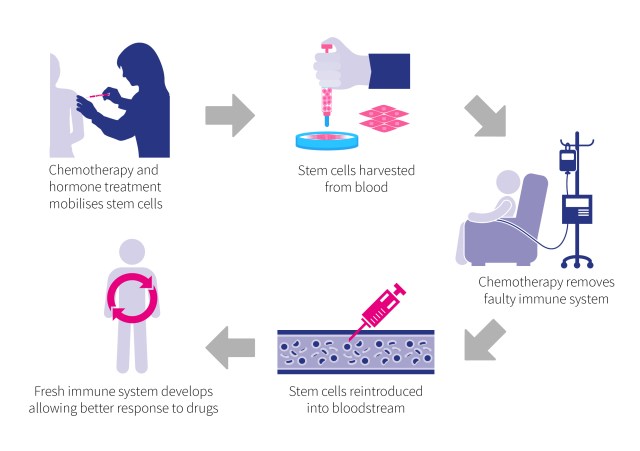
In the trial, patients undergo chemotherapy and hormone treatment to mobilise their stem cells, which are then harvested from their blood. Further chemotherapy is then used to wipe out their faulty immune system. When the stem cells are re-introduced back into the body, they develop into new immune cells which give the patient a fresh immune system.

In theory, the new immune system will then no longer react adversely to the patient’s own gut to cause inflammation, and it will also not act on drug compounds to remove them from their gut before they have had a chance to work.

Professor Tom Walley, Director of the NIHR Evaluation, Trials and Studies programmes, which funded the trial, said: “Stem cell therapies are an important, active and growing area of research with great potential. There are early findings showing a role for stem cells in replacing damaged tissue. In Crohn’s disease this approach could offer real benefits for the clinical care and long term health of patients.”

The current clinical trial, called ‘ASTIClite’, is a follow up to the team’s 2015 ‘ASTIC’ trial, which investigated a similar stem cell therapy. Although the therapy in the original trial did not cure the disease, the team found that many patients did see benefit from the treatment, justifying a further clinical trial. There were also some serious side effects from the doses of drugs used, so this follow-up trial will be using a lower dose of the treatment to minimise risks due to toxicity.

Patients will be recruited to the trial through Barts Health NHS Trust, Cambridge University Hospitals NHS Foundation Trust, Guy’s & St Thomas’ NHS Foundation Trust, NHS Lothian, Nottingham University Hospitals NHS Trust, Oxford University Hospitals NHS Foundation Trust, Royal Liverpool and Broadgreen University Hospital NHS Trust and Sheffield Teaching Hospitals NHS Foundation Trust.

The trial will involve academics from the University of Manchester, University of Nottingham, University of Sheffield, Nottingham Trent University, University of Edinburgh, University of Oxford, King’s College London, as well as Queen Mary University of London.

The study was funded by a Medical Research Council and NIHR partnership created to support the evaluation of interventions with potential to make a step-change in the promotion of health, treatment of disease and improvement of rehabilitation or long-term care.

https://www.qmul.ac.uk/media/news/2018/smd/stem-cell-transplants-to-be-used-in-treating-crohns-disease.html

Scientists Think They’ve Found The Part of The Brain That Makes People Pessimistic

\

by DAVID NIELD

A specific part of the brain called the caudate nucleus could control pessimistic responses, according to animal tests, a finding which might help us unlock better treatments for mental disorders like anxiety and depression.

These disorders often come with negative moods triggered by a pessimistic reaction, and if scientists can figure out how to control that reaction, we might stand a better chance of dealing with the neuropsychiatric problems that affect millions of people worldwide – and maybe discover the difference between glass half full and glass half empty people along the way.

The research team from MIT found that when the caudate nucleus was artificially stimulated in macaques, the animals were more likely to make negative decisions, and consider the potential drawback of a decision rather than the potential benefit.

This pessimistic decision-making continued right through the day after the original stimulation, the researchers found.

“We feel we were seeing a proxy for anxiety, or depression, or some mix of the two,” says lead researcher Ann Graybiel. “These psychiatric problems are still so very difficult to treat for many individuals suffering from them.”

The caudate nucleus has previously been linked to emotional decision-making, and the scientists stimulated it with a small electrical current while the monkeys were offered a reward (juice) and an unpleasant experience (a puff of air to the face) at the same time.

In each run through the amount of juice and the strength of the air blast varied, and the animals could choose whether or not to accept the reward – essentially measuring their ability to weigh up the costs of an action against the benefits.

When the caudate nucleus was stimulated, this decision-making got skewed, so the macaques started rejecting juice/air ratios they would have previously accepted. The negative aspects apparently began to seem greater, while the the rewards became devalued.

“This state we’ve mimicked has an overestimation of cost relative to benefit,” says Graybiel. After a day or so, the effects gradually disappeared.

The researchers also found brainwave activity in the caudate nucleus, part of the basal ganglia, changed when decision-making patterns changed. This might give doctors a marker to indicate whether someone would be responsive to treatment targeting this part of the brain or not.

The next stage is to see whether the same effect can be noticed in human beings – scientists have previously linked abnormal brain activity in people with mood disorders to regions connected to the caudate nucleus, but there’s a lot more work to be done to confirm these neural connections.

Making progress isn’t easy because of the incredibly complexity of the brain, but the researchers think their results show the caudate nucleus could be disrupting dopamine activity in the brain, controlling mood and our sense of reward and pleasure.

“There must be many circuits involved,” says Gabriel. “But apparently we are so delicately balanced that just throwing the system off a little bit can rapidly change behaviour.”

The research has been published in Neuron.

https://www.sciencealert.com/we-found-the-brain-region-for-pessimism

A Songwriting Mystery Solved: Math Proves John Lennon Wrote ‘In My Life’


Paul McCartney and John Lennon wrote songs for The Beatles under Lennon-McCartney, but a new statistical model can be used to tell who actually took the lead.

Lennon-McCartney is likely one of the most famous songwriting credits in music. John Lennon and Paul McCartney wrote lyrics and music for almost 200 songs and The Beatles have sold hundreds of millions of albums. The story goes that the two Beatles agreed as teenagers to the joint credit for all songs they wrote, no matter the divide in work.

Over the years, Lennon and McCartney have revealed who really wrote what, but some songs are still up for debate. The two even debate between themselves — their memories seem to differ when it comes to who wrote the music for 1965’s “In My Life.”

If the songwriters’ memories (perhaps tainted by the mind-altering era they were writing in) have failed, how can this mystery ever be solved? Well, we can get by with a little help from math.

Mathematics professor Jason Brown spent 10 years working with statistics to solve the magical mystery. Brown’s the findings were presented on Aug. 1 at the Joint Statistical Meeting in a presentation called “Assessing Authorship of Beatles Songs from Musical Content: Bayesian Classification Modeling from Bags-Of-Words Representations.”

Stanford University mathematician Keith Devlin breaks down how Brown figured it out. Read Devlin’s edited conversation with NPR’s Scott Simon below and listen at the audio link.

Scott Simon: I don’t understand “bags-of-words representations,” although, I’ve sometimes been called a bag of words by some.

Keith Devlin: We’ll get to that. First of all, just to say that this is really serious stuff in terms of what was done. The three co-authors of this paper — there was someone called Mark Glickman who was a statistician at Harvard. He’s also a classical pianist. Another person, another Harvard professor of engineering, called Ryan Song. And the third person was a Dalhousie University mathematician called Jason Brown. And you may recall back to 2008, you and I talked about him. He figured out how The Beatles created that striking opening chord in “Hard Day’s Night.” And when we did that piece, I actually said he was working on who wrote the music for “In My Life.” And 10 years later, here we are talking about the discovery. It took him a long time, but he’s now got it.

“Bags of words”? What are they?

It actually goes back to the 1950s. It’s used by the computer scientists who created spam filters. What you do is you take a piece of text, and you ignore the grammar, you ignore the word order, and you just regard it as a collection of words. And once you’ve done that, you can count the frequencies of the different words in the bag of words. To do it for music, you had to get little snippets, and the way they did that was the team analyzed, I think, about 70 songs from Lennon and McCartney, and they found there were 149 very distinct transitions between notes and chords that are present in almost all Beatles songs. And those transitions will be unique to one person or the other person.

So they’d be bags of notes and chords.

Bags of notes and chords, pairs of notes and chords. Those are the little items, and you just count them.

Part of the confusion is that Paul McCartney said he wrote the music. John Lennon said Paul McCartney wrote a section of music. So what did this trio of mathematicians detect?

Cutting to the chase, it turns out Lennon wrote the whole thing. When you do the math by counting the little bits that are unique to the people, the probability that McCartney wrote it was .018 — that’s essentially zero. In other words, this is pretty well definitive. Lennon wrote the music. And in situations like this, you’d better believe the math because it’s much more reliable than people’s recollections, especially given they collaborated writing it in the ’60s with an incredibly altered mental state due to all the stuff they were ingesting.

I know what you are saying.

I would go with mathematics.

Keith, alright, I ask you — what about the artistic process of collaboration? Isn’t it possible they were such close and accomplished collaborators that they inhaled a little bit of each other’s technique and Lennon could write like McCartney and McCartney like John Lennon?

For sure. And that’s why it’s hard for the human ear to tell the thing apart. It’s also hard for them to realize who did it and this is why actually the only reliable answer is the mathematics because no matter how much people collaborate, they’re still the same people, and they have their preferences without realizing it. Lennon would use certain kinds of things over and over again. So would McCartney. It was the collaboration. Those two things come together that works, but they were still separate little bits. The mathematics isolates those little bits that are unique to the two people.

https://www.npr.org/2018/08/11/637468053/a-songwriting-mystery-solved-math-proves-john-lennon-wrote-in-my-life?ft=nprml&f=1039

The book that fights sexism with science


Angela Saini

With Inferior, Angela Saini counters long-held beliefs that biology stands in the way of parity between the sexes. Now her message is set to reach thousands of schools.

When young men and women come up against sexist stereotypes masquerading as science, Angela Saini wants them to be armed with the facts. “I call my book ammunition,” she says of her 288-page prize-winning work Inferior: The True Power of Women and the Science that Shows It. “There are people out there who insist that somehow the inequalities we see in society are not just because of historic discrimination, but also because of biology – the idea that there are factors within us that will cause men or women to be better at some things than others.”

She wrote Inferior to demonstrate that “actually, science doesn’t support that point of view. I think it’s important we understand these scientific facts. We need that ammunition to counter the weird mistruths that are circulating within and outside science about sex difference”.

To female scientists fed up with being treated as though their brains are the odd exceptions among their sex, Inferior is more than just a book. It’s a battle cry – and right now, it is having a galvanising effect on its core fanbase. On 31 July a crowdfunding campaign to send a copy of Inferior to every mixed secondary school in England with more than 1,000 pupils was launched by Dr Jessica Wade, a British physicist who writes 270 Wikipedia pages a year to raise the profile of female scientists. Within two days the campaign had raised £2,000. Yesterday it reached its original £15,000 target and was powering its way towards £20,000 – a figure which would allow the book to be sent to every state school in the country.

“There’s nothing you want more than for people to be inspired by your work,” says Saini, 37, a multiple award-winning science journalist, who first became intrigued by sex difference research when she wrote about the menopause for the Observer. “What Jess is doing means such a lot to me. I hope if my book can empower her, it can empower other young women, and men, too.”

The key message she hopes her readers will take away is that nothing in science suggests equality is not possible. “We are not as different as the inequalities in our society makes us believe we are. Even now, there are people saying we shouldn’t be pushing for gender equality because we’re never going to see it for biological reasons.” For example, many people think there are large psychological differences in spatial awareness, mathematical reasoning or verbal skills between men and women. “Actually, those differences are tiny, a fraction of a standard deviation,” says Saini. “Psychologically, the differences between the sexes are not enough to account for the inequalities we see in our society today.”

Inferior is not a children’s book by any stretch of the imagination. It includes a firsthand account of female genital mutilation and deliberately examines a large number of academic studies in painstaking detail. But, like recent bestselling children’s books Goodnight Stories for Rebel Girls and Fantastically Great Women Who Changed the World, it could play a valuable role in breaking down gender stereotypes for the next generation of would-be scientists and mathematicians, and Saini is confident many teenagers will engage with it. “Girls and boys aged 13 or 14 upwards have really responded to the message, and the earlier we can get this message to them, the better.” She was the only girl in science and maths classes at school. “Even if it’s not overtly stated to you, just being in a minority – especially a minority of one – makes you think maybe there are some differences between the sexes.”

Researching and writing the book has totally changed how she feels about herself, destroying her own “subconscious stereotypes” about women. “It made me look at the world differently. That’s the power of science.”

In one of the most shocking chapters, Saini relays a letter written by Charles Darwin in which he argues that women are intellectually inferior to men. “He was looking at society. He saw women weren’t achieving as much and he treated us almost the way you would treat observations of lions or peacocks in the wild. He thought: this reflects the biological facts.”

Even at the time, contemporary female intellectuals pointed out that this theory ignored a lot of obvious historical and cultural factors, but Darwin failed to take on board their arguments. “It was quite lazy of him, which is surprising, because he wasn’t a lazy scientist. He was usually so painstaking and thorough.”

But she still admires him for everything he got right. “Even the best scientists can fall into this trap of looking at the world around them and thinking: things are the way they are because of nature.” After all, she points out, assuming 19th-century scientists could be biased but 21st-century scientists never are makes no sense. “That’s why, in the book, I look not just at the science, but at the scientists.”

These range from Kristen Hawkes, whose research suggesting postmenopausal women played a vital role in increasing the human lifespan has been met with dogged resistance from some male scientists, to Robert Trivers who, Saini shows, used evidence from a flawed 1948 experiment on fruit flies when he famously argued that men are more naturally promiscuous than women. “A lot of people – especially scientists – view science as perfectly objective and rational. But the questions researchers choose to ask, and the answers they come up with, are heavily affected by their prior assumptions.” At times, the book shows a staggering lack of respect from male scientists towards the work of their female contemporaries. “Science won’t improve unless we understand that we all have biases and those biases affect research,” says Saini.

Since it was published in 2017, her book has sold 20,000 copies, won Physics World Book of the Year and triggered a worldwide “STEMinist” book club movement among feminist scientists, technologists, engineers and mathematicians. Saini says she has even had positive feedback about it from James Damore, a Google software engineer who made headlines last year when he wrote an internal memo arguing biological differences were the reason behind the low number of women in tech. “We need scientific arguments to counter those politically motivated statements,” she says. “These arguments matter personally, in terms of how we think about ourselves, but also politically. We cannot afford to be complacent. There are movements around the world that are trying to take back the rights of women – rights our mothers and grandmothers fought so hard for. We can take anything for granted.”

Wade says the book gave her “all this power. You read it and you have evidence. You can debate it”. She set up the crowdfunding campaign because she suspected private girls’ schools would be buying it for their libraries, and wanted state school students to have the same access. “Reading this book when doing your GCSEs or A levels is the perfect time, because you’re making decisions that will impact your entire career. I want girls to recognise they can do anything.”

The actor Daniel Radcliffe, a childhood friend of Wade, is planning to release a video in support of the crowdfunding campaign this week. He describes Inferior as “a truly mind-blowing book”, which has made him completely reevaluate his understanding of the world.“As many people as possible should have access to this book, and I am certain Jessie – who has always been the smartest person I know – is going to make that happen,” he says.

Saini, a Londoner with Indian parentage, is working on her next book on the science of race. “Race science is more taboo, but the way prejudice plays out within the research illuminates similar issues as those of Inferior.”

Despite the sexism and racism she has documented in science, she feels positive about the future. “If we catch children early, we can achieve enormous change. I don’t think anyone is born with prejudices. I’m optimistic.” She points out that, historically, male scientists gained their power by excluding women from clubs, societies and institutes. “Now women are forming their own networks. And there’s no limit to what we can achieve.”

https://www.theguardian.com/science/2018/aug/11/women-equal-to-men-science-fact-book-angela-saini