Experiment with ‘lost’ wallets reveals that people are surprisingly honest

They say honesty is the best policy — and now there’s scientific evidence to prove it.

An unconventional study that offered volunteers the chance to pocket nearly $100 found that the more people stood to gain by hiding the truth, the more likely they were to come clean.

The results, published recently in the journal Science, offer surprising insights into the ways that money influences honesty.

The findings could help shape policies that encourage conscientious behavior in a range of situations, researchers said. The Internal Revenue Service could design its forms in a way that discourages people from cheating on their taxes, for example, while insurance companies could change the way they collect information about a car accident so that lying becomes less appealing.

“Honesty is essential for almost all social and economic relations,” said Michel Maréchal, an economics professor at the University of Zurich who helped lead the study.

Scientists have studied how the temptation of money affects honesty in laboratory settings, but little is known about how they’re related in the real world — especially on a global scale.

So a team of economists devised an experiment involving more than 170,000 “lost” wallets that turned up in 335 cities across 40 countries, from Indonesia to Ghana to Brazil.

Each wallet contained a grocery list, a key, and three business cards with the same male name and email address. Some of them had no money, while others had the equivalent of about $13.50.


The contents of a wallet used in the experiment. All three business cards were identical.

To kick off the experiment, a research assistant brought a wallet to the front desk of a hotel, bank, post office or other public place. He or she would claim to have found it on outside and push it toward the person behind the desk.

“Somebody must have lost it,” the research assistant would tell the unwitting employee. “I’m in a hurry and have to go. Can you please take care of it?”

The study authors hypothesized that employees would be more likely to email the wallet’s “owner” (using the address on the business card) if it contained no cash. After all, economists assume people will behave rationally and maximize their utility — which in this case would mean keeping the $13.50 windfall.

But that’s not what happened.

“Much to our surprise, we observed the opposite effect,” Maréchal said. “People were more likely to return the wallet when it contained a higher amount of money.”

In the experiment, 51% of wallets with cash were returned, compared with 40% of those without bills or coins.

And people were not treating themselves to a finder’s fee. Spot checks of the wallets showed that 98% of the money was turned in.

“When there was something missing, it was coins,” said study leader Alain Cohn, a behavioral economist at the University of Michigan. In those cases, he said, the researchers figured the coins simply “fell out of the wallet.”

Perhaps $13.50 was such a pittance “that people simply wouldn’t bother stealing it,” said co-author Christian Zünd, a graduate student at the University of Zurich. So the researchers expanded their experiment to include wallets with the equivalent of about $94.

The extra cash seemed to induce yet more honesty. Wallets with the big bucks were returned 72% of the time, compared with 61% of the wallets with less money and 46% of wallets with no cash. Once again, the economists were stumped.

“Why are people more likely to return a wallet that contains more rather than less money?” Zünd said.


Across 40 countries, the trend was clear: Wallets with money in them were more likely to be returned than wallets without cash.

Perhaps people were afraid of getting into legal trouble if they kept the money for themselves. The researchers checked to see if the return rates were higher when the wallet was dropped off in the presence of witnesses or security cameras, but those factors didn’t seem to make a difference. Nor was there a correlation between return rates and local lost-property laws.

If people weren’t acting out of fear or being influenced by peer pressure, maybe they were sincerely concerned about the well-being of the wallet’s “owner.” So the researchers introduced “lost” wallets that contained money but no key. The result: Employees were 9.2% more likely to return a wallet with a key than a wallet without one — a sign of altruism, the study authors said.

But that wouldn’t explain why wallets with $94 were returned at higher rates than wallets with $13.50. The researchers conducted a survey in the U.S., the United Kingdom and Poland (the three places where big-money wallets were “lost”) and asked people to rate how much they would feel like thieves if they kept a wallet, with or without money.

Keeping a wallet with no money in it did not feel like stealing, Zünd said. “With money, however, it suddenly feels like stealing, and it feels even more like stealing when the money in the wallet increases.”

In other words, the more money the ”lost” wallet contained, the greater the psychological cost of seeing oneself as a thief. That was a price people didn’t want to pay.

The results bolster the idea “that people care about maintaining a positive moral view of themselves,” said Nina Mažar, a Boston University behavioral economist who was not involved in the study.

Policymakers could use this insight to encourage better behavior among citizens “by making it more difficult for them to convince themselves that they are honest, when in fact, they did something wrong,” Cohn said.

Previous research has shown that reminding people about their moral standards just before they perform a specific task helps reduce their temptation to cheat. For example, people were more likely to fill out an insurance form honestly if they had to sign an honor statement at the beginning of the form rather than at the end.

Future studies should test whether these results would hold up if the owner of the “lost” wallet appeared to be a foreigner, according to Shaul Shavi, who studies behavioral ethics and economics at the University of Amsterdam.

“People find it worthwhile to act kindly toward members of their own group but not members of other groups,” he wrote in an essay that accompanies the study.

Mažar said she’d like to know more about how honest behavior varies across countries. In the experiment, for instance, the odds of a wallet with money being returned were more than three times higher in Switzerland than in China.

“We want to understand, ‘What are the commonalities, what are the differences?’” Mažar said. “Because if we understand those, maybe we’ll have a better sense of how we could increase civil honesty on a much larger scale or reduce corruption.”

https://www.latimes.com/science/la-sci-people-are-honest-lost-wallets-experiment-20190620-story.html

Unusual Skull Turns Out to Be Ultra-Rare Hybrid of a Narwhal And a Beluga Whale

by MICHELLE STARR

A skull long suspected of belonging to a rare Arctic hybrid has now had its unusual biology confirmed via DNA analysis.

According to the results, this strange beast had a beluga whale for a dad and a narwhal for a mum, and would have forged its own path, distinct from the lifestyles of both parents.

The skull was collected in 1990 by a hunter who found three of the unusual animals swimming in the waters off the coast of West Greenland. The animals described by the hunter were like no cetacean ever before seen, so the single skull he preserved from the hunt was taken to the Natural History Museum of Denmark, where it’s been ever since.

In 1993, a paper concluded that, based on its physical characteristics, the specimen was the hybrid of a narwhal (Monodon monoceros) and a beluga whale (Delphinapterus leucas) – the only two species in the Monodontidae family.

The skull didn’t exhibit the narwhal’s characteristic horn; in fact, it was pretty different from both species.

“The anomalous whale’s skull is much larger than those of normal narwhals and belugas. In particular, the rostrum and mandibles are relatively long and massive,” the researchers wrote in that 1993 paper.

“The dentition is unlike that of any known cetacean, but some features of the teeth are considered analogous to those of both narwhals and belugas.”

In the image above, you can see skulls of a beluga whale (top), the anomalous hybrid (middle), and a narwhal (bottom).

But before now, it was also still possible that the skull could have belonged to an anomalous beluga, researchers thought. Now, 26 years later, genetic analysis has clinched it.

Using genetic material extracted from the skull’s teeth, scientists from the University of Copenhagen conducted a genome-wide DNA sequencing and mitochondrial DNA analysis of the specimen.

They then compared the results of these to the genomes of eight living beluga whales and eight living narwhals, all from around the region where the skull was found.

The genome confirmed it. The skull belonged to a ‘narluga’ that the researchers determined to be male – half narwal, half beluga, with narwhal DNA that can only come from the female germline – in other words, mum.

This was a surprise, since narwhals and belugas are thought to have diverged 5.5 million years ago, and the gene flow between them ceased at least 1.25 million years ago.

In addition, narwhal horns are thought to be a secondary sex characteristic, which could indicate male belugas would have difficulty securing a female narwhal mate. The discovery or the narluga’s parentage suggests that successful matings can occur, even when dad isn’t, ahem, horny.

But the skull had more secrets to reveal. By analysing isotopes of carbon and nitrogen in the bone collagen, the scientists were able to reconstruct the animal’s diet. This was compared to the isotopes of 18 beluga whale skulls and 18 narwhal skulls.

The narluga skull had a higher concentration of carbon isotopes than both of its parent species – indicating that its source of food was different. High carbon isotope concentrations generally indicate benthic prey, suggesting that the narwhal foraged deeper for food than either of his parents.

Although the hunter who discovered the skull reported seeing three narlugas in the wild – all uniformly dark grey, with flippers like a beluga and tails like a narwhal – the skull is the only known evidence we have of this interspecies breeding.

But interbreeding between other cetacean species isn’t all that uncommon, such as a dolphin-whale hybrid seen swimming off the coast of Hawaii last year. And at least 16 other similar cases of cetacean hybridisation have been described in scientific literature – so you can bet your blowhole there are probably many others that scientists haven’t spotted.

Some of them may even be hiding in museum collections like this one was, just waiting for someone to come along and sequence their DNA.

The research has been published in Scientific Reports.

https://www.sciencealert.com/a-skull-in-museum-storage-is-the-ultra-rare-hybrid-of-a-narwhal-and-beluga-whale

Stem Cells Sprayed into the Nose Restore Mice’s Ability to Smell

by KERRY GRENS

In mice whose sense of smell has been disabled, a squirt of stem cells into the nose can restore olfaction, researchers report today (May 30) in Stem Cell Reports. The introduced “globose basal cells,” which are precursors to smell-sensing neurons, engrafted in the nose, matured into nerve cells, and sent axons to the mice’s olfactory bulbs in the brain.

“We were a bit surprised to find that cells could engraft fairly robustly with a simple nose drop delivery,” senior author Bradley Goldstein of the University of Miami Miller School of Medicine says in a press release. “To be potentially useful in humans, the main hurdle would be to identify a source of cells capable of engrafting, differentiating into olfactory neurons, and properly connecting to the olfactory bulbs of the brain. Further, one would need to define what clinical situations might be appropriate, rather than the animal model of acute olfactory injury.”

Goldstein and others have independently tried stem cell therapies to restore olfaction in animals previously, but he and his coauthors note in their study that it’s been difficult to determine whether the regained function came from the transplant or from endogenous repair stimulated by the experimental injury to induce a loss of olfaction. So his team developed a mouse whose resident globose basal cells only made nonfunctional neurons, and any restoration of smell would be attributed to the introduced cells.
The team developed the stem cell transplant by engineering mice that produce easily traceable green fluorescent cells. The researchers then harvested glowing green globose basal cells (as identified by the presence of a receptor called c-kit) and delivered them into the noses of the genetically engineered, smell-impaired mice. Four weeks later, the team observed the green cells in the nasal epithelium, with axons working their way into the olfactory bulb.

Behaviorally, the mice appeared to have a functioning sense of smell after the stem cell treatment. Unlike untreated animals, they avoided an area of an enclosure that had a bad smell to normal mice.

To move this technology into humans suffering from a loss of olfaction, more experiments in animals are necessary, says James Schwob, an olfactory researcher at Tufts University who has collaborated with Goldstein but was not involved in the latest study, in an interview with Gizmodo. “The challenge is going to be trying to [engraft analogous cells] in humans in a way . . . that [would] not make things worse.”

https://www.the-scientist.com/news-opinion/stem-cells-delivered-to-the-nose-restore-mices-ability-to-smell-65953

Scientists develop a super-strong wood that completely reflects the sun’s heat


The new super compressed wood is nearly nine times stronger than its natural counterpart. (Photo: University of Maryland)

Researchers at the University of Maryland have re-designed wood to make it entirely impervious to visible light, while only absorbing the slightest levels of near-infrared light.

Rather than absorbing sunlight, the new wood could bounce it right back into the environment. In effect, homes made from this material would be able to prevent virtually all heat from seeping indoors, potentially easing our reliance on air conditioning in summer months.

“When applied to building, this game-changing structural material cools without the input of electricity or water,” noted Yao Zhai, one of the study authors, in a press release.

We know that air conditioning saves lives, especially in climates where heat takes a deadly toll on air quality. But we also know that as we dial up the AC, we also dial up demand on fossil fuel-burning power plants. And emissions from those plants stir up an atmospheric cocktail that can be just as toxic.

“Reducing human reliance on energy-inefficient cooling methods such as air conditioning would have a large impact on the global energy landscape,” the researchers note in the study abstract.

To make that kind of “cooling” wood, scientists used hydrogen peroxide to strip away the lignin, a support element in the cell walls of trees. That process exposed only the wood’s cellulose, which is a powerful building block of plants and trees. It’s also incredibly impervious to the sun’s energy.

What’s more, the lignin-free wood allows heat produced indoors to escape. That’s because indoor heat occupies a slightly different wavelength than your garden variety sunlight — a wavelength that doesn’t get repulsed by the new wood variant. So by day, the sun’s heat is kept at bay, and at night, indoor heat dissipates into the environment, although the team admits this could be an issue when it comes to actually retaining heat indoors.

Another benefit to wood made entirely of cellulose? It’s incredibly strong. In a previous study, researchers noted that cellulose nanofibers outperform steel and spider silk as the “strongest bio-material” on Earth.

The University of Maryland team claims the new wood packs a tensile strength of around 404 megapascals, or more than eight times that of natural wood. That puts it somewhere in the neighborhood of steel.

“Wood has been used for thousands of years and has emerged as an important sustainable building material to potentially replace steel and concrete because of its economic and environmental advantages,” the authors note.

https://www.mnn.com/green-tech/research-innovations/stories/cooling-wood-reflects-heat-sun?utm_source=Weekly+Newsletter&utm_campaign=9bbb9aca6f-RSS_EMAIL_CAMPAIGN_WED0529_2019&utm_medium=email&utm_term=0_fcbff2e256-9bbb9aca6f-40844241

Ravens appear to share negative emotions with one another, but not positive ones.

by Carolyn Wilke

Here’s a downer: Pessimism seems contagious among ravens. But positivity? Not so much.

When ravens saw fellow birds’ responses to a disliked food, but not the food itself, their interest in their own food options waned, researchers report May 20 in the Proceedings of the National Academy of Sciences. The study suggests that the birds pick up on and even share negative emotions, the researchers say.

Ravens are “very good problem solvers … but this paper’s really highlighting their social intelligence as well,” says Andrew Gallup, a psychologist at SUNY Polytechnic Institute in Utica, N.Y., who was not involved in the study. The work paints a richer picture of how the birds’ brains work, he says.

Known for their smarts, ravens act in ways that suggest a capacity for empathy, such as by appearing to console a distressed comrade. Thomas Bugnyar, a cognitive ethologist at the University of Vienna, and his colleagues wanted to look into one building block of empathy — whether animals share emotions. To be able to feel for others, an animal needs to be able to feel like others, he says.

But sizing up an animal’s mood is tricky. Scientists generally rely on behavioral or physiological cues to clue into a creature’s emotional state. More challenging is assessing how one animal’s mood might influence another’s: Similar actions appearing to stem from kindred emotions may just be mimicry.

To tune into the moods of ravens, the researchers set up experiments to watch whether the birds reacted positively or negatively to a neutral stimulus. This so-called cognitive bias test, used on a wide variety of animals from bees to pigs, “is basically … asking how you would judge a glass — if it’s half full or half empty,” Bugnyar says.

Eight ravens, tested in pairs, were first given a choice between a box containing a cheese treat and an empty box. Once the birds learned the location of each option, they were given a third box in a new spot that hadn’t been used in the training. Whether a bird acted as if the box was a trick or a treat indicated a cognitive bias, interpreted as pessimism or optimism.

Next, one bird in a pair was offered both unappealing raw carrots and tastier dried dog food before one was taken away. Birds left with the treat moved their heads and bodies as they studied it, while those getting the carrots appeared crankier, spending less time attending to the offering and sometimes kicking or scratching elsewhere. The other bird in the pair watched these reactions from a separate compartment, without being able to see the researcher or which food the bird received.

Both birds then performed the cognitive bias test again. This time, observer birds that had seen their partner appearing perky showed on average the same level of interest in their own ambiguous box as they had previously. But those that had seen their partner reacting negatively typically took more than twice as long to approach the ambiguous box. This dip in the observer birds’ interest was somehow influenced by seeing their partner’s apparent disappointment, the researchers say.

Each bird was tested four times, half of the time with the undesired food and the other half with the treat.

It’s interesting that while the negative responses seemed contagious, the positive ones did not, Gallup says. This may be because negative reactions are easier to provoke or observe, or because animals tune in more to negative information in their environment, the authors say.

The ravens study marks one of the first times the cognitive bias test has been used to examine emotions and social behavior, says coauthor Jessie Adriaense, a comparative psychologist at the University of Vienna. “Emotions are extremely important drivers of our behavior, but how they actually drive animals … is still an open question,” she says. To truly understand what motivates behavior in animals, scientists need to delve deeper into their emotions, she says.

Bad moods could be contagious among ravens

The devastating biological consequences of homelessness

Maria Haverstock, a participant in the Oakland study, became homeless at 58 when she could not find work after leaving an abusive partner.

When Serggio Lanata moved to San Francisco in 2013, he was stunned by its sprawling tent cities. “Homelessness was everywhere I looked,” he says. Lanata, a neurologist at the University of California, San Francisco (UCSF), was also struck by similarities in the behaviour of some older homeless people and patients he had treated for dementia in the clinic. Now, years later, he is embarking on a study that will examine homeless adults for early signs of Alzheimer’s disease and other degenerative brain disorders to better understand the interplay between these conditions and life on the street.

The work, which is set to begin next month, ties into an ongoing effort by researchers at UCSF to understand the biological effects of homelessness in older people. Since 2013, a team led by Margot Kushel, director of the university’s Center for Vulnerable Populations, has followed a group of about 350 older homeless adults in Oakland, California, to determine why this group ages in hyper-speed. Although the participants’ average age is 57, they experience strokes, falls, visual impairment and urinary incontinence at rates typical of US residents in their late 70s and 80s.

The research has drawn attention from politicians, economists and health-care providers across the country who are struggling to help the homeless and reduce their numbers. Although homelessness is a global problem, the situation in California is particularly acute. Nearly 70% of the 130,000 people without homes in the state are considered to be ‘unsheltered’, living on the streets or in locations unfit for human habitation, compared with just 5% in New York City. In the San Francisco Bay Area — California’s wealthy technology hub, which includes Silicon Valley — roughly 28,200 people are homeless.

Homeless encampments, like this one in Oakland, California, are a familiar site in the San Francisco Bay Area.

The United States’ homeless population is also greying: rising housing prices in many areas have increased the rate of homelessness among ‘baby boomers’ born between 1954 and 1964. But many hospitals, police and homeless shelters are unprepared to deal with the special needs of an ageing homeless population. “I hear from shelter providers, ‘Gosh, we are set up for people who use drugs but we have no idea how to manage dementia’,” Kushel says. By understanding how homelessness can accelerate ageing, her team hopes to identify ways to curb suffering and save governments money.

“This crisis is upon us,” says Dennis Culhane, a social scientist at the University of Pennsylvania in Philadelphia. “A lot of money will be spent on this population. We can draw upon Margot’s data and learn how to spend that money wisely — or else we’ll just spend and still have lots of human misery.”

He and his colleagues estimate that Los Angeles, California, will spend $621 million annually on emergency medical care, nursing home beds and shelters for homeless people over the age of 55 between 2019 and 2030. Their analysis suggests that the city could reduce its spending by $33 million per year if it provided homes to elderly people who lack them.

A closer look

Researchers have known for decades that physical and mental health problems are prevalent among the homeless (see ‘Declining health’). But there was little systematic research on the progression and causes of their ailments in 2013, when Kushel launched a study on the life trajectories of older homeless adults in the Bay Area. Since then, 42 of the initial 350 participants have died — mainly from cancer, heart attacks and diabetes. (Earlier this year, the study enrolled another 100 people to compensate for the loss of original participants.)

Kushel and her colleagues got a boost on 1 May, when philanthropists Marc and Lynne Benioff announced that they had donated US$30 million to create a research initiative at UCSF on homelessness. Marc Benioff, who founded the San Francisco-based computing company Salesforce, says the money will support research to explore the causes of homelessness and identify ways to prevent it.

Lanata’s study, which is set to begin next month, will look for signs of debilitating brain conditions — such as dementia of the frontal and temporal lobes, which can cause behavioural changes — in at least 20 homeless adults. He and his colleagues will conduct neurological exams, which might include brain scans, on participants to learn how homelessness influences these brain disorders. People living on the streets might face several factors that can contribute to neurological disease, Lanata says, such as lack of sleep, exposure to polluted air near highways, poorly controlled diabetes, high blood pressure and alcohol abuse.

By asking study participants about their personal histories, he also hopes to learn whether neurological issues might have helped to put them on the street — perhaps by impairing their ability to work or seek government assistance. That would make sense to him, given his experience treating people with some types of dementia. “If those patients didn’t have strong family support, they would be homeless, since no one could or would care for them,” Lanata says. “They can be hard to handle.”

And Kushel has begun a new phase of her ongoing study, which will explore how the sudden stress of homelessness might trigger or exacerbate existing conditions. Many of the people in her study were over the age of 50 when they became homeless.

Kimberly Lea (left) greets Vernada Jones, who is recovering from a gunshot wound to the face. Both women are participating in the Oakland study.

Nearly half of the participants exhibit signs of extreme loneliness, which has been linked to poor outcomes in people with cancer and other diseases1. One-quarter of those in the study meet the criteria for cognitive impairment, compared with less than 10% among people over the age of 70 in the United States more generally2. And in a paper in the press, Kushel and her colleagues found that 10% of participants report being physically or sexually assaulted at least every six months.

An increasing toll

Although Culhane and other health economists have already begun to use Kushel’s findings to project how much it costs to care for the indigent, it is not clear whether politicians or the public will accept such suggestions.

California Governor Gavin Newsom included $500 million for shelters and other support facilities in his proposed $209 billion state budget for 2019–20. But in late March, San Francisco residents rapidly met their goal of raising more than $100,000 to block the construction of a homeless shelter in a wealthy, waterfront neighbourhood. And although city voters approved a plan in November 2018 to fund services for the homeless by taxing the San Francisco’s biggest companies, business groups are challenging the policy in court.

Coco Auerswald, a public-health researcher at the University of California, Berkeley, hopes that Kushel’s work and other studies of homelessness strike a moral nerve. “You judge a society on how it treats its most vulnerable,” she says. “My fear is that we will accept this as a state of affairs in our country.”

Nature 569, 467-468 (2019)

References
1.
Patanwala, M. et al. J. Gen. Intern. Med. 33, 635–643 (2018).

Ohio high school senior loses 115 pounds by walking to school, changing diet

By KATIE KINDELAN

Michael Watson, 18, battled his weight his entire life but decided to make a lasting change when he looked in a mirror his sophomore year of high school.

“When I looked in the mirror I was really ready to get it done and thought, ‘I can’t just fail anymore on my diet,’” Watson said. “I need to actually do this.”

Watson, now a high school senior in Canton, Ohio, started by walking to and from school every day, more than 40 minutes round trip.

He walked to school every day of his junior year, no matter whether it was hot, raining or snowing.

“When I took the bus to school, I’d want to sit by a kid and they’d say, ‘No, go sit somewhere else because I was so big,’” Watson recalled. “When I started walking, I didn’t even know what time the bus came and that was my motivation, ‘I have to walk.’”

Watson also changed his diet, working with his dad to learn how to count calories and then forgoing his normal fast food meals for salads, oatmeal and soup.

“It was extremely hard, especially at first,” said Watson, who also worked at a local Kentucky Fried Chicken restaurant during his weight loss. “What motivated me was stepping on the scale.”

“I’d see that I was 290 [pounds] and say, ‘Let’s get to 280, come on Michael, you got this,’” he said.

Watson started at his highest weight of 325 pounds. He now weighs 210 pounds, achieving a 115 pound weight loss.

In addition to walking, Watson now lifts weights in a home gym he created in his family’s garage.

“I lost a lot of my insecurities when I lost all that weight,” he said. “You work for it and you get it, so it feels amazing for sure.”

Watson’s father, Jim Watson, said he notices his son walk around now with “more confidence,” allowing him to show his “funny and outgoing” personality to more people.

Watson’s accomplishment caught the attention of his classmates and teachers at McKinley Senior High School, from which he will graduate later this month.

“His story stuck with me,” said Terrance Jones, a family support specialist at McKinley who nominated Watson for the school’s “Senior Limelight” recognition.

“Michael is a young man who aspired to be able to be a better person for himself. We’re not talking about athletic accomplishments or academic accomplishments, this is a personal development success,” he said. “We need to pay more attention to personal development successes with students.”

Watson plans to find a full-time job after graduation, possibly in the food industry. He studied in his school’s culinary program during his weight loss and credits his teacher in the program with helping him learn more about healthier food choices and cooking.

“I hope I can be an inspiration to others,” Watson said, adding that he achieved his weight loss by reminding himself that “every day is a new day.”

“That’s what I said on my diet all the time because I’d mess up some days,” he said. “I’d tell myself, ‘Tomorrow is a new day. You’ve’ got to start over and eat the oatmeal in the morning.”

https://abcnews.go.com/GMA/Wellness/high-school-senior-loses-115-pounds-walking-school/story?id=63047775

Brain imaging biomarker developed for suicidal ideation in patients with PTSD


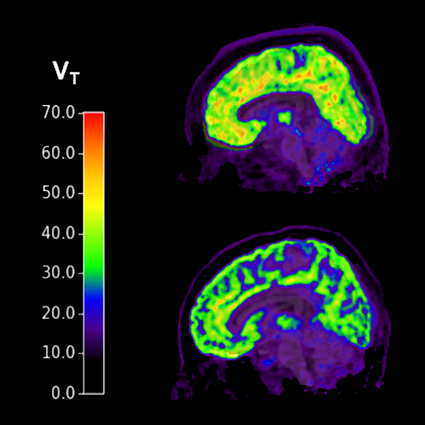
Brains of individuals with PTSD and suicidal thoughts (top) show higher levels of mGluR5 compared to healthy controls (bottom).

By Bill Hathawaymay

The risk of suicide among individuals with post-traumatic stress disorder (PTSD) is much higher than the general population, but identifying those individuals at greatest risk has been difficult. However, a team at Yale has discovered a biological marker linked to individuals with PTSD who are most likely to think about suicide, the researchers report May 13 in the journal Proceedings of the National Academy of Sciences.

Researchers used PET imaging to measure levels of metabotropic glutamatergic receptor 5 (mGluR5) — which has been implicated in anxiety and mood disorders — in individuals with PTSD and major depressive disorder. They found high levels of mGluR5 in the PTSD group with current suicidal thoughts. They found no such elevated levels in the PTSD group with no suicidal thoughts or in those with depression, with or without current suicidal thoughts.

There are two FDA approved treatments for PTSD, both of which are anti-depressants. It can take weeks or months to determine whether they are effective. That can be too late for those who are suicidal, note the researchers.

“If you have people who suffer from high blood pressure, you want to reduce those levels right away,” said Irina Esterlis, associate professor of psychiatry at Yale and senior author of the study. “We don’t have that option with PTSD.”

Esterlis said testing for levels of mGluR5 in people who have experienced severe trauma might help identify those at greatest risk of harming themselves and prompt psychiatric interventions. Also, researchers might investigate ways to regulate levels mGluR5 with hopes of minimizing suicide risk in PTSD patients, she said.

https://news.yale.edu/2019/05/13/biomarker-reveals-ptsd-sufferers-risk-suicide

Numerous graduate students and postdocs around the world ghostwrite peer reviews for senior colleagues, receiving no authorship

A large proportion of graduate students and postdocs ghostwrite peer reviews for senior colleagues and supervisors, receiving no professional credit for their work, finds a study1.

Co-authors of the article, which was posted on the preprint server bioRxiv on 26 April, surveyed 498 early-career researchers at institutions in the United States (74%), Europe (17%), Asia (4%) and elsewhere to assess how often junior scientists contribute to such reports and how they feel about them. Half of survey respondents said that they had ghostwritten a peer review, but 80% of those said that they felt the practice was unethical, according to the article.

The survey took pains to distinguish ghostwriting from co-reviewing, a well-established form of training in which an invited reviewer shares a manuscript with junior researchers to solicit their assessment of the paper’s quality; those researchers can expect to receive some type of credit for their efforts. With ghostwriting, by contrast, a principal investigator (PI) uses part or all of a junior researcher’s review contributions and provides no credit. Roughly 75% of survey respondents said that they had co-reviewed; 95% found it to be a beneficial practice and 73% deemed it ethical.

“Co-reviewing and ghostwriting get conflated, and one is used to justify the other as a normal part of training,” says study co-author Rebeccah Lijek, a molecular biologist at Mount Holyoke College in South Hadley, Massachusetts. “But they are separable; some can be done as training exercises and some deserve named credit.” She says that senior researchers have expressed disbelief that ghostwriting is a widespread practice, whereas early-career researchers in the study indicated no surprise at all.

Sabina Alam, associate editorial director of medicine and health journals for Taylor & Francis Group, an academic publisher based near Oxford, UK, was also unsurprised. As journal editors, she says, “we know it happens.” Alam adds that she was pleased to finally see data quantifying the practice. “This form of ghostwriting has to be brought out of the shadows,” she says. “Not knowing who has had a hand in writing the review is totally unethical. It’s a system we’ve allowed to continue for too long.”

Alam notes that ghostwriting breaches the confidentiality of peer review. “Editors make publishing decisions based on reviews and on an understanding that the person they invited wrote the review,” she says. And journal editors make great efforts to find the most appropriate manuscript reviewers; they do not expect reviewers to share manuscripts, unless the journal explicitly says that it is acceptable for a colleague to co-review. Both co-reviewing and ghostwriting can pose ethical issues beyond the absence of credit, she adds. “If a researcher wants to co-review, let the editors know — preferably before you ask a junior colleague — so we can make sure the person is a good fit, free of conflicts of interest.”

Ethical line
David Resnik, a bioethicist at the National Institute of Environmental Health Sciences in Research Triangle Park, North Carolina, says that ghostwriting can even be considered a form of plagiarism. “Under the federal research regulations, misconduct applies not only to publishing research but also reviewing research,” he notes.

Beyond misrepresentation, the lack of academic credit short-changes the junior researcher or ghostwriter in intangible ways. For example, peer review gives early-career scientists an opportunity to become known to journal editors, says Resnik. Reviewing papers, he adds, can build a graduate student’s or postdoc’s reputation; it can lead to an invitation to join a journal’s editorial board, and can serve as a form of networking that can help to advance a career. “The idea that credit for peer review is not important doesn’t stand up to scrutiny,” says Resnik. Alam agrees: “This is scholarly work at the end of the day, and should be recognized,” she says.

The report laments that there is “no systematic way of training people to do peer review”. Yet it is pivotal to the scientific enterprise, notes co-author Gary McDowell, executive director of Future of Research, an advocacy group for junior researchers that is based in Abington, Massachusetts. “We need more establishment of best practices of peer review,” adds Resnik. “Peer review is one of the most important aspects of scientific research [and it] just does not get enough attention in terms of ethics, objectivity and fairness.”

Alam says that the study could help to catalyse long-needed changes to the peer-review process. Both she and Resnik agree with the study’s recommendation that journals revise their policies to explicitly ask for the names of co-review contributors. McDowell suggests that greater transparency would benefit the scientific enterprise as a whole — for example, by legitimately increasing the pool of reviewers, who are often in short supply. “Journals are going to have graduate students and postdocs doing this regardless; they just won’t be known,” says McDowell.

McDowell and Lijek encourage PIs and early-career researchers to clearly discuss their expectations regarding co-reviewed reports and the apportioning of credit. Resnik agrees: “I would advise PIs to not involve other people in the review of a paper without permission from the editors, and without a clear understanding from the person involved about how they will be credited for their work.”

Alam advises early-career researchers who are eager to write peer reviews to ask their PI for opportunities to do so, as well as for feedback on their efforts; they should also ask their PI to let journals know about their contributions. Then, she says, junior researchers should take necessary steps to verify their contributions on Publons, an online database through which academics can track and highlight their peer-review and editorial contributions. That way, the junior researchers can build their profiles as peer reviewers.

Lijek says she hopes that this study will arm junior researchers with evidence that they can use to advocate for credit for their contributions. “It may sound cheesy and naive, but we want peer review to be the best it can be,” she says. Ultimately, she says, the problem can be resolved. “We all agree — we need to fix it.”

doi: 10.1038/d41586-019-01533-8

References

McDowell, G. S., Knutsen, J., Graham, J., Oelker, S. K. & Lijek, R. S. Preprint at bioRxiv https://doi.org/10.1101/617373 (2019).

https://www.nature.com/articles/d41586-019-01533-8?utm_source=Nature+Briefing&utm_campaign=9f8bbd0a81-briefing-dy-20190515&utm_medium=email&utm_term=0_c9dfd39373-9f8bbd0a81-44039353

A new AI acquired humanlike ‘number sense’ on its own

Artificial intelligence can share our natural ability to make numeric snap judgments.

Researchers observed this knack for numbers in a computer model composed of virtual brain cells, or neurons, called an artificial neural network. After being trained merely to identify objects in images — a common task for AI — the network developed virtual neurons that respond to specific quantities. These artificial neurons are reminiscent of the “number neurons” thought to give humans, birds, bees and other creatures the innate ability to estimate the number of items in a set (SN: 7/7/18, p. 7). This intuition is known as number sense.

In number-judging tasks, the AI demonstrated a number sense similar to humans and animals, researchers report online May 8 in Science Advances. This finding lends insight into what AI can learn without explicit instruction, and may prove interesting for scientists studying how number sensitivity arises in animals.

Neurobiologist Andreas Nieder of the University of Tübingen in Germany and colleagues used a library of about 1.2 million labeled images to teach an artificial neural network to recognize objects such as animals and vehicles in pictures. The researchers then presented the AI with dot patterns containing one to 30 dots and recorded how various virtual neurons responded.

Some neurons were more active when viewing patterns with specific numbers of dots. For instance, some neurons activated strongly when shown two dots but not 20, and vice versa. The degree to which these neurons preferred certain numbers was nearly identical to previous data from the neurons of monkeys.

Dot detectors
A new artificial intelligence program viewed images of dots previously shown to monkeys, including images with one dot and images with even numbers of dots from 2 to 30 (bottom). Much like the number-sensitive neurons in monkey brains, number-sensitive virtual neurons in the AI preferentially activated when shown specific numbers of dots. As in monkey brains, the AI contained more neurons tuned to smaller numbers than larger numbers (top).

To test whether the AI’s number neurons equipped it with an animal-like number sense, Nieder’s team presented pairs of dot patterns and asked whether the patterns contained the same number of dots. The AI was correct 81 percent of the time, performing about as well as humans and monkeys do on similar matching tasks. Like humans and other animals, the AI struggled to differentiate between patterns that had very similar numbers of dots, and between patterns that had many dots (SN: 12/10/16, p. 22).

This finding is a “very nice demonstration” of how AI can pick up multiple skills while training for a specific task, says Elias Issa, a neuroscientist at Columbia University not involved in the work. But exactly how and why number sense arose within this artificial neural network is still unclear, he says.

Nieder and colleagues argue that the emergence of number sense in AI might help biologists understand how human babies and wild animals get a number sense without being taught to count. Perhaps basic number sensitivity “is wired into the architecture of our visual system,” Nieder says.

Ivilin Stoianov, a computational neuroscientist at the Italian National Research Council in Padova, is not convinced that such a direct parallel exists between the number sense in this AI and that in animal brains. This AI learned to “see” by studying many labeled pictures, which is not how babies and wild animals learn to make sense of the world. Future experiments could explore whether similar number neurons emerge in AI systems that more closely mimic how biological brains learn, like those that use reinforcement learning, Stoianov says (SN: 12/8/18, p. 14).

A new AI acquired humanlike ‘number sense’ on its own