Chemists make first-ever ring of pure 18-atom ‘cyclocarbon’ that could be a step towards molecule-scale transistors

by Davide Castelvecchi

Long after most chemists had given up trying, a team of researchers has synthesized the first ring-shaped molecule of pure carbon — a circle of 18 atoms.

The chemists started with a triangular molecule of carbon and oxygen, which they manipulated with electric currents to create the carbon-18 ring. Initial studies of the properties of the molecule, called a cyclocarbon, suggest that it acts as a semiconductor, which could make similar straight carbon chains useful as molecular-scale electronic components.

It is an “absolutely stunning work” that opens up a new field of investigation, says Yoshito Tobe, a chemist at Osaka University in Japan. “Many scientists, including myself, have tried to capture cyclocarbons and determine their molecular structures, but in vain,” Tobe says. The results appear in Science1 on 15 August.

Pure carbon comes in several different forms, including diamond, graphite and ‘nanotubes’. Atoms of the element can form chemical bonds with themselves in various configurations: for example, each atom can bind to four neighbours in a pyramid-shaped pattern, as in diamond; or to three, as in the hexagonal patterns that make up the single-atom-thick sheets of graphene. (Such a three-bond pattern is also found in bulk graphite as well as in carbon nanotubes and in the globular molecules called fullerenes.)

But carbon can also form bonds with just two nearby atoms. Nobel-prizewinning chemist Roald Hoffmann at Cornell University in Ithaca, New York, and others have long theorized that this would lead to pure chains of carbon atoms. Each atom might form either a double bond on each side — meaning the adjacent atoms share two electrons — or a triple bond on one side and a single bond on the other. Various teams have attempted to synthesize rings or chains based on this pattern.

But because this type of structure is more chemically reactive than graphene or diamond, it is less stable, especially when bent, says chemist Przemyslaw Gawel of the University of Oxford, UK. Synthesizing stable chains and rings has usually required the inclusion of elements other than carbon. Some experiments have hinted at the creation of all-carbon rings in a gas cloud, but they have not able to find conclusive proof.

One ring
Gawel and his collaborators have now created and imaged the long-sought ring molecule carbon-18. Using standard ‘wet’ chemistry, his collaborator Lorel Scriven, an Oxford chemist, first synthesized molecules that included four-carbon squares coming off the ring with oxygen atoms attached to squares. The team then sent their samples to IBM laboratories in Zurich, Switzerland, where collaborators put the oxygen–carbon molecules on a layer of sodium chloride, inside a high-vacuum chamber. They manipulated the rings one at a time with electric currents (using an atomic-force microscope that can also act as a scanning-tunelling microscope), to remove the extraneous, oxygen-containing parts. After much trial-and-error, micrograph scans revealed the 18-carbon structure. “I never thought I would see this,” says Scriven.

The IBM researchers showed that the 18-carbon rings had alternating triple and single bonds. Theoretical results had disagreed over whether carbon-18 would have this kind of structure, or one made entirely of double bonds.

Alternating bond types are interesting because they are supposed to give carbon chains and rings the properties of semiconductors. The results suggest that long, straight carbon chains might be semiconductors, too, Gawel says, which could make them useful as components of future molecular-sized transistors.

For now, the researchers are going to study the basic properties of carbon-18, which they have been able to make one molecule at a time only. They are also going to keep trying alternative techniques that might yield greater quantities. “This is so far very fundamental research,” Gawel says.

“The work is beautiful,” says Hoffmann, although he adds that it remains to be seen whether carbon-18 is stable when lifted off the salt surface, and whether it can be synthesized more efficiently than one molecule at a time.

doi: 10.1038/d41586-019-02473-z
References
1. Kaiser, K. et al. Science https://doi.org/10.1126/science.aay1914 (2019).

https://www.nature.com/articles/d41586-019-02473-z?utm_source=Nature+Briefing&utm_campaign=8838a84803-briefing-dy-20190819&utm_medium=email&utm_term=0_c9dfd39373-8838a84803-44039353

Study on cannabis chemical as a treatment for pancreatic cancer may have ‘major impact,’ Harvard researcher says


Scientists from Harvard University’s Dana-Farber Cancer Institute have found evidence that a chemical derived from cannabis may be capable of extending the life expectancy for those with pancreatic cancer.

Pancreatic cancer makes up just 3 percent of all cancers in America. But with a one-year survival rate of just 20 percent (and five-year survival rate of less than 8), it’s predicted to be the second leading cause of cancer-related death by 2020.

Headlines about the illness, as a result, tend to be discouraging. But this month scientists from Harvard University’s Dana-Farber Cancer Institute have released some much-needed good news. In their study, published in the journal Frontiers of Oncology on July 23, the researchers revealed that a chemical found in cannabis has demonstrated “significant therapy potential” in treatment of pancreatic cancer.

The specific drug, called FBL-03G, is a derivative of a cannabis “flavonoid” — the name for a naturally-occurring compound found in plants, vegetables and fruits which, among other purposes, provides their vibrant color. Flavonoids from cannabis were discovered by a London researcher named Marilyn Barrett in 1986, and were later found to have anti-inflammatory benefits.

But while scientists long suspected that cannabis flavonoids may have therapeutic potential, the fact that they make up just 0.14 percent of the plant meant that researchers would need entire fields of it to be grown in order to extract large enough quantities. That changed recently when scientists found a way to genetically engineer cannabis flavonoids — making it possible to investigate their benefits.

Enter the researchers at Dana-Farber, who decided to take the therapeutic potential of one of these flavonoids, FBL-03G, and test it on one of the deadliest cancers through a lab experiment. The results, according to Wilfred Ngwa, PhD, an assistant professor at Harvard and one of the study’s researcher, were “major.”

“The most significant conclusion is that tumor-targeted delivery of flavonoids, derived from cannabis, enabled both local and metastatic tumor cell kill, significantly increasing survival from pancreatic cancer,” Ngwa tells Yahoo Lifestyle. “This has major significance, given that pancreatic cancer is particularly refractory to current therapies.”

Ngwa says that the study is the first to demonstrate the potential new treatment for pancreatic cancer. But on top of successfully killing those cells, the scientist found FBL-03G capable of attacking other cancer cells — which was startling even to them. “We were quite surprised that the drug could inhibit the growth of cancer cells in other parts of the body, representing metastasis, that were not targeted by the treatment,” says Ngwa. “This suggests that the immune system is involved as well, and we are currently investigating this mechanism.”

The significance of that, says Ngwa, is that, because pancreatic cancer is often diagnosed in later stages, once it has spread, and the flavonoids seem to be capable of killing other cancer cells, it may mean the life expectancy of those with the condition could increase.

“If successfully translated clinically, this will have major impact in treatment of pancreatic cancer,” says Ngwa.

The next step for the Harvard researchers is to complete ongoing pre-clinical studies, which Ngwa hopes will be completed by the end of 2020. That could set the stage for testing the new treatment in humans, opening up a new window of hope for a group long in need of it.

https://www.yahoo.com/lifestyle/study-on-cannabis-chemical-as-a-treatment-for-pancreatic-cancer-may-have-major-impact-harvard-researcher-says-165116708.html?.tsrc=notification-brknews

Eat less meat: UN climate-change report calls for change to human diet

by Quirin Schiermeier

Efforts to curb greenhouse-gas emissions and the impacts of global warming will fall significantly short without drastic changes in global land use, agriculture and human diets, leading researchers warn in a high-level report commissioned by the United Nations.

The special report on climate change and land by the Intergovernmental Panel on Climate Change (IPCC) describes plant-based diets as a major opportunity for mitigating and adapting to climate change ― and includes a policy recommendation to reduce meat consumption.

On 8 August, the IPCC released a summary of the report, which is designed to inform upcoming climate negotiations amid the worsening global climate crisis. More than 100 experts, around half of whom hail from developing countries, worked to compile the report in recent months.

“We don’t want to tell people what to eat,” says Hans-Otto Pörtner, an ecologist who co-chairs the IPCC’s working group on impacts, adaptation and vulnerability. “But it would indeed be beneficial, for both climate and human health, if people in many rich countries consumed less meat, and if politics would create appropriate incentives to that effect.”

Deforestation concerns
Researchers also note the relevance of the report to tropical rainforests, with concerns mounting about accelerating rates of deforestation. The Amazon rainforest is a huge carbon sink that acts to cool global temperature, but rates of deforestation are rising, in part because of the policies and actions of the government of Brazilian President Jair Bolsonaro.

Unless stopped, deforestation could turn much of the remaining Amazon forests into a degraded type of desert, and could release more than 50 billion tonnes of carbon into the atmosphere in 30 to 50 years, says Carlos Nobre, a climate scientist at the University of São Paolo in Brazil. “That’s very worrying,” he says.

“Unfortunately, some countries don’t seem to understand the dire need of stopping deforestation in the tropics,” says Pörtner. “We cannot force any government to interfere. But we hope that our report will sufficiently influence public opinion to that effect.”

Paris goals
Although the burning of fossil fuels for energy and transport garners the most attention, activities relating to land management, including agriculture and forestry, produce almost one-quarter of heat-trapping gases resulting from human activities. The race to limit global warming to 1.5°C above pre-industrial levels ― the goal of the international Paris climate agreement made in 2015 ― might be a lost cause unless land is used in a more sustainable and climate-friendly way, the latest IPCC report says.

The report highlights the need to preserve and restore forests, which soak up carbon from the air, and peatlands, which release carbon if dug up. Cattle raised on pastures created by clearing woodland are particularly emission-intensive. This practice often comes with large-scale deforestation, as seen in Brazil and Colombia. Cows also produce large amounts of methane, a potent greenhouse gas, as they digest their food.

The report states with high confidence that balanced diets featuring plant-based and sustainably produced animal-sourced food “present major opportunities for adaptation and mitigation while generating significant co-benefits in terms of human health”.

By 2050, dietary changes could free up several million square kilometres of land, and reduce global CO2 emissions by up to eight billion tonnes per year, relative to business as usual, the scientists estimate (see ‘What if people ate less meat?’).

“It’s really exciting that the IPCC is getting such a strong message across,” says Ruth Richardson in Toronto, Canada, the executive director at the Global Alliance for the Future of Food, a strategic coalition of philanthropic foundations. “We need a radical transformation, not incremental shifts, towards a global land-use and food system that serves our climate needs.”

Careful management
The report cautions that land must remain productive to feed a growing world population. Warming enhances plant growth in some regions, but in others ― including northern Eurasia, parts of North America, Central Asia and tropical Africa ― increasing water stress seems to reduce vegetation. So the use of biofuel crops and the creation of new forests ― seen as measures with the potential to mitigate global warming ― must be carefully managed to avoid the risk of food shortages and biodiversity loss, the report says.

Farmers and communities around the world must also grapple with more intense rainfall, floods and droughts resulting from climate change, warns the IPCC. Land degradation and expanding deserts threaten to affect food security, increase poverty and drive migration.

About one-quarter of Earth’s ice-free land area seems to be suffering from human-induced soil degradation already ― and climate change is expected to make thing worse, particularly in low-lying coastal areas, river deltas, drylands and permafrost areas. Sea-level rise is also adding to coastal erosion in some regions, the report says.

Industrialized farming practices are responsible for much of the observed soil erosion, and for soil pollution, says André Laperrière, the executive director of Global Open Data for Agriculture and Nutrition in Wallingford, UK, an initiative that aims to make relevant scientific information accessible worldwide.

The report might provide a much-needed, authoritative call to action, he says. “The biggest hurdle we face is to try and teach about half a billion farmers globally to re-work their agricultural model to be carbon sensitive.”

Nobre also hopes that the IPCC’s voice will give greater prominence to land-use issues in upcoming climate talks. “I think that the policy implications of the report will be positive in terms of pushing all tropical countries to aim at reducing deforestation rates,” he says.

Regular assessments
Since 1990, the IPCC has regularly assessed the scientific literature, producing comprehensive reports every six years or so, and special reports ― such as today’s ― on specific aspects of climate change, at irregular intervals.

A special report released last year concluded that global greenhouse-gas emissions, which hit an all-time high of more than 37 billion tonnes in 2018, must decline sharply in the very near future to limit global warming to within 1.5°C of pre-industrial levels ― and that this will require drastic action without further delay. The IPCC’s next special report, about the ocean and ice sheets in a changing climate, is due next month.

Governments from around the world will consider the IPCC’s latest findings at a UN climate summit next month in New York. The next round of climate talks of parties to the Paris agreement will then take place in December in Santiago.

António Guterres, the UN secretary-general, said last week that it is “absolutely essential” to implement that landmark agreement ― and “to do so with an enhanced ambition”.

“We need to mainstream climate-change risks across all decisions,” he said. “That is why I am telling leaders don’t come to the summit with beautiful speeches.”

Nature 572, 291-292 (2019)

doi: 10.1038/d41586-019-02409-7

https://www.nature.com/articles/d41586-019-02409-7?utm_source=Nature+Briefing&utm_campaign=8838a84803-briefing-dy-20190819&utm_medium=email&utm_term=0_c9dfd39373-8838a84803-44039353

Alzheimer’s Directly Kills Brain Cells That Keep You Awake


Brain tissue from deceased patients with Alzheimer’s has more tau protein buildup (brown spots) and fewer neurons (red spots) as compared to healthy brain tissue.

By Yasemin Saplakoglu

Alzheimer’s disease might be attacking the brain cells responsible for keeping people awake, resulting in daytime napping, according to a new study.

Excessive daytime napping might thus be considered an early symptom of Alzheimer’s disease, according to a statement from the University of California, San Francisco (UCSF).

Some previous studies suggested that such sleepiness in patients with Alzheimer’s results directly from poor nighttime sleep due to the disease, while others have suggested that sleep problems might cause the disease to progress. The new study suggests a more direct biological pathway between Alzheimer’s disease and daytime sleepiness.

In the current study, researchers studied the brains of 13 people who’d had Alzheimer’s and died, as well as the brains from seven people who had not had the disease. The researchers specifically examined three parts of the brain that are involved in keeping us awake: the locus coeruleus, the lateral hypothalamic area and the tuberomammillary nucleus. These three parts of the brain work together in a network to keep us awake during the day.

The researchers compared the number of neurons, or brain cells, in these regions in the healthy and diseased brains. They also measured the level of a telltale sign of Alzheimer’s: tau proteins. These proteins build up in the brains of patients with Alzheimer’s and are thought to slowly destroy brain cells and the connections between them.

The brains from patients who had Alzheimer’s in this study had significant levels of tau tangles in these three brain regions, compared to the brains from people without the disease. What’s more, in these three brain regions, people with Alzheimer’s had lost up to 75% of their neurons.

“It’s remarkable because it’s not just a single brain nucleus that’s degenerating, but the whole wakefulness-promoting network,” lead author Jun Oh, a research associate at UCSF, said in the statement. “This means that the brain has no way to compensate, because all of these functionally related cell types are being destroyed at the same time.”

The researchers also compared the brains from people with Alzheimer’s with tissue samples from seven people who had two other forms of dementia caused by the accumulation of tau: progressive supranuclear palsy and corticobasal disease. Results showed that despite the buildup of tau, these brains did not show damage to the neurons that promote wakefulness.

“It seems that the wakefulness-promoting network is particularly vulnerable in Alzheimer’s disease,” Oh said in the statement. “Understanding why this is the case is something we need to follow up in future research.”

Though amyloid proteins, and the plaques that they form, have been the major target in several clinical trials of potential Alzheimer’s treatments, increasing evidence suggests that tau proteins play a more direct role in promoting symptoms of the disease, according to the statement.

The new findings suggest that “we need to be much more focused on understanding the early stages of tau accumulation in these brain areas in our ongoing search for Alzheimer’s treatments,” senior author Dr. Lea Grinberg, an associate professor of neurology and pathology at the UCSF Memory and Aging Center, said in the statement.

The findings were published Monday (Aug. 12) in Alzheimer’s & Dementia: The Journal of the Alzheimer’s Association.

https://www.livescience.com/alzheimers-attacks-wakefulness-neurons.html?utm_source=notification

These 6 Specific Exercises Can Cut Body Weight, Even if You’re Predisposed to Obesity

by DAVID NIELD

We know that a range of factors influence weight, including those related to lifestyle and genetics, but researchers have now identified six specific exercises that seem to offer the best chance of keeping your weight down – even if your genes don’t want you to.

Based on an analysis of 18,424 Han Chinese adults in Taiwan, aged between 30 and 70 years old, the best ways of reducing body mass index (BMI) in individuals predisposed to obesity are: regular jogging, mountain climbing, walking, power walking, dancing (to an “international standard”), and lengthy yoga practices.

But interestingly, many popular exercise types weren’t shown to do much good for those who’s genetic risk score makes them more likely to be obese.

Specifically, exercises including cycling, stretching, swimming and legendary console game Dance Dance Revolution don’t appear to be able to counteract genetic bias (though are beneficial in many other ways).

“Our findings show that the genetic effects on obesity measures can be decreased to various extents by performing different kinds of exercise,” write the researchers in their paper published in PLOS Genetics.

“The benefits of regular physical exercise are more impactful in subjects who are more predisposed to obesity.”

Besides BMI, the team also looked at four other obesity measures for a more complete picture: body fat percentage (BFP), waist circumference (WC), hip circumference (HC), and waist-to-hip ratio (WHR).

Regular jogging – 30 minutes, three times a week – turned out to be the most effective way of counteracting obesity genes across all of them.

The researchers also suggest, based on the information dug up in the Taiwan BioBank database, that the less effective forms of exercise typically don’t use up as much energy, which is why they don’t work quite so well.

The researchers specifically noted that activities in cold water, such as swimming, could make people hungrier and cause them to eat more.

The study was able to succeed in one of its main aims, which was to show that having a genetic disposition towards obesity doesn’t mean that obesity is inevitable – the right type of exercise, carried out regularly, can fight back against that built-in genetic coding.

“Obesity is caused by genetics, lifestyle factors, and the interplay between them,” epidemiologist Wan-Yu Lin, from the National Taiwan University, told Newsweek. “While hereditary materials are inborn, lifestyle factors can be determined by oneself.”

It’s worth noting that not every type of exercise was popular enough within the sample population to be included: activities like weight training, table tennis, badminton or basketball may or may not be helpful, too. There wasn’t enough data to assess.

But with obesity numbers rising sharply across the world – and 13 percent of the global population now thought to quality as being obese – it’s clear that measures need to be taken to reverse the trend.

Being obese affects our physiological health in the way it increases the risk of cardiovascular disease, some cancers, and other issues; and there’s evidence that being seriously overweight can have a negative effect on our brains too.

Studies like this latest one can point towards ways of sticking at a healthy weight, even when the genetic cards are stacked against it. In some cases all it takes is a few minutes of exertion per day.

“Previous studies have found that performing regular physical exercise could blunt the genetic effects on BMI,” conclude the researchers.

“However, few studies have investigated BFP or measures of central obesity. These obesity measures are even more relevant to health than BMI.”

The research has been published in PLOS Genetics.

https://www.sciencealert.com/these-six-exercises-can-keep-weight-down-even-with-genetic-tendencies-for-obesity

The truth about exercise and weight loss

by MARY JO DILONARDO

When you want to lose weight, there are two things you do: eat less and exercise more.

Just cutting calories should cause you to drop pounds. But exercise alone is rarely enough for weight loss. Life isn’t fair, after all.

Think of it this way: When going on a 30-minute brisk walk at about 4 miles per hours (that’s a 15-minute mile), a 155-pound person burns about 167 calories, according to Harvard Medical School. Want to celebrate your accomplishment? That exercise is quickly erased by a large scoop of vanilla ice cream or two small chocolate chip cookies.

If more serious exercise is your thing, 30 minutes of vigorous stationary bicycling burns 391 calories. But that gets wiped away with one slice of pepperoni pizza.

It doesn’t seem fair how all that effort can be nullified by a few bites of tasty food.

Is more exercise the answer?

It seems like simple math: If exercising for x minutes burns y calories, then just exercise longer and burn more calories. But research shows it’s not that easy.

Recently, New Scientist explained it with a story called, “Why doing more exercise won’t help you burn more calories.” Science writer Teal Burrell explored the idea of the so-called exercise paradox. People who dramatically increase their workout regimens often find that despite all the sweat and motion, they shed few pounds. Scientists have several theories why that might happen.

They eat more. You went for a grueling hike and are so proud of yourself, so you reward yourself later with a chocolate shake. People tend to overestimate the calories they burn when they exercise. In one study, people worked out on a treadmill and then were told to eat from a buffet the amount of food that equaled the calories they thought they burned. They guessed they had burned about 800 calories and ate about 550, when they had really burned just 200.

They move less. You went on that grueling hike in the morning, so you sprawled on the couch the rest of the day. Another theory is that people make up for their workouts by spending the rest of the time being sedentary. These are called “compensatory behaviors” when the moving and not moving balance each other out. But exercise physiologist Lara Dugas of Loyola University doesn’t buy this idea. “That doesn’t mean you lose that 500-calorie run because you’re sedentary for the rest of the day,” she tells New Scientist. “That doesn’t make sense.”

The body adapts. The theory that seems to make the most sense is that when you exercise more, your body adjusts by spending less energy on internal functions, from the immune system to digestion. Those systems that are working in the background, spending calories, just become more efficient when you exercise more, researchers think.

The role of exercise

Mathematician and obesity researcher Kevin Hall explained to Vox why adding more exercise probably won’t lead to much weight loss. Hall used the National Institutes of Health’s Body Weight Planner to calculate that if a 200-pound man added 60 minutes of medium-intensity running four days per week for a month while keeping his calorie intake the same, he’d lose five pounds. “If this person decided to increase food intake or relax more to recover from the added exercise, then even less weight would be lost,” Hall added.

So if someone is trying to lose a lot of weight, it would take a lot of time and effort to try to lose pounds based on exercise alone.

But of course, that doesn’t mean you should cancel your gym membership and toss your sneakers into the back of your closet. Exercise is still a key part of the one-two punch to weight loss. You just have to combine it with calorie control.

Nutritionists will say that weight loss is about 80% diet and 20% exercise. So yes, watch the brownies and the snacks if you’re trying to lose the love handles, but keep moving. It’s an eat-move combination that does require smart eating and regular movement to be healthy.

https://www.mnn.com/health/fitness-well-being/stories/why-exercise-doesnt-matter-all-much-weight-loss?utm_source=Weekly+Newsletter&utm_campaign=10b270682b-RSS_EMAIL_CAMPAIGN_FRI0802_2019&utm_medium=email&utm_term=0_fcbff2e256-10b270682b-40844241

Sweating is a clue into who develops PTSD—and who doesn’t

Within four hours of a traumatic experience, certain physiological markers—namely, sweating—are higher in people who go on to develop posttraumatic stress disorder (PTSD), according to a new study by a researcher at Case Western Reserve University and other institutions.

Around 90% of people who experience a traumatic event do not develop PTSD, according to existing data and research, making the medical community eager for better insights into the 10% who do—and for how to best treat these patients.

The study, conducted at Atlanta’s Grady Memorial Hospital, found that micro perspirations—detected non-invasively by a mobile device in an emergency department—can be plugged into a new mathematical model developed by the researchers to help predict who may be more at risk for developing PTSD.

The findings are especially important for targeting early treatment efforts and prevention of the disorder, said Alex Rothbaum, a pre-doctoral researcher in the Department of Psychological Sciences in the College of Arts and Sciences at Case Western Reserve.

“With PTSD, there is a need for more reliable and immediate patient information, especially in situations where research suggests people may underreport their own symptoms, such as with men, and those who live in violent neighborhoods or are on active duty,” said Rothbaum, a co-author of the study, which was published in the journal Chronic Stress.

“While skin is always secreting sweat, our method can discern meaningful, actionable information from perspirations too small for the naked eye to see,” he added.

The measurement differs from traditional practices to diagnose PTSD, which look for psychological differences in patients based on self-reported data and clusters of symptoms defined by the Diagnostic and Statistical Manual of Mental Disorders (often referred to as the DSM) published by the American Psychiatric Association.

“Eventually, this finding may help contribute to changes in how we diagnose and treat PTSD, pointing us toward which patients would do better in therapy, with medication, or a combination of the two—or no treatment at all,” said Rothbaum.

New testing device: less expensive, more accessible
Researchers hope the PTSD test can become available and standard in emergency departments, aided by the recent development of a practical and inexpensive device that can plug into common tablets and can measure “skin conductance response”—a measure of sweating.

Before, such tests could only be conducted on a large stand-alone machine costing upwards of $10,000. While the new device lacks the sensitivity of its more expensive counterpart, the readings it provides can be used to determine who should continue with additional testing and who is not at risk for developing PTSD.

The study—which included nearly 100 patients—was prompted, in part, by recent research showing the ineffectiveness of current methods practiced with patients immediately after traumas, known as critical incident stress debriefing and psychological debriefing.

Both the new method and model created by researchers will need to be further validated by a larger study underway with a National Institutes of Health grant.

The research
The study was co-authored with researchers at Emory University School of Medicine: Rebecca Hinrichs, Sanne J. H. van Rooij, Jennifer Stevens, Jessica Maples-Keller and Barbara O. Rothbaum; Vasiliki Michopoulos of Emory and Yerkes National Primate Research Center; Katharina Schultebraucks and Isaac Galatzer-Levy of New York University School of Medicine; Sterling Winters of Wayne State University; Tanja Jovanovic of Emory and Wayne State; and Kerry J. Ressler of Emory and Harvard/ McLean Hospital.

The research was supported by the National Institute of Mental Health and a Brain and Behavior Research Foundation NARSAD Independent Investigator Award.

https://thedaily.case.edu/sweating-a-clue-for-who-develops-ptsd-and-who-doesnt/

Doctors find 526 teeth in boy’s mouth after he complains of jaw pain

A 7-year-old boy complaining of jaw pain was found to have 526 teeth inside his mouth, according to the hospital in India where he was treated.

The boy was admitted last month in the southern city of Chennai because of swelling and pain near his molars in his lower right jaw.

When doctors scanned and x-rayed his mouth, they found a sac embedded in his lower jaw filled with “abnormal teeth,” Dr. Prathiba Ramani, the head of Oral and Maxillofacial Pathology at Saveetha Dental College and Hospital, told CNN.

While the surgery to remove the teeth took place last month, doctors needed time to individually examine each tooth before they could confirm their findings.

After discovering the sac, two surgeons removed it from the boy’s mouth. Then Ramani’s team took four to five hours to empty the sac to confirm its contents and discovered the hundreds of teeth.

“There were a total of 526 teeth ranging from 0.1 millimeters (.004 inches) to 15 millimeters (0.6 inches). Even the smallest piece had a crown, root and enamel coat indicating it was a tooth,” she said.

The boy was released three days after the surgery and is expected to make a full recovery, Ramani said.

Ramani said the boy was suffering from a very rare condition called compound composite odontoma. She said what caused the condition is unclear, but it could be genetic or it could be due to environmental factors like radiation.

The boy actually may have had the extra teeth for some time. His parents told doctors that they had noticed swelling in his jaw when he was as young as 3, but they couldn’t do much about it because he would not stay still or allow doctors to examine him.

Dr. P. Senthilnathan, head of the hospital’s Oral and Maxillofacial Surgery Department and one of two surgeons who operated on the boy, detailed the procedure to CNN.

“Under general anesthesia, we drilled into the jaw from the top,” he said. “We did not break the bone from the sides, meaning reconstruction surgery was not required. The sac was removed. You can think of it as a kind of balloon with small pieces inside.”

Dr. Senthilnathan said the discovery showed it was important to seek treatment for dental issues as early as possible.

Awareness about dental and oral health was improving, he said, though access in rural areas remained problematic.

“Earlier, things like not as many dentists, lack of education, poverty meant that there was not as much awareness. These problems are still there.

“You can see people in cities have better awareness but people who are in rural areas are not as educated or able to afford good dental health.”

In Ravindrath’s case, all has turned out well; the boy now has a healthy count of 21 teeth, Dr. Senthilnathan said.

Doctors find 526 teeth in boy’s mouth after he complains of jaw pain

First sun-dimming experiment will test a way to cool Earth


Frank Keutsch, Zhen Dai and David Keith (left to right) in Keutsch’s laboratory at Harvard University.

Zhen Dai holds up a small glass tube coated with a white powder: calcium carbonate, a ubiquitous compound used in everything from paper and cement to toothpaste and cake mixes. Plop a tablet of it into water, and the result is a fizzy antacid that calms the stomach. The question for Dai, a doctoral candidate at Harvard University in Cambridge, Massachusetts, and her colleagues is whether this innocuous substance could also help humanity to relieve the ultimate case of indigestion: global warming caused by greenhouse-gas pollution.

The idea is simple: spray a bunch of particles into the stratosphere, and they will cool the planet by reflecting some of the Sun’s rays back into space. Scientists have already witnessed the principle in action. When Mount Pinatubo erupted in the Philippines in 1991, it injected an estimated 20 million tonnes of sulfur dioxide into the stratosphere — the atmospheric layer that stretches from about 10 to 50 kilometres above Earth’s surface. The eruption created a haze of sulfate particles that cooled the planet by around 0.5 °C. For about 18 months, Earth’s average temperature returned to what it was before the arrival of the steam engine.

The idea that humans might turn down Earth’s thermostat by similar, artificial means is several decades old. It fits into a broader class of planet-cooling schemes known as geoengineering that have long generated intense debate and, in some cases, fear.

Researchers have largely restricted their work on such tactics to computer models. Among the concerns is that dimming the Sun could backfire, or at least strongly disadvantage some areas of the world by, for example, robbing crops of sunlight and shifting rain patterns.

But as emissions continue to rise and climate projections remain dire, conversations about geoengineering research are starting to gain more traction among scientists, policymakers and some environmentalists. That’s because many researchers have come to the alarming conclusion that the only way to prevent the severe impacts of global warming will be either to suck massive amounts of carbon dioxide out of the atmosphere or to cool the planet artificially. Or, perhaps more likely, both.

If all goes as planned, the Harvard team will be the first in the world to move solar geoengineering out of the lab and into the stratosphere, with a project called the Stratospheric Controlled Perturbation Experiment (SCoPEx). The first phase — a US$3-million test involving two flights of a steerable balloon 20 kilometres above the southwest United States — could launch as early as the first half of 2019. Once in place, the experiment would release small plumes of calcium carbonate, each of around 100 grams, roughly equivalent to the amount found in an average bottle of off-the-shelf antacid. The balloon would then turn around to observe how the particles disperse.

The test itself is extremely modest. Dai, whose doctoral work over the past four years has involved building a tabletop device to simulate and measure chemical reactions in the stratosphere in advance of the experiment, does not stress about concerns over such research. “I’m studying a chemical substance,” she says. “It’s not like it’s a nuclear bomb.”

Nevertheless, the experiment will be the first to fly under the banner of solar geoengineering. And so it is under intense scrutiny, including from some environmental groups, who say such efforts are a dangerous distraction from addressing the only permanent solution to climate change: reducing greenhouse-gas emissions. The scientific outcome of SCoPEx doesn’t really matter, says Jim Thomas, co-executive director of the ETC Group, an environmental advocacy organization in Val-David, near Montreal, Canada, that opposes geoengineering: “This is as much an experiment in changing social norms and crossing a line as it is a science experiment.”

Aware of this attention, the team is moving slowly and is working to set up clear oversight for the experiment, in the form of an external advisory committee to review the project. Some say that such a framework, which could pave the way for future experiments, is even more important than the results of this one test. “SCoPEx is the first out of the gate, and it is triggering an important conversation about what independent guidance, advice and oversight should look like,” says Peter Frumhoff, chief climate scientist at the Union of Concerned Scientists in Cambridge, Massachusetts, and a member of an independent panel that has been charged with selecting the head of the advisory committee. “Getting it done right is far more important than getting it done quickly.”

Joining forces
In many ways, the stratosphere is an ideal place to try to make the atmosphere more reflective. Small particles injected there can spread around the globe and stay aloft for two years or more. If placed strategically and regularly in both hemispheres, they could create a relatively uniform blanket that would shield the entire planet (see ‘Global intervention’). The process does not have to be wildly expensive; in a report last month, the Intergovernmental Panel on Climate Change suggested that a fleet of high-flying aircraft could deposit enough sulfur to offset roughly 1.5 °C of warming for around $1 billion to $10 billion per year1.
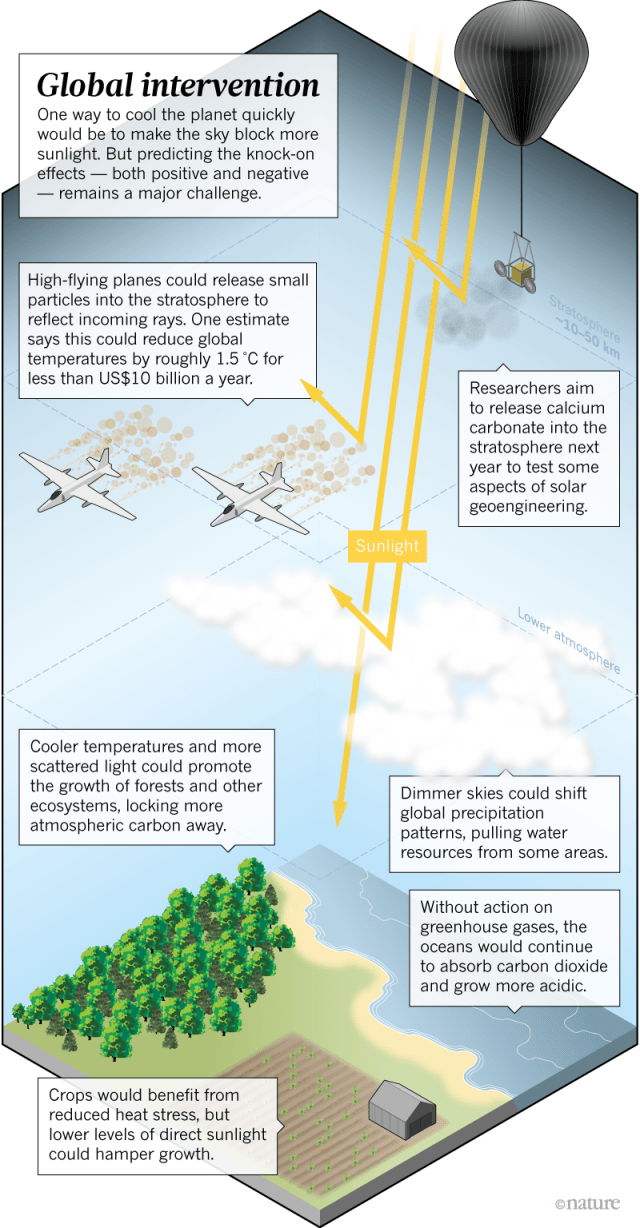
Most of the solar geoengineering research so far has focused on sulfur dioxide, the same substance released by Mount Pinatubo. But sulfur might not be the best candidate. In addition to cooling the planet, the aerosols generated in that eruption sped up the rate at which chlorofluorocarbons deplete the ozone layer, which shields the planet from the Sun’s harmful ultraviolet radiation. Sulfate aerosols are also warmed by the Sun, enough to potentially affect the movement of moisture and even alter the jet stream. “There are all of these downstream effects that we don’t fully understand,” says Frank Keutsch, an atmospheric chemist at Harvard and SCoPEx’s principal investigator.

The SCoPEx team’s initial stratospheric experiments will focus on calcium carbonate, which is expected to absorb less heat than sulfates and to have less impact on ozone. But textbook answers — and even Dai’s tabletop device — can’t capture the full picture. “We actually don’t know what it would do, because it doesn’t exist in the stratosphere,” Keutsch says. “That sets up a red flag.”

SCoPEx aims to gather real-world data to sort this out. The experiment began as a partnership between atmospheric chemist James Anderson of Harvard and experimental physicist David Keith, who moved to the university in 2011. Keith has been investigating a variety of geoengineering options off and on for more than 25 years. In 2009, while at the University of Calgary in Canada, he founded the company Carbon Engineering, in Squamish, which is working to commercialize technology to remove carbon dioxide from the atmosphere. After joining Harvard, Keith used research funding he had received from Microsoft co-founder Bill Gates, to begin planning the experiment.

Keutsch, who got involved later, is not a climate scientist and is at best a reluctant geoengineer. But he worries about where humanity is heading, and what that means for his children’s future. When he saw Keith talk about the SCoPEx idea at a conference after starting at Harvard in 2015, he says his initial reaction was that the idea was “totally insane”. Then he decided it was time to engage. “I asked myself, an atmospheric chemist, what can I do?” He joined forces with Keith and Anderson, and has since taken the lead on the experimental work.

An eye on the sky
Already, SCoPEx has moved farther along than earlier solar geoengineering efforts. The UK Stratospheric Particle Injection for Climate Engineering experiment, which sought to spray water 1 kilometre into the atmosphere, was cancelled in 2012 in part because scientists had applied for patents on an apparatus that could ultimately affect every human on the planet. (Keith says there will be no patents on any technologies involved in the SCoPEx project.) And US researchers with the Marine Cloud Brightening Project, which aims to spray saltwater droplets into the lower atmosphere to increase the reflectivity of ocean clouds, have been trying to raise money for the project for nearly a decade.

Although SCoPEx could be the first solar geoengineering experiment to fly, Keith says other projects that have not branded themselves as such have already provided useful data. In 2011, for example, the Eastern Pacific Emitted Aerosol Cloud Experiment pumped smoke into the lower atmosphere to mimic pollution from ships, which can cause clouds to brighten by capturing more water vapour. The test was used to study the effect on marine clouds, but the results had a direct bearing on geoengineering science: the brighter clouds produced a cooling effect 50 times greater than the warming effect of the carbon emissions from the researchers’ ship2.

Keith says that the Harvard team has yet to encounter public protests or any direct opposition — aside from the occasional conspiracy theorist. The challenge facing researchers, he says, stems more from a fear among science-funding agencies that investing in geoengineering will lead to protests by environmentalists.

To help advance the field, Keith set a goal in 2016 of raising $20 million to support a formal research programme that would cover not just the experimental work, but also research into modelling, governance and ethics. He has raised around $12 million so far, mostly from philanthropic sources such as Gates; the pot provides funding to dozens of people, largely on a part-time basis.

Keith and Keutsch also want an external advisory committee to review SCoPEx before it flies. The committee, which is still to be selected, will report to the dean of engineering and the vice-provost for research at Harvard. “We see this as part of a process to build broader support for research on this topic,” Keith says.

Keutsch is looking forward to having the guidance of an external group, and hopes that it can provide clarity on how tests such as his should proceed. “This is a much more politically challenging experiment than I had anticipated,” he says. “I was a little naive.”

SCoPEx faces technical challenges, too. It must spray particles of the right size: the team calculates that those with a diameter of about 0.5 micrometres should disperse and reflect sunlight well. The balloon must also be able to reverse its course in the thin air so that it can pass through its own wake. Assuming the team is able to find the calcium carbonate plume — and there is no guarantee that they can — SCoPEx needs instruments that can analyse the particles and, it is hoped, carry samples back to Earth.

“It’s going to be a hard experiment, and it may not work,” says David Fahey, an atmospheric scientist at the National Oceanic and Atmospheric Administration in Boulder, Colorado. In the hope that it will, Fahey’s team has provided SCoPEx with a lightweight instrument that can reliably measure the size and number of particles that are released. The balloon will also be equipped with a laser device that can monitor the plume from afar. Other equipment that could collect information on the level of moisture and ozone in the stratosphere could fly on the balloon as well.

Up to the stratosphere
Keutsch and Keith are still working out some of the technical details. Plans with one balloon company fell through, so they are now working with a second. And an independent team of engineers in California is working on options for the sprayer. To simplify things, the SCoPEx group plans to fly the balloon during the spring or autumn, when stratospheric winds shift direction and — for a brief period — calm down, which will make it easier to track the plume.

For all of these reasons, Keutsch characterizes the first flight as an engineering test, mainly intended to demonstrate that everything works as it should. The team is ready to spray calcium carbonate particles, but could instead use salt water to test the sprayer if the advisory committee objects.

Keith still thinks that sulfate aerosols might ultimately be the best choice for solar geoengineering, if only because there has been more research about their impact. He says that the possibility of sulfates enhancing ozone depletion should become less of a concern in the future, as efforts to restore the ozone layer through pollutant reductions continue. Nevertheless, his main hope is to establish an experimental programme in which scientists can explore different aspects of solar geoengineering.

There are a lot of outstanding questions. Some researchers have suggested that solar geoengineering could alter precipitation patterns and even lead to more droughts in some regions. Others warn that one of the possible benefits of solar geoengineering — maintaining crop yields by protecting them from heat stress — might not come to pass. In a study published in August, researchers found that yields of maize (corn), soya, rice and wheat3 fell after two volcanic eruptions, Mount Pinatubo in 1991 and El Chichón in Mexico in 1982, dimmed the skies. Such reductions could be enough to cancel out any potential gains in the future.

Keith says the science so far suggests that the benefits could well outweigh the potential negative consequences, particularly compared with a world in which warming goes unchecked. The commonly cited drawback is that shielding the Sun doesn’t affect emissions, so greenhouse-gas levels would continue to rise and the ocean would grow even more acidic. But he suggests that solar geoengineering could reduce the amount of carbon that would otherwise end up in the atmosphere, including by minimizing the loss of permafrost, promoting forest growth and reducing the need to cool buildings. In an as-yet-unpublished analysis of precipitation and temperature extremes using a high-resolution climate model, Keith and others found that nearly all regions of the world would benefit from a moderate solar geoengineering programme. “Despite all of the concerns, we can’t find any areas that would be definitely worse off,” he says. “If solar geoengineering is as good as what is shown in these models, it would be crazy not to take it seriously.”

There is still widespread uncertainty about the state of the science and the assumptions in the models — including the idea that humanity could come together to establish, maintain and then eventually dismantle a well-designed geoengineering programme while tackling the underlying problem of emissions. Still, prominent organizations, including the UK Royal Society and the US National Academies of Sciences, Engineering, and Medicine, have called for more research. In October, the academies launched a project that will attempt to provide a blueprint for such a programme.

Some organizations are already trying to promote discussions among policymakers and government officials at the international level. The Solar Radiation Management Governance Initiative is holding workshops across the global south, for instance. And Janos Pasztor, who handled climate issues under former UN secretary-general Ban Ki-moon, has been talking to high-level government officials around the world in his role as head of the Carnegie Climate Geoengineering Governance Initiative, a non-profit organization based in New York. “Governments need to engage in this discussion and to understand these issues,” Pasztor says. “They need to understand the risks — not just the risks of doing it, but also the risks of not understanding and not knowing.”

One concern is that governments might one day panic over the consequences of global warming and rush forward with a haphazard solar-geoengineering programme, a distinct possibility given that the costs are cheap enough that many countries, and perhaps even a few individuals, could probably afford to go it alone. These and other questions arose earlier this month in Quito, Ecuador, at the annual summit of the Montreal Protocol, which governs chemicals that damage the stratospheric ozone layer. Several countries called for a scientific assessment of the potential effects that solar geoengineering could have on the ozone layer, and on the stratosphere more broadly.

If the world gets serious about geoengineering, Fahey says that there are plenty of sophisticated experiments that researchers could do using satellites and high-flying aircraft. But for now, he says, SCoPEx will be valuable — if only because it pushes the conversation forward. “Not talking about geoengineering is the greatest mistake we can make right now.”

Nature 563, 613-615 (2018)

doi: 10.1038/d41586-018-07533-4

Why You Should Always Wash New Clothes Before Wearing Them

BY MARKHAM HEID

If you’re the type who dons new duds without washing them first, there’s a chance you may pay a price for it a few days later. A red, itchy, painful price.

Allergic contact dermatitis is an immune system-related reaction to an allergen that has come into contact with your skin. It causes a delayed reaction: a rash that appears a few days after exposure, and then can last for weeks. “When we see allergic contact dermatitis from clothing, it’s usually from disperse dyes,” says Dr. Susan Nedorost, a professor of dermatology at Case Western Reserve University and director of the dermatitis program at University Hospitals Cleveland Medical Center. Disperse dyes are primarily used in synthetic clothing materials like polyester and nylon, Nedorost says. And they may be present at higher levels in a brand-new, unwashed article of clothing.

Nedorost says that sweating and friction can cause disperse dye to leach out of clothing. Synthetic workout gear—the shiny, stretchy, water-repelling materials that are so popular nowadays—are often the culprit when she treats people for allergic contact dermatitis. “If a patient comes in and has a rash around the back of the neck and along their sides around their armpits, the first question I ask is what they wear when they work out,” she says.

It’s not clear how common disperse-dye allergies are among the general public. But there is one way to limit your risk for bad reactions: “By washing new clothing, you might remove a little extra dye and so have a lower exposure,” Nedorost says.

In very rare cases, taking this step could even prevent the development of a new allergy. If enough of the dye leached onto a skinned knee or other open wound, she says, that could activate the immune system and create a lasting sensitivity.

Allergic rashes aren’t the only health issue associated with clothing chemicals. In a 2014 study, a group of researchers from Stockholm University in Sweden tested 31 clothing samples purchased at retail stores, and that were “diverse in color, material, brand, country of manufacture, and price, and intended for a broad market.” They found a type of chemical compound called “quinoline” (or one of its derivatives) in 29 of the 31 samples, and the levels of this chemical tended to be especially high in polyester garments. Quinoline is used in clothing dyes, and the U.S. Environmental Protection Agency has classified it as a “possible human carcinogen” based on some studies linking it to “tumor-initiating activity” in mice—though the agency also states that no human studies have been conducted to assess the cancer-causing potential of quinoline.

Ulrika Nilsson, a member of the Stockholm University group and a professor of analytical chemistry, also calls out nitroanilines and benzothiazoles, two more chemical compounds that turn up in clothing and that lab and animal evidence has linked to potential adverse health effects, including cancer. While some of these chemicals may remain locked away in the fibers of your clothing, others may slowly work their way out onto your skin or into the air you breathe as your clothing ages and degrades. Unfortunately, Nilsson says, “these chemicals are so far not well studied regarding skin uptake or related health effects” in humans, so it’s not clear whether exposure to these chemicals in your clothing could make you sick.

David Andrews, a senior scientist with the nonprofit Environmental Working Group who has investigated the use of chemicals in the textile industry, says clothing is often treated with stain-repellents, color-fasteners, anti-wrinkle agents, softness-enhancers, and any number of other chemical treatments. Clothing manufacturers don’t have to disclose any of these to customers, and many of the chemicals, including a popular type of waterproofing chemical called fluorosurfactants (often referred to as PFAS), have little or no research backing their safety. Not only could these chemicals pose health risks to people, but they also end up in the air and water supplies, where they could do further harm.

“It’s always in your best interest to wash clothing before wearing,” he says. Nilsson agrees, saying washing new clothes “reduces the content of chemicals,” especially residual chemicals that may be left over from the manufacturing process.

But even so, that doesn’t prevent clothing chemicals from breaking down and leaching out of your clothing and onto your skin or into the air your breathe. And, unfortunately, there’s no easy way to point people toward clothing items that may be safer, Andrews says. Some of the research on clothing suggests synthetic materials may be treated with more chemicals than natural fibers such as cotton. But there’s really no label indicator or certification that signals a garment is chemical-free, he says.

“What’s maddening for the consumer is that you buy a shirt that says ‘100% cotton,’ and yet you’re given no information about any of the chemicals or additives that have been used.”

https://time.com/5631818/wash-new-clothes/