Air Pollution Exposure Comparable to High-Fat Diet, Could Lead to Cardiometabolic Diseases Like Diabetes

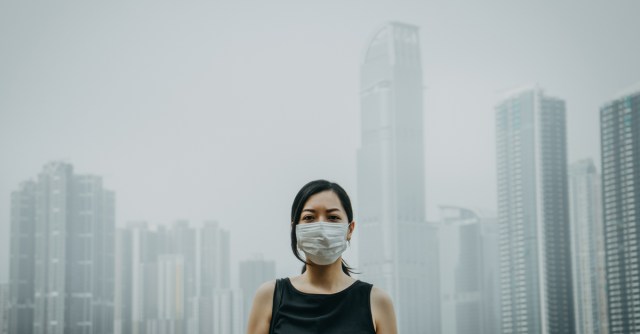
In a first-of-its-kind study, researchers have found that air pollution can play a role in the development of cardiometabolic diseases such as diabetes. Moreover, the study also shows that living in a polluted region was comparable to eating a high-fat diet.

A team of researchers from the Case Western Reserve University and John Hopkins Bloomberg School of Public Health in the US, led by Indian-origin scientist Dr Sanjay Rajagopalan, made the discovery. The study shows that air pollution was a ‘risk factor for a risk factor’ that formed the underlying cause of fatal problems like heart attack and stroke.

“In this study, we created an environment that mimicked a polluted day in New Delhi or Beijing,” Dr Rajagopalan said. “We concentrated fine particles of air pollution called PM2.5. Concentrated particles like this develop from human impact on the environment, such as automobile exhaust, power generation and other fossil fuels.”

The fine pollution particles have been strongly linked to risk factors for several diseases like lung cancer, heart failure, Alzheimer’s and other chronic diseases. Air pollution is the deadliest environmental hazard in the current times, with an estimated death toll of more than 90 lakh per year. The evidence for the cardiovascular effects of air pollution can lead to heart attack and stroke and cardiometabolic diseases like diabetes is also growing.

In the present research, the results show that air pollution can be added as a risk factor for the development of such cardiometabolic diseases similar to an unhealthy diet and lack of exercise. The research team has shown exposure to air pollution can increase the likelihood of the same risk factors that lead to heart diseases, such as insulin resistance and type 2 diabetes.

In its statement, the University Hospitals Cleveland Medical Center explains that the mouse model study involved three groups: a control group receiving clean filtered air, a group exposed to polluted air for 24 weeks, and a group fed a high-fat diet. Both the pollution-exposed group and the high-fat diet group showed insulin resistance and abnormal metabolism—similar to a pre-diabetic state.

“The good news is that these effects were reversible, at least in our experiments. Once the air pollution was removed from the environment, the mice appeared healthier, and the pre-diabetic state seemed to reverse,” said Dr Rajagopalan.

The results could have a significant contribution in responding to severe heart attack and other such cardio-related risks. As a next step, the researchers are planning to involve more experts and the National Institute of Health, to explore the possibility of clinical trials to compare heart health and the level of air pollution.

The researchers are hopeful that the study will encourage policymakers to act on the reduction of air pollution in highly polluted regions like India and China.

The study was published in the Journal of Clinical Investigation last week.

https://weather.com/en-IN/india/pollution/news/2020-08-23-air-pollution-exposure-comparable-high-fat-diet-lead-to

750 Million Genetically Modified Mosquitoes Will Be Released in the Florida Keys


There have been no reports of health or environmental harm in other locations where genetically modified mosquitoes have been introduced over the last decade.

By Lisa Winter

With the aim of reducing rates of the mosquito-borne illnesses yellow fever and dengue, a pilot program will release 750 million genetically modified mosquitoes into the Florida Keys in 2021, thanks to approval by the barrier islands’ Mosquito Control District Board of Commissioners at a meeting on Tuesday (August 18).

The strain of GM mosquitoes, known as OX513A, is an altered form of Aedes aegypti created by UK-based biotech firm Oxitec. Released mosquitoes will be all male, as male mosquitoes do not bite and generally only feed on nectar. Thanks to a conditionally lethal genetic variant, when OX513A mosquitoes mate with wild females, their offspring should die before they are old enough for females to begin biting.

Over the last 10 years, Oxitec deployed these GM mosquitoes in the Cayman Islands and Brazil. This will be the first release of any GM mosquitoes in the US. The Centers for Disease Control and Prevention (CDC) and scientists at the University of Florida will oversee program.

“It’s gone extremely well,” Oxitec scientist Kevin Gorman tells the AP. “We have released over a billion of our mosquitoes over the years. There is no potential for risk to the environment or humans.”

A September 2019 study published in Scientific Reports concluded that female progeny of Oxitec’s GM mosquitoes were not dying off as intended in Brazil. Less than a week after it was published, an editor’s note about criticisms was appended. In May 2020, the paper received a formal Editorial Expression of Concern about the study design and erroneous or misleading claims.

Oxitec’s journey to releasing the mosquitoes in the Florida Keys has been several years in the making. The company commissioned 25 studies to obtain approval from the CDC, the US Environmental Protection Agency (EPA), and seven state and local agencies in Florida, Oxitec reports. The pilot program will target the Florida Keys because A. aegypti mosquitoes are invasive there and are increasingly resistant to insecticides meant to control their numbers, according to reports.

“The science is there. This is something Monroe County needs,” Jill Cranny-Gage, a supporter of the program, said at the Mosquito Control District’s meeting, according to the AP. “We’re trying everything in our power, and we’re running out of options.”

Oxitec has also received federal approval to release the mosquitoes in Texas, BBC News reports, but will face a similar battle to get the go-ahead from state and local agencies.

https://www.the-scientist.com/news-opinion/750-million-gm-mosquitoes-will-be-released-in-the-florida-keys-67855?utm_campaign=TS_DAILY%20NEWSLETTER_2020&utm_medium=email&_hsmi=93795084&_hsenc=p2ANqtz-9lmVxlNcCMOS833bxmZyvcCcSsJFmqsdVtUIQj7GO6I7635EymKxy49Mj9yuLx1fOyG5LdFBzN9kRQp3UU9BdiSubwVw&utm_content=93795084&utm_source=hs_email

Your ‘Surge Capacity’ Is Depleted — It’s Why You Feel Awful

By Tara Haelle

It was the end of the world as we knew it, and I felt fine. That’s almost exactly what I told my psychiatrist at my March 16 appointment, a few days after our children’s school district extended spring break because of the coronavirus. I said the same at my April 27 appointment, several weeks after our state’s stay-at-home order.

Yes, it was exhausting having a kindergartener and fourth grader doing impromptu distance learning while I was barely keeping up with work. And it was frustrating to be stuck home nonstop, scrambling to get in grocery delivery orders before slots filled up, and tracking down toilet paper. But I was still doing well because I thrive in high-stress emergency situations. It’s exhilarating for my ADHD brain. As just one example, when my husband and I were stranded in Peru during an 8.0-magnitude earthquake that killed thousands, we walked around with a first aid kit helping who we could and tracking down water and food. Then I went out with my camera to document the devastation as a photojournalist and interview Peruvians in my broken Spanish for my hometown paper.

Now we were in a pandemic, and I’m a science journalist who has written about infectious disease and medical research for nearly a decade. I was on fire, cranking out stories, explaining epidemiological concepts in my social networks, trying to help everyone around me make sense of the frightening circumstances of a pandemic and the anxiety surrounding the virus.

I knew it wouldn’t last. It never does. But even knowing I would eventually crash, I didn’t appreciate how hard the crash would be, or how long it would last, or how hard it would be to try to get back up over and over again, or what getting up even looked like.

In those early months, I, along with most of the rest of the country, was using “surge capacity” to operate, as Ann Masten, PhD, a psychologist and professor of child development at the University of Minnesota, calls it. Surge capacity is a collection of adaptive systems — mental and physical — that humans draw on for short-term survival in acutely stressful situations, such as natural disasters. But natural disasters occur over a short period, even if recovery is long. Pandemics are different — the disaster itself stretches out indefinitely.

“The pandemic has demonstrated both what we can do with surge capacity and the limits of surge capacity,” says Masten. When it’s depleted, it has to be renewed. But what happens when you struggle to renew it because the emergency phase has now become chronic?

By my May 26 psychiatrist appointment, I wasn’t doing so hot. I couldn’t get any work done. I’d grown sick of Zoom meetups. It was exhausting and impossible to think with the kids around all day. I felt trapped in a home that felt as much a prison as a haven. I tried to conjure the motivation to check email, outline a story, or review interview notes, but I couldn’t focus. I couldn’t make myself do anything — work, housework, exercise, play with the kids — for that whole week.

Or the next.

Or the next.

Or the next.

I know depression, but this wasn’t quite that. It was, as I’d soon describe in an emotional post in a social media group of professional colleagues, an “anxiety-tainted depression mixed with ennui that I can’t kick,” along with a complete inability to concentrate. I spoke with my therapist, tweaked medication dosages, went outside daily for fresh air and sunlight, tried to force myself to do some physical activity, and even gave myself permission to mope for a few weeks. We were in a pandemic, after all, and I had already accepted in March that life would not be “normal” for at least a year or two. But I still couldn’t work, couldn’t focus, hadn’t adjusted. Shouldn’t I be used to this by now?

“Why do you think you should be used to this by now? We’re all beginners at this,” Masten told me. “This is a once in a lifetime experience. It’s expecting a lot to think we’d be managing this really well.”

It wasn’t until my social media post elicited similar responses from dozens of high-achieving, competent, impressive women I professionally admire that I realized I wasn’t in the minority. My experience was a universal and deeply human one.

An unprecedented disaster

While the phrase “adjusting to the new normal” has been repeated endlessly since March, it’s easier said than done. How do you adjust to an ever-changing situation where the “new normal” is indefinite uncertainty?

“This is an unprecedented disaster for most of us that is profound in its impact on our daily lives,” says Masten. But it’s different from a hurricane or tornado where you can look outside and see the damage. The destruction is, for most people, invisible and ongoing. So many systems aren’t working as they normally do right now, which means radical shifts in work, school, and home life that almost none of us have experience with. Even those who have worked in disaster recovery or served in the military are facing a different kind of uncertainty right now.

“I think we maybe underestimate how severe the adversity is and that people may be experiencing a normal reaction to a pretty severe and ongoing, unfolding, cascading disaster,” Masten says. “It’s important to recognize that it’s normal in a situation of great uncertainty and chronic stress to get exhausted and to feel ups and downs, to feel like you’re depleted or experience periods of burnout.”

Research on disaster and trauma focuses primarily on what’s helpful for people during the recovery period, but we’re not close to recovery yet. People can use their surge capacity for acute periods, but when dire circumstances drag on, Masten says, “you have to adopt a different style of coping.”

Understanding ambiguous loss

It’s not surprising that, as a lifelong overachiever, I’ve felt particularly despondent and adrift as the months have dragged on, says Pauline Boss, PhD, a family therapist and professor emeritus of social sciences at the University of Minnesota who specializes in “ambiguous loss.”

“It’s harder for high achievers,” she says. “The more accustomed you are to solving problems, to getting things done, to having a routine, the harder it will be on you because none of that is possible right now. You get feelings of hopelessness and helplessness, and those aren’t good.”
That’s similar to how Michael Maddaus, MD, a professor of thoracic surgery at the University of Minnesota, felt when he became addicted to prescription narcotics after undergoing several surgeries. Now recovered and a motivational speaker who promotes the idea of a “resilience bank account,” Maddaus had always been a fast-moving high achiever — until he couldn’t be.

“I realized that my personal operating system, though it had led to tremendous success, had failed me on a more personal level,” he says. “I had to figure out a different way of contending with life.”

That mindset is an especially American one, Boss says.

“Our culture is very solution-oriented, which is a good way of thinking for many things,” she says. “It’s partly responsible for getting a man on the moon and a rover on Mars and all the things we’ve done in this country that are wonderful. But it’s a very destructive way of thinking when you’re faced with a problem that has no solution, at least for a while.”
That means reckoning with what’s called ambiguous loss: any loss that’s unclear and lacks a resolution. It can be physical, such as a missing person or the loss of a limb or organ, or psychological, such as a family member with dementia or a serious addiction.

“In this case, it is a loss of a way of life, of the ability to meet up with your friends and extended family,” Boss says. “It is perhaps a loss of trust in our government. It’s the loss of our freedom to move about in our daily life as we used to.” It’s also the loss of high-quality education, or the overall educational experience we’re used to, given school closures, modified openings and virtual schooling. It’s the loss of rituals, such weddings, graduations, and funerals, and even lesser “rituals,” such as going to gym. One of the toughest losses for me to adapt to is no longer doing my research and writing in coffee shops as I’ve done for most of my life, dating back to junior high.

“These were all things we were attached to and fond of, and they’re gone right now, so the loss is ambiguous. It’s not a death, but it’s a major, major loss,” says Boss. “What we used to have has been taken away from us.”

Just as painful are losses that may result from the intersection of the pandemic and the already tense political division in the country. For many people, issues related to Covid-19 have become the last straw in ending relationships, whether it’s a family member refusing to wear a mask, a friend promoting the latest conspiracy theory, or a co-worker insisting Covid-19 deaths are exaggerated.

Ambiguous loss elicits the same experiences of grief as a more tangible loss — denial, anger, bargaining, depression, and acceptance — but managing it often requires a bit of creativity.


A winding, uncharted path to coping in a pandemic

While there isn’t a handbook for functioning during a pandemic, Masten, Boss, and Maddaus offered some wisdom for meandering our way through this.

Accept that life is different right now
Maddaus’ approach involves radical acceptance. “It’s a shitty time, it’s hard,” he says. “You have to accept that in your bones and be okay with this as a tough day, with ‘that’s the way it is,’ and accept that as a baseline.”

But that acceptance doesn’t mean giving up, he says. It means not resisting or fighting reality so that you can apply your energy elsewhere. “It allows you to step into a more spacious mental space that allows you to do things that are constructive instead of being mired in a state of psychological self torment.”

Expect less from yourself

Most of us have heard for most of our lives to expect more from ourselves in some way or another. Now we must give ourselves permission to do the opposite. “We have to expect less of ourselves, and we have to replenish more,” Masten says. “I think we’re in a period of a lot of self discovery: Where do I get my energy? What kind of down time do I need? That’s all shifted right now, and it may take some reflection and self discovery to find out what rhythms of life do I need right now?”

She says people are having to live their lives without the support of so many systems that have partly or fully broken down, whether it’s schools, hospitals, churches, family support, or other systems that we relied on. We need to recognize that we’re grieving multiple losses while managing the ongoing impact of trauma and uncertainty. The malaise so many of us feel, a sort of disinterested boredom, is common in research on burnout, Masten says. But other emotions accompany it: disappointment, anger, grief, sadness, exhaustion, stress, fear, anxiety — and no one can function at full capacity with all that going on.

Recognize the different aspects of grief

The familiar “stages” of grief don’t actually occur in linear stages, Boss says, but denial, anger, bargaining, depression, and acceptance are all major concepts in facing loss. Plenty of people are in denial: denying the virus is real, or that the numbers of cases or deaths are as high as reported, or that masks really help reduce disease transmission.
Anger is evident everywhere: anger at those in denial, anger in the race demonstrations, anger at those not physically distancing or wearing masks, and even anger at those who wear masks or require them. The bargaining, Boss says, is mostly with scientists we hope will develop a vaccine quickly. The depression is obvious, but acceptance… “I haven’t accepted any of this,” Boss says. “I don’t know about you.”

Sometimes acceptance means “saying we’re going to have a good time in spite of this,” Boss says, such as when my family drove an hour outside the city to get far enough from light pollution to look for the comet NEOWISE. But it can also mean accepting that we cannot change the situation right now.

“We can kick and scream and be angry, or we can feel the other side of it, with no motivation, difficulty focusing, lethargy,” Boss says, “or we can take the middle way and just have a couple days where you feel like doing nothing and you embrace the losses and sadness you’re feeling right now, and then the next day, do something that has an element of achievement to it.”

Experiment with “both-and” thinking

This approach may not work for everyone, but Boss says there’s an alternative to binary thinking that many people find helpful in dealing with ambiguous loss. She calls it “both-and” thinking, and sometimes it means embracing a bit of the irrational.

For the families of soldiers missing in action in Vietnam that Boss studied early in her career, or the family members of victims of plane crashes where the bodies aren’t recovered, this type of thinking means thinking: “He is both living and maybe not. She is probably dead but maybe not.”

“If you stay in the rational when nothing else is rational, like right now, then you’ll just stress yourself more,” she says. “What I say with ambiguous loss is the situation is crazy, not the person. The situation is pathological, not the person.”

An analogous approach during the pandemic might be, “This is terrible and many people are dying, and this is also a time for our families to come closer together,” Boss says. On a more personal level, “I’m highly competent, and right now I’m flowing with the tide day-to-day.”

It’s a bit of a Schrödinger’s existence, but when you can’t change the situation, “the only thing you can change is your perception of it,” she says.

Of course, that doesn’t mean denying the existence of the pandemic or the coronavirus. As Maddaus says, “You have to face reality.” But how we frame that reality mentally can help us cope with it.

Look for activities, new and old, that continue to fulfill you

Lots of coping advice has focused on “self-care,” but one of the frustrating ironies of the pandemic is that so many of our self-care activities have also been taken away: pedicures, massages, coffee with friends, a visit to the amusement park, a kickboxing class, swimming in the local pool — these activities remain unsafe in much of the country. So we have to get creative with self-care when we’re least motivated to get creative.

“When we’re forced to rethink our options and broaden out what we think of as self-care, sometimes that constraint opens new ways of living and thinking,” Masten says. “We don’t have a lot of control over the global pandemic but we do over our daily lives. You can focus on plans for the future and what’s meaningful in life.”

For me, since I missed eating in restaurants and was tired of our same old dinners, I began subscribing to a meal-kit service. I hate cooking, but the meal kits were easy, and I was motivated by the chance to eat something that tasted more like what I’d order in a restaurant without having to invest energy in looking through recipes or ordering the right ingredients.

Okay, I’ve also been playing a lot of Animal Crossing, but Maddaus explains why it makes sense that creative activities like cooking, gardening, painting, house projects — or even building your own imaginary island out of pixels — can be fulfilling right now. He references the book The Molecule of More, which explores how dopamine influences our experiences and happiness, in describing the types of activities most likely to bring us joy.

“There are two ways the brain deals with the world: the future and things we need to go after, and the here and now, seeing things and touching things,” Maddaus says. “Rather than being at the mercy of what’s going on, we can use the elements of our natural reward system and construct things to do that are good no matter what.”
Those kinds of activities have a planning element and a here-and-now experience element. For Maddaus, for example, it was simply replacing all the showerheads and lightbulbs in the house.

“It’s a silly thing, but it made me feel good,” he says.

Focus on maintaining and strengthening important relationships

The biggest protective factors for facing adversity and building resilience are social support and remaining connected to people, Masten says. That includes helping others, even when we’re feeling depleted ourselves.

“Helping others is one of those win-win strategies of taking action because we’re all feeling a sense of helplessness and loss of control about what’s going on with this pandemic, but when you take action with other people, you can control what you’re doing,” she says. Helping others could include checking in on family friends or buying groceries for an elderly neighbor.

Begin slowly building your resilience bank account

Maddaus’ idea of a resilience bank account is gradually building into your life regular practices that promote resilience and provide a fallback when life gets tough. Though it would obviously be nice to have a fat account already, he says it’s never too late to start. The areas he specifically advocates focusing on are sleep, nutrition, exercise, meditation, self-compassion, gratitude, connection, and saying no.

“Start really small and work your way up,” he says. “If you do a little bit every day, it starts to add up and you get momentum, and even if you miss a day, then start again. We have to be gentle with ourselves and keep on, begin again.”

After spending an hour on the phone with each of these experts, I felt refreshed and inspired. I can do this! I was excited about writing this article and sharing what I’d learned.
And then it took me two weeks to start the article and another week to finish it — even though I wanted to write it. But now, I could cut myself a little more slack for taking so much longer than I might have a few months ago. I might have intellectually accepted back in March that the next two years (or more?) are going to be nothing like normal, and not even predictable in how they won’t be normal. But cognitively recognizing and accepting that fact and emotionally incorporating that reality into everyday life aren’t the same. Our new normal is always feeling a little off balance, like trying to stand in a dinghy on rough seas, and not knowing when the storm will pass. But humans can get better at anything with practice, so at least I now have some ideas for working on my sea legs.

https://elemental.medium.com/your-surge-capacity-is-depleted-it-s-why-you-feel-awful-de285d542f4c

Ohio newlyweds donate and serve wedding reception food to local shelter


Ohio newlyweds turned their canceled reception into an act of service by donating their reception food to a local women’s shelter.

By Kelsie Smith

Ohio newlyweds turned their canceled reception into an act of service by donating their reception food to a local women’s shelter.

Before the pandemic hit, Tyler and Melanie Tapajna, of Parma, Ohio, had arranged to celebrate their nuptials in a more traditional way. They had planned a large 150-person party, and booked a DJ and local caterers to help ring in their big day in August.

But as venues began to cancel events due to coronavirus, the couple — like countless others with scheduled ceremonies in 2020 — had to change their plans.

The couple opted to ditch the large gathering, for safety reasons, and donate what would have been the food at their party — from Ohio-based food truck and catering service Betty’s Bomb Ass Burgers — to a shelter.

“It was really either have the big wedding or donate the food,” Melanie Tapajna told CNN. “We were actually kind of excited I think more about donating the food than being stressed during the wedding.”

On Saturday, after a small backyard wedding with immediate family members, the newlyweds headed over to Laura’s Home — a women and children’s facility run by The City Mission in Cleveland, Ohio — to make their donation.

Tyler, who dressed in a black and white tuxedo, and Melanie, who wore her white lace wedding gown, kept their face masks on and put on gloves and hairnets to serve the food.

They served fried chicken, green beans, salad and mac and cheese to a total of 135 women and children, according to Rich Trickel, the CEO of The City Mission.

“Something like that had never occurred before,” said Trickel, who coordinated with the couple and the caterer to get the food delivered. “It was really unbelievable especially when you think of many of our clients, the women and kids that are in our building, possibly have never been at a wedding like that before.”

The couple said they hope their donation inspired others whose plans have been derailed by the virus.

“You can definitely give back in times like this,” Melanie said.

https://www.cnn.com/2020/08/17/us/newlyweds-reception-food-shelter-trnd/index.html?utm_term=1598097748471417f0510cc0f&utm_source=The+Good+Stuff+08%2F22%2F20&utm_medium=email&utm_campaign=237792_1598097748472&bt_ee=0HjTDVQDBK2MZ33xeNriHA0bGimGQlUj%2FhnqaNLNvfPybgWkGSLhm0TJ5utn0Syn&bt_ts=1598097748472

Alzheimer’s risk factors may be measurable in adolescents and young adults

Risk factors for Alzheimer’s dementia may be apparent as early as our teens and 20s, according to new research reported at the Alzheimer’s Association International Conference® (AAIC®) 2020.

These risk factors, many of which are disproportionately apparent in African Americans, include heart health factors — such as high blood pressure, high cholesterol and diabetes — and social factors like education quality. According to the Alzheimer’s Association Alzheimer’s Disease Facts and Figures report, older African Americans are about twice as likely to have Alzheimer’s or other dementias as older whites.

“By identifying, verifying, and acting to counter those Alzheimer’s risk factors that we can change, we may reduce new cases and eventually the total number of people with Alzheimer’s and other dementia,” said Maria C. Carrillo, Ph.D., Alzheimer’s Association chief science officer. “Research like this is important in addressing health inequities and providing resources that could make a positive impact on a person’s life.”

“These new reports from AAIC 2020 show that it’s never too early, or too late, to take action to protect your memory and thinking abilities,” Carrillo said.

The Alzheimer’s Association is leading the U.S. Study to Protect Brain Health Through Lifestyle Intervention to Reduce Risk (U.S. POINTER), a two-year clinical trial to evaluate whether lifestyle interventions that simultaneously target many risk factors protect cognitive function in older adults who are at increased risk for cognitive decline. U.S. POINTER is the first such study to be conducted in a large, diverse group of Americans across the United States.

African American Youth At Higher Risk of Dementia

In a population of more than 714 African Americans in the Study of Healthy Aging in African Americans (STAR), Kristen George, Ph.D., MPH, of the University of California, Davis, and colleagues found that high blood pressure and diabetes, or a combination of multiple heart health-related factors, are common in adolescence and are associated with worse late-life cognition. Study participants were adolescents (n=165; ages 12-20), young adults (n=439; ages 21-34) and adults (n=110; ages 35-56). Mean age at cognitive assessment was 68.

Cognition was measured using in-person tests of memory and executive function. The researchers found that, in this study population, having diabetes, high blood pressure, or two or more heart health risk factors in adolescence, young adulthood, or mid-life was associated with statistically significantly worse late-life cognition. These differences persisted after accounting for age, gender, years since risk factors were measured, and education.

Before this report, little was known about whether cardiovascular disease (CVD) risk factors developed prior to mid-life were associated with late-life cognition. This is an important question because African Americans have a higher risk of CVD risk factors compared to other racial/ethnic groups from adolescence through adulthood.

According to the researchers, these findings suggest that CVD risk factors as early as adolescence influence late-life brain health in African Americans. Efforts to promote heart and brain healthy lifestyles must not only include middle-aged adults, but also younger adults and adolescents who may be especially susceptible to the negative impact of poor vascular health on the brain.

Early Adult BMI Associated With Late Life Dementia Risk

In what the authors say is the first study to report on the issue, higher early adulthood (age 20-49) body mass index (BMI) was associated with higher late-life dementia risk.

Relatively little is known about the role of early life BMI on the risk of Alzheimer and other dementias. The scientists studied a total of 5,104 older adults from two studies, including 2,909 from the Cardiovascular Health Study (CHS) and 2,195 from the Health, Aging and Body Composition study (Health ABC). Of the total sample, 18% were Black and 56% were women. Using pooled data from four established cohorts spanning the adult life course, including the two cohorts under the study, the scientists estimated BMI beginning at age 20 for all older adults of CHS and Health ABC.

For women, dementia risk increased with higher early adulthood BMI. Compared to women with normal BMI in early adulthood, dementia risk was 1.8 times higher among those who were overweight, and 2.5 times higher among those who were obese. Analyses were adjusted for midlife and late life BMI.

They found no association between midlife BMI and dementia risk among women.

For men, dementia risk was 2.5 times higher among those who were obese in early adulthood, 1.5 times higher among those who were overweight in mid-life and 2.0 times higher among those who were obese in mid-life, in models also adjusted for late life BMI.

For both women and men, dementia risk decreased with higher late life BMI.

Adina Zeki Al Hazzouri, Ph.D. of Columbia University and colleagues found that high BMI in adulthood is a risk factor for dementia in late life. The researchers suggest that efforts aimed at reducing dementia risk may need to begin earlier in life with a focus on obesity prevention and treatment.

Quality of Early-Life Education Influences Dementia Risk

In a diverse group of more than 2,400 people followed up to 21 years, higher quality early-life education was associated with better language and memory performance, and lower risk of late-life dementia. Results were somewhat different between men and women, and between Blacks and Whites in the study.

The study included 2,446 Black and White men and women, age 65 and older, enrolled in the Washington Heights/Inwood Columbia Aging Project who attended elementary school in the United States. A school quality variable based on historical measures included: mandatory school enrollment age, minimum dropout age, school term length, student-teacher ratio, and student attendance.

People who attended school in states with lower quality education had more rapid decline in memory and language as an older adult. Black women and men and White women who attended schools in states with higher quality education were less likely to develop dementia. According to the scientists, the results were explained, in part, because people who attend higher quality schools end up getting more years of school.

Justina Avila-Rieger, PhD, a postdoctoral research scientist at Columbia University Irving Medical Center and colleagues say the findings provide evidence that later life dementia risk and cognitive function is influenced by early-life state educational policies.

https://www.sciencedaily.com/releases/2020/07/200730092616.htm

National Left-Hander’s Day

It’s National Left-Hander’s Day, a celebration founded by the Left-Handers Club to honor leftie style.

Now in its 17th year, the day has been celebrated with right vs. left sports matches, left-handed drinking events and other activities, the club says.

In honor of the day, some tidbits about sinistrality:

About that name

Sinistrality is the formal name for left-handedness and carries quite a history.

It’s based on the Latin word “sinistra,” for “on the left.” But as time wore on, it began to accumulate associations with evil that persist today.

Throughout the ages, left-handedness has been associated with weakness, impurity or evil. Today, few would consider the left-handers in our midst evil, but they do have to endure numerous inconveniences of a right-handed world.

Lefty stats

About 10% of the world’s population is believed to be left-handed, although the number ebbs and flows with time and place, researchers say. In more free-wheeling times and cultures, researchers say, left-handedness is more common, while in more restrictive times and places, the incidence seems to be reduced.

Lefty careers

In a 1996 study, Harvard Medical School researchers found that orthopedic surgeons, librarians and mathematicians were mostly right-handed while attorneys and architects were, as a group, “either the least right-handed or the most left-handed.” Other studies have shown that there are more left-handed people working as artists and musicians and in university settings. Interestingly, more than 20% of Apollo astronauts were lefties, according to NASA.

Lefty presidents

Politics aside, at least four of the past seven presidents have been left-handed: Barack Obama, Bill Clinton, George H.W. Bush and Gerald Ford.

Ronald Reagan also often shows up on the list of lefties even though he wrote with his right hand. Some historians suggest that he was born left-handed but forced to switch as a child.

Why are so many US presidents left-handed?

There’s no clear research, and it may just be a fluke.

But the website leftrightwrong.com puts forth a few of the theories: Politicians are often lawyers, a profession that has among the highest concentrations of left-handers; lefties are more mentally resilient because of all the tribulations they have to endure in a right-handed world; lefties have the reputed ability to process language on both sides of their brains.

Lefty earnings

Research indicates that left-handers may have increased rates of high blood pressure, irritable bowel syndrome, schizophrenia and maybe even premature death. It turns out they may also get the short end when it comes to earnings, according to 2014 study.

Economist Joshua Goodman of Harvard University’s Kennedy School of Government found that lefties’ earnings were 10% to 12% lower than those of right-handed people.

That’s totally at odds with a 2006 paper for the National Bureau of Economic Research, in which economists from Lafayette College and Johns Hopkins University found that “among the college-educated men in our sample, those who report being left-handed earn 15 percent more than those who report being right-handed.”
The same wasn’t true for left-handed women, they said.

https://www.cnn.com/2020/08/13/us/national-left-handers-day-trnd/index.html

‘Too many are selfish’: U.S. nears 5 million virus cases as Americans resist curbs on everyday life

By PHIL MARCELO, CARLA K. JOHNSON and LISA MARIE PANE

Big house parties and weddings, summer camps, concerts, crowded bars and restaurants, shopping trips without masks — Americans’ resistance to curbs on everyday life is seen as a key reason the U.S. has racked up more confirmed coronavirus deaths and infections by far than any other country.

The nation has recorded more than 155,000 dead in a little more than six months and is fast approaching an almost off-the-charts 5 million COVID-19 infections.

Some Americans have resisted wearing masks and social distancing, calling such precautions an over-the-top response or an infringement on their liberty. Public health experts say such behavior has been compounded by confusing and inconsistent guidance from politicians and a patchwork quilt of approaches to containing the scourge by county, state and federal governments.

“The thing that’s maddening is country after country and state after state have shown us how we can contain the virus,” said Dr. Jonathan Quick, who is leading a pandemic initiative for the Rockefeller Foundation. “It’s not like we don’t know what works. We do.”

The number of confirmed infections in the U.S. has topped 4.7 million, with new cases running at over 60,000 a day. While that’s down from a peak of well over 70,000 in the second half of July, cases are on the rise in 26 states, many of them in the South and West, and deaths are climbing in 35 states.

On average, the number of COVID-19 deaths per day in the U.S. over the past two weeks has gone from about 780 to 1,056, according to an Associated Press analysis.

In Massachusetts, leading physicians, including the president of the Massachusetts Medical Society, have been calling on Republican Gov. Charlie Baker to consider scaling back the state’s phased reopening because of an uptick in cases.

Massachusetts health officials said they are investigating at least a half-dozen new clusters of cases connected to such events as a lifeguard party, a high school graduation party, a prom party, an unsanctioned football camp and a packed harbor cruise trip.

One recent house party on Cape Cod has led to more than a dozen new cases and prompted some restaurants to close or limit service at the height of tourist season because seasonal workers had attended the gathering.

Elsewhere around the state, a Springfield hospital is dealing with an outbreak of more than 40 cases linked to a staffer who recently returned from an out-of-state vacation and then spread the virus to colleagues while eating lunch in a break room.

Hot spots around the U.S. are cropping up in what once seemed like ideal places to ride out the outbreak: rural, less populated and with lots of outdoor space. In South Dakota, a spike erupted at a Christian youth summer camp in the Black Hills, with cases growing to 96 among 328 people who attended.

In Virginia, cases have surged so much in cites like Norfolk and Virginia Beach that Democratic Gov. Ralph Northam placed limits last week on the region’s alcohol sales and gatherings of more than 50 people. Northam, the nation’s only governor who is a doctor, cited rising infections among young people and said the problem is that “too many people are selfish.”

“We all know that alcohol changes your judgment,” he said. “You just don’t care as much about social distancing after you’ve had a couple of drinks. That’s when the virus gets spread.”

Dr. Demetria Lindsay, the Virginia Department of Health’s district director for Virginia Beach and Norfolk, said there has been a pronounced spike among people ages of 20 to 29. She said factors behind the surge include gatherings of people not wearing masks or keeping a safe distance.

“Father’s Day, Memorial Day, graduations, birthdays, backyard barbecues, you name it,” Lindsay said.

The wedding industry likewise is seeing no-mask receptions with crowded dance floors and no social distancing.

Wedding planner Lynne Goldberg has a December wedding scheduled for 200 guests at the home of the bride’s parents in upstate New York.

“They have emphatically shared that this pandemic is not going to get in the way of their wedding plans and that there will be no masks handed out and no signs promoting social distancing at their wedding,” she said. “The bride has said that when she shows her children her wedding video, she doesn’t want it to be a documentary of the 2020 pandemic.”

‘Too many are selfish’: U.S. nears 5 million virus cases as Americans resist curbs on everyday life

Public restroom hand dryers found to harbor Staphylococcus and fecal matter

Automatic hand dryers in men’s and women’s public restrooms can harbor and spread bacteria, including Staphylococcus and fecal matter, according to research presented during ASM Microbe, which is being held virtually this year.

To assess the contamination of public restroom hand dryers, Craig Oberg, PhD, Brady Distinguished Professor of Microbiology at Weber State University in Ogden, Utah, and two undergraduate students collected samples using 3M Quickswabs from three different locations in each hand dryer — the top of the dryer above the air vents, in the middle beneath the air vents on the internal part of the dryer and the bottom of the dryer.

“Initially, the students were looking for contamination on exercise equipment, then they started looking at other common use equipment in gym areas and restrooms when they settled on hand dryers, especially since they have the potential to aerosolize into the surrounding area,” Oberg told Healio.

Results of the study showed that the bottom of dryers in both the men’s and women’s restrooms had the most contamination, with an average of about 300 organisms/5 cm2, followed by the middle section, which had roughly half as many organisms, averaging 140 organisms/5 cm2 and the top of the dryer, which contained 75 organisms/5 cm2. The researchers said there was no overall difference between the two brands of dryers tested in the study — Dyson Airblade and Mediclinics Dualflow Plus.

As far as finding safer ways to use the dryers, Oberg said the best option is to redesign them with internal ultraviolet light sources to prevent the buildup of microorganisms inside the dryer.

“We recommend that the inside of the dryer be cleaned as part of the bathroom cleaning schedule, which would mean turning off the dryer, then cleaning the hand chamber manually with disinfectant,” he said, adding that using paper towels is likely a safer option, provided that they are not already carrying some microorganisms.

“I think there is certainly the possibility of thinking your hands are clean when they may have been inoculated with micrograms while being dried,” Oberg said. “Our next study is to determine if microorganisms residing on the inside of the dryer readily transmit to the hand. I suspect that would be the case.”

https://www.healio.com/news/infectious-disease/20200803/bathroom-hand-dryers-can-harbor-spread-staphylococcus-fecal-matter?utm_source=selligent&utm_medium=email&utm_campaign=news&m_bt=1162769038120

Eugene Shoemaker: the only person whose ashes have been buried on any celestial body outside Earth


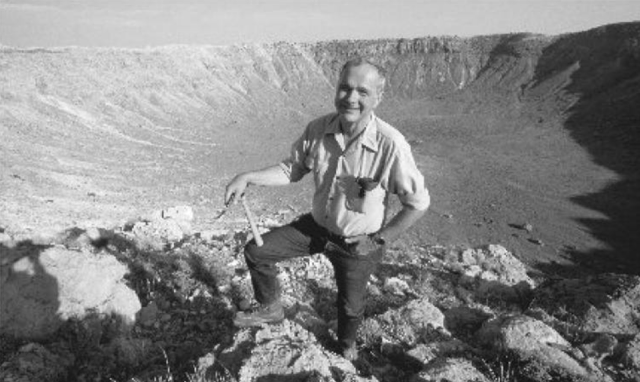
Eugene Shoemaker


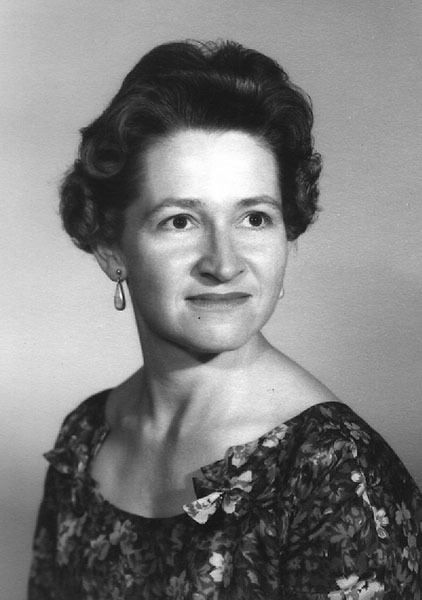
Carolyn Shoemaker


Carolyn and Eugene Shoemaker stand by the 18″ Schmidt Telescope at the Palomar Observatory. They used it to search for asteroids and comets that may come close to the earth’s orbit.


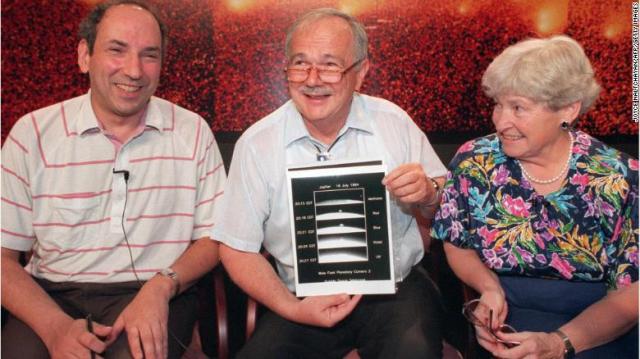
Scientist Eugene Shoemaker (C) pictured on July, 17, 1994 in Greenbelt, Maryland, with a series of images of the Shoemaker-Levy 9 comet impact with Jupiter. At right is his wife Carolyn and at left is David Levy.

Today, we know Neil Armstrong and Buzz Aldrin as the first men to land on the moon, 51 years ago. But, if not for a turn of events, history may have also known another name: Eugene Shoemaker.

Thirty years after that one small step for mankind, Eugene would make his own, extraordinary journey to the moon.

Chapter 1: Boy meets girl

In the summer of 1950, Carolyn Spellmann was a college student living in Chico, California. It was there where she would first meet her future husband and science partner, Eugene Shoemaker.

“He came to be my brother’s best man at his wedding,” Carolyn recalled. “He came there, and I opened the back door, and there was Gene.”

That first meeting turned into a long-distance pen pal relationship, and a year later, they were married.

Chapter 2: Reaching for the stars

It was Gene who would encourage Carolyn to step behind a telescope, sparking a lifelong passion and profession.

“Gene simply said, ‘Maybe I would like to see things through the telescope,'” Carolyn remembered. “I thought, ‘No, I’ve never stayed awake a night in my life, I don’t think so.’ But I gradually fell into the program, into the work.”

Carolyn went on to become a celebrated astronomer, and even held the Guinness World Record for the greatest number of comets discovered by an individual. “That earned me the nickname of Mrs. Comet,” said Carolyn.

While Carolyn focused her research on comets and near-Earth asteroids, her husband was interested in the things that asteroids created — craters.

“He always thought big, and so the origin of the universe was his project,” Carolyn said. “The more we found that had craters on them, the more excited he was.”

Chapter 3: Shooting for the moon

But for Eugene, the moon was always the ultimate goal.

“Gene wanted to go to the moon more than anything since he was a very young man,” Carolyn said. “Gene felt that putting a man on the moon was a step in science … He felt that we had a lot to learn about the origin of the moon, and therefore, other planets.”

So, in 1961, when President John F. Kennedy announced that the United States would be sending a man to the moon before the end of the decade, Eugene’s life changed forever. As a geologist dedicated to studying craters, he wanted the chance to stand on the moon, study its surface with his own two hands.

“Gene thought that he was going to the moon,” Carolyn said. “He wanted to, he worked very hard toward that end. Gene was terribly excited and worried, too, because he felt it was too soon. Too soon, he wasn’t prepared and ready, yet, he was still learning lots of things that he would need to know.”

Chapter 4: A dream deferred

But, it wasn’t his time. A failed medical test stopped his dreams in their tracks.

“It was discovered that he had Addison’s disease, which is a failure of the adrenal glands,” Carolyn recalled.

“That meant that there was no prospect at all of his ever going to the moon.”

Carolyn said Eugene “felt like his goal had suddenly disappeared.”

“At the same time, he was not a quitter,” she added.

Eugene continued to work to bring qualified people into the astronaut training program.

“He helped train Neil Armstrong, he helped train many of the astronauts,” Carolyn said. “He took the first group, and then several other groups to Meteor Crater (in Arizona).”

Meteor Crater was used as a training ground for astronauts because it mimicked the surface of the moon, both being dotted with meteor-impact craters.

Chapter 5: Turning their attention

While Eugene tucked away his hope of going to the moon, he and Carolyn set up an observation program at Palomar Observatory in California, looking to uncover near-Earth objects. That led them to one of their greatest discoveries — Comet Shoemaker-Levy 9, the comet that collided with Jupiter. It was the first time in history humans had observed a collision between two bodies in the solar system.

“He let the dream of going to the moon himself go, he was realistic about it,” Carolyn said. “At the same time, it was still on his mind. When we would do our observing program, he would be looking at the moon with that in mind, I’m sure.”

Eventually, Carolyn and Eugene would put space behind them and turn their attention to their own backyard.

“Our focus changed over the years from looking up at the moon and looking at the sky only, to considering what would happen on Earth,” Carolyn said. “Gene had a dream of seeing an asteroid hit the Earth.”

Their search for impact craters took them all over the world, with a special focus on Australia.

“The trips to Australia were rather special,” Carolyn said. “We went to Australia because it had the oldest land surface available to study.”

“We were living out of our truck … We were able to camp out under the stars, which was really special because their sky was just magnificent, and it was different from ours. It was upside down.”

Chapter 6: A fateful day

On July 18, 1997, Eugene and Carolyn were driving to meet a friend who would help them with some crater-mapping.

“We were just looking off in the distance, talking about how much fun we were having, what we were going to do,” Carolyn remembers. “Then suddenly, there appeared a Land Rover in front of us, and that was it.”

The two vehicles collided, and Eugene died.

“I had been hurt and I thought to myself, ‘Well, Gene will come around like he always does and rescue me,'” Carolyn recalls. “So I waited, and I called, and nothing happened.”

Chapter 7: Getting the call

While Carolyn was recovering in the hospital, she received a call from Carolyn Porco — an ex-student of Eugene’s who had been working on the Lunar Prospector space probe mission with NASA.

“She said, ‘I’m here in Palo Alto with some people who are working on Lunar Prospector,'” Carolyn remembers.

“They’re about to send a mission up to the moon, I wonder if you would like to put Gene’s ashes on the moon?”


I said, ‘Yes … I think that would be wonderful.'”
On January 6, 1998, the Lunar Prospector was sent off, carrying Eugene’s ashes onboard. “The whole family was there to wave Gene goodbye,” Carolyn said.

Chapter 8: A telling passage

Along with the space probe, an epigraph, laser-etched onto a piece of brass foil, was sent up with Eugene’s remains. It included a passage from Shakespeare’s “Romeo and Juliet.”

“And, when he shall die,
Take him and cut him out in little stars,
And he will make the face of heaven so fine
That all the world will be in love with night,
And pay no worship to the garish sun.”

After the Prospector’s mission was completed, it ran out of fuel and crashed into the side of the moon, by the South Pole. The impact created its own crater, and that’s where Eugene’s ashes remain today.

“Gene spent most of his life thinking about craters, about the moon,” Carolyn said. “It was ironic that he ended his life also with the moon … but he would have been very pleased to know that happened.”

Epilogue

A few years prior to his death, while receiving the William Bowie Medal for his contributions to geophysics, Eugene noted that “not going to the moon and banging on it with my own hammer has been my biggest disappointment in life”

“But then, I probably wouldn’t have gone to Palomar Observatory to take some 25,000 films of the night sky with Carolyn,” he continued. “We wouldn’t have had the thrills of finding those funny things that go bump in the night.”

Carolyn misses him always. To this day, she’ll look up to the moon and imagine him there with his rocks — looking down.

To hear her say it, he still lights up every single one of her night skies.

https://www.cnn.com/2020/07/26/us/man-on-the-moon-ashes-scn-trnd/index.html?utm_term=159628334818014c51a639e8f&utm_source=The+Good+Stuff+08%2F01%2F20&utm_medium=email&utm_campaign=228899_1596283348182&bt_ee=1Cu9PD%2F%2FgVrCcw92d%2FAaZbpmmIocfY3gomZAPHzMl1dqSKup05CAB5fzEw%2FWW0gZ&bt_ts=1596283348182

Experimental Blood Test Could Flag Alzheimer’s


New studies show that elevated levels of a form of tau called p-tau217 can accurately distinguish Alzheimer’s disease from other forms of dementia, and perhaps even predict it.

by Kerry Grens

Three studies presented at the Alzheimer’s Association International Conference this week describe the performance of blood tests used to diagnose, and even predict, Alzheimer’s disease using circulating levels of a form of tau protein called p-tau217. The largest assessment of this approach, which included 1,402 participants, showed that circulating p-tau217 levels worked just as well at detecting Alzheimer’s as standard PET scans and tests of cerebrospinal fluid.

“This blood test very, very accurately predicts who’s got Alzheimer’s disease in their brain, including people who seem to be normal,” Michael Weiner, an Alzheimer’s disease researcher at the University of California, San Francisco, who was not involved in the study, tells The New York Times. “It’s not a cure, it’s not a treatment, but you can’t treat the disease without being able to diagnose it. And accurate, low-cost diagnosis is really exciting, so it’s a breakthrough.”

A blood test could help identify people on track to develop Alzheimer’s early on—and perhaps get them enrolled in drug trials aimed at finding an effective treatment for the disease. Scientists have pursued a number of potential circulating biomarkers, such as amyloid-β, to find those that can reliably diagnose Alzheimer’s disease or predict its development, but to date none have come to market.

High levels of tau or its phosphorylated form, p-tau, have emerged as promising biomarker candidates because they may indicate the presence of damaging structures known as neurofibrillary tangles in the brain.

The large study on one type of p-tau, p-tau217, published in JAMA July 28 to coincide with the presentation at the meeting, was a collection of three experiments using a blood test developed by Eli Lilly (some of the coauthors work for the company). In one assessment of several hundred Swedes, the test accurately distinguished patients who had Alzheimer’s from those with other forms of dementia with 89–98 percent accuracy. “That’s pretty good. We’ve never seen that” precision before, Maria Carrillo, the Alzheimer’s Association’s chief science officer, tells the Associated Press.

In another assessment of the Eli Lilly test, which included hundreds of related individuals, some of whom have a gene that causes Alzheimer’s, p-tau217 levels in the blood aligned with the genetics, even decades before cognitive impairment is likely to begin.

Another study presented at the conference found a p-tau217 blood test could accurately distinguish Alzheimer’s patients from those with frontotemporal lobar degeneration, according to a conference press release. And a third presentation of a study by Suzanne Schindler of Washington University in St. Louis and her colleagues reported that circulating p-tau217 was superior to another form that’s been studied as a potential biomarker, p-tau181, as a proxy for amyloid accumulation in the brain.

“I personally find it very reassuring that these different groups are using different types of assays and getting the same result,” Schindler tells the Times. “It looks real. It looks like 217 has tremendous promise as a blood test for Alzheimer’s disease, and it is likely to correspond with the symptoms.”

Speaking to The Guardian, Clive Ballard, who studies age-related disease at the University of Exeter Medical School and who was not involved in these projects, says, “further validation in people from more routine clinical settings are still needed, and a lot of work will be needed to achieve standardisation of the test across laboratories—so it could still be at least five years before we see an accurate blood biomarker test for dementia in the clinic.”

https://www.the-scientist.com/news-opinion/experimental-blood-test-could-flag-alzheimers-67779?utm_campaign=TS_DAILY%20NEWSLETTER_2020&utm_medium=email&_hsmi=92321648&_hsenc=p2ANqtz-8ayk91AfO8kNKldfK3kfssyQf2GRuKPsOimQKjhl3hz5Ap-KFfFI0molaN5LwimzBJw9JHyX8TCowcon5V50G5hr5ErA&utm_content=92321648&utm_source=hs_email