Largest volcano on Earth discovered lurking beneath Pacific Ocean and named after Texas A&M University

volcano

The world’s largest volcano lurks beneath the Pacific Ocean, researchers announced Thursday in the journal Nature Geoscience.

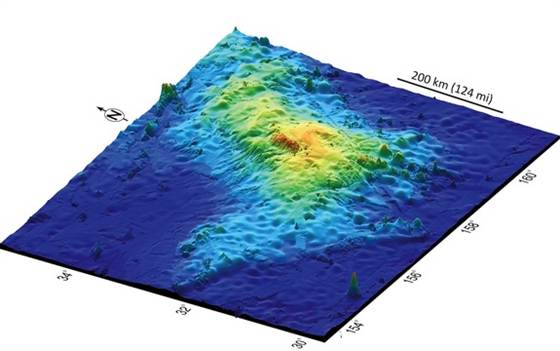
Called the Tamu Massif, the enormous mound dwarfs the previous record holder, Hawaii’s Mauna Loa, and is only 25 percent smaller than Olympus Mons on Mars, the biggest volcano in Earth’s solar system, said William Sager, lead study author and a geologist at the University of Houston.

“We think this is a class of volcano that hasn’t been recognized before,” Sager said. “The slopes are very shallow. If you were standing on this thing, you would have a difficult time telling which way was downhill.”

Tamu is 400 miles (650 kilometers) wide but only about 2.5 miles (4 km) tall. It erupted for a few million years during the early Cretaceous period, about 144 million years ago, and has been extinct since then, the researchers report.

Like other massive volcanoes, Tamu Massif seems to have a central cone that spewed lava down its broad, gentle slopes. The evidence comes from seismic surveys and lava samples painstakingly collected over several years of surveys by research ships. The seismic waves show lava flows dipping away from the summit of the volcano. There appears to be a series of calderas at the summit, similar in shape to the elongated and merged craters atop Mauna Loa, Sager said.

Until now, geologists thought Tamu Massif was simply part of an oceanic plateau called Shatsky Rise in the northwest Pacific Ocean. Oceanic plateaus are massive piles of lava whose origins are still a matter of active scientific debate. Some researchers think plumes of magma from deep in the mantle punch through the crust, flooding the surface with lava. Others suggest pre-existing weaknesses in the crust, such as tectonic-plate boundaries, provide passageways for magma from the mantle, the layer beneath the crust. Shatsky Rise formed atop a triple junction, where three plates pulled apart.

Tamu Massif’s new status as a single volcano could help constrain models of how oceanic plateaus form, Sager said. “For anyone who wants to explain oceanic plateaus, we have new constraints,” he told LiveScience. “They have to be able to explain this volcano forming in one spot and deliver this kind of magma supply in a short time.”

Geochemist David Peate of the University of Iowa, who was not involved in the study, said he looks forward to new models explaining the pulses of magma that built Shatsky Rise. Tamu Massif is the biggest and oldest volcano, and the cones grow smaller and younger to the northeast of Tamu. Sager and his colleagues suggest that pulses of magma created the volcanic trail.

“It seems that in many oceanic plateaus the melting is continuous, but here you have a big shield volcano,” Peate told LiveScience. “Understanding the source of the volume of that magma, the rate of production of the magma and the time interval between those pulses will help give better constraints to feed into those models,” he said.

Sager said other, bigger volcanoes could be awaiting discovery at other oceanic plateaus, such as Ontong Java Plateau, located north of the Solomon Islands in the southwest Pacific Ocean. “Structures that are under the ocean are really hard to study,” he said.

Oceanic plateaus are the biggest piles of lava on Earth. The outpourings have been linked to mass extinctions and climate change. The volume of Tamu Massif alone is about 600,000 cubic miles (2.5 million cubic km). The entire volcano is bigger than the British Isles or New Mexico.

Despite Tamu’s huge size, the ship surveys showed little evidence the volcano’s top ever poked above the sea. The world’s biggest volcano has been hidden because it sits on thin oceanic crust (or lithosphere), which can’t support its weight. Its top is about 6,500 feet (1,980 meters) below the ocean surface today.

“In the case of Shatsky Rise, it formed on virtually zero thickness lithosphere, so it’s in isostatic balance,” Sager said. “It’s basically floating all the time, so the bulk of Tamu Massif is down in the mantle. The Hawaiian volcanoes erupted onto thick lithosphere, so it’s like they have a raft to hold on to. They get up on top and push it down. And with Olympus Mons, it’s like it formed on a two-by-four.”

Sager and his colleagues have studied Shatsky Rise for decades, seeking to solve the puzzle of oceanic plateaus. About 20 years ago, they named Tamu Massif after Texas A&M University, Sager’s former employer, he said.

http://www.nbcnews.com/science/its-largest-volcano-earth-it-lurks-beneath-pacific-ocean-8C11085698

Dash-Cam video of landslide boulder almost crushing car in Taiwan

After Tropical Storm Kong-Rey slammed the nation with rain and wind, rocks are seen sliding down a hill. But as a massive boulder is about to crush the car, it falls in the opposite direction, sparing the passengers.

This Taiwanese driver is lucky to be alive after a gigantic boulder tumbled across a road during a devastating landslide.

Incredible dashcam footage shows the enormous rock — which weighed hundreds of tons — rolling down a hillside and coming to a stop just inches away from a passing car.

The near miss, near Keelung, came after heavy rain from Tropical Storm Kong-Rey triggered a series of mudslides across Taiwan.

Read more: http://www.nydailynews.com/news/world/car-narrowly-avoids-crushed-boulder-landslide-article-1.1443407#ixzz2dmGinUIl

New study in the journal Science shows that poverty reduces brainpower needed for navigating other areas of life

povertyResearch based at Princeton University found that poverty and all its related concerns require so much mental energy that the poor have less remaining brainpower to devote to other areas of life. Experiments showed that the impact of financial concerns on the cognitive function of low-income individuals was similar to a 13-point dip in IQ, or the loss of an entire night’s sleep. To gauge the influence of poverty in natural contexts, the researchers tested 464 sugarcane farmers in India who rely on the annual harvest for at least 60 percent of their income. Each farmer performed better on common fluid-intelligence and cognition tests post-harvest compared to pre-harvest.

Poverty and all its related concerns require so much mental energy that the poor have less remaining brainpower to devote to other areas of life, according to research based at Princeton University. As a result, people of limited means are more likely to make mistakes and bad decisions that may be amplified by — and perpetuate — their financial woes.

Published in the journal Science, the study presents a unique perspective regarding the causes of persistent poverty. The researchers suggest that being poor may keep a person from concentrating on the very avenues that would lead them out of poverty. A person’s cognitive function is diminished by the constant and all-consuming effort of coping with the immediate effects of having little money, such as scrounging to pay bills and cut costs. Thusly, a person is left with fewer “mental resources” to focus on complicated, indirectly related matters such as education, job training and even managing their time.

In a series of experiments, the researchers found that pressing financial concerns had an immediate impact on the ability of low-income individuals to perform on common cognitive and logic tests. On average, a person preoccupied with money problems exhibited a drop in cognitive function similar to a 13-point dip in IQ, or the loss of an entire night’s sleep.

But when their concerns were benign, low-income individuals performed competently, at a similar level to people who were well off, said corresponding author Jiaying Zhao, who conducted the study as a doctoral student in the lab of co-author Eldar Shafir, Princeton’s William Stewart Tod Professor of Psychology and Public Affairs. Zhao and Shafir worked with Anandi Mani, an associate professor of economics at the University of Warwick in Britain, and Sendhil Mullainathan, a Harvard University economics professor.

“These pressures create a salient concern in the mind and draw mental resources to the problem itself. That means we are unable to focus on other things in life that need our attention,” said Zhao, who is now an assistant professor of psychology at the University of British Columbia.

“Previous views of poverty have blamed poverty on personal failings, or an environment that is not conducive to success,” she said. “We’re arguing that the lack of financial resources itself can lead to impaired cognitive function. The very condition of not having enough can actually be a cause of poverty.”

The mental tax that poverty can put on the brain is distinct from stress, Shafir explained. Stress is a person’s response to various outside pressures that — according to studies of arousal and performance — can actually enhance a person’s functioning, he said. In the Science study, Shafir and his colleagues instead describe an immediate rather than chronic preoccupation with limited resources that can be a detriment to unrelated yet still important tasks.

“Stress itself doesn’t predict that people can’t perform well — they may do better up to a point,” Shafir said. “A person in poverty might be at the high part of the performance curve when it comes to a specific task and, in fact, we show that they do well on the problem at hand. But they don’t have leftover bandwidth to devote to other tasks. The poor are often highly effective at focusing on and dealing with pressing problems. It’s the other tasks where they perform poorly.”

The fallout of neglecting other areas of life may loom larger for a person just scraping by, Shafir said. Late fees tacked on to a forgotten rent payment, a job lost because of poor time-management — these make a tight money situation worse. And as people get poorer, they tend to make difficult and often costly decisions that further perpetuate their hardship, Shafir said. He and Mullainathan were co-authors on a 2012 Science paper that reported a higher likelihood of poor people to engage in behaviors that reinforce the conditions of poverty, such as excessive borrowing.

“They can make the same mistakes, but the outcomes of errors are more dear,” Shafir said. “So, if you live in poverty, you’re more error prone and errors cost you more dearly — it’s hard to find a way out.”

The first set of experiments took place in a New Jersey mall between 2010 and 2011 with roughly 400 subjects chosen at random. Their median annual income was around $70,000 and the lowest income was around $20,000. The researchers created scenarios wherein subjects had to ponder how they would solve financial problems, for example, whether they would handle a sudden car repair by paying in full, borrowing money or putting the repairs off. Participants were assigned either an “easy” or “hard” scenario in which the cost was low or high — such as $150 or $1,500 for the car repair. While participants pondered these scenarios, they performed common fluid-intelligence and cognition tests.

Subjects were divided into a “poor” group and a “rich” group based on their income. The study showed that when the scenarios were easy — the financial problems not too severe — the poor and rich performed equally well on the cognitive tests. But when they thought about the hard scenarios, people at the lower end of the income scale performed significantly worse on both cognitive tests, while the rich participants were unfazed.

To better gauge the influence of poverty in natural contexts, between 2010 and 2011 the researchers also tested 464 sugarcane farmers in India who rely on the annual harvest for at least 60 percent of their income. Because sugarcane harvests occur once a year, these are farmers who find themselves rich after harvest and poor before it. Each farmer was given the same tests before and after the harvest, and performed better on both tests post-harvest compared to pre-harvest.

The cognitive effect of poverty the researchers found relates to the more general influence of “scarcity” on cognition, which is the larger focus of Shafir’s research group. Scarcity in this case relates to any deficit — be it in money, time, social ties or even calories — that people experience in trying to meet their needs. Scarcity consumes “mental bandwidth” that would otherwise go to other concerns in life, Zhao said.

“These findings fit in with our story of how scarcity captures attention. It consumes your mental bandwidth,” Zhao said. “Just asking a poor person to think about hypothetical financial problems reduces mental bandwidth. This is an acute, immediate impact, and has implications for scarcity of resources of any kind.”

“We documented similar effects among people who are not otherwise poor, but on whom we imposed scarce resources,” Shafir added. “It’s not about being a poor person — it’s about living in poverty.”

Many types of scarcity are temporary and often discretionary, said Shafir, who is co-author with Mullainathan of the book, “Scarcity: Why Having Too Little Means So Much,” to be published in September. For instance, a person pressed for time can reschedule appointments, cancel something or even decide to take on less.

“When you’re poor you can’t say, ‘I’ve had enough, I’m not going to be poor anymore.’ Or, ‘Forget it, I just won’t give my kids dinner, or pay rent this month.’ Poverty imposes a much stronger load that’s not optional and in very many cases is long lasting,” Shafir said. “It’s not a choice you’re making — you’re just reduced to few options. This is not something you see with many other types of scarcity.”

The researchers suggest that services for the poor should accommodate the dominance that poverty has on a person’s time and thinking. Such steps would include simpler aid forms and more guidance in receiving assistance, or training and educational programs structured to be more forgiving of unexpected absences, so that a person who has stumbled can more easily try again.

“You want to design a context that is more scarcity proof,” said Shafir, noting that better-off people have access to regular support in their daily lives, be it a computer reminder, a personal assistant, a housecleaner or a babysitter.

“There’s very little you can do with time to get more money, but a lot you can do with money to get more time,” Shafir said. “The poor, who our research suggests are bound to make more mistakes and pay more dearly for errors, inhabit contexts often not designed to help.”

The paper, “Poverty impedes cognitive function,” was published Aug. 30 by Science. The work was supported by the National Science Foundation (award number SES-0933497), the International Finance Corporation and the IFMR Trust in India.

http://www.princeton.edu/main/news/archive/S37/75/69M50/index.xml?section=topstories

German law change to recognize third sex

herm

Germans will soon be legally divided into three genders – those born as hermaphrodites have the right to not identify as male or female. It has been described as a revolution, effectively creating legal recognition of a third sex.

The Süddeutsche Zeitung reported on Friday that a change due to come into effect in November would give legal recognition to the fact that intersexual people were not clearly either male or female.

Although the law change stops short of actually creating a third sex, it will allow birth certificates to be left blank and for those concerned to make a decision later whether to identify as male, female or neither.

“If the child cannot be identified as female or male, the personal gender is to be left blank and to be so entered into the births register,” the new law due to take effect in November states, the Süddeutsche Zeitung said.

This small but crucial difference in the law will have knock-on effects in a whole range of other registration rules such as those for ID cards and passports, the paper said. Currently passports have to carry an F for female or an M for male.

Having nothing could create difficulties for intersexual people travelling to some countries, the Magazine for Family Law (FamRZ) said, suggesting that an X be used, as was decided in Australia earlier this year.

The background to the German law change is a ruling from the Federal Constitutional Court which said the “deeply felt and lived” gender was a function of personal rights and must apply to unclear gender.

The new law will apply to intersexuals, or hermaphrodites – people born with gender-indeterminate bodies, rather than transsexuals, who are born with a specific sex but feel they are members of the other gender.

Brussels-based lawyer Wolf Sieberich told the FamRZ transsexuals should also get the right to determine their own legally recognized gender.

Marriage law may also have to be altered as a result he said. Currently a marriage in Germany is only allowed between a man and a woman and a legally recognized life partnership is allowed for members of the same gender. Sieberich questioned what that would mean for someone whose gender is not specified.

Justice Minister Sabine Leuthheusser-Schnarrenberger told the Süddeutsche Zeitung “comprehensive reform” would be necessary.

http://www.thelocal.de/society/20130816-51439.html

Thanks to Jody Troupe for bringing this to the attention of the It’s Interesting community.

Die-off of bottlenose dolphins, linked to virus, is worst in 25 years

dying dolphins

A widespread die-off of bottlenose dolphins off the Mid-Atlantic Coast — the worst of its kind in more than a quarter-century — almost certainly is the work of a virus that killed more than 740 dolphins in the same region in 1987 and 1988, marine scientists said Tuesday.

Since the beginning of July, 357 dead or dying dolphins have washed ashore from New York to North Carolina — 186 of them in Virginia. Authorities have received numerous additional reports of carcasses floating in the ocean, said Teri Rowles, director of the marine mammal health and stranding response program for the National Oceanic and Atmospheric Administration’s fisheries service. The actual number of deaths is certainly greater, she said.

The cause is thought to be cetacean morbillivirus, which has been confirmed or is suspected in 32 of 33 dolphins tested, she said. Marine officials are looking at the possibility of other factors, including high levels of polychlorinated biphenyls and other chemicals in the water, but have not linked the die-off to anything else.

From 2007 to 2012, the average number of yearly strandings — when dead or dying dolphins wash ashore — in the same states was 36, Rowles said.

“If, indeed, this plays out the way that die-off occurred, we’re looking at the die-off being higher and the morbillivirus spreading southward,” Rowles said. The 1987-88 episode affected 50 percent of the coastal migratory bottlenose dolphins, according to NOAA’s Web site, leading them to be classified as “depleted.”

The virus poses no threat to people, although it is related to the virus that causes measles in humans and distemper in canines. So far, there is no evidence of the virus jumping to other species, but other animals that have washed ashore are being tested, the scientists said in a telephone news conference Tuesday afternoon.

Secondary infections could be dangerous. Authorities urged people to stay away from stranded dolphins.

“For people not trained in working with these animals and who don’t understand the risk, it’s much better . . . to stay away from them, particularly if you have open wounds,” Rowles said.

It is not clear what started the most recent problem, but Jerry Saliki, a virologist at the University of Georgia, said enough time had probably passed since the last mass die-off that herds of dolphins now lack natural immunity to morbillivirus. The virus is spread by direct contact between the animals or inhalation of droplets exhaled by infected dolphins above the water’s surface.

“When the collective immunity drops below a certain, critical point, which we don’t really know for marine mammals, then the whole population becomes susceptible,” Saliki said. Generally, the virus causes death by suppressing the immune system, leaving the dolphin vulnerable to pneumonia and other lethal infections.

The large number of deaths in Virginia “is really not surprising if you understand how the population of dolphins works,” said W. Mark Swingle, director of research and conservation for the Virginia Aquarium and Marine Science Center, which is part of a network of agencies that responds to marine animal strandings along the East Coast.

http://www.washingtonpost.com/national/health-science/die-off-of-bottlenose-dolphins-caused-by-virus-is-worst-in-25-years/2013/08/27/69c135cc-0f48-11e3-bdf6-e4fc677d94a1_story.html

Zurich launches drive-in prostitution plan

zurich-opens-drive-in-sex-boxes

A series of wooden sheds have been constructed in Zurich, Switzerland as part of an initiative to regulate prostitution.

They look like garages or shelters but are being called by the locals ‘drive-in sex boxes’.

The idea is that men wanting to pay for sex can drive into one of the sheds having picked up a prostitute from an approved area.

Project director Michael Herzig said the boxes should improve security for sex workers.

“We’ve had a problem here which has been getting worse over the last few years, especially regarding Roma women, some of whom were being forced into prostitution. This was a degrading situation which we really had to stop.”

It is hoped the sex boxes will persuade prostitutes to sell their services away from residential areas, in a safe environment – the sheds are all equipped with alarms.

“This solution has several advantages: the support service for the women is better because we are directly here on site. The infrastructure is better. The women can come to us and use the shower and the toilets. We can talk to them without other people listening and the area is closed and observable,” said Ursula Kocher, of the Flora Dora centre for women:

The million euro project was approved by voters in Zurich last year in a referendum. The site is only open to drivers of cars and will operate from early evening until 5am each day.

http://www.euronews.com/2013/08/19/zurich-opens-drive-in-sex-boxes/

Kyrgyz authorities discover vodka pipeline

vodka

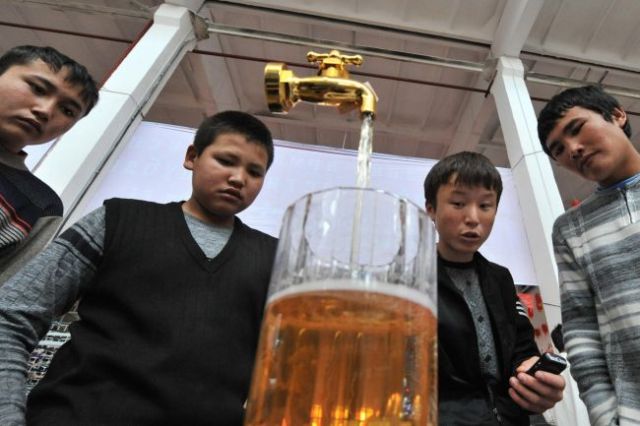
The authorities in Kyrgyzstan shut off a pipeline carrying alcohol from Kazakhstan after it was discovered last week, the Kyrgyz news agency AKIpress reported.

It’s believed to have carried mostly vodka through an 8 inch-wide tube over a third of a mile under the Chu River, which divides the two countries. The pipeline ended in the city of Tokmok in northern Kyrgyzstan.

Kyrgyz border guards found the pipeline during a routine search.

“We assume that thousands of liters of alcohol were smuggled,” a Tokmok police official told AKIpress.

Police are searching for the pipeline’s operators.

Kyrgyzstan, a majority Muslim country, has a growing demand for cheap alcohol from Kazakhstan, one of the largest grain producers in the region.

Last fall, the authorities discovered a similar pipeline smuggling oil under the Chu River.

http://www.globalpost.com/dispatch/news/offbeat/130820/vodka-pipeline-shut-kyrgyzstan

Pennsylvania Woman Turns up Alive After Her Own New Jersey Funeral

sharolyn-jackson-e1377283273729

Carrie Minney could have sworn the woman in the casket was her 50-year-old daughter.

When Minney and the rest of Sharolyn Jackson’s family attended her viewing, funeral and burial in New Jersey on Aug. 3, they noted that Jackson’s nose looked thinner. But they figured something had happened to it during the embalming process.

The truth is far stranger: The woman they buried that day was not, in fact, their loved one but a lookalike. Jackson showed up at a Philadelphia hospital on Aug. 16, several weeks after she had been reported missing and 13 days after her family thought they had laid her to rest at Colonial Memorial Park in Hamilton, N.J.

“There was really a strong resemblance, a really strong resemblance,” Minney, 69, said Friday in a phone interview from her home in Trenton, N.J. “She looks so much like Sharol they could be sisters.”

Jackson was reported missing around the time that paramedics took a woman who’d been found lying in a Philadelphia street to a hospital, where she died July 20. One of Jackson’s sons and a social worker at Horizon House, where her mother said she had been receiving treatment for drug and mental health problems, viewed pictures of the dead woman’s body and made the identification.

The medical examiner determined the woman died of heat stroke, signed a death certificate and released the body to the family, Philadelphia Department of Health spokesman James Garrow said.

“If someone comes in and they’re a family member and say, ‘That’s my mom,’ that’s generally good enough,” Garrow said.

After Jackson showed up at Pennsylvania Hospital last week, police confirmed her identity through fingerprints. Her son went to the hospital and immediately recognized her.

“He said, ‘That’s my mom. We made a terrible mistake,'” Garrow said.

Philadelphia officials plan to exhume the buried body in hopes of correctly identifying it.

Minney said her daughter remains hospitalized. They’ve spoken only briefly over the phone, and Minney isn’t sure her daughter knows a funeral was held for her.

“I’m still overjoyed,” Minney said. “I got to come down from the joy because somebody else is dead. We don’t know who it is, and it bothers me that somebody else’s daughter is laying in that grave out there.”

http://abcnews.go.com/US/wireStory/pa-woman-turns-alive-funeral-20048307