AI-Assisted Cough Tracking Could Help Detect the Next Pandemic

Some researchers have turned their focus to artificial intelligence to study an underused symptom common to most respiratory pathogens—cough.

by Max Kozlov

When Joe Brew worked for the Florida Department of Health as an epidemiologist for two years starting in 2013, he helped with syndromic surveillance, meaning he had the arduous job of reviewing the symptoms of patients coming into the emergency departments from all across the state. The goal of such work: to detect an abnormal spike of symptoms in an area that may indicate there’s a public health concern. 

Public health authorities worldwide continue to use this type of surveillance. The outbreak of a novel pathogen in Wuhan, China in late 2019, for instance, was in part detected by a large uptick of patients coming to the hospital with symptoms of a respiratory infection, with unknown etiology. But Brew says this system fails to prevent the transmission of a virus like SARS-CoV-2 because by the time patients arrive at the hospital, they have likely already been infectious for a matter of days. COVID-19 tests, too, often fail to return a result in time for patients to properly isolate while they’re infectious.

This realization led Brew to turn to a device that billions have in their pockets—a smartphone—to provide public health authorities with real-time symptomatic data from the community. Brew and several colleagues founded Hyfe, a free phone application that uses artificial intelligence to detect and track users’ coughs, a hallmark of many respiratory conditions including COVID-19. 

“The way you beat COVID is by acting fast—by being ahead of it,” says Brew, who is now the CEO of Hyfe. “Those places that very quickly identified clusters and outbreaks were able to shut things down and basically control the pandemic even without a vaccine.”

People who are curious to monitor their cough frequency trends, say, if they have a respiratory condition or want to share these data with loved ones or medical professionals, can download Hyfe onto their smartphones. When the application hears a loud, abrupt noise, such as a cough, it captures that approximately half-second snippet of sound and converts it into a 3-D image called a spectrogram that represents the pitch and intensity of the sound over time. The spectrogram is then processed through a machine learning algorithm known as a convolutional neural network, which has been trained on a dataset of more than 270,000 sounds—a cough, laugh, grunt, burp, or a fork hitting a plate, for example—that two human listeners have labeled as a cough or not a cough that help the algorithm determine whether the abrupt noise was, indeed, a cough. The app also learns an individual’s unique cough, so if the app detects another person’s cough that significantly deviates from their previous coughs, it won’t log it.

Brew and a team of scientists aim to take this concept into the field to see if they can detect an outbreak of an infectious respiratory pathogen. Their pilot project will examine the cough data at a community-wide level in a small municipality on the outskirts of Pamplona, Spain.

A spectrogram, which is a visual representation of audio frequency and intensity over time, that shows an archetypical cough. Hyfe converts snippets of users’ suspected coughs into these images and processes them through a machine learning algorithm to determine whether the sound is a cough.HYFE

“There’s a lot of people thinking about diagnostics, but everyone is thinking individually,” ISGlobal Barcelona Institute for Global Health epidemiologist Carlos Chaccour, who is leading the study, tells The Scientist. “But so far, the community perspective has not been pursued.”

While Brew admits that there could be many non–infectious disease causes for a cough—air quality, asthma, allergies, fumes from cooking, to name a few—he says the lack of specificity is a feature not a bug. In the case of wastewater surveillance, which is another tool for public health officials to use to indirectly detect and monitor the spread of infectious disease, “you’re already looking for the virus, and you’re already in an epidemic situation,” he says, whereas Hyfe could, in theory, detect a surprise flare-up from an novel disease before it progresses to that point.

Chaccour and his team have enrolled more than 60 people in the community so far and aim for as many as 500 to test the concept. As part of the study, participants grant researchers access to their hospital records and their Hyfe data to determine if a rise from a baseline level of coughing among the participants correlates to more diagnoses of respiratory conditions, including COVID-19. 

If Hyfe can successfully demonstrate that its detection of a higher community incidence in coughing precedes more respiratory diagnoses in the clinic, Chaccour says, he envisions users could then view a heat map of anonymized data showing which communities have the highest prevalence of coughing—a tool that could come in handy for public health officials but also people hoping to understand the risk of infection in a community.

A missed opportunity

Cough has long been a symptom that physicians record, yet the method for monitoring it is typically limited to a self-report during a clinic visit. Previous research suggests that patients often underreport how much they cough, which has led epidemiologists such as Brew to think that there is untapped potential in using cough data.

Alyn Morice, who is the head of respiratory medicine at Hull York Medical School in the UK and specializes in the diagnosis and treatment of cough, says that patients answering questionnaires are entirely unreliable. He’s even seen patients fabricate data from peak flow meters, portable devices that patients use at home to measure how efficiently air flows through their lungs.

“The great thing about this cough monitoring is it will be passive—the patient won’t actually have to do anything,” he says.

University of Washington infectious disease expert Peter Small, who is the senior director of Global Health Technologies and is not involved with Hyfe, tells The Scientist he is optimistic about this new frontier of technology, particularly in the context of eradicating tuberculosis. “Patients seek care very late in the disease and part of that is because we, as a society, tend to ignore cough in adults,” he says. 

With the help of AI-assisted cough tracking, he envisions a world in which users who have been coughing at a higher rate than normal for, say, two weeks would receive a text notifying them of their symptoms with directions to a public clinic that can test them for tuberculosis.

Even in patients with a confirmed TB diagnosis, Small says, the technology could show patients’ recovery progress. “I’ve been around a lot of TB patients and it’s a very disconcerting diagnosis,” he says. “Even though it’s almost always curable, it’s psychologically difficult on patients, and having objective evidence that their cough is getting better can help with their spirits.”

The Hyfe group is not the only one working to integrate cough into a more effective public health tool. Morice, for instance, developed an alert system using cough tracking through an external monitor users wear around their necks for impending chronic obstructive pulmonary disease (COPD) exacerbations—severe episodes that can often lead to hospitalization. His research team detected 45 percent of these flare-ups an average of four days prior to diagnosis, according to data they presented at this year’s European Respiratory Society virtual conference. With early intervention, patients who take steroids or bronchodilators can prevent or lessen the severity of these exacerbations, Morice says.

“If you’re able to prevent hospital admissions in these folks, it’s much better for the patient but it’s also much better for the health economy because [treating the] exacerbation is an expensive thing,” he says.

An MIT group tried to develop a tool to determine if it’s possible to identify a COVID-19–specific cough. The researchers processed more than 70,000 forced-cough audio samples, of which 2,660 were submitted by people with COVID-19, through a machine learning algorithm, which they claim accurately identifies 98.5 percent of coughs from people who were confirmed to have COVID-19, including 100 percent of forced coughs from those who were asymptomatic, according to their paper published in October in IEEE Journal of Engineering in Medicine and Biology

In other endeavors, researchers are soliciting healthy and COVID-19–infected individuals to help train their AI models to eventually allow users to understand if they have the virus based on their cough. These projects include a Bill and Melinda Gates Foundation–funded initiative, Cough Against Covid, at the Wadhwani Institute for Artificial Intelligence in Mumbai, the University of Cambridge’s COVID-19 Sounds project, and the Coughvid project at the Swiss Federal Institute of Technology Lausanne.

Morice remains skeptical of apps that claim they can diagnose users’ coughs: “Frankly, I don’t believe them. You can tell a wet cough from a dry cough, but that’s about it from the cough sounds.” Several coauthors of the MIT study declined requests for an interview to discuss their work.

Brew says he not only wants to better understand the acoustic signature of different ailments, but also track the diurnal pattern of cough—do people with COVID-19, for example, tend to cough more during a certain part of the day or night? “When do they begin coughing? Does a change in cough frequency indicate a certain prognosis?” Brew asks. “These are super basic questions that no one really knows [the answer to] at this point.”

Privacy concerns of recording audio

More than 40 countries and 21 US states and territories use official state-sponsored COVID-19 applications that aid contact tracers in stemming the spread of the virus. Despite the promise of these apps, few people in the US have downloaded them, in part because users worry about handing over their detailed location history to their government, says Chaccour. 

Any app monitoring cough would also require permission to record audio through users’ smartphones and, in Hyfe’s case, track their location to measure cough at a community level. Brew says he hopes to reassure users that the app would only record roughly half-second snippets following an abrupt noise. Still, he says he thinks there needs to be some value offered back to the user. One idea is to design a dashboard of users’ personal data akin to what Fitbit does with step counts. “Nobody cared about step counts 15 years ago until Fitbit made it trendy,” he says.

To Chaccour, if the technology proves useful, the end goal is not to provide it to governments, but perhaps to third-party companies such as Apple or Google, which can integrate it into their phone operating systems. He’s noticed that in Spain, people aren’t very trustful of the official government COVID-19 app, but they don’t mind their phones listening for users to summon the voice assistant or tracking how much they’ve slept.

Brew says he thinks the present moment is a perfect opportunity to roll out the technology. People care about public health and “cough counting would have been interesting in 1990, but right now we have some five billion humans carrying a microphone with them at all times every day, everywhere.”

Neanderthal DNA Linked To Cancer And Autoimmune Diseases In Modern Humans

It’s been a long time since we had any romantic dealings with Neanderthals, but research suggests that our past inter-breeding with this extinct hominid may continue to influence our health today. According to a new study in the journal Genome Biology and Evolution, Neanderthal DNA within the modern human genome could determine the susceptibility of certain populations to prostate cancer, autoimmune diseases and diabetes.

When the first Homo sapiens migrated out of Africa and began spreading across the Eurasian landmass, they encountered some of our ancestral cousins, including Denisovans and Neanderthals. While the latter of these became extinct some 40,000 years ago, there was still plenty of time for hanky-panky, which is why many modern humans from outside of Africa carry small amounts of Neanderthal DNA.

For instance, previous research has indicated that certain Neanderthal genes influence the susceptibility of Europeans to conditions like cystic fibrosis and schizophrenia. However, the impact of these ancient genes on geographically diverse human populations has remained largely unstudied.

To address this, Michael Dannemann from the University of Tartu in Estonia analyzed data from the Biobank Japan Project, looking specifically at the genome-wide association maps for 40 different diseases. When comparing these to similar data relating to a British cohort, Dannemann noted a number of associations between Neanderthal DNA and health that are specific to Asians.

For example, three key ancient gene variants – otherwise known as archaic single nucleotide polymorphisms (aSNPs) – were found to directly impact dermatitis, Graves’ disease and rheumatoid arthritis in the Japanese cohort. All these conditions have been linked to autoimmune processes and were found to be significantly more common in people carrying these particular aSNPs.

Interestingly, a completely different aSNP was found to contribute to the risk of dermatitis in the British cohort, suggesting that Neanderthal DNA affects the health of multiple human populations, but that the exact genes involved differ from group to group.

A single aSNP was also associated with a decreased risk of prostate cancer among the UK sample, while two separate aSNPs were found to work together to produce this effect in the Japanese population. This is particularly interesting as it suggests that Neanderthal DNA brings both advantages and disadvantages, by promoting susceptibility to certain conditions while protecting against others.

This conclusion is backed up by the fact that two aSNPs were identified as contributors to type 2 diabetes among Japanese people, one of which increases the risk of developing the condition while the other decreases this risk. Both of these ancient genes are extremely rare among Brits yet have a significant impact on diabetes rates in Japan.

“My findings show that while the Neandertal DNA in European and Asian populations differ they both contain variants that increase the risk of autoimmune diseases like dermatitis, Graves’ disease and rheumatoid arthritis,” explained Dannemann in a statement.

“This [highlights] the importance of studying a wider range of ancestries to help us to ascertain how the phenotypic legacy of Neandertals influences modern humans today.”

https://www.iflscience.com/health-and-medicine/neanderthal-dna-linked-cancer-autoimmune-diseases-modern-humans/

Thanks to Mr. C for bringing this to the It’s Interesting community.

Scientists Beamed Shapes and Motion Directly Into Monkeys’ Brains Using Light

By Edd Gent

Being able to beam images directly into someone’s brain could help restore sight to the blind and open up a host of new possibilities in everything from communication to entertainment. And now researchers have achieved the most high-definition results so far in experiments in monkeys.

People have been experimenting with using implanted electrodes to stimulate the brain’s visual cortex since the 1970s, and it’s well established that the approach can produce flashes of light on a person’s visual field known as phospenes.

American company Second Sight even produces a commercial “bionic eye” called the Argus II that transmits signals from a camera mounted on a pair of glasses to an implant that directly stimulates the user’s retina.

But so far, most of these devices have been very low-resolution. The Argus II relies on a 6 by 10 grid of electrodes, which means it’s only really able to give users rough clues to help them navigate their environment. Most previous attempts to directly stimulate the visual cortex have placed electrodes on the brain’s surface, requiring strong currents to stimulate deeper neurons. That limits the number that can be safely stimulated at the same time, and can also lead to interference between nearby electrodes.

But by injecting tiny needle-like electrodes into the visual cortex of monkeys, the authors of a new paper in Science were able to create a 1024 pixel array that could safely stimulate multiple electrodes at the same time. This allowed the animals to identify complex shapes like letters and motion.

“The number of electrodes that we have implanted in the visual cortex, and the number of artificial pixels that we can generate to produce high-resolution artificial images, is unprecedented,” lead researcher Pieter Roelfsema from the Netherlands Institute for Neuroscience said in a press release.

By injecting very small electrodes deeper into the brain tissue, the researchers were able to use much smaller currents and be far more precise about which neurons they stimulated. This not only allowed them to squeeze far more “pixels” into the area where the electrodes were implanted, but also allowed them to stimulate up to 15 electrodes at the same time.

The researchers were able to test whether the implants were producing the desired effect, because the monkeys had been trained to make specific eye movements in response to dots moving across a screen or various letters made up of dots. When the team traced out these shapes and movements on the electrode array, the animals’ response was the same as if they had seen them in the real world.

Adapting the technology for use in humans will prove challenging, according to New Scientist, because the central part of the visual field is much deeper in humans and the implants would have a short shelf life due to scar tissue buildup and the corrosive environment in the brain.

But there have been recent advances that may help overcome these issues. In April, researchers created a new kind of ultra-thin, flexible interface that could last up to six years in the brain. And Elon Musk’s brain-machine interface startup Neuralink has also shown off a sewing-machine-like robot that’s able to implant electrodes deep in the cortical tissue.

The authors admit that they’d also have to convert their system, which currently needs to be connected by a cable, to wireless before it could be practical. Nonetheless, Roelfsema is optimistic and told UPI the technology could be ready to test in humans by 2023.

What’s most interesting about the research is that the monkeys the tests were done on weren’t blind, which suggests that beyond restoring sight to the 40 million people who are visually impaired, the technology could ultimately be used to superimpose images over someone’s visual field.

It’s unlikely you’d be able to use this to beam movies directly into your head, as this would require millions not thousands of electrodes and there’s still no way to influence the color of phosphenes. But it does open up intriguing possibilities for augmenting our perception, perhaps using the tech to display information from external sensors or overlay text or images on our field of vision.

Genetic Reprogramming Restores Vision in Mice: Study

Researchers repaired what is otherwise irreversible damage in the animals’ ocular neurons, by activating transcription factors ordinarily used to generate induced pluripotent stem cells.

Loss of visual acuity is a common feature of aging, whether it’s from age-related conditions such as glaucoma, an impaired ability for cells to respond to damage, or degeneration. In an attempt to address these issues with a genetic intervention, scientists reprogrammed neurons in mouse eyes to regrow after inducing glaucoma or crushing the optic nerve, and restored visual acuity in healthy, middle-aged mice to that of younger mice by expressing a set of genes known to revert cells to a pluripotent state, according to a study published in Nature Wednesday (December 2). The before-and-after genome methylation profiles of treated neurons and the requirement of demethylation enzymes for the success of the treatment indicate that the epigenome may be critical to aging—and to efforts to reverse it.

“This study is very exciting because it’s really proposing an approach to rejuvenate neurons. . . and is going to make a difference in the field,” José-Alain Sahel, who chairs the University of Pittsburgh department of ophthalmology and was not involved with the study, tells The Scientist.

Harvard Medical School geneticist David Sinclair and his colleagues aimed to reset the biological clocks of a group of cells to see if they could rejuvenate injured and aging cells. They looked to genes that encode transcription factors that de-differentiate cells. These so-called Yamanaka factors, named after biologist Shinya Yamanaka, are widely used to generate induced pluripotent stem cells (iPSCs). In a 2016 Cellpaper, a different group of scientists had activated these transcription factors in mice with progeria, a condition that causes premature aging, and found that the treatment alleviated symptoms and extended their lifespan by a matter of weeks. These findings raised the possibility that Yamanaka factors could hold the key to counteract aging.

A risk of using Yamanaka factors in vivo is that dedifferentiation can cause cells to divide rapidly, so researchers in the Cell study only turned them on in short bursts. To avoid such out-of-control proliferation, which would risk causing cancerous growth, Sinclair’s team eliminated one of the Yamanaka factors from their study—MYC, which is a known oncogene—and fitted the remaining three into an adeno-associated virus and injected it into mice. The researchers found that the mice didn’t develop tumors, even after more than a year. The next challenge: to see if these transcription factors could successfully revert old and injured neurons back to a more youthful and healthy state. The eyes were a logical target because younger mice can regrow axons of ocular neurons, unlike older mice. 

The team focused on retinal ganglion cells (RGCs), which are neurons whose axons make up the optic nerve and snake their way into the brain, transmitting information from light-sensitive photoreceptors. Although these cells can regenerate if injured during development, they typically lose their ability to heal within a few days of a mouse’s birth. To test whether adult mice can regain this ability, the researchers crushed the optic nerves of some mice and induced glaucoma in another set of mice by inserting tiny beads into their eyes, then injected the virus encoding the three transcription factors into all the mice’s eyes.

The treatment caused mice to grow new axons from RGCs that reached back into the brain and halted glaucoma progression. The rodents with glaucoma regained around half of their lost visual acuity, marking the first time that mice with a glaucoma-like condition have restored vision loss.

“Vision loss from glaucoma was not thought to be recoverable,” says Sinclair. “Bruce [Ksander, a collaborator] called me at ten o’clock at night and told me the news. It was difficult to believe.”

A mouse with a microbead injected into its eye to induce glaucoma.YUANCHENG LU/SINCLAIR LAB

Many research groups are trying to regenerate new ganglion cells outside the eye to be transplanted back in, says Sahel, but “this is much better because the cells are already [in place]—they just need to regrow and reconnect.” He notes, however, that the researchers used an acute model of injury, and that it isn’t possible to regenerate ganglion cells that have already died. “You would like to see what happens in a more advanced situation that would mimic what we see in patients that are desperate for regaining vision,” he says.

In another set of experiments, the researchers injected the virus bearing the genes that encode the three transcription factors into the eyes of healthy, middle-aged (one-year-old) mice. Although they had scored worse on tests of visual acuity than did younger mice before treatment, a month afterward, the one-year-old mice had similar acuity scores to younger ones, yet the researchers did not find an increase in the number or density of retinal ganglion cells. Eighteen-month-old mice that received the injection did not show any differences in visual acuity compared with untreated rodents, a result the authors ascribe to an increase in corneal opacity as the mice aged.

University of Edinburgh geneticist Tamir Chandra, who also studies aging and was not involved in this study, says that while these results are interesting, it is unclear to what extent their results are indicative of rejuvenation rather than dedifferentiation. “That almost sounds like a semantic question, but it’s quite important because dedifferentiation always carries the risk of inducing cancer,” he says. “The fact that they didn’t induce tumors in the healthy mice is more conceivable in the absence of MYC, but that doesn’t mean that if you had a tumor-prone mouse, that you’d get the same result.”

Epigenetics at work

Scientists have long looked to the epigenome for clues into understanding disease susceptibilitybehavior, and even mental health. Sinclair has been studying how aging affects the epigenome and found in a 2008 Cell study that a loss of epigenetic information over time contributed to aging.

“If epigenetic loss drives aging, can you recover it, thereby reversing the aging process, and if you do that, do you get the youthful function of a complex tissue back again?” he says.

When the researchers looked at DNA methylation patterns of the retinal ganglion cells, they saw that changes caused by injury resembled methylation patterns in the ganglion cells of older mice, and that treatment with the transcription factor–encoding virus reversed those changes. The intervention did not work in mice that did not have the enzymes necessary to remove methyl groups from DNA, suggesting that the demethylation process plays an important role in rejuvenating the neurons.

“It’s not just that gene A went off with aging and came back on with treatment,” says Sinclair. “There are hundreds and hundreds of genes that went down a certain level and then came back up a proportional level with the programming. So somehow the cell has recorded not just which genes should be altered, but the level [to which] they should be altered.” Still, Sinclair says, this study doesn’t show whether DNA methylation is directly responsible for rejuvenation or if it is more of a bystander.

Both Chandra and Sahel question the paper’s general relevance to aging, as the researchers used injury models rather than degeneration models, but they are encouraged by the potential new avenue of treatment.

“It’s already amazing that we are able to ask these questions based on this paper,” says Sahel.

Y. Lu et al., “Reprogramming to recover youthful epigenetic information and restore vision,” Nature, doi:10.1038/s41586-020-2975-4, 2020.

New pathway in Alzheimer’s disease provides earlier target for potential therapies

Researchers at the Case Western Reserve University School of Medicine have identified a new target in development of Alzheimer’s disease (AD) that could lead to therapies focused on treating the neurodegenerative condition early in its progression.

The discovery helps bolster a promising approach to AD research: finding and manipulating processes earlier in the disease’s development with hopes of slowing its advance.

“This is a missing part of the puzzle,” said Xin Qi, a professor in the Department of Physiology and Biophysics at the School of Medicine and lead researcher of the study, just published in the journal Science Advances. “We’ve discovered a pathway that is accessible to detection and potential treatment, prior to much of the disease’s damage and well before clinical symptoms appear.”

First identified more than 100 years ago, AD is an age-related neurodegenerative disorder that is associated with deposits of plaques of amyloid beta protein and tangles of tau protein in the brain, along with progressive nerve cell death. The cause of AD is not known, and the greatest risk factors for developing AD are age, genetics, and a previous traumatic brain injury.

Before the defining pathological characteristics of the disease are in place, the new pathway identified by Case Western Reserve researchers can be targeted by potential therapeutics that aim to mitigate the degeneration of white matter that impairs the normal functions of brain circuitry.

“There is a growing body of evidence in the field that AD develops much earlier than previously thought, most likely decades before our current ability to clinically diagnose the condition,” said study co-author Andrew A. Pieper, the Morley-Mather Chair in Neuropsychiatry in the School of Medicine, Director of the Harrington Discovery Institute Neurotherapeutics Center at University Hospitals.

“Detecting the disease—and potentially treating it—at earlier stages will be critical to our battle against its devastating effects. The new pathway uncovered by Dr. Qi’s laboratory could be targeted for therapy before the disease has progressed to the point of causing cognitive problems,” said Pieper, also a psychiatrist at the Louis Stokes Cleveland VA Medical Center Geriatrics Research Education and Clinical Center (GRECC).

The Drp1 pathway

Researchers found that the pathway—known as Drp1-HK1-NLRP3—plays a key role in disrupting normal function of brain cells that produce the protective white matter sheathing for nerves, known as myelin.

The dysfunction and eventual death of these myelin-producing cells—called oligodendrocytes (OLs)—are well-established early events in AD that lead to cognitive deficits.

The new findings illuminate how OLs start to go awry: the overexpression of a certain protein (Drp1) within the recently discovered pathway.

It’s the hyperactivation of Drp1 protein that triggers inflammation and injury to OLs, culminating in a reduction of myelin—slowing communication in the brain—which leads to the degeneration of white matter and significant cognitive impairment.

What’s next—targeting with therapeutics

A near total degeneration of OLs occurs before common symptoms of AD become apparent in most patients.

As such, researchers hope to target and manipulate the pathway with therapeutics that regulate the expression of Drp1, thereby slowing or reducing damage to myelin-producing OLs.

In fact, Qi’s lab has patented a small molecule, known as a peptide inhibitor, that regulates the expression of Drp1—putting the brakes on degeneration of brain cells.

In the study published by Science Advances, researchers found that eliminating Drp1 expression in mouse models corrected the energy-related defect in OLs associated with the hyperexpression of that protein; this approach also reduced the activation of inflammation OLs, lessened tissue damage at those brain sites and improved cognitive performance.

“Our results show promise that targeting the Drp1-HK1-NLRP3 pathway and reducing the expression of the Drp1 protein could help reduce the downstream cascade of abnormal brain functions associated with the progression of AD,” said Qi, whose lab has studied Drp1 for a decade, mostly in Parkinson’s and Huntington’s diseases.”

“If therapies targeting this pathway can slow, stop or even reverse early stage AD progression, then possibly there can be a reduction or delay to later stage damage and impairments,” Qi said.

Most AD diagnoses are in patients 65 or older, so identifying the disease in younger patients can be difficult. Many patients experience a significant loss in their brain’s white matter—central to cognition, emotion and consciousness—before receiving a diagnosis.

“Identifying how AD unfolds in its earliest processes will help scientists better understand how to focus research into potential solutions for patients,” said Pieper. “The Qi lab’s findings may help in targeting AD earlier, potentially leading to better management of its symptoms and progression.

“There have still been only a very small number of approved medications for AD since its discovery in 1907. While these medicines augment neurotransmission to provide temporary symptomatic benefit, they do nothing to slow disease progression,” said Pieper. “Identification of earlier approaches to treating AD—such as this research—is critical for society as the magnitude of AD is growing explosively with our aging population.”

Researchers validated the discovery of the pathway using mouse models and post-mortem brain samples of AD patients.


Explore furtherResearchers discover neuroprotective treatment for chronic traumatic brain injury


More information: “Oligodendroglial glycolytic stress triggers inflammasome activation and neuropathology in Alzheimer’s disease” Science Advances (2020). DOI: 10.1126/sciadv.abb8680Journal information:Science Advances

https://medicalxpress.com/news/2020-12-pathway-alzheimer-disease-earlier-potential.html

Another Win for Senolytics: Fighting Aging at the Cellular Level Just Got Easier

senolytics cells longevity aging

By Shelly Fan

Longevity research always reminds me of the parable of blind men and an elephant. A group of blind men, who’ve never seen an elephant before, each touches a different part of the elephant’s body to conceptualize what the animal is like. Because of their limited experience, each person has widely different ideas—and they all believe they’re right.

Aging, thanks to its complexity, is the biomedical equivalent of the elephant. For decades, researchers have focused on one or another “hallmark” of aging, with admirable success. For example, we now know that energy production in aging cells goes haywire. Immune responses ramp up, stewing aging tissue in a soup of inflammatory molecules. Dying cells turn into zombie-like “senescent cells,” where they abdicate their normal functions and instead pump out chemicals that further contribute to inflammation and damage.

Yet how these hallmarks fit together into a whole picture remained a mystery. Now, thanks to a new study published in Nature Metabolism, we’re finally starting to connect the dots. In mice, the study linked up three promising anti-aging pathways—battling senescent cells, inflammation, and wonky energy production in cells—into a cohesive detective story that points to a master culprit that drives aging.

Spoiler: senolytics, the drug that wipes out senescent cells and a darling candidate for prolonging healthspan, may also have powers to rescue energy production in cells.

Let’s meet the players.

From Metabolism to Zombie Cells

Individual cells are like tiny cities with their own power plants to keep them running. One “celebrity” molecular worker in the process of generating energy is nicotinamide adenine dinucleotide (NAD). It’s got a long name, but an even longer history and massive fame.

Discovered in 1906, NAD is a molecule that’s critical for helping the cell’s energy factory, the mitochondria, churn out energy. NAD is a finicky worker that appears on demand—the cell will make more if it needs more; otherwise, extra molecules are destroyed (harsh, I know). As we age, our cells start losing NAD. Without the critical worker, the mitochondria factory goes out of whack, which in turn knocks the cell’s normal metabolism into dysfunction.

At least, that’s the story in mice. Although yet unproven for slowing aging or age-related disorders in humans, NAD boosters are already making a splash in the supplement world, raising even more need to understand how and why NAD levels drop as we age.

Giving NAD a run for its anti-aging fame are senolytics, a group of chemicals that destroy senescent “zombie” cells. These frail, beat-up cells are oddities: rather than dying from DNA damage, they turn to the dark side, staying alive but leaking an inflammatory cesspool of molecules called SASP (senescence associated secretory phenotype) that “spread” harm to their neighbors.

A previous study in ancient mice, the equivalent of a 90-year-old human, found that wiping out these zombie cells with two simple drugs increased their lifespan by nearly 40 percent. Others using a genetic “kill switch” in mice found that destroying just half of zombie cells helped the mice live 20 percent longer, while having healthier kidneys, stronger hearts, luscious fur, and perkier energy levels. Similar to NAD supplements, pharmaceutical companies are investigating over a dozen potential senolytics in a race to bring one to market.

But what if we can combine the two?

A Hub for Aging

The new study, led by aging detectives Drs. Judith Campisi and Eric Verdin at the Buck Institute for Research on Aging in Novato, California, asked if we can connect the line between NAD and zombie cells, like suspects on an evidence board.

Their “lightbulb” clue was a third molecule of interest, highlighted in a 2016 study. Meet CD38, a molecule that plays double roles as an aging culprit. It wreaks havoc as an immune molecule to boost inflammation, while chewing up and destroying NAD. If CD38 is a new drug flooding the streets, then the team’s goal is to hunt down where it came from.

Using tissue from both mice and humans, the team traced CD38 to a type of immune cells. These cells, called M1 macrophages (literally, “big eaters”) are well known to increase inflammation in the body and cause DNA damage with age. When comparing fat tissue isolated from young and old mice, the team realized that these over-hyper immune cells pump out CD38 like crazy as the cells age—which, in turn, breaks down the good-for-you molecule, NAD.

One mystery in aging, explained Verdin, is whether NAD levels drop because of a faucet problem—our ability to make NAD—or leaky sink problem, where aging cells break down NAD too fast. “Our data suggests that, at least in some cases, the issue stems from the leaky sink,” he said.

The Zombie Connection

Here’s the evidence so far: aging triggers a type of immune cells to pump out CD38, a nasty chemical from immune cells that eats up NAD. But why? More importantly, how can we stop it?

In an unexpected twist of events, the connection seemed to be zombie cells.

Remember, zombie cells leave a chemical evidence trace of inflammatory chemicals called SASP. They also change their “molecular look” so it’s possible to tease them out from a sea of healthy cells (think zombies versus humans in any zombie movie). In fatty tissue from aged mice, the team identified zombie cells and found that their “toxic waste” massively increased the amount of CD38 floating around. Going back to the drug analogy, if CD38 is a drug, then the specific immune cells are the manufacturers pumping it out to eat up NAD and wreck the cell’s energy production. Here, zombie cells are the drug kingpin, and their SASP molecules direct immune cells to make more CD38.

Frozen in Time

If zombie cells are the kingpin, then getting rid of them should reduce the inflammatory CD38 “drug,” and in turn, preserve good guy NAD. To test it out, the team used a genetically engineered mouse, which allows scientists to identify zombie cells and selectively kill them off.

The team injected the mice with a drug that damaged their DNA. This mimics aging, in the sense that it increased zombie cells and CD38. Killing zombie cells lowered CD38 levels—like clearing a drug off the streets—and preserved NAD.

Voilà—case solved!

“We are very excited to link two phenomena which have been separately associated with aging and age-related disease,” said Verdin.

For now, zombie cells seem to be a master-level culprit that drives inflammation, decreases NAD levels, and breaks the cell’s energy production. This suggests that senolytics, which selectively kills off zombie cells, could as a secondary effect also increase NAD—something we didn’t know previously.

To Verdin, however, that doesn’t mean NAD supplements are useless or that senolytics are the one-and-only silver bullet against aging. “Ultimately I think supplementation will be part of the equation, but filling the sink without dealing with the leak will be insufficient to address the problem,” he said. In other words, for NAD supplementation to better work, we may need to also use senolytics to decrease zombie cells and CD38 levels, thus “plugging the leak.”

If all this makes your head spin—yup, same here! Our bodies run multiple “aging programs,” and we’ve just begun linking all these disparate culprits together. But the rewards could be great for creating therapies that slow or even reverse aging. After all, if we can find several masters that drive aging, why go after the little guys when you can target the boss?

This Company Wants to Put a Human-Size Hologram Booth in Your Living Room

hologram

By Vanessa Bates Ramirez

Over the last several months we’ve gotten very used to communicating via video chat. Zoom, FaceTime, Google Hangouts, and the like have not only replaced most in-person business meetings, they’ve acted as a stand-in for gatherings between friends and reunions between relatives. Just a few short years ago, many of us would have found it strange to think we’d be spending so much time talking to people “face-to-face” while sitting right in our own homes.

Now there’s a new technology looming on the horizon that may one day replace video calls with an even stranger-to-contemplate, more futuristic tool: real-time, full-body holograms.

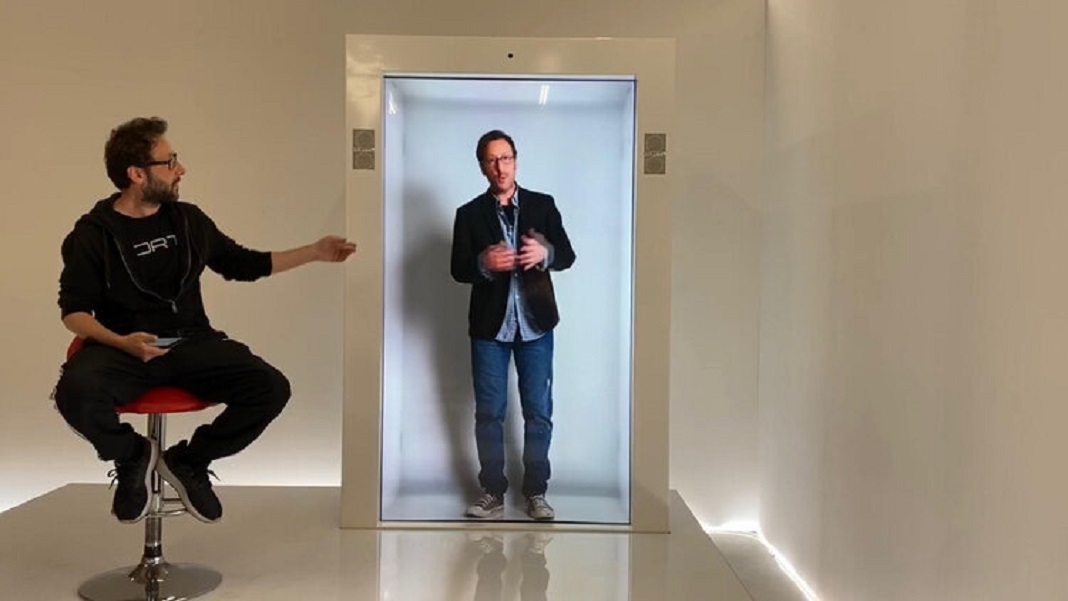
Picture this: you’re sitting in your living room having a cup of coffee when the phone-booth-size box in the corner dings, alerting you that you have an incoming call. You accept it, and within seconds your best friend (or your partner, your grandmother, your boss) appears in the box—in the form of millions of points of light engineered to look and sound exactly like the real person. And the real person is on the other end of the line, talking to you in real time as their holographic likeness moves around the box—you can see their gestures, body language, and facial expression just as if they were really there with you.

The closest approximation to this that you may have heard about was when a holographic version of the late Tupac Shakur performed at Coachella in 2012. The hologram was simultaneously highly detailed—the lines of Tupac’s washboard abs were clearly defined and visible—and somewhat blurry; after the opening “scene,” in which the hologram stood still, it was hard to see any of Tupac’s facial features.

The Tupac hologram was created by events tech company AV Concepts and Hollywood special effects studio Digital Domain, and reportedly cost at least $100,000. It seems holograms don’t come cheap; the afore-mentioned hologram box is currently going for $60,000.

The box is called an Epic HoloPortl, and it’s made by PORTL, a company whose founder was inspired by Tupac’s hologram; after seeing the 2012 performance, David Nussbaum quickly bought the patents for the technology that made it possible, and has been working on turning the tech into something useful, fun, and scalable ever since.

The Epic has high-resolution transparent LCD screens embedded into its interior walls. The person on the other end—the one appearing as a hologram, that is—just needs to have a camera and be standing against a white background. A camera on the Epic shows the sender the room and people he or she is being beamed to, essentially just like a Zoom call.

Last month PORTL raised $3 million in funding, led by Silicon Valley venture capitalist Tim Draper. Nussbaum says he’s sold a hundred Epics, has pre-orders “in excess of a thousand,” and dozens of the devices have already been delivered, with clients including malls, airports, and movie theaters (all places that aren’t very frequented today—but here’s hoping they’ll make a comeback when the pandemic subsides).

In fact, PORTL may not have gotten this funding if it weren’t for the pandemic; Nussbaum told TechCrunch that Draper pushed him to expand his vision for the company and its technology when the virus hit, likely anticipating that people will want new ways to communicate from a distance.

Few can afford to shell out $60k for a hologram booth, though (not to mention having space for a 7-foot-tall by 5-foot-wide by 2-foot-deep box), and Nussbaum knows it; his next project is to build a smaller, cheaper version of the Epic.

Even at a tenth of the current cost, the tech likely wouldn’t see widespread adoption by people wanting their own personal hologram portal at home. But there are many possible use cases beyond person-to-person communication.

Any venue or event that would typically hire famous people to appear in person—be they celebrities, academics, religious figures, or business leaders—could beam a hologram of those people in instead. The implications may be most significant for education and business; Nussbaum believes the CEOs of the not-too-distant future will conduct their meetings via hologram. “You can now make that very important personal emotional contact with people that you need to talk to without actually having to leave your office,” he said.

Whether this is true remains to be seen. Many of us have experienced Zoom fatigue over the course of the pandemic, becoming acutely aware that while it’s better than nothing, it’s also nothing like being in a room with someone in person; there’s only so much you can get from a face and voice on a screen.

Will a face and voice on a three-dimensional, life-sized hologram be better? Stay tuned to find out.

Image Credit: PORTL

How Iceland hammered COVID with science

A rainbow over Reykjavik as seen from the deCODE genetics facility
The tiny island nation brought huge scientific heft to its attempts to contain and study the coronavirus. Here’s what it learnt.

Driving along Reykjavik’s windswept roads on a cold March morning, Kári Stefánsson turned up the radio. The World Health Organization had just announced that an estimated 3.4% of people infected with SARS-CoV-2 would die — a shockingly high fatality rate, some 30 times larger than that for seasonal influenza.

There was a problem with that estimate, however: it was based on reported cases of COVID-19, rather than all cases, including mild and asymptomatic infections. “I couldn’t figure out how they could calculate it out without knowing the spread of the virus,” recalls Stefánsson, who is the founder and chief executive of deCODE genetics, a human-genomics company in Reykjavik. He became convinced that making sense of the epidemic, and protecting the people of Iceland from it, would require a sweeping scientific response.

When Stefánsson arrived at work, he phoned the leadership of Amgen, the US pharmaceutical company that owns deCODE, and asked whether he could offer deCODE’s resources to track the spread of the virus, which had landed on Icelandic shores only six days earlier. “The response I got from them was, ‘For heaven’s sake, do that,’” says Stefánsson.

Over the ensuing nine months, deCODE and Iceland’s Directorate of Health, the government agency that oversees health-care services, worked hand-in-hand, sharing ideas, data, laboratory space and staff. The high-powered partnership, coupled with Iceland’s diminutive size, has put the country in the enviable position of knowing practically every move the virus has made. The teams have tracked the health of every person who has tested positive for SARS-CoV-2, sequenced the genetic material of each viral isolate and screened more than half of the island’s 368,000 residents for infection.

Late nights analysing the resulting data trove led to some of the earliest insights about how the coronavirus spreads through a population. The data showed, for example, that almost half of infected people are asymptomatic, that children are much less likely to become sick than adults and that the most common symptoms of mild COVID-19 are muscle aches, headaches and a cough — not fever. “Scientific activities have been a huge part of the entire process,” says Runolfur Palsson, director of internal-medicine services at Landspitali — The National University Hospital of Iceland. Researchers at deCODE and the hospital worked day in and day out to gather and interpret the data.

Their achievements aren’t merely academic. Iceland’s science has been credited with preventing deaths — the country reports fewer than 7 per 100,000 people, compared with around 80 per 100,000 in the United States and the United Kingdom. It has also managed to prevent outbreaks while keeping its borders open, welcoming tourists from 45 countries since mid-June. The partnership again kicked into high gear in September, when a second large wave of infections threatened the nation.

Carefusteps

COVID-19 is not the first pandemic to reach Iceland’s shores: in October 1918, two ships carrying pandemic influenza docked in Reykjavik’s downtown harbour. Within six weeks, two-thirds of the capital city’s inhabitants were infected1.

A century later, the Icelandic government was better prepared, enacting a national pandemic preparedness plan at the beginning of January, two months before COVID-19 arrived. “We decided from the beginning we would use isolation, quarantine and contact tracing,” says Þórólfur Guðnason, chief epidemiologist at the Directorate of Health. As part of that plan, the microbiology laboratory at the university hospital began testing citizens in early February.

On 28 February, a man returning from a skiing holiday in northeastern Italy tested positive for the virus. Within a week, the number of cases had climbed from 1 to 47, the opening notes of a coming crescendo. As health-care workers began ordering hundreds of tests per day, one of the hospital’s machines for isolating and purifying RNA broke from overuse. “We were not able to cope with all the specimens coming in,” recalls Karl Kristinsson, the university hospital’s chief of microbiology.

By 13 March, deCODE had begun screening the general public and was able to quickly take over much of the hospital’s testing. The company repurposed a large phenotyping centre that it had been using to study the genetics of Icelanders for more than two decades into a COVID-19 testing centre. “It almost looked like these 24 years preceding COVID-19 had just been a training session,” says Stefánsson. “We dove into this full force.”

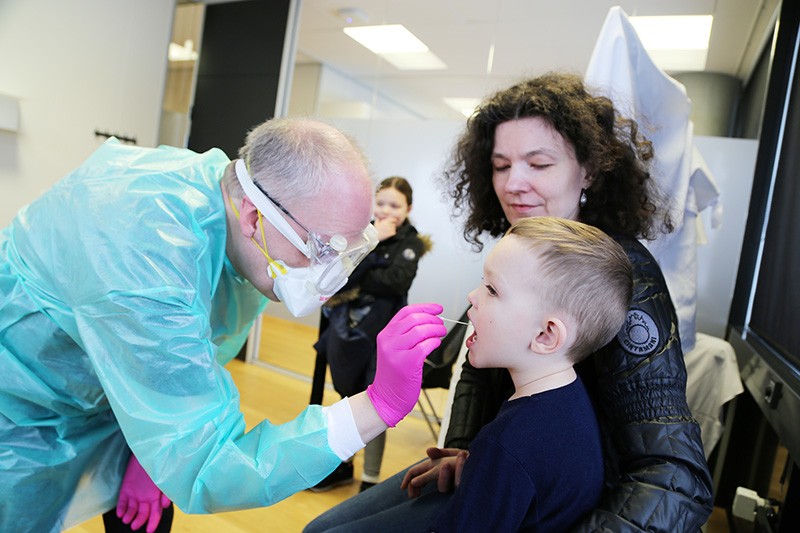
A family gets tested for COVID-19 at deCODE’s testing facility in Reykjavik, Iceland
One of the first families in Iceland to be screened with deCODE’s COVID-19 test.Credit: Jon E. Gustafsson

The company has the staff and machinery to sequence 4,000 whole human genomes per week as part of its regular research activities, says Stefánsson. Throughout the spring, it would set that aside to devote its analytical and sequencing heft to the pandemic response.

deCODE’s main activity has been COVID-19 screening, including open invitations to the general population. Today, any resident with even the mildest symptom can sign up to be tested. Residents sign up online using dedicated COVID software built by deCODE programmers. At a testing centre, they show a barcode from their phone to automatically print a label for a swab sample. Once taken, the sample is sent to a laboratory at deCODE’s headquarters that is run jointly by the university hospital and deCODE and operates from 6 a.m. to 10 p.m. Results are always available within 24 hours, but are often ready in just 4 to 6. “We now have the capacity for about 5,000 samples per day,” says Kristinsson. As a whole, the collaborators have so far screened 55% of the country’s population.

If the test is negative, the person receives an all-clear text. If the test is positive, it triggers two chains of action: one at the hospital and one at the lab.

At the hospital, the individual is registered in a centralized database and enrolled in a tele-health monitoring service at a COVID outpatient clinic for a 14-day isolation period. They will receive frequent phone calls from a nurse or physician who documents their medical and social history, and runs through a standardized checklist of 19 symptoms. All the data are logged in a national electronic medical record system. A team of clinician-scientists at the hospital created the collection system in mid-March with science in mind. “We decided to document clinical findings in a structured way that would be useful for research purposes,” says Palsson.

In the lab, each sample is tested for the amount of virus it contains, which has been used as an indicator for contagiousness and severity of illness. And the full RNA genome of the virus is sequenced to determine the strain of the virus and track its origin.

The same approach could work in other countries that have suitable resources, such as the United States, where all the methods deCODE is currently using were developed, says Stefánsson. In fact, early in the pandemic, many US labs pivoted to offer coronavirus testing, but were stymied by regulatory and administrative obstacles, which critics attribute to a lack of federal leadership. “This was a wonderful opportunity for academia in the United States to show its worth, and it didn’t,” Stefánsson says. “I was surprised.”

Viral fingerprints

Researchers at deCODE, the university hospital and the Directorate of Health began analysing the wealth of data in early March, and quickly published several early results. “Once we started to generate data, we couldn’t resist the temptation to begin to try to pull something cohesive out of it,” says Stefánsson.

Iceland’s COVID-19 results are limited by the fact that cases are occurring in a small and genetically homogeneous population compared with other countries, notes Palsson. But in some cases, that small sample size is also a strength, because it has led to detailed, population-wide data.

In early spring, most of the world’s COVID-19 studies focused on individuals with moderate or severe disease. By testing the general population in Iceland, deCODE was able to track the virus in people with mild or no symptoms. Of 9,199 people recruited for population screening between 13 March and 4 April, 13.3% tested positive for coronavirus. Of that infected group, 43% reported no symptoms at the time of testing2. “This study was the first to provide high-quality evidence that COVID-19 infections are frequently asymptomatic,” says Jade Benjamin-Chung, an epidemiologist at the University of California, Berkeley, who used the Iceland data to estimate rates of SARS-CoV-2 infection in the United States3. “It was the only study we were aware of at the time that conducted population-based testing in a large sample.”

A smaller population study, carried out in an Italian town, came to similar results on asymptomatic infection months later. When a 78-year-old man died in the northern Italian town of Vo’, Italy’s first COVID-19 death, the region’s governor locked the town down and ordered that its 3,300 citizens be tested. After the initial round of government testing, Andrea Crisanti, head of microbiology at the University of Padua in Italy, asked the local government whether his team could run a second round of testing. “Then we could measure the effect of the lockdown and the efficiency of contact tracing,” says Crisanti, who is currently on leave from Imperial College London. The local government agreed. On the basis of the results of the two rounds of testing, the researchers found that lockdown and isolation reduced transmission by 98%, and — in line with Iceland’s results — that 43% of the infections across the two tests were asymptomatic4.

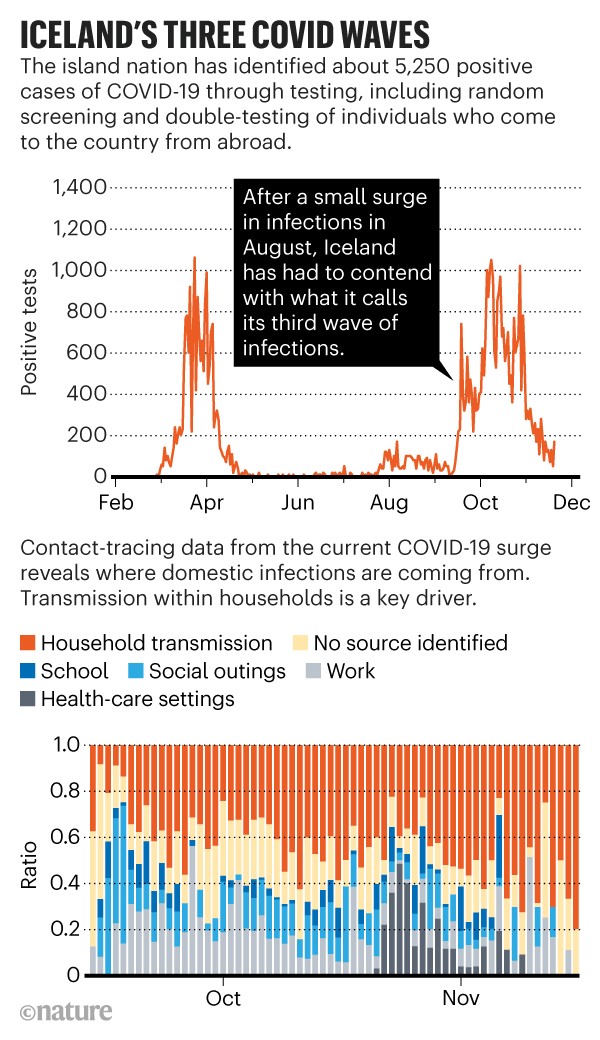
In addition to tracking asymptomatic infections, the researchers in Iceland concluded that children under 10 were about half as likely to test positive as people aged 10 and older — a finding confirmed in Crisanti’s study of Vo’, as well as studies in the United Kingdom5 and United States6. Additionally, the deCODE team analysed the viral genetic material of every positive case, and used that fingerprint to track where each strain of the virus came from and how it spread. Most of the initial cases, the researchers found, were imported from popular skiing destinations, whereas later transmission occurred mainly locally, within families (see ‘Iceland’s three COVID waves’).

Infographic: Iceland's three COVID waves. Charts showing the COVID-19 infections and sources of transmission in Iceland.
Source: http://www.covid.is/data; deCODE genetics

That genetic-tracing approach, called molecular epidemiology, was similarly applied in New Zealand to good effect. In March, New Zealand’s government implemented a stringent countrywide lockdown aimed at eliminating the virus. “Essentially, the New Zealand population more or less stayed at home for 7 weeks. After that, we emerged into a virus-free country,” says Michael Baker, a public-health researcher at the University of Otago in Wellington. That’s a feat for a country of 5 million people, more than 13 times larger than Iceland.

Genetic analysis of the first New Zealand wave, from March to May, showed that the strict lockdown began working right away. The rate of transmission — the number of people infected by each person with the virus — dropped from 7 to 0.2 in the first week in the largest cluster7. Sequencing data also showed that an August outbreak in Auckland, the source of which remains unknown, was from a single lineage, reassuring public-health authorities that there had only been one breach. “Genomics has played a vital role in tracking the re-emergence of COVID-19 in New Zealand,” says Jemma Geoghegan, a microbiologist at Otago who co-led the project with Joep de Ligt at the Institute of Environmental Science and Research in Porirua.

Getting the full picture

This summer at the university hospital, Palsson’s team used the clinical data to investigate8 the full spectrum of disease caused by SARS-CoV-2. The most common symptoms among the 1,797 people who tested positive between 31 January and 30 April were muscle aches, headache and a non-productive cough — not fever, a symptom listed in both the US Centers for Disease Control and the World Health Organization case definitions for COVID-19. When used to guide testing, those definitions are likely to miss some symptomatic people, says Palsson. “Hopefully others will come to a similar conclusion and that will result in changes in the criteria,” he says.

The results from Palsson’s team led to direct medical intervention in Iceland: individuals showing any sign of a common cold or aches are now encouraged to get tested, and the hospital categorizes new patients into one of three stages according to their symptoms, which dictates their level of care.

The most recent study from Iceland focused on a major COVID-19 question: how long does immunity to SARS-CoV-2 last? deCODE’s team found that anti-SARS-CoV-2 antibodies remained high in the blood of 91% of infected people for 4 months after diagnosis9, running counter to earlier results suggesting that antibodies decline quickly after infection10,11. It is possible that the conflicting results represent two waves of antibodies. In an editorial accompanying the paper12, Galit Alter at Harvard Medical School in Boston, Massachusetts, and Robert Seder at the US National Institutes of Health’s Vaccine Research Center in Bethesda, Maryland, suggest that a first wave is generated by short-lived plasma cells in response to acute infection, then a second wave, produced by longer-lived cells, bestows lasting immunity.

And finally, Stefánsson was able to pin down the elusive statistic that first intrigued him — the infection fatality ratio (IFR), or the proportion of infected people who die from the disease. Since the beginning of the pandemic, IFR estimates have ranged from less than 0.1% to a whopping 25%, depending on the size of the study and the age of the population. A growing number of studies are converging at about 0.5 to 1%. In Iceland, where the median age is 37 — relatively young compared with other wealthy nations — and patients have access to good health care, Stefánsson’s team found it to be 0.3%.

New wave

On 15 June, Iceland opened its borders to non-essential visitors from 31 European nations. A month later, on 16 July, the country also lifted restrictions on visitors from 12 more countries, including Canada, New Zealand and South Korea. The opening gave a boost to the struggling tourism industry, although numbers of visitors remained low, with about 75–80% fewer summer tourists than in 2019, according to the Icelandic Tourist Board.

People gather at a bar in Reykjavik, Iceland, as bars reopened after a two-month closure
Bars in Reykjavik reopened on 31 May, after a two-month closure.Credit: Haraldur Gudjonsson/AFP via Getty

Then, on 10 August, a pair of tourists at Reykjavik airport tested positive for SARS-CoV-2, ignored regulations and went into town. That incursion led to a small bump of cases in August centred on two pubs and a fitness centre visited by the tourists. Then, in mid-September, the number of infections increased abruptly, from 1 to 55 in a week. “This one clone of virus was able to spread around and cause lurking infections all over, especially in Reykjavik, and all of a sudden, we saw this increase,” says Guðnason. “It’s evidence of how difficult the virus is to contain.”

By October, coronavirus was more widespread in the community than it had been in the first wave, peaking at 291 infections per day. On 17 October, the number of active infections finally began to decline, which researchers attribute to widespread testing, tracing and quarantine procedures, as well as fresh government restrictions and emphasis on mask wearing. “Hopefully we can start relaxing our restrictions soon,” says Guðnason.

Despite the outbreak, the country continues to keep its borders open to tourists from some countries, although entry requirements are now stricter. Travellers must either self-quarantine for 14 days after arrival or participate in two screening tests: one on arrival, followed by five days of quarantine, then a second test. This method has led to the discovery that 20% of people who test negative in the first round will test positive in the second, notes Guðnason. That is a high number, but seems consistent with other analyses13. The new requirement is likely to have caught many strains of virus that would have otherwise entered the country.

Unlike New Zealand, which closed its borders, elimination was never supported in Iceland for fears that the country would go bankrupt without tourism. So it is possible that new cases will continue to arise, says Guðnason. Furthermore, he and others think the current outbreak might be in large part due to pandemic fatigue, as people disregard health precautions after months of being careful. “I think we’re going to be dealing with the virus, trying to suppress it as much as possible, until we get the vaccine,” he says.

And research continues in any and every spare hour. Palsson’s team is planning to analyse the effect of viral loads on patient outcomes and viral transmission, and to use contact-tracing data to tease out the risk factors for a super-spreading event. “We’ve had households where almost everybody gets infected, then other places where people carry the infection and stay in the workplace and nobody gets infected,” says Palsson. “It’s very difficult to understand.”

At deCODE, Stefánsson and his colleagues are investigating cellular immune responses and whether people with COVID-19 who are very sick produce antibodies directed against their own tissues. And together, the deCODE and university-hospital teams are collaborating on the long-term effects of COVID and how genetics affects susceptibility and responses to the disease.

“We’ve been committed for a long time to take everything we learn about human disease and publish it,” says Stefánsson. “There is no way in which we would have not utilized the opportunity.”

Nature 587, 536-539 (2020)doi: https://doi.org/10.1038/d41586-020-03284-3

References

  1. 1.Gottfredsson, M. et al. Proc. Natl Acad. Sci. USA 105, 1303–1308 (2008).
  2. 2.Gudbjartsson, D. F. et al. N. Engl. J. Med. 382, 2302–2315 (2020).
  3. 3.Wu, S. L. et al. Nature Commun. 11, 4507 (2020).
  4. 4.Lavezzo, E. et al. Nature 584, 425–429 (2020).
  5. 5.Docherty, A. B. et al. Br. Med. J. 369, m1985 (2020).
  6. 6.Rosenberg, E. S. et al. Clin. Infect. Dis. 71, 1953–1959 (2020).
  7. 7.Geoghegan, J. L. et al. Preprint at medRxiv https://doi.org/10.1101/2020.08.05.20168930 (2020).
  8. 8.Eythorsson, E. et al. Preprint at medRxiv https://doi.org/10.1101/2020.08.09.20171249 (2020).
  9. 9.Gudbjartsson, D. F. et al. N. Engl. J. Med. 383, 1724–1734 (2020).
  10. 10.Long, Q.-X. et al. Nature Med. 26, 1200–1204 (2020).
  11. 11.Ibarrondo, F. J. et al. N. Engl. J. Med. 383, 1085–1087 (2020).
  12. 12.Alter, G. & Seder, R. N. Engl. J. Med. 383, 1782–1784 (2020).
  13. 13.Kucirka, L. M., Lauer, S. A., Laeyendecker, O., Boon, D. & Lessler, J. Ann. Intern. Med. 173, 262–267 (2020).

https://www.nature.com/articles/d41586-020-03284-3

New genetic link to Alzheimer’s dementia discovered

A research team has discovered that Dlgap2, a gene that helps facilitate communication between neurons in the nervous system, is associated with the degree of memory loss in mice and risk for Alzheimer’s dementia in humans. When studying post-mortem human brain tissue, the researchers also discovered low levels of Dlgap2 in people experiencing ‘poorer cognitive health’ and ‘faster cognitive decline’ prior to death.

A gene known for helping facilitate communication between neurons in the nervous system has been discovered to be connected with Alzheimer’s dementia and cognitive decline, according to a national research team led by The Jackson Laboratory and University of Maine.

Catherine Kaczorowski, associate professor and Evnin family chair in Alzheimer’s research at The Jackson Laboratory (JAX), and adjunct professor with the UMaine Graduate School of Biomedical Science and Engineering (GSBSE), spearheaded a study to pinpoint the genetic mechanisms that affect resistance or vulnerability to weakening cognition and dementias, such as Alzheimer’s.

Andrew Ouellette, a Ph.D student at JAX and a GSBSE NIH T32 predoctoral awardee, led the project, along with his mentor Kaczorowski and scientists from across the U.S.

By studying the memory and brain tissue from a large group of genetically diverse mice, the team found that the expression of the gene Dlgap2 is associated with the degree of memory loss in mice and risk for Alzheimer’s dementia in humans. Further research will ascertain how the gene influences dementia and mental function.

Dlgap2, located in the synapses of neurons, serves to anchor critical receptors for signals between neurons required for learning and memory. When studying post-mortem human brain tissue, the team discovered low levels of Dlgap2 in people experiencing “poorer cognitive health” and “faster cognitive decline” prior to death, according to researchers.

The team’s findings were published in the journal Cell Reports.

“The reason why this is so important is because a lot of research around cognitive aging and Alzheimer’s has been hyper-focused on well-known risk genes like APOE and brain pathologies,” Kaczorowski says. “We wanted to give ourselves the option of looking at new things people keep ignoring because they’ve never heard about a gene before.”

Researchers found that Dlgap2 influences the formation of dendritic spines on neurons, which can affect cognitive function. Longer, thinner spines shaped like mushrooms demonstrate higher mental performance than stubbier spines in mice, Ouellette says, and decreased cognition correlates with a loss in dendritic spines.

The study serves as a springboard for additional research into Dlgap2. Ouellette will explore how it influences cognition and how it can be used in therapeutic treatment for memory loss, in part by manipulating the gene with the editing tool CRISPR. Other members of the Kaczorowski lab are studying how to regulate Dlgap2 with pharmaceuticals to help prevent cognitive decline with age.

Scientists relied on Diversity Outbred mice, a population from eight parents created by The Jackson Laboratory to better reflect genetic diversity in humans. The Dlgap2 study involved 437 mice, each one either six, 12 or 18 months old.

“It’s great because you can harness the best parts of a mouse study and human society,” Ouellette says. “Historically, research has been done with inbred mice with similar genetic makeups; same, similar genetic models. But clinically, humans don’t work like that because they’re not genetically identical.”

The team performed quantitative trait loci mapping on the mouse population, examining entire genome sequences to identify genes responsible for varying cognitive function and where they occurred in the sequences. After pinpointing the connection between Dlgap2 and memory decline in mice, researchers evaluated its significance in human mental functionality using genomewide association studies for Alzheimer’s dementia and studying samples of post-mortem brain tissue using imaging, microscopy and other methods.

Kaczorowski says the project relied on information and expertise from all 25 co-authors. For example, Gary Churchill, professor and Karl Gunnar Johansson chair at JAX, Elissa Chesler, professor at JAX, and postdoctoral fellow Niran Hadad provided their expertise in utilizing diversity outbred models and cross-species genomic data integration to the project. Their efforts, she says, emphasizes the importance of teamwork in advancing medical research.

“We’re going to be able to contribute a lot more to human health with team science,” she says.

The GSBSE and The Jackson Laboratory partner to provide cooperative Ph.D. programs that include on-site training at the laboratory in Bar Harbor. The school also partners with other academic and research institutions to provide similar learning experiences. UMaine grants the degrees for these programs.

Kaczorowski says the GSBSE’s biomedical science Ph.D. program gives students hands-on learning opportunities that, like with Ouellette, can help them realize their passion and talents. Researching Dlgap2 with Kaczorowski influenced Ouellette’s Ph.D. dissertation further exploring how the Dlgap2 influences cognition in animals.

“I really like this study because it’s very interdisciplinary,” Ouellette says, adding that it harmonizes biological and computational science. “This study set me on a path that makes me want to be a more interdisciplinary scientist.”


Story Source:

Materials provided by University of MaineNote: Content may be edited for style and length.


Journal Reference:

  1. Andrew R. Ouellette, Sarah M. Neuner, Logan Dumitrescu, Laura C. Anderson, Daniel M. Gatti, Emily R. Mahoney, Jason A. Bubier, Gary Churchill, Luanne Peters, Matthew J. Huentelman, Jeremy H. Herskowitz, Hyun-Sik Yang, Alexandra N. Smith, Christiane Reitz, Brian W. Kunkle, Charles C. White, Philip L. De Jager, Julie A. Schneider, David A. Bennett, Nicholas T. Seyfried, Elissa J. Chesler, Niran Hadad, Timothy J. Hohman, Catherine C. Kaczorowski. Cross-Species Analyses Identify Dlgap2 as a Regulator of Age-Related Cognitive Decline and Alzheimer’s DementiaCell Reports, 2020; 32 (9): 108091 DOI: 10.1016/j.celrep.2020.108091

University of Maine. “New connection between Alzheimer’s dementia and Dlgap2.” ScienceDaily. ScienceDaily, 23 November 2020. <www.sciencedaily.com/releases/2020/11/201123161040.htm>.

Zebra Finches Recognize the Calls of Over 40 Fellow Finches

Their ability to distinguish between individuals is strong evidence for fast mapping, a learning tool generally thought to belong only to humans.

By Amanda Heidt

Fast mapping, the ability to rapidly learn an association between two things after very little exposure, is a key tool responsible for the vast repertoire of human language. It’s the reason we can recognize voices from another room and why newborns prefer to listen to their mothers read them The Cat in the Hat over other women. While fast mapping is generally thought of as a human ability, zebra finches can also distinguish dozens of other finches’ vocalizations, doing so with very little exposure and retaining those memories for at least a month, researchers report today (November 13) in Science Advances.

“The reason that this study is groundbreaking is because zebra finches are the very first vocally learning species aside from ourselves with any evidence that fast mapping takes place,” Samantha Carouso-Peck, a behavioral neuroscientist at Cornell University who researches social influences on vocal learning in zebra finches but was not involved in the current work, tells The Scientist.

Prior to the new study, evidence of fast mapping in nonhumans had been suggested for only a single nonhuman species: dogs. Rico the border collie is capable of distinguishing the name of more than 200 individual objects, while another dog named Chaser could discriminate between more than 1,000. Whether this is truly evidence of fast mapping, however, has been debated among scientists who believe that only species capable of language, specifically humans, can be said to truly fast map. 

To test zebra finches’ ability to recognize individual calls, and the number of exposures they need to do so, researchers at the University of California, Berkeley, designed a five-day “learning ladder.” Birds were initially trained on a small set of call data that became increasingly larger over several days. 

On the first day of testing, each bird in the training arena went through a series of trials during which they heard brief clips of either a song or a distance call used by birds to locate their group when it is out of sight. These two distinct vocalizations were chosen because they are thought to have the most variation between individuals. Nineteen birds were trained on songs, while another 19 heard only distance calls. The vocalizations were parsed, so that one set led to a food reward, while the other set didn’t.

In the team’s experiments, birds in an arena learned to distinguish between vocalizations that came with a reward (Re Vocalizer) and those that did not (NoRe Vocalizer). When birds recognized a call they had heard before, they allowed the clip to play fully, which activated a food reward. When they did not, they hit a button to skip ahead to the next trial. In this way, scientists were able to show that individual finches can remember an average of 42 other vocalizers.JULIE ELIE, UC BERKELEY

In that first test, each finch only needed to discriminate between two individuals’ vocalizations, one that provided a food reward and one that did not. By pecking a key, the finch would start the sound file. It could then either peck the key again to start a new trial or listen to the entire clip to receive a food reward. Repeating this process over several trials, the finches learned to associate vocalizations that led to a reward from the ones that did not and to quickly skip vocalizations that weren’t rewarding.

Each successive day, sounds from additional individuals were added to the training set. While finches were originally trained to discriminate between one pair of individuals, by day two it jumped to four pairs, and then eight on days three through five, for a total of 16 different individuals’ vocalizations. The researchers began evaluating the finches’ performance only on days four and five, when each bird had been exposed at least once to each possible vocalizer. 

To be certain the finches weren’t simply memorizing the sound files, each bird providing the vocalization was recorded 10 different times. “We were pulling randomly from a large library of calls that we have, so the calls were all different every time,” Frederic Theunissen, an auditory scientist at the University of California, Berkeley, tells The Scientist. “Not only are they different vocalizers, but they heard different renditions from the same vocalizer.”

Even with this added layer of complexity, Theunissen says he was “really impressed” by how well the finches performed. All 19 finches trained using song files were able to discriminate between the vocalizers they recognized based on their individual signatures and those they did not, and the same was true for 18 of the finches trained using distance calls. 

Beyond their ability to recognize other birds based on their calls, the team was also struck by how quickly the finches were able make the distinctions. The majority of birds could hear as few as 10 exposures to an individual and memorize their signature, while some required fewer than five, strong evidence for fast mapping in the species.

“We didn’t expect the birds to be so good at this,” Theunissen tells The Scientist. “We thought this was going to be interesting, but the fact that the number of vocalizers is so high, and that they can do this so quickly, was really quite astonishing.” 

In the study, the team decided to create what Theunissen calls “an impossible task” to test the limits of the finches’ performance. He created a new set of stimuli that included both songs and distance calls from 56 distinct vocalizers. Only four randomly-selected birds went through this mega-task, but on average, they were able to remember 42 individual vocalizers. 

A month later, he tested the recall of two of the four birds by running them through the same, 56-vocalizer test and found that they were still able to distinguish between individuals—they had retained their memories of the individual calls. Both the speed of their learning and their retention over time, Theunissen says, “point towards these really remarkable abilities that these birds have in terms of making auditory memories.”

Because these birds are so social, living gregariously in colonies of more than 100 individuals, it isn’t unexpected that zebra finches could discriminate between dozens of individuals, says Sarah Woolley, a neuroethologist at McGill University who studies the neurological basis for social behavior in songbirds. “We’ve always been pretty sure that birds could do that, zebra finches included,” Woolley says. “But no one had really demonstrated it, certainly not to the degree that they do in this paper.”

While the results are “very interesting evidence” that zebra finches are capable of fast mapping, Carouso-Peck says that more work on a larger sampling of birds is needed “before we can make weightier claims about what they’re capable of.” For example, one of the criticisms of the previous work with Rico the border collie is that fast mapping is a tool for learning language, and therefore only species capable of language truly do it. While Carouso-Peck says she doesn’t necessarily agree, as a next step she would like to see if finches are also capable of fast mapping verbally. For example, how many times must young zebra finches hear their father’s song before they can reproduce it for themselves?

“Language is something which we humans tend to hold up as our great crowning achievement, something that we are capable of which absolutely no [other] species is capable of,” Caruso-Peck tells The Scientist. “Over the last few decades, we’ve had to change the goalposts for what is language in order to maintain that high and mighty position.” 

K. Yu et al., “High-capacity auditory memory for vocal communication in a social songbird,” Science Advances, doi:10.1126/sciadv.abe0440, 2020.