South Korean Researchers Clone Stem Cells From Human Adults

Scientists from South Korea have devised a technique for cloning adult stem cells that doesn’t involve the destruction of human embryos. The resulting stem cells, which are highly personalized, could be used to treat illnesses such as heart disease and blindness — but the technique could also be used to clone adults.

It’s a process called therapeutic cloning and it involves the production of embryonic cells that are genetically identical to those of the donor, typically for the purpose of using the resulting pluripotent cells to treat disease. The scientists, whose study now appears in Cell, extracted skin cells from two adult males, aged 35 and 75. The DNA was then fused with human eggs donated by four adult women.

A burst of electricity was used to fuse grown cells with eggs whose own DNA had been removed. The eggs then multiplied and soon developed into embryos in the shape of a hollow sphere. This resulted in pluripotent cells — cells that can turn into any kind of human cell.

Last year, scientists essentially did the same thing, though the cells were derived from human fetal and infant DNA (which tend to be more malleable). This technique is considered much more ethically palatable because it does not involve the destruction of human embryos.

As noted, and in addition to creating personalized stem cells to treat such conditions as Parkinson’s disease, heart disease, multiple sclerosis or type-1 diabetes, the technique could be used to clone human adults.

http://io9.com/researchers-clone-stem-cells-from-human-adults-1564755314

Thanks to Da Brayn for bringing this to the attention of the It’s Interesting community.
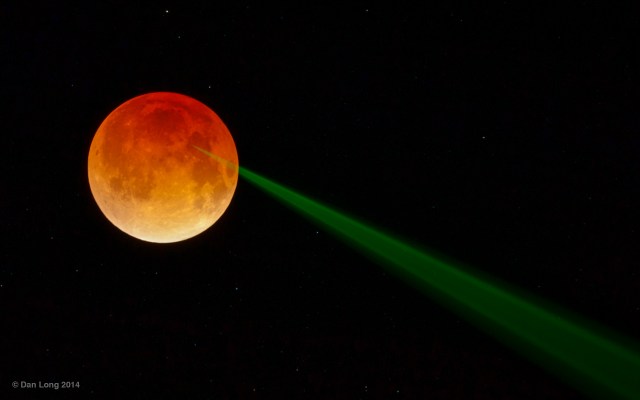
Red Moon, Green Light

This is not a scene from a sci-fi special effects movie. The green beam of light and red lunar disk are real enough, captured in the early morning hours of April 15. Of course, the reddened lunar disk is easy to explain as the image was taken during this week’s total lunar eclipse. Immersed in shadow, the eclipsed Moon reflects the dimmed reddened light of all the sunsets and sunrises filtering around the edges of planet Earth, seen in silhouette from a lunar perspective. But the green beam of light really is a laser. Shot from the 3.5-meter telescope at Apache Point Observatory in southern New Mexico, the beam’s path is revealed as Earth’s atmosphere scatters some of the intense laser light. The laser’s target is the Apollo 15 retroreflector, left on the Moon by the astronauts in 1971. By determining the light travel time delay of the returning laser pulse, the experimental team from UC San Diego is able to measure the Earth-Moon distance to millimeter precision and provide a test of General Relativity, Einstein’s theory of gravity. Conducting the lunar laser ranging experiment during a total eclipse uses the Earth like a cosmic light switch. With direct sunlight blocked, the reflector’s performance is improved over performance when illuminated by sunlight during a normal Full Moon, an effect fondly known as The Full Moon Curse.

http://apod.nasa.gov/apod/ap140418.html

Thanks to Kebmodee for bringing this to the attention of the It’s Interesting community.
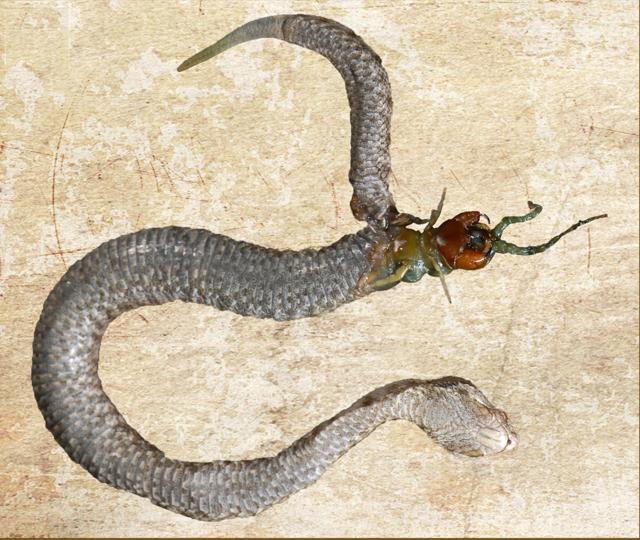
Last Supper: Centipede Dies Eating Way Out of Snake Belly

A Serbian herpetologist was out snake-tagging in Macedonia when she came across a bizarre find: A young viper, with a centipede’s head poking out of its abdomen.

It took Ljiljana Tomovic 10 seconds to figure out what it was: The snake had swallowed the centipede, which had then tried to cut a path to freedom … by eating its way out.

Some time during its violent dash, the centipede died. Perhaps the snake’s venom kicked in — that’s Tomovic’s best guess.

The island of Golem Grad in Macedonia’s Lake Prespa, where the pair were found, is also known as “Snake Island” and for good reason: it’s crawling with snakes, lizards and tortoises. Adult vipers chow down on small rodents, leaving the younger crowd to snack on centipedes.

It seems this time “the young snake gravely underestimated the size and strength of the centipede,” Tomovic, biology professor at the University of Belgrade, and her colleagues write in a brief report.

After dissolving (or digesting) the snake’s bones and gut the centipede was wearing its skin like a cloak. “We found that only the snake’s body wall remained — the entire volume of its body was occupied by the centipede,” Tomovic and co. write in Ecologica Montenegrina.

Some centipede species are equally cavalier and ferocious. They’ll lunge into battle with animals many times their size like mice and snakes. The foot-long Amazonian giant centipede hunts and eats bats.

Tomovic doesn’t know of any other centipede that has eaten its way out. “It’s possible that this situation is not so uncommon, just we did not have opportunity to see it until now,” she told NBC News via Skype.

http://www.nbcnews.com/science/weird-science/last-supper-centipede-dies-eating-way-out-snake-belly-n80071

Thanks to Pete Cuomo for bringing this to the attention of the It’s Interesting community.

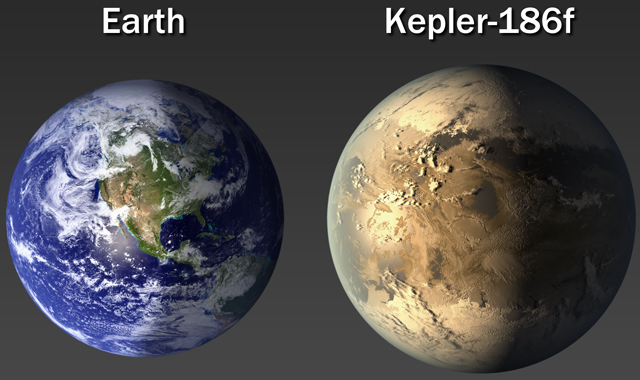
NASA discovers Kepler-186f, Earth-sized world in orbit that could support life

For the first time, scientists have found an Earth-sized world orbiting in a life-friendly zone around a distant star.

The discovery, announced on Thursday, is the closest scientists have come so far to finding a true Earth twin. The star, known as Kepler-186 and located about 500 light years away in the constellation Cygnus, is smaller and redder than the sun.

The star’s outermost planet, designated Kepler-186f, receives about one-third the radiation from its parent star as Earth gets from the sun, meaning that high noon on this world would be roughly akin to Earth an hour before sunset, said astronomer Thomas Barclay, with NASA’s Ames Research Center in Moffett Field, California.

The planet is the right distance from its host star for water — if any exists — to be liquid on the surface, a condition that scientists suspect is necessary for life.

“This planet is an Earth cousin, not an Earth twin,” said Barclay, who is among a team of scientists reporting on the discovery in the journal Science this week.

NASA launched its Kepler space telescope in 2009 to search about 150,000 target stars for signs of any planets passing by, or transiting, relative to the telescope’s point of view. Kepler was sidelined by a positioning system failure last year.

Analysis of archived Kepler data continues. From Kepler’s observational perch, a planet about the size and location of Earth orbiting a sun-like star would blot out only about 80 to 100 photons out of every million as it transits.

The pattern is repeated every 365 days and at least three transits would be needed to rule out other possibilities, so the search takes time.

“It’s very challenging to find Earth analogs,” Barclay said. “Most candidates don’t pan out, but things change as we get more measurements.”

Scientists don’t know anything about the atmosphere of Kepler-186f, but it will be a target for future telescopes that can scan for telltale chemicals that may be linked to life.

“This planet is in the habitable zone, but that’s doesn’t mean it is habitable,” Barclay said.

So far, scientists have found nearly 1,800 planets beyond the solar system.

“The past year has seen a lot of progress in the search for Earth-like planets. Kepler-168f is significant because it is the first exoplanet that is the same temperature and is (almost) the same size as Earth,” astronomer David Charbonneau, with the Harvard-Smithsonian Center for Astrophysics, wrote in an email.

“For me the impact is to prove that yes, such planets really do exist,” Charbonneau said. “Now we can point to a star and say, “There lies an Earth-like planet.'”

http://in.mobile.reuters.com/article/idINBREA3G1XI20140417?irpc=932

Thanks to Da Brayn for bringing this to the attention of the It’s Interesting community.
Female insect uses spiky penis to extract nourishment from male in marathon-long mating sessions

In desolate caves throughout Brazil live insects that copulate for days, the female’s penetrating erectile organ sticking fast in a reluctant male’s genital chamber until he offers a gift of nutritious semen. Neotrogla seems to be unique among species with reversed sex roles — with choosy males and aggressive, promiscuous females — in also having swapped anatomy, researchers report.

Not all animal species have a male penis, but because the evolution of body parts usually works through slow modification of existing structures, there would need to be a good reason for a female to develop a penetrating organ, says entomologist Kazunori Yoshizawa of Hokkaido University in Japan, a co-author of the study.

Yoshizawa and his colleagues think that they have found that reason in Neotrogla, which was first described in 2012. The insects were originally spotted in Brazilian caves by ecologist Rodrigo Ferreira from the Federal University of Lavras in Brazil. Entomologist Charles Lienhard at the Geneva Museum of Natural History in Switzerland recognized them as a new genus — and also as possessing unusual genitalia. The team’s work describing the reproductive practices of four separate species of Neotrogla is published today in Current Biology.

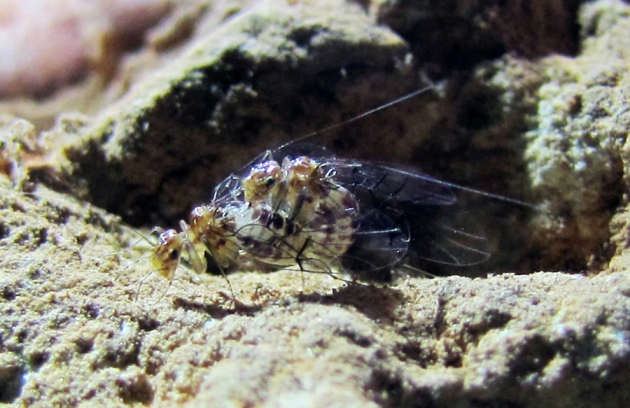
When the flea-sized winged insects mate, the female mounts the male and penetrates deep into a thin genital opening in his back. Membranes in her organ swell to lock her in, and multiple spiky spines act as grappling hooks to anchor her tightly to the male. (When researchers tried to pull apart two mating insects, the female was gripping so tightly that the male was accidentally ripped in half, leaving his genitalia still attached to the female.) The tip of the female’s penis fits neatly into the male’s genitalia to allow her to receive a large, teardrop-shaped sperm capsule over their 40–70 hours of copulation.

The key to the anatomy and role reversal might be simple hunger. Neotrogla species live in extremely dry caves, says Ferreira, where there is not much in the way of food, save for bat guano and the occasional dead bat. A female needs enough nourishment to make eggs and reproduce, though, so she likely found another source of nutrition, Yoshizawa says: her mate’s semen capsule. In some other insects, males expend personal resources to create highly sought-after ‘nuptial gifts’ of sperm and nutrients that they bestow upon their mate during copulation. Although it’s not clear whether Neotrogla couples do likewise, the females accept seminal gifts and drain them even when they’re too young to reproduce, Yoshizawa says, so it’s obvious they’re using the sperm capsules for more than mere reproduction.

If Neotrogla males need to spend valuable resources producing their sperm packets, it’s likely they would be choosy about their mates, Yoshizawa says, which would help explain why the females have evolved a penis well designed to hold down reluctant mates long enough to wring out all their gifts. This might be a combination unique to Neotrogla, he says: Although other animals have swapped sex roles where the female is the promiscuous aggressor (the scorpion fly, for example), and others have swapped anatomy where the female penetrates the male (seahorses, for example), none appears to have developed both reversed sex roles and a female penis with grappling hooks.

The authors make a “convincing case” that this female penis is associated with sex-role reversal where males are choosy, as would be expected under sexual-selection theory, says William Eberhard, an evolutionary biologist at the University of Costa Rica in San Pedro.

If Neotrogla can be observed in captivity, they might be good models for studying how and why male and female roles and anatomy can get switched around during copulation, he adds.

Yoshizawa and his colleagues are now working to establish a healthy population in the lab, but the biggest challenge will be finding a suitable food to replace the cave-bat droppings, Yoshizawa says. Flour, yeast and skimmed milk are all under consideration. to replace the cave-bat droppings.

http://www.nature.com/news/female-insect-uses-spiky-penis-to-take-charge-1.15064

Thanks to Dr. Lutter for bringing this to the attention of the It’s Interesting community.
New study shows that casual marijuana use alters the brain

The days when people thought only heavy Cheech-and-Chong pot smokers suffered cognitive consequences may be over. A study in The Journal of Neuroscience says even casual marijuana smokers showed significant abnormalities in two vital brain regions important in motivation and emotion.

“Some of these people only used marijuana to get high once or twice a week,” said co-author Hans Breiter, quoted in Northwestern University’s Science Newsline. Breiter hailed the study as the first to analyze the effects of light marijuana use. “People think a little recreational use shouldn’t cause a problem, if someone is doing OK with work or school,” he said. “Our data directly says this is not the case.”

“This study raises a strong challenge to the idea that casual marijuana use isn’t associated with bad consequences,” he added.

The study analyzed 20 pot smokers and 20 non-pot smokers between 18 and 25. Scientists asked them to estimate how much marijuana they smoked and how often they lit up over a three-month test period. Even those who smoked once a week showed brain abnormalities, while larger changes were seen in those who smoked more.

Marijuana is by far the most recognizable drug in the United States, with almost 19 million people reporting recent use, according to the National Survey on Drug Use. Cultural attitudes toward the drug are changing fast. What would have been inconceivable a generation ago — the decriminalization and legalization of marijuana — has happened in several states over the last several years. Nascent industries around the plant have sprouted in Colorado and Washington since they legalized the drug.

The study did not look at the behavior of the pot smokers, only their brains. What effect, if any, Wednesday’s findings will have on future legislation remains unclear.

The drug’s effect on the human brain, however, is substantially more clear, researchers say. In the study, scientists compared the size, shape and density of the nucleus accumbens and the amygdala, which control emotion. Those who had smoked had abnormally large nucleus accumbens, an area of the brain that controls pleasure, reward, and reinforcement learning.

Although structural changes were noted, it is not known whether this has any consequence on human behavior or emotion.

http://www.washingtonpost.com/news/morning-mix/wp/2014/04/16/even-casually-smoking-marijuana-can-change-your-brain-study-says/?tid=pm_national_pop

Japan’s Annual Penis Festival Is As Phallic As You’d Expect

Each spring, people flock to Kawasaki, Japan, to celebrate Kanamara Matsuri, aka the “Festival of the Steel Phallus.”

Held this year on April 6, the festival is a celebration of the penis and fertility. People parade gigantic phallic-shaped mikoshi (portable Shinto shrines) down the streets during the event, as revelers suck on penis lollipops, buy penis-themed memorabilia and pose with sculptures in the shape of — you guessed it — penises.

According to the BBC, the festival is believed to have roots in the 17th century, when prostitutes are said to have prayed for protection from sexually transmitted infections at Kawasaki’s Kanamara shrine.

The festival raises awareness about safe sex practices and fundraises for HIV prevention.

http://www.huffingtonpost.com/2014/04/07/japan-penis-festival-kanamara-matsuri_n_5106378.html

Thanks to Ray Gaudette for bringing this to the attention of the It’s Interesting community.

U.S. Navy Has Found A Way To Turn Seawater Into Fuel

Scientists with the United States Navy say they have successfully developed a way to convert seawater into jet fuel, calling it a potentially revolutionary advancement.

Researchers at the Naval Research Laboratory (NRL) developed technology to extract carbon dioxide from seawater while simultaneously producing hydrogen, and then converted the gasses into hydrocarbon liquid fuel. The system could potentially shave hours off the at-sea refueling process and eliminate time spent away from missions.

Currently, most of the Navy’s vessels rely entirely on oil-based fuel, with the exception of some aircraft carriers and submarines that use nuclear propulsion, reports the International Business Times. The ability to render fuel from seawater may change that.

“For us in the military, in the Navy, we have some pretty unusual and different kinds of challenges,” Vice Admiral Philip Cullom told Agence-France Presse. “We don’t necessarily go to a gas station to get our fuel. Our gas station comes to us in terms of an oiler, a replenishment ship. Developing a game-changing technology like this, seawater to fuel, really is something that reinvents a lot of the way we can do business when you think about logistics, readiness.”

The carbon and hydrogen gasses produced from the seawater extraction process are converted to liquids using metal catalytic converters in a reactor system. That liquid product contains hydrocarbon molecules with carbon levels suitable for replacing petroleum jet fuel, the NRL noted in a press release.

“Basically, we’ve treated energy like air, something that’s always there and that we don’t worry about too much. But the reality is that we do have to worry about it,” Cullom told AFP.

The NRL projects the new fueling system could be commercially viable in less than 10 years and could produce jet fuel that costs $3-6 dollars per gallon.

Forbes columnist Tim Worstall says the system could be great for the Navy, but he doubts it will be an economically feasible or energy-efficient alternative for those of us on land. “We need more energy to go into the process than we get out of it,” he wrote of the Navy’s method for converting seawater to fuel, adding later, “[A]s a general rule it’s not really all that useful. We want to produce energy, not just transform it with efficiency losses along the way.”

http://www.huffingtonpost.com/2014/04/09/seawater-to-fuel-navy-vessels-_n_5113822.html

Thanks to Ray Gaudetter for bringing this to the attention of the It’s Interesting community.


Where’s Ukraine? Each dot depicts the location where a U.S. survey respondent situated Ukraine; the dots are colored based on how far removed they are from the actual country, with the most accurate responses in red and the least accurate ones in blue. (Data: Survey Sampling International; Figure: Thomas Zeitzoff/The Monkey Cage)

Since Russian troops first entered the Crimean peninsula in early March, a series of media polling outlets have asked Americans how they want the U.S. to respond to the ongoing situation. Although two-thirds of Americans have reported following the situation at least “somewhat closely,” most Americans actually know very little about events on the ground — or even where the ground is.

On March 28-31, 2014, we asked a national sample of 2,066 Americans (fielded via Survey Sampling International Inc. (SSI), what action they wanted the U.S. to take in Ukraine, but with a twist: In addition to measuring standard demographic characteristics and general foreign policy attitudes, we also asked our survey respondents to locate Ukraine on a map as part of a larger, ongoing project to study foreign policy knowledge. We wanted to see where Americans think Ukraine is and to learn if this knowledge (or lack thereof) is related to their foreign policy views. We found that only one out of six Americans can find Ukraine on a map, and that this lack of knowledge is related to preferences: The farther their guesses were from Ukraine’s actual location, the more they wanted the U.S. to intervene with military force.

Survey respondents identified Ukraine by clicking on a high-resolution world map, shown above. We then created a distance metric by comparing the coordinates they provided with the actual location of Ukraine on the map. Other scholars, such as Markus Prior, have used pictures to measure visual knowledge, but unlike many of the traditional open-ended items political scientists use to measure knowledge, distance enables us to measure accuracy continuously: People who believe Ukraine is in Eastern Europe clearly are more informed than those who believe it is in Brazil or in the Indian Ocean.

About one in six (16 percent) Americans correctly located Ukraine, clicking somewhere within its borders. Most thought that Ukraine was located somewhere in Europe or Asia, but the median respondent was about 1,800 miles off — roughly the distance from Chicago to Los Angeles — locating Ukraine somewhere in an area bordered by Portugal on the west, Sudan on the south, Kazakhstan on the east, and Finland on the north.

Accuracy varies across demographic groups. In general, younger Americans tended to provide more accurate responses than their older counterparts: 27 percent of 18-24 year olds correctly identified Ukraine, compared with 14 percent of 65+ year-olds. Men tended to do better than women, with 20 percent of men correctly identifying Ukraine and 13 percent of women. Interestingly, members of military households were no more likely to correctly locate Ukraine (16.1 percent correct) than members of non-military households (16 percent correct), but self-identified independents (29 percent correct) outperformed both Democrats (14 percent correct) and Republicans (15 percent correct). Unsurprisingly, college graduates (21 percent correct) were more likely to know where Ukraine was than non-college graduates (13 percent correct), but even 77 percent of college graduates failed to correctly place Ukraine on a map; the proportion of college grads who could correctly identify Ukraine is only slightly higher than the proportion of Americans who told Pew that President Obama was Muslim in August 2010.

Does it really matter whether Americans can put Ukraine on a map? Previous research would suggest yes: Information, or the absence thereof, can influence Americans’ attitudes about the kind of policies they want their government to carry out and the ability of elites to shape that agenda. Accordingly, we also asked our respondents a variety of questions about what they thought about the current situation on the ground, and what they wanted the United States to do. Similarly to other recent polls, we found that although Americans are undecided on what to do with Ukraine, they are more likely to oppose action in Ukraine the costlier it is — 45 percent of Americans supported boycotting the G8 summit, for example, while only 13 percent of Americans supported using force.

However, the further our respondents thought that Ukraine was from its actual location, the more they wanted the U.S. to intervene militarily. Even controlling for a series of demographic characteristics and participants’ general foreign policy attitudes, we found that the less accurate our participants were, the more they wanted the U.S. to use force, the greater the threat they saw Russia as posing to U.S. interests, and the more they thought that using force would advance U.S. national security interests; all of these effects are statistically significant at a 95 percent confidence level. Our results are clear, but also somewhat disconcerting: The less people know about where Ukraine is located on a map, the more they want the U.S. to intervene militarily.

http://www.washingtonpost.com/blogs/monkey-cage/wp/2014/04/07/the-less-americans-know-about-ukraines-location-the-more-they-want-u-s-to-intervene/

Columbian Mammoth becomes South Carolina’s state fossil, with official language in the State Bill of it’s creation by God on the Sixth Day

<img src="https://its-interesting.com/wp-content/uploads/2014/04

The Columbian Mammoth is about to become an official state symbol of South Carolina, but its path to the limelight was long and fraught with controversy.

Here's the text of the bill that made it official:

Section 1-1-712A. The Columbian Mammoth, which was created on the Sixth Day with the other beasts of the field, is designated as the official State Fossil of South Carolina and must be officially referred to as the ‘Columbian Mammoth’, which was created on the Sixth Day with the other beasts of the field.

This is actually the watered-down version of the bill; one version, proposed earlier, made even more explicit references to the role of a divine creator in the mammoth’s history.

This all started when an 8-year-old suggested that the Columbian mammoth become South Carolina’s state fossil. Olivia McConnell had some good reasoning behind her suggestion: Mammoth teeth found in a South Carolina swamp in 1725 were the first vertebrate fossils identified in North America.

Her submission became a bill. The original draft was simple enough: “Section 1-1-691. The Wooly Mammoth is designated as the official State Fossil of South Carolina.” But almost immediately the proposal ran into trouble. On a practical level: Senate Majority Leader Harvey Peeler objected strenuously to having any new state symbols enacted in a state that already has a state spider, state beverage and a state hospitality beverage among many others. On a philosophical level: proclaiming a state fossil in a state where there is still intense debate over teaching evolution as fact creates some problems.

From USA Today:

State Sen. Mike Fair, a Greenville Republican who serves on the panel that will decide the science standards, said that natural selection should be taught as theory rather than as scientific fact. He argues that natural selection can make biological changes within species but it can’t explain the whole progression from microbes to humans.

“This whole subject should be taught as a pro and con,” he said.

Last week, Fair had raised his own objection that temporarily killed Olivia’s bill but withdrew it after another senator told him the story of the Lake City girl’s campaign to get an official state fossil.

Fair wasn’t the only one who had objections. Another State Senator, Kevin Bryant started a pushing a change that would add some biblical flair to the otherwise direct language. The New York Times:

But then Senator Kevin Bryant proposed an amendment rooted in the Book of Genesis, imputing God as the creator of the woolly mammoth: “And God made the beast of the earth after his kind, the cattle after their kind, and everything that creepeth upon the earth after his kind: and God saw that it was good.”
Bryant’s version was struck down, but the final version of the bill did include that language about the Mammoth being created on the sixth day.

There was one other addition, too. Frustrated by the amount of time spent discussing state symbols instead of governing, legislators also added an amendment to the bill prohibiting the General Assembly from enacting any new state symbols “until such time as the General Assembly directly by legislative enactment removes this moratorium.”

Read more: http://www.smithsonianmag.com/smart-news/south-carolinas-state-fossil-creation-controversy-180950474/#4mOTlJmLsprzxrmM.99

Thanks to Kebmodee for bringing this to the attention of the It’s Interesting community.