A hospital ward in Oregon has been quarantined after 5 people fall ill with mysterious hallucinations

An emergency room in Oregon has been quarantined after five people started experiencing hallucinations that appear to have been spread via touch.

The unidentified condition was first reported at around 3am last Wednesday, when a 54-year-old caregiver in North Bend Oregon phoned police complaining about seven or eight people trying to “take the roof off her vehicle”.

Police investigated her house and couldn’t find any evidence of the crime, but when the caregiver called about the incident again a few hours later, two Sheriff’s deputies escorted her to the nearby Bay Area hospital to be examined for symptoms of hallucinations.

The woman was declared healthy and sent home, but pretty soon, one of the deputies who’d helped out with the case started hallucinating himself.

And then the second deputy, a hospital worker, and the caregiver’s 78-year-old patient also began hallucinating, and were admitted to hospital.

All four had been in physical contact with the caregiver.

A Haz Mat team was deployed to both the hospital and the caregiver’s residence, while the emergency room was emptied and quarantined to check for the source of the unidentified illness. Experts have so far been unable to locate a common source of contamination.

Blood tests of the affected patients also haven’t turned up anything unusual.

Initially, police though that the hallucinations could have been caused by narcotic fentanyl patches, which are prescribed for chronic pain, and were worn by the caregiver’s 78-year-old patient.

But they’ve since ruled that explanation out.

“Investigation has found that all those patches and potential medications that may have caused the symptoms have been accounted for,” Coos County Sheriff’s Office spokesperson Patrick Downing told KVAL News.

“The vehicles, equipment, and uniforms have been checked with no contaminates identified or located on or about them.”

All patients have now been treated, released home, and have reportedly recovered – although the hospital worker is displaying some flu-like symptoms. The quarantine has also been lifted from the hospital.

But the investigation into the source of the hallucinations is ongoing, with police saying that the only thing they suspect for sure is that the illness was spread by direct contact.

However, it’s not yet been ruled out that this isn’t a case of mass hysteria – where many people in contact with each other all start to think they’re suffering from the same physical condition, symptoms, or threat. It’s possible that all these people who came in contact with the caregiver became so anxious that they also started hallucinating.

This is not the first time a mysterious illness has swept through a group of people, either – last year, dozens of children started fainting during a Remembrance Day ceremony in the UK. In that case, the suspected cause appears to have been a simple been a case of heating and widespread panic about children becoming ill.

http://www.sciencealert.com/a-hospital-ward-has-been-quarantined-after-5-people-fall-ill-with-mysterious-hallucinations

Thanks to Kebmodee for bringing this to the attention of the It’s Interesting community.

Hybrid of extinct aurochs and ice age bison discovered in cave paintings, named the Higgs Bison

An ancient species of bison, which once roamed extensively for more than 100,000 years across Eurasia and North America, has only now been discovered by scientists — and they have ice age cave artists to thank for the find, reports Phys.org.

Cave paintings that date to more than 15,000 years ago seem to depict two different kinds of bison, one with long horns and large forequarters — familiar features of many modern bison — as well as one with odd-featured shorter horns and small humps. Researchers have long chalked up these differences to artistic imperfection, but new genetic analysis has proven that Ice Age cave artists knew exactly what they were doing.

Not only did genetic analysis reveal that an entirely new species of bison had once roamed across the world’s northern latitudes, but it showed that the creature was the result of a hybridization event that occurred some 120,000 years ago between the extinct aurochs and the ice age steppe bison. Since hybridization rarely leads to speciation, this event represents an unexpected twist in the evolution of these magnificent beasts.

“Finding that a hybridization event led to a completely new species was a real surprise — as this isn’t really meant to happen in mammals,” explained study leader Alan Cooper. “The genetic signals from the ancient bison bones were very odd, but we weren’t quite sure a species really existed – so we referred to it as the Higgs Bison.”

“Higgs bison,” the tentative new name for the mystery hybrid species, is a playful reference to the Higgs boson, an equally-elusive elementary particle in physics, the existence of which was also only just recently confirmed.

Interestingly, researchers also learned that the Higgs bison eventually became the ancestor of the modern European bison, or wisent, which means that its genetic heritage still survives into modern times.

“The dated bones revealed that our new species and the Steppe Bison swapped dominance in Europe several times, in concert with major environmental changes caused by climate change,” explained lead author, Dr. Julien Soubrier. “When we asked, French cave researchers told us that there were indeed two distinct forms of bison art in Ice Age caves, and it turns out their ages match those of the different species. We’d never have guessed the cave artists had helpfully painted pictures of both species for us.”

Paleontologists may want to begin paying closer attention to detail in ancient cave paintings. Who knows what other ancient species might be hiding in those depictions, first spied by human eyes thousands of years ago.

http://www.mnn.com/earth-matters/animals/stories/hybrid-extinct-aurochs-and-ice-age-bison-discovered-cave-paintings

Newly discovered mechanism in the throats of mice works like a supersonic jet engine

by Bryan Nelson

Mice are known for their squeaks, but scientists have just discovered how these diminutive rodents are also capable of making ultrasonic vocalizations far beyond the human capacity to hear. And the secret songs they sing usually take the form of love ballads for their mates.

Though researchers have known for a while that a fair amount of mouse communication happens at ultrasonic frequencies, they’ve only just figured out how the rodents do it. Using ultra-high-speed video recording at a whopping 100,000 frames per second, the team was able to see that a mouse is capable of pointing a small air jet, which comes from the windpipe, to blow against the inner wall of the larynx. This causes a resonance and produces an ultrasonic whistle.

“Mice make ultrasound in a way never found before in any animal,” said study lead author Elena Mahrt, from Washington State University, in a press release.

The mechanism is so bizarre that its closest analogue might be in human technology. Namely, what’s happening in the throats of mice is akin to a jet engine.

“This mechanism is known only to produce sound in supersonic flow applications, such as vertical takeoff and landing with jet engines, or high-speed subsonic flows, such as jets for rapid cooling of electrical components and turbines,” said study co-author Dr. Anurag Agarwal. “Mice seem to be doing something very complicated and clever to make ultrasound.”

Humans can’t hear these sounds, and maybe that’s the point. Singing in ultrasound allows mice to communicate at frequencies that many other animals can’t hear. That’s a boon when you’re often on the menu for most other larger predators.

Scientists think that the ultrasound whistles are actually mating calls, often sung by males to attract females; a mouse version of a “cat call,” perhaps. The sounds are also likely used for signaling territorial boundaries to rivals, though the full extent and use of the songs is still being studied. It’s even possible that this ultrasound mechanism was a prerequisite for the echolocation abilities seen in bats.

“Even though mice have been studied so intensely, they still have some cool tricks up their sleeves,” said senior author Dr. Coen Elemans.

http://www.mnn.com/earth-matters/animals/stories/mice-sing-secret-ultrasonic-frequencies-their-mates

San Jose to tackle homelessness with tiny houses

by Matt Hickman

Sprawling and largely suburban in character, San Jose — highly affluent de facto capital of California’s Silicon Valley — is home to one of the nation’s most well-educated, socially progressive, ethnically diverse and highest paid populaces. It’s also blessed with beautiful weather, a fabulous park system and a low crime rate for a city of its size. Everything is hunky-dory, all sunshine and Dionne Warwick songs, in the well-heeled epicenter of America’s busiest tech hub.

Except that it’s not.

Like its (technically smaller) neighbor to the north, San Francisco, the third most populous city in California struggles with exorbitant housing costs, severe income inequality and a homelessness crisis that shows no signs of abating.

Yes, there are homeless people in the Silicon Valley. And way more than you might imagine.

As reported by the Mercury News citing 2014 statistics released by the U.S Department of Housing and Urban Development, San Jose and greater Santa Clara County have the fourth largest homeless population in the United States. With an estimated 4,063 homeless residents, San Jose has the nation’s third largest population of chronically homeless residents and the nation’s fifth largest population of homeless veterans.

In total, 69 percent of San Jose’s homeless population are living on the streets, in cars, in abandoned buildings and in encampments. One such encampment, “The Jungle,” was one of the largest — if not the largest — homeless camps in the nation until it was cleared out in 2014. The site has since been reclaimed by nature and other, smaller settlements have popped up around the city’s secluded wooded areas along creeks and riverbeds. In lieu of overcrowded shelters or encampments, many of the Silicon Valley’s homeless sleep aboard the 22 Bus, the only 24-hour bus line in Santa Clara County.

Never a city to shy away from innovation and outside-the-box thinking, San Jose is now turning to the tiny house movement to give shelter — even if just temporarily — to those who most desperately need it.

Crisis mode meets creative thinking

A new piece of legislation authored by Assemblywoman Nora Campos and signed into law by California Gov. Jerry Brown on Sept. 27 would allow San Jose to circumvent statewide building, health and safety codes that would otherwise impede the creation of garden shed-sized standalone dwellings. In lieu of abiding by state regulations, city officials will adopt their own unique set of building regulations that enable the construction and distribution of homeless-geared tiny houses.

The law, which will be valid for five years at which point its impact will be assessed, can only be enacted if San Jose declares a “shelter crisis” — and it already has.

When the law goes into effect in January of next year, San Jose will be the first city in California to officially embrace tiny houses as a means of combating homelessness.

Speaking to the Mercury News, Ray Bramson, the city’s homeless response manager, notes that the tiny houses, so en vogue with middle-class downsizers and flexibility-seeking Millenials, would serve as a sort of “temporary stopping point” while the city constructs 500 affordable apartment units over the next several years.

“This law really is the first of its kind,” Bramson tells the Mercury News. “It will allow us to create bridge housing opportunities — a stable place people can live and stay while they’re waiting to be placed in a permanent home.”

Tiny houses with a big impact

San Jose will soon launch a competition seeking designs for the diminutive housing units. The emphasis, according to the Mercury News, will be on “innovative features, cost effectiveness and replicability.”

The legislation, Assembly Bill 2176, dictates that single-person “emergency shelter cabins” must measure at least 70 square feet while standalone shelters for couple must be no less than 120 square feet. Each unit must be insulated, wired for electricity, include at least one lighting fixture and be topped with a weatherproofed roof. And this is a biggie: Each tiny house must also include a privacy lock.

Tiny houses, often bespoke and kitted out with high-tech bells and whistles, are generally in the 200 to 300-square-feet range in a non-transitional housing context. So, yes, 70 square feet is on the extremely petite side for a tiny house.

As for location, it would appear that San Jose is following in the footsteps of cities such as Austin, Texas, and Olympia, Washington, by establishing transitional micro-housing villages. Although sites have not been selected — and this may prove to be tricky part — the new law states that the tiny houses must be placed on city-owned or leased land no less than a half-acre. Each cluster of tiny houses, referred to in the bill as “emergency bridge housing communities,” would include on-site supportive services and bathroom facilities.

“It was huge for the governor to sign this because it’s outside-the-box and no one else has done it,” Assemblywoman Campos announced in a statement. “Other big cities like San Francisco and Los Angeles will be looking at what we do here. We had to do something because what we were doing wasn’t working.

It’s interesting that Campos mentions Los Angeles, a city where officials have yet to embrace the concept of tiny houses for the homeless but where private citizens have.

Such is the case of Elvis Summers, a power drill-wielding mohawked Angeleno that, in the absence of action from city officials, stepped up and decided to do something for his neighbors living on the streets of South L.A.

In 2015, Summers and a team of volunteers began constructing dozens of tiny houses, each costing about $1,200 to build. For financing, Summers launched a successful crowdfunding campaign that raised big bucks and garnered international media attention.

However, not long after the recipients of Summers’ hand-built micro-shelters began to get accustomed to sleeping with honest to goodness roofs over the heads, L.A. sanitation workers, under orders from City Hall, began an aggressive crackdown on the structures. While some were saved by Summers and temporarily moved to private property, others were impounded by the city.

Why?

It’s simple: The brightly hued tiny homes built and distributed by Summers failed to meet the very same stringent building and safety codes that San Jose will soon be smartly bypassing.

http://www.mnn.com/your-home/remodeling-design/blogs/san-jose-tackle-homelessness-tiny-houses

Paralyzed man’s robotic arm gains a sense of touch and shakes Obama’s hand

by Lorenzo Tanos

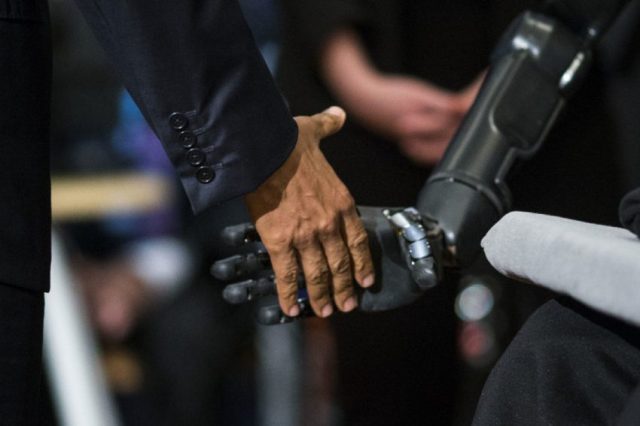
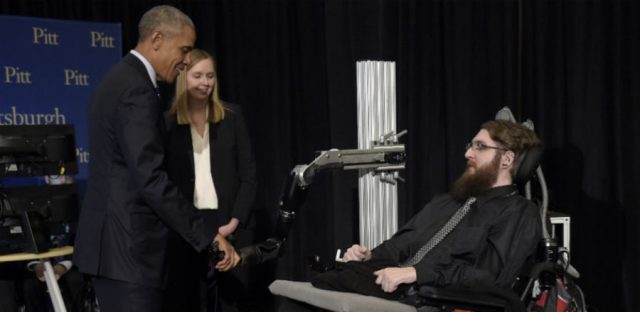
The mind-controlled robotic arm of Pennsylvania man Nathan Copeland hasn’t just gotten the sense of touch. It’s also got to shake the hand of the U.S. President himself, Barack Obama.

Copeland, 30, was part of a groundbreaking research project involving researchers from the University of Pittsburgh and the University of Pittsburgh Medical Center. In this experiment, Copeland’s brain was implanted with microscopic electrodes — a report from the Washington Post describes the tiny particles as being “smaller than a grain of sand.” With the particles implanted into the cortex of the man’s brain, they then interacted with his robotic arm. This allowed Copeland to gain some feeling in his paralyzed right hand’s fingers, as the process worked around the spinal cord damage that robbed him of the sense of touch.

More than a decade had passed since Copeland, then a college student in his teens, had suffered his injuries in a car accident. The wreck had resulted in tetraplegia, or the paralysis of both arms and legs, though it didn’t completely rob the Western Pennsylvania resident of the ability to move his shoulders. He then volunteered in 2011 for the University of Pittsburgh Medical Center project, a broader research initiative with the goal of helping paralyzed individuals feel again. The Washington Post describes this process as something “even more difficult” than helping these people move again.

For Nathan Copeland, the robotic arm experiment has proven to be a success, as he’s regained the ability to feel most of his fingers. He told the Washington Post on Wednesday that the type of feeling does differ at times, but he can “tell most of the fingers with definite precision.” Likewise, UPMC biomedical engineer Robert Gaunt told the publication that he felt “relieved” that the project allowed Copeland to feel parts of the hand that had no feeling for the past 10 years.

Prior to this experiment, mind-controlled robotic arm capabilities were already quite impressive, but lacking one key ingredient – the sense of touch. These prosthetics allowed people to move objects around, but since the individuals using the arms didn’t have working peripheral nerve systems, they couldn’t feel the sense of touch, and movements with the robotic limbs were typically mechanical in nature. But that’s not the case with Nathan Copeland, according to UPMC’s Gaunt.

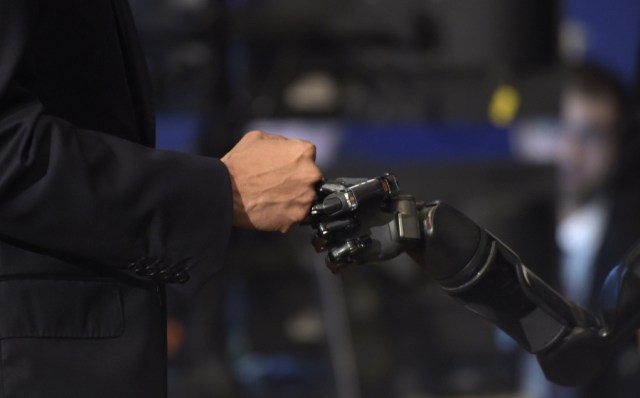
“With Nathan, he can control a prosthetic arm, do a handshake, fist bump, move objects around,” Gaunt observed. “And in this (study), he can experience sensations from his own hand. Now we want to put those two things together so that when he reaches out to grasp an object, he can feel it. … He can pick something up that’s soft and not squash it or drop it.”

But it wasn’t just ordinary handshakes that Copeland was sharing on Thursday. On that day, he had exchanged a handshake and fist bump with President Barack Obama, who was in Pittsburgh for a White House Frontiers Conference. And Obama appeared to be suitably impressed with what Gaunt and his team had achieved, as it allowed Copeland’s robotic arm and hand to have “pretty impressive” precision.

“When I’m moving the hand, it is also sending signals to Nathan so he is feeling me touching or moving his arm,” said Obama.

Unfortunately, Copeland won’t be able to go home with his specialized prosthesis. In a report from the Associated Press, he said that the experiment mainly amounts to having “done some cool stuff with some cool people.” But he nonetheless remains hopeful, as he believes that his experience with the robotic arm will mark some key advances in the quest to make paralyzed people regain their natural sense of touch.

Read more at http://www.inquisitr.com/3599638/paralyzed-mans-robotic-arm-gets-to-feel-again-shakes-obamas-hand/#xVzFDHGXukJWBV05.99

Caffeine may help protect older women from dementia

In a large group of older women, those who consumed higher amounts of caffeine had lower rates of incident dementia than those who consumed lower amounts over as many as 10 years of follow-up in a study. Researchers published their findings in The Journals of Gerontology.

“The mounting evidence of caffeine consumption as a potentially protective factor against cognitive impairment is exciting given that caffeine is also an easily modifiable dietary factor with very few contraindications,” said study lead author Ira Driscoll, PhD, a professor of psychology at the University of Wisconsin-Milwaukee. “What is unique about this study is that we had an unprecedented opportunity to examine the relationships between caffeine intake and dementia incidence in a large and well-defined, prospectively-studied cohort of women.”

The findings are based on 6467 community-dwelling women age 65 and older who self-reported their daily caffeine consumption upon enrollment in the Women’s Health Initiative Memory Study, which is funded by the National Heart, Lung, and Blood Institute.

Over up to a decade of follow-up, the women received annual assessments of cognitive function, and 388 of them were diagnosed with probable dementia or some form of cognitive impairment.

After adjusting for a number of risk factors including age, hormone therapy, sleep quality, and depression, researchers found that women who consumed above-average levels of caffeine (more than 261 mg per day) were 36% less likely to develop incident dementia. To provide perspective, the study explained that an 8-ounce cup of coffee contains 95 mg of caffeine, 8 ounces of brewed black tea contains 47 mg, and a 12-ounce can of cola contains 33 mg.

“Our findings suggest lower odds of probable dementia or cognitive impairment in older women whose caffeine consumption was above median for this group,” the researchers concluded, “and are consistent with the existing literature showing an inverse association between caffeine intake and age-related cognitive impairment.”

—Jolynn Tumolo

References

Driscoll I, Shumaker SA, Snively BM, et al. Relationships between caffeine intake and risk for probable dementia or global cognitive impairment: the Women’s Health Initiative Memory Study. The Journals of Gerontology. 2016 September 27;[Epub ahead of print].

Tech billionaires who think we’re living in a computer simulation run by an advanced civilization are secretly funding a way out

By Owen Hughes

Technology moguls convinced that we are all living in a Matrix-like simulation are secretly bankrolling efforts to help us break free of it, according to a new report. It’s alleged that two Silicon Valley billionaires are funding work by scientists on proving the simulation hypothesis, a theory backed by Space X CEO Elon Musk.

The simulation hypothesis is based on the idea that humans are not living in reality at all, and are instead a product of a simulation being run by an extremely advanced post-human civilisation. Much like in the Matrix, this simulation is so sophisticated that humans aren’t even aware they are living in it.

It seems like a far-fetched notion, but it’s one that’s held in increasing regard in the wake of recent technological leaps in computing power and artificial intelligence. According to the New Yorker, some of tech’s top minds are so convinced by this theory that they are now funding a solution – though exactly what this would look like is unclear.

“Many people in Silicon Valley have become obsessed with the simulation hypothesis, the argument that what we experience as reality is in fact fabricated in a computer,” reports the New Yorker. “Two tech billionaires have gone so far as to secretly engage scientists to work on breaking us out of the simulation.”

The comments were made by author Tad Friend within a profile piece on Sam Altman, CEO of Y Combinator. Neither of the two billionaires referenced were named, although one prominent figure to have made his views on the subject vocal is Elon Musk.

Musk has previously suggested that given the rate of progress in 3D graphics, at some point in the future, video games will be indistinguishable from reality. Thus, it would be impossible to tell if we had already advanced to that point and are now living through a simulation.

In fact, Musk believes that the chance we humans are living in the “base reality” – that is, the true reality – is “one in billions”.

“The strongest argument for us probably being in a simulation is that 40 years ago we had Pong, two rectangles and a dot,” he told a Recode conference in June. “That was what games were. Now, 40 years later, we have photorealistic 3D simulations with millions of people playing simultaneously and it’s getting better every year, and soon we’ll have virtual reality.

“So given that we’re clearly on a trajectory to have games that are indistinguishable from reality… and there would probably be billions of computers, it would seem to follow that the odds we are in base reality is one in billions.”

In the New Yorker piece, Altman also touched on the threats posed by artificial intelligence, suggesting that the human race might be able to avoid a doomsday scenario by merging itself with machines.

“Any version without a merge will have conflict: we enslave the AI or it enslaves us,” said Altman. “The full-on-crazy version of the merge is we get our brains uploaded into the cloud. We need to level up humans, because our descendants will either conquer the galaxy or extinguish consciousness in the universe forever.”

http://www.ibtimes.co.uk/take-red-pill-tech-billionaires-who-think-were-living-matrix-are-secretly-funding-way-out-1585315

What science tells us about leadership

by Tomas Chamorro-Premuzic

Although the scientific study of leadership is well established, its key discoveries are unfamiliar to most people, including an alarmingly large proportion of those in charge of evaluating and selecting leaders.

This science-practitioner gap explains our disappointing state of affairs. Leaders should drive employee engagement, yet only 30% of employees are engaged, costing the U.S. economy $550 billion a year in productivity loss. Moreover, a large global survey of employee attitudes toward management suggests that a whopping 82% of people don’t trust their boss. You only need to google “my boss is…” or “my manager is…” and see what the autocomplete text is to get a sense of what most people think of their leaders.

Unsurprisingly, over 50% of employees quit their job because of their managers. As the old saying goes, “people join companies, but quit their bosses.” And the rate of derailment, unethical incidents, and counterproductive work behaviors among leaders is so high that it is hard to be shocked by a leader’s dark side. Research indicates that 30%–60% of leaders act destructively, with an estimated cost of $1–$2.7 million for each failed senior manager.

Part of the problem is that many widely held beliefs about leadership are incongruent with the scientific evidence. As Mark Twain allegedly noted, “It ain’t what you don’t know that gets you into trouble. It’s what you know for sure that just ain’t so.” For example, it is quite common for people to believe that leadership is largely dependent on the situation, that it’s hard to predict whether someone will be a good (or bad) leader, and that any person can be a leader. In reality, some people have a much higher probability of becoming leaders, regardless of the context, and this probability can be precisely quantified with robust psychological tools.

What do we really know about the measurement of leadership potential? Here are some critical findings:

Who becomes a leader? Although leaders come in many shapes, a few personality characteristics consistently predict whether someone is likely to emerge as a leader. As the most widely cited meta-analysis in this area shows, people who are more adjusted, sociable, ambitious, and curious are much more likely to become leaders. (53% of the variability in leadership emergence is explained by these personality factors.) Unsurprisingly, higher levels of cognitive ability (IQ) also increase an individual’s likelihood to emerge as a leader, though by less than 5%. Of course, emergence doesn’t imply effectiveness, but one has to emerge in order to be effective.

What are the key qualities of effective leaders? The ultimate measure of leader effectiveness is the performance of the leader’s team or organization, particularly vis-à-vis competitors. Leadership is a resource for the group, and effective leaders enable a group to outperform other groups. While the same personality and ability traits described above help leaders become more effective — they are not just advantageous for emergence — the best leaders also show higher levels of integrity, which enables them to create a fair and just culture in their teams and organizations. In addition, effective leaders are generally more emotionally intelligent, which enables them to stay calm under pressure and have better people skills. Conversely, narcissistic leaders are more prone to behaving in unethical ways, which is likely to harm their teams.

How will the person lead? Not everyone leads in the same way. Leadership style is largely dependent on personality. Ambitious, thick-skinned leaders tend to be more entrepreneurial, so they are focused on growth and innovation. Curious, sociable, and sensitive leaders tend to be more charismatic, though charisma often reflects dark side traits, such as narcissism and psychopathy. Studies also highlight gender differences in leadership styles, with men being more transactional and women more transformational. However, gender roles are best understood as a psychological and normally distributed variable, as people differ in masculinity and femininity regardless of their biological sex.

Are leaders born or made? Any observable pattern of human behaviors is the byproduct of genetic and environmental influences, so the answer to this question is “both.” Estimates suggest that leadership is 30%-60% heritable, largely because the character traits that shape leadership — personality and intelligence — are heritable. While this suggests strong biological influences on leadership, it does not imply that nurture is trivial. Even more-heritable traits, such as weight (80%) and height (90%), are affected by environmental factors. Although there is no clear recipe for manipulating the environment in order to boost leadership potential, well-crafted coaching interventions boost critical leadership competencies by about 20%–30%.

What is the role of culture? Culture is key because it drives employee engagement and performance. However, culture isn’t the cause of leadership so much as the result of it. Thus leaders create the explicit and implicit rules of interaction for organizational members, and these rules affect morale and productivity levels. When people’s values are closely aligned with the values of the organization (and leadership), they will experience higher levels of fit and purpose.

How early can we predict potential? Any prediction is a measure of potential or the probability of something happening. Because leadership is partly dependent on genetic and early childhood experiences, predicting it from an early age is certainly possible. Whether doing so is ethical or legal is a different question. However, most of the commonly used indicators to gauge leadership potential — educational achievement, emotional intelligence, ambition, and IQ — can be predicted from a very early age, so it would be naïve to treat them as more malleable. Perhaps in the future, leadership potential will be assessed at a very early age by inspecting people’s saliva.

Does gender matter? Less than we think. The fact that so many leaders are male has much more to do with social factors (people’s expectations, cultural norms, and opportunities) than actual gender differences in leadership potential, which are virtually nonexistent. In fact, some studies have shown that women are slightly more effective as leaders on the job, but this may be because the standards for appointing women to leadership positions are higher than those for appointing men, which creates a surplus of incompetent men in leadership positions. The solution is not to get women to act more like men, but to select leaders based on their actual competence.

Why do leaders derail? We cannot ignore the wide range of undesirable and toxic outcomes associated with leadership. It is not the absence of bright side qualities, but rather their coexistence with dark side tendencies, that makes leaders derail. Indeed, as Sepp Blatter, Dominique Strauss-Kahn, and Bernie Madoff demonstrate, technical brilliance often coexists with self-destructive and other destructive traits. This is just one reason why it is so important for leadership development and executive coaching interventions to highlight leaders’ weaknesses, and help them keep their toxic tendencies in check.

Although these findings have been replicated in multiple studies, a skeptic could ask, “Now that we’re (allegedly) living in an era of unprecedented technological change, could some of these findings be outdated?”

Not really.

Leadership evolved over millions of years, enabling us to function as group-living animals. It is therefore unlikely that the core foundations of leadership will change. That said, the specific skills and qualities that enable leaders and their groups to adapt to the world are certainly somewhat context dependent. For example, just as physical strength mattered more, and intellectual ability less, in the past, it is conceivable that human differentiators such as curiosity, empathy, and creativity will become more important in a world of ever-growing technological dependence and ubiquitous artificial intelligence.

In short, the science of leadership is well established. There is no real need to advance it in order to improve real-world practices. We should focus instead on applying what we already know, and ignoring what we think we know that isn’t true.

https://hbr.org/2016/09/what-science-tells-us-about-leadership-potential

Bees Added To U.S. Endangered Species List For 1st Time

by Merrit Kennedy

The U.S. Fish and Wildlife Service has given endangered status to seven species of yellow-faced bees native to the Hawaiian islands. These are “the first bees in the country to be protected under the Endangered Species Act,” according to the Xerces Society, which advocated for the new designation.

The new rule designating protections for the bees, published Friday in the Federal Register, states that yellow-faced bees are known “for their yellow-to-white facial markings.” They look like small wasps, according to the rule, except for their “plumose [branched] hairs on the body that are longest on the sides of the thorax, which readily distinguish them from wasps.”

The yellow-faced bee is the only bee native to Hawaii, meaning that it was able to reach the Hawaiian Islands on its own, according to a fact sheet provided by the University of Hawaii’s Master Gardner Program. “From that one original colonist they evolved into 63 known endemic species, about 10% of the world’s yellow-faced bees and more than are found in this genus in all of North America.”

But the populations of these seven species are getting smaller and smaller, according to Fish and Wildlife. For example, the Hylaeus anthracinus was once found in dozens of locations around Hawaii but is now in only 15 — while Hylaeus hilaris and Hylaeus kuakea are each found only in one location.

The seven endangered species are impacted by a wide variety of threats, including habitat destruction because of urbanization or nonnative animals, the introduction of nonnative plant species, wildfires, nonnative predators and natural events such as hurricanes, tsunamis and drought.

The protected status “will allow authorities to implement recovery programs, access funding and limit their harm from outside sources,” as Gregory Koob of the Fish and Wildlife Service told The Associated Press. He added that “all federal agencies must consult with the Fish and Wildlife Service when interacting with endangered species.”

The Xerces Society called the new rule “excellent news” but added that “there is much work that needs to be done to ensure that Hawaii’s bees thrive.”

“These bees are often found in small patches of habitat hemmed in by agricultural land or developments,” the group said. “Unfortunately, the [Fish and Wildlife Service] has not designated any ‘critical habitat’ areas of land of particular importance for the endangered bees.”

As we’ve reported, pollinators are under threat around the world. A U.N.-sponsored report released in February found that “about 40 percent of invertebrate pollinator species (such as bees and butterflies) are facing extinction.” This could have major implications for world food supply, because “about 75 percent of the world’s food crops … depend at least partly on pollination.”

Despite the threats, the University of Hawaii says these bees “have managed to persist with amazing tenacity.” While this group of species is now endangered, new species of the genus are discovered regularly — “11 new native species have been found in the past 15 years.”

The rule, which goes into effect at the end of the month, also gives the endangered designation to 39 plant species found on the islands and to three other animals native to Hawaii — the band-rumped storm-petrel, the orangeblack Hawaiian damselfly, and the anchialine pool shrimp.

The anchialine pool shrimp is known for its unusual longevity — according to the Hawaii Nature Journal, the shrimp can live for 10 to 15 years in the wild.

http://www.npr.org/sections/thetwo-way/2016/10/03/496402620/bee-species-added-to-u-s-endangered-species-list-for-1st-time

‘Hangover-free alcohol’ could replace all regular alcohol by 2050, says David Nutt

Professor David Nutt. Neuropsychopharmacology.

by Katie Forster

A new type of synthetic alcohol has been discovered which could allow people to enjoy the sociable effects of a few pints, but skip the hangover that usually follows.

The new drink, known as ‘alcosynth’, is designed to mimic the positive effects of alcohol but doesn’t cause a dry mouth, nausea and a throbbing head, according to its creator Professor David Nutt.

The Imperial College Professor and former government drugs advisor told The Independent he has patented around 90 different alcosynth compounds.

Two of them are now being rigorously tested for widespread use, he said – and by 2050, he hopes alcosynth could completely replace normal alcohol.

“It will be there alongside the scotch and the gin, they’ll dispense the alcosynth into your cocktail and then you’ll have the pleasure without damaging your liver and your heart,” he said.

“They go very nicely into mojitos. They even go into something as clear as a Tom Collins. One is pretty tasteless, the other has a bitter taste.”

By researching substances that work on the brain in a similar way to alcohol, Professor Nutt and his team have been able to design a drug which they say is non-toxic and replicates the positive effects of alcohol.

“We know a lot about the brain science of alcohol; it’s become very well understood in the last 30 years,” said Professor Nutt.

“So we know where the good effects of alcohol are mediated in the brain, and can mimic them. And by not touching the bad areas, we don’t have the bad effects.”

Advocates of alcosynth believe it could revolutionise public health by relieving the burden of alcohol on the health service.

According to Alcohol Concern, drinking is the third biggest risk factor for disease and death in the UK, after smoking and obesity.

“People want healthier drinks,” said Professor Nutt. “The drinks industry knows that by 2050 alcohol will be gone.”

“They know that and have been planning for this for at least 10 years. But they don’t want to rush into it, because they’re making so much money from conventional alcohol.”

Early experiments into alcosynth, such as those reported on by BBC’s Horizon in 2011, used a derivative of benzodiazepine – the same class of drugs as Valium.

Mr Nutt said his new drinks did not contain benzodiazepine, and their formulas would remain a closely guarded, patented secret.

However, the huge cost of funding research into the drug and regulatory concerns mean it could be a long time before people can order an alcosynth cocktail at their local pub.

Professor Nutt, who was sacked from his position as the government drugs tsar in 2009 after he claimed taking ecstasy was less dangerous than riding a horse, said he was unsure if the use of synthetic alcohol would be restricted by the new Psychoactive Substances Act, which came into force in May.

“It’s an interesting idea, but too much in its infancy at the moment for us to comment on,” a Department of Health spokesperson told The Independent.

“I don’t think we’d give money to it until it was a little further along,” said the spokesperson. “If [Professor Nutt] were to apply for funding, it would go through the process of everything else and would be judged on its merits.”

“It would be great for producing better workforce efficiency if no one was hungover,” they added.

According to Professor Nutt, the effects of alcosynth last around a couple of hours – the same as traditional alcohol.

He said he and his team have also managed to limit the effects of drinking a lot of alcosynth, so in theory it would be impossible to ever feel too ‘drunk’.

“We think the effects round out at about four or five ‘drinks’, then the effect would max out,” he said.

“We haven’t tested it to destruction yet, but it’s safer than drinking too much alcohol. With clever pharmacology, you can limit and put a ceiling on the effects, so you can’t ever get as ill or kill yourself, unlike with drinking a lot of vodka.”

Researcher Guy Bentley worked with Professor Nutt on a new report by the liberal think tank the Adam Smith Institute into alcosynth regulation.

Mr Bentley told The Independent he hoped to persuade the government to accept the drug as a way of reducing the harm caused by alcohol.

“[The report] is trying to spark what happened with e-cigarettes and tobacco, but with alcohol,” he said. “Professor Nutt has been experimenting on this for a long time, but I thought to myself – ‘where is it?’ I wanted my hangover-free booze.”

However, not everyone was as keen on the new discovery.

Neil Williams, from the British Beer and Pub Association, said alcosynth was not necessary, as “there are other ways of avoiding a hangover”.

“There are plenty of low-strength drinks, particularly beers,” he told The Independent. “We should all drink in moderation so we shouldn’t need to have a hangover anyway.”

“I’d want to know more about it before I tried it myself,” he said.

http://www.independent.co.uk/life-style/health-and-families/health-news/hangover-free-alcohol-david-nutt-alcosynth-nhs-postive-effects-benzodiazepine-guy-bentley-a7324076.html?cmpid=facebook-post