Coyotes and badgers hunt together

by Russell McLendon

Competition and cooperation aren’t mutually exclusive. Just ask a coyote or a badger.

Both are crafty carnivores, and since they often hunt the same prey in the same prairies, it would make sense for them to be enemies, or at least to avoid each other. But while they don’t always get along, coyotes and badgers also have an ancient arrangement that illustrates why it can be smart for rivals to work together.

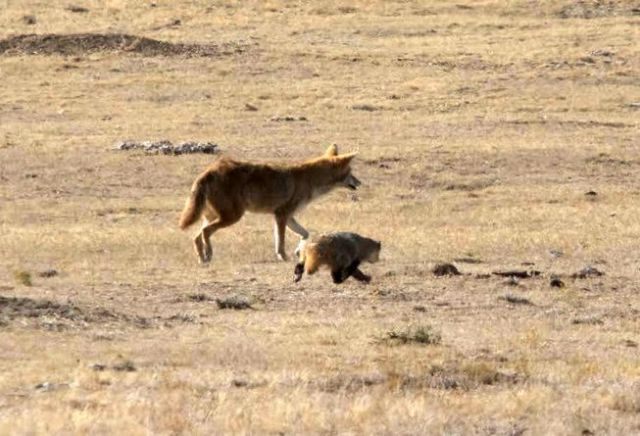
An example of that partnership recently unfolded on a prairie in northern Colorado, near the National Black-footed Ferret Conservation Center. And it was captured in photos, both by a wildlife camera trap and by sharp-eyed photographers:

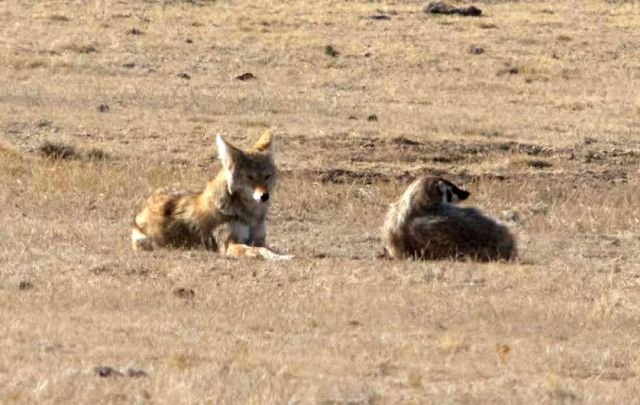
While it’s relatively rare to capture such good photos of a hunt like this, the phenomenon is well-documented. It was familiar to many Native Americans long before Europeans reached the continent, and scientists have studied it for decades. It has been reported across much of Canada, the United States and Mexico, according to Ecology Online, typically with one badger hunting alongside one coyote.

(In one study at the National Elk Refuge in Wyoming, 90 percent of all coyote-badger hunts featured one of each animal, while about 9 percent involved one badger with two coyotes. Just 1 percent saw a lone badger join a coyote trio.)

But why would these predators work together at all? When one of them finally catches something, they aren’t known to share the spoils. So what’s the point?

The point, apparently, is to improve the likelihood that at least one of the hunters will snag some prey. Even if that means the other one ends up empty-handed, the partnership seems to pay off for both species in the long run.

Each member of the hunting party has a distinct set of skills. Coyotes are nimble and quick, so they excel at chasing prey across an open prairie. Badgers are slow and awkward runners by comparison, but they’re better diggers than coyotes are, having evolved to pursue small animals in underground burrow systems. So when they hunt prairie dogs or ground squirrels on their own, badgers usually dig them up, while coyotes chase and pounce. The rodents therefore use different strategies depending which predator is after them: They often escape a digging badger by leaving their burrows to flee aboveground, and evade coyotes by running to their burrows.

When badgers and coyotes work together, however, they combine these skills to hunt more effectively than either could alone. Coyotes chase prey on the surface, while badgers take the baton for subterranean pursuits. Only one may end up with a meal, but overall, research suggests the collaboration makes both predators better at their jobs. If you’re a prairie dog trying to escape this dynamic duo, good luck.

“Coyotes with badgers consumed prey at higher rates and had an expanded habitat base and lower locomotion costs,” according to the authors of the National Elk Refuge study. “Badgers with coyotes spent more time below ground and active, and probably had decreased locomotion and excavation costs. Overall, prey vulnerability appeared to increase when both carnivores hunted in partnership.”

Badgers and coyotes aren’t always friendly, though. While the majority of their interactions “appear to be mutually beneficial or neutral,” Ecology Online notes they do sometimes prey on each other. The two species have developed “a sort of open relationship,” according to the U.S. Fish and Wildlife Service (FWS), since they tend to collaborate in warmer months, then often drift apart as winter sets in.

“In the winter, the badger can dig up hibernating prey as it sleeps in its burrow,” the FWS explains. “It has no need for the fleet-footed coyote.”

Not at the time, anyway. But winter eventually turns to spring, and these two hunters may start to need each other again. And just as they have for thousands of years, they’ll make peace, embrace their differences and get back to work.

http://www.mnn.com/earth-matters/animals/blogs/coyote-and-badger-hunt-together

Tesla solar roofing

by Matt Hickman

When Tesla, the Silicon Valley automaker and energy storage firm founded by billionaire and Mars colonization enthusiast Elon Musk, unveiled its gorgeous solar roofing system back in October, it was assumed that said shingles would be significantly spendier than conventional roofing — you know, roofing that isn’t capable of transforming free and abundant sunshine into a form of home-powering renewable energy.

After all, why would a roof that’s more durable, longer-lasting and flat-out sexier also be comparable in price — or, gasp, even more affordable — than a traditional asphalt roof?

Weeks later, Musk, a clean tech entrepreneur never without a few surprises up his sleeve, is claiming that Tesla’s sleek solar roofing option will indeed be the cheaper option even before the annual energy savings associated with having an electricity-producing roof kick in.

Made from tempered glass, Tesla’s low-cost solar roofing shingles are slated for a widespread rollout at the end of 2017.

Musk made the potentially too-good-to-be-true claim directly following last week’s announcement that Tesla shareholders had voted to merge with SolarCity, the residential solar behemoth founded by Musk’s cousin Lyndon Rive. (Musk himself serves as chairman of SolarCity, which will now operate as a wholly owned subsidiary of Tesla).

As noted by Bloomberg, the $2 billion acquisition aims to position Tesla, primarily known to most consumers as a manufacturer of beautiful yet prohibitively pricey electric sports cars and sedans, as “one-stop shopping for consumers eager to become independent of fossil fuels.” In the near future, Tesla showrooms won’t just be places to buy and/or ogle high-end EVs. They’ll also be places where consumers can peruse solar roofing options that will help to power their homes and, of course, that Tesla Model S parked in the garage.

Noting that the tiles’ electricity-producing capabilities are “just a bonus,” Musk goes on to pose the question: “So the basic proposition will be: Would you like a roof that looks better than a normal roof, lasts twice as long, costs less and — by the way — generates electricity? Why would you get anything else?”

To be available in a quartet of styles — Slate, Tuscan, Textured Glass and Smooth Glass — that closely mimic not-so-cheap premium roofing materials, Tesla’s solar shingles are a boon for consumers who have long balked at the thought of installing rooftop solar for aesthetic reasons. (Read: big black patches that invoke the ire of the neighbors). Tesla’s shingles look just like the real deal — even nicer. “The key is to make solar look good,” said Musk during last month’s public debut of Tesla’s solar shingles, which you can watch below in its entirety. “We want you to call your neighbors over and say, ‘Check out this sweet roof.’” You can hear his pitch in more detail in the video below:

As reported by Bloomberg, while Tesla’s inoffensive-looking solar shingles are indeed considered a premium product when compared to non-solar shingles, significant savings kick in when considering the cost of shipping. Traditional roofing tiles are heavy and awkward and, as a result, cost an arm and a leg to transport. They’re also super-fragile and have a high rate of breakage. Tesla’s engineered glass shingles, on the other hand, are durable, lightweight (as much as five times lighter than conventional roofing materials) and easy to ship. The significant cost-savings associated with decreased shipping costs, as anticipated by Musk, will be passed on to consumers.

While there are skeptics who doubt that the savings gained in decreased shipping costs will render Tesla’s solar singles the most affordable option for upfront cost-focused consumers, others are embracing Musk’s claims as a potential game-changer that could potentially usher in the end of “dumb” roofing as we know it.

http://www.mnn.com/earth-matters/energy/blogs/will-tesla-solar-roofing-be-cheaper-normal-roofing

Google’s AI translation tool seems to have invented its own secret internal language

Google AI computers have created their own secret language, creating a fascinating and existentially challenging development.

In September, Google announced that its Neural Machine Translation system had gone live. It uses deep learning to produce better, more natural translations between languages.

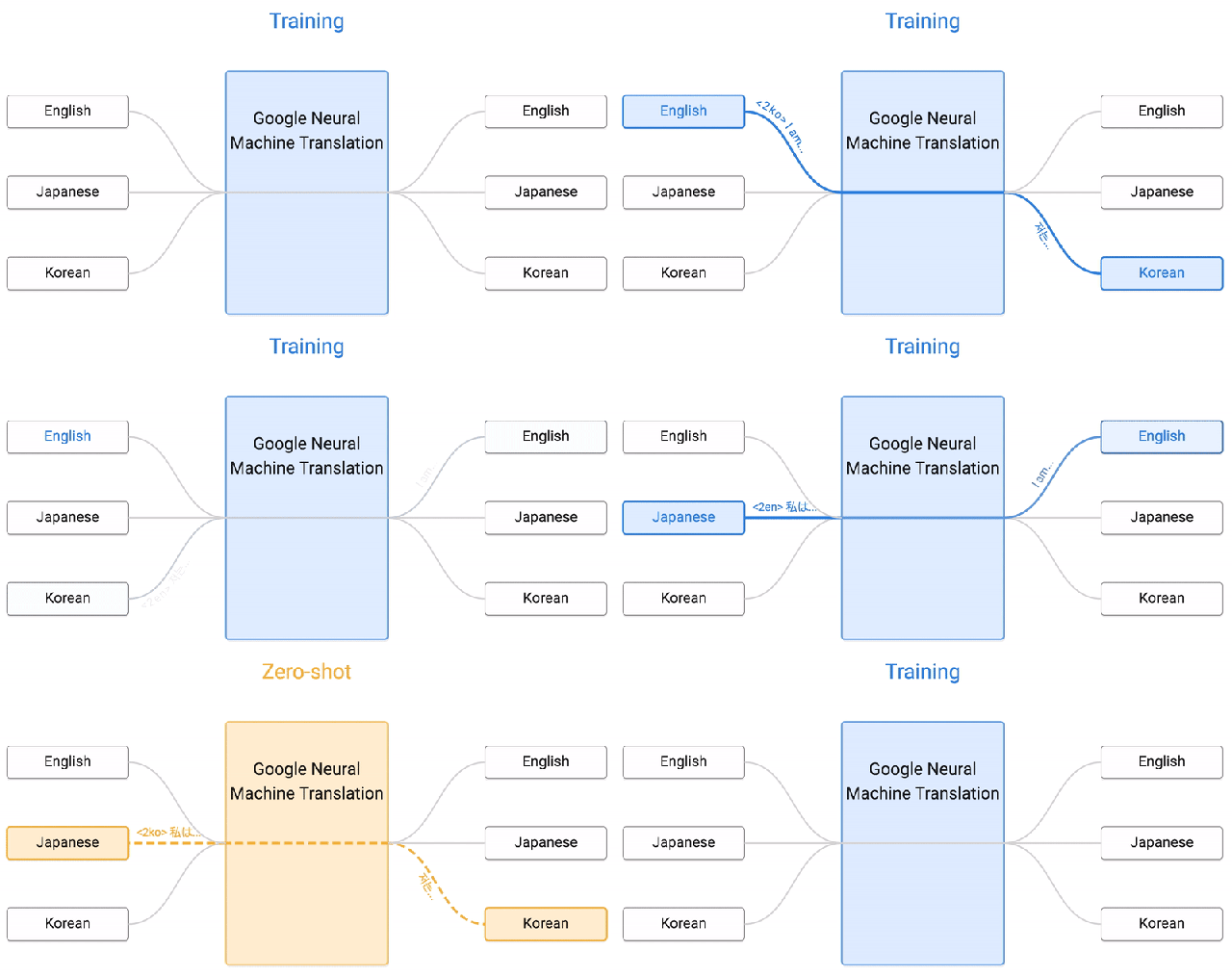
Following on this success, GNMT’s creators were curious about something. If you teach the translation system to translate English to Korean and vice versa, and also English to Japanese and vice versa… could it translate Korean to Japanese, without resorting to English as a bridge between them?

This is called zero-shot translation, illustrated below.

Indeed, Google’s AI has evolves to produce reasonable translations between two languages that it has not explicitly linked in any way.

But this raised a second question. If the computer is able to make connections between concepts and words that have not been formally linked… does that mean that the computer has formed a concept of shared meaning for those words, meaning at a deeper level than simply that one word or phrase is the equivalent of another?

n other words, has the computer developed its own internal language to represent the concepts it uses to translate between other languages? Based on how various sentences are related to one another in the memory space of the neural network, Google’s language and AI boffins think that it has.

This “interlingua” seems to exist as a deeper level of representation that sees similarities between a sentence or word in all three languages. Beyond that, it’s hard to say, since the inner processes of complex neural networks are infamously difficult to describe.

It could be something sophisticated, or it could be something simple. But the fact that it exists at all — an original creation of the system’s own to aid in its understanding of concepts it has not been trained to understand — is, philosophically speaking, pretty powerful stuff.

Google’s AI translation tool seems to have invented its own secret internal language

Thanks to Kebmodee for bringing this to the attention of the It’s Interesting community.

Computer Algorithms Accurately Identify Suicidal Patients


by Jolynn Tumolo

By analyzing a patient’s spoken and written words, computer tools classified with up to 93% accuracy whether the person was suicidal, in a study published online in Suicide and Life-Threatening Behavior.

“While basic sciences provide the opportunity to understand biological markers related to suicide,” researchers wrote, “computer science provides opportunities to understand suicide thought markers.”

The study included 379 patients from emergency departments, inpatient centers, and outpatient centers at 3 sites. Researchers classified 130 of the patients as suicidal, 126 as mentally ill but not suicidal, and 123 as controls with neither mental illness nor suicidality.

Patients completed standardized behavioral rating scales and participated in semi-structured interviews. Five open-ended questions were used to stimulate conversation, including “Do you have hope?” “Are you angry?” and “Does it hurt emotionally?”

Using machine learning algorithms to analyze linguistic and acoustic characteristics in patients’ responses, computers were 93% accurate in classifying a person who was suicidal and 85% accurate in identifying whether a person was suicidal, had a mental illness but was not suicidal, or was neither.

“These computational approaches provide novel opportunities to apply technological innovations in suicide care and prevention, and it surely is needed,” said study lead author John Pestian, PhD, a professor in the divisions of biomedical informatics and psychiatry at Cincinnati Children’s Hospital Medical Center in Ohio.

“When you look around health care facilities, you see tremendous support from technology, but not so much for those who care for mental illness. Only now are our algorithms capable of supporting those caregivers. This methodology easily can be extended to schools, shelters, youth clubs, juvenile justice centers, and community centers, where earlier identification may help to reduce suicide attempts and deaths.”

References

Pestian JP, Sorter M, Connolly B, et al. A machine learning approach to identifying the thought markers of suicidal subjects: a prospective multicenter trial. Suicide and Life-Threatening Behavior. 2016 November 3;[Epub ahead of print].

Using a patient’s own words machine learning automatically identifies suicidal behavior [press release]. Cincinnati, OH: Cincinnati Children’s Hospital Medical Center; November 7, 2016.

This island is powered entirely by solar panels and batteries thanks to SolarCity


Ta’u Island’s residents live off a solar power and battery storage-enabled microgrid.

by Amelia Heathman

SolarCity was applauded when it announced its plans for solar roofs earlier this year. Now, it appears it is in the business of creating solar islands.

The island of Ta’u in American Samoa, more than 4,000 miles from the United States’ West Coast, now hosts a solar power and battery storage-enabled microgrid that can supply nearly 100 per cent of the island’s power needs from renewable energy.

The microgrid is made up of 1.4 megawatts of solar generation capacity from SolarCity and Tesla and six-megawatt hours of battery storage from 60 Tesla Powerpacks. The whole thing took just a year to implement.

Due to the remote nature of the island, its citizens were used to constant power rationing, outages and a high dependency on diesel generators. The installation of the microgrid, however, provides a cost-saving alternative to diesel, and the island’s core services such as the local hospital, schools and police stations don’t have to worry about outages or rationing anymore.

“It’s always sunny out here, and harvesting that energy from the sun will make me sleep a lot more comfortably at night, just knowing I’ll be able to serve my customers,” said Keith Ahsoon, a local resident whose family owns one of the food stores on the island.

The power from the new Ta’u microgrid provides energy independence for the nearly 600 residents of the island. The battery system also allows the residents to use stored solar energy at night, meaning energy will always be available. As well as providing energy, the project will allow the island to significantly save on energy costs and offset the use of more than 109,500 gallons of diesel per year.

With concerns over climate change and the effects the heavy use of fossil fuels are having on the planet, more initiatives are taking off to prove the power of solar energy, whether it is SolarCity fueling an entire island or Bertrand Piccard’s Solar Impulse plane flying around the world on only solar energy.

Obviously Ta’u island’s location off the West Coast means it is in a prime location to harness the Sun’s energy, which wouldn’t necessarily work in the UK. Having said that, this is an exciting way to show where the future of solar energy could take us if it was amplified on a larger scale.

The project was funded by the American Samoa Economic Development Authority, the Environmental Protection Agency and the Department of Interior, whilst the microgrid is operated by the American Samoa Power Authority.

http://www.wired.co.uk/article/island-tau-solar-energy-solarcity

Thanks to Kebmodee for bringing this to the attention of the It’s Interesting community.

The ‘Shazam’ For Plants Will Identify Any Plant From A Picture

by Alanna Ketler

An estimated 400,000 flowering plant species exist in the world, and, understandably, it can be difficult to keep track. The vast majority of us can only recognize and name a handful of plants, even if we would like it to be otherwise. If you would like to sharpen your knowledge in the wonderful realm of plant species, I have some good news for you. Like everything else: there’s an app for that.

If you ever walk by a specific plant that you would like to identify, or you have extensive knowledge about plant species that you would like to share, then the PlantNet app is for you. Available for iPhone and Android devices, it is essentially the Shazam for plants. It’s pretty awesome to consider what technology is capable of these days.

The app works by collecting data from a large social network which uploads pictures and information about plants. Scientists from four French research organizations including Cirad, IRA, Inria/IRD, and the Tela Botanica Network developed the app.

The app features visualization software which recognizes many plant species, provided they have been illustrated well enough in the botanical reference base. PlantNet currently works on more than 4,100 species of wild flora of the French territory, and the species list is provided through the application. The number of species included and images used by the application grows as more users contribute.

While only a small percentage of plant species can be identified so far, the more users who join, and the more participants from different countries become involved, the more diverse this app will become. So if this is something that interests you, get the app and start contributing today.

While at the moment it doesn’t focus on edibles, this app lays the frame work for herb collecting and identifying plants in nature that could either be dangerous to you or that you would love to learn more about. The average person these days is enjoying a greater appreciation for nature this app can help them outfit their home and living space with plants they love.

In the future, an edible database could help foragers pick from the wild spread nature has to offer. Not only are wild sources of plants and herbs cleaner and free of pesticides, but they also can be picked fresher and be more nutritious.

At the same time, this app is inevitably going to get people out in nature more as now they can walk about trails and nature with a keen curiosity to learn more about what’s around them.

http://www.collective-evolution.com/2016/03/10/the-shazam-for-plants-will-identify-any-plant-from-a-picture/

Pedestrian hit by flying deer in Tennessee

A pedestrian was hit by a deer that was hit by a car on Providence Boulevard Thursday evening in Clarksville, Tennessee. At about 5 p.m., a car hit a deer on the road near downtown, according to Clarksville Police spokeswoman Officer Natalie Hall.

“The deer flew off the car and hit a pedestrian,” Hall said.

The pedestrian had broken bones and was taken to Tennova Healthcare for treatment.

“This is not a type of crash that happens often,” Hall said.

http://www.theleafchronicle.com/story/news/local/clarksville/2016/11/18/pedestrian-hit-deer-hit-car-clarksville/94064382/

How to make phosphorus by doing disgusting things with urine

by Esther Inglis-Arkell

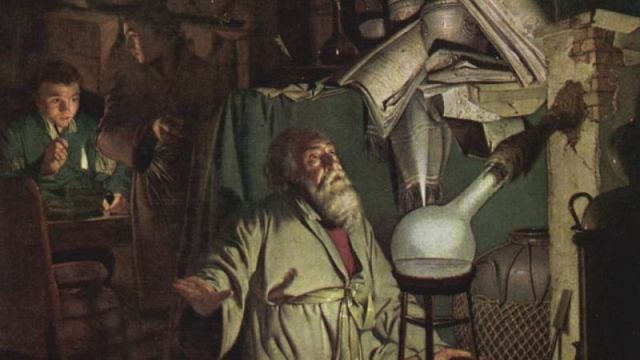
Hennig Brand discovered the element of phosphorus in 1669. That sounds like quite an achievement, but Brand’s life wasn’t one that should, necessarily, be emulated. His steps to discovering this element were undignified, to say the least. His first step was marrying well; he was an officer in the army, but his wife had enough money for him to leave. She didn’t have enough money overall — at least not according to Brand — and so he used what money she had to try to make more money.

Sadly, his chosen path for this increase in wealth was alchemy. He wanted to come up with the philosopher’s stone, which turned everyday elements into gold. At that stage, the science generally meant doing weird and dangerous things to any substance scientists could get their hands on. It wasn’t cheap, and Brand burned through all of his wife’s money. She didn’t have to live in poverty only because she was born in the 1600s, and so died young. Brand mourned for a time, and then went in search of another financially secure wife. Surprisingly, he got one.

As soon as he got his hands on her money, he started his experiments again. Alchemists tried anything, but they generally fixated on certain substances. Terribly rare and precious elements were popular, but so were human fluids. Humans were alchemical factories, turning ordinary substances like meat and grain into all kinds of things. The easiest thing to be got from the body was urine, and Brand, somehow, acquired a lot of it. About 1500 gallons of urine went into his experiment, but it paid off. After a complicated process of boiling and separating and recombining, he utterly failed to come up with gold. He did, however, come up with something he called “cold fire.” It glowed, perpetually, in the dark. It was what we now call phosphorus.

Although no direct use was found for cold fire in Brand’s life, people were fascinated with it. Brand capitalized on that — probably to his wife’s great relief. He sold the secret to anyone who would pay enough, including Wilhelm Leibniz, the inventor of calculus. The buyers sold the secret to others, but it remained valuable and well-kept until 1737, when someone sold it to the Academy of Science in Paris and it was published.

How do you get phosphorus from urine? Boil the urine until it’s a “syrup.” Heat the syrup until a red oil comes out of it. Grab that oil! Let the rest cool. The substance will cool into two parts, a black upper part and a grainy lower part. Scrape off the lower part and throw it away. Mix the oil back into the black upper part. Heat that for about 16 hours. The oil will come back out, followed by phosphorus fumes. Channel the phosphorus into water to cool it down. Voila.

Neanderthals Built Mysterious Stone Circles


Rings of stalagmites found in a cave in France suggest that our ancient relatives were surprisingly skilled builders.

By Nadia Drake

Once illuminated by the flickering fires of prehistoric builders, an array of mysterious stone circles hid in darkness for millennia, tucked into the recesses of a cave in France. Now, these ancient structures are again emerging from the shadows.

The strange rings are crafted from stalagmites and are roughly 176,000 years old, scientists reported in Nature. And if the rings were built by a bipedal species, as archaeologists suspect, then they could only be the work of Neanderthals, ancient human relatives that are proving to be much more “human” than anticipated.

“This discovery provides clear evidence that Neanderthals had fully human capabilities in the planning and the construction of ‘stone’ structures, and that some of them penetrated deep into caves, where artificial lighting would have been essential,” says paleoanthropologist Chris Stringer of the Natural History Museum in London.

However, why Neanderthals ventured deep into the darkness and constructed such elaborate structures is an enigma, at least for now.

Sealed since the Pleistocene, Bruniquel Cave is located in southwest France, in a region littered with decorated caves and other Paleolithic sites. In 1990, spelunkers excavated its entrance and squeezed through, finding signs of long-vanished cave bears and other extinct megafauna just inside.

But the cave’s real treasure lay in a damp chamber more than 1,000 feet (330 meters) from the entrance. There, several large, layered ring-like structures protruded from the cave floor, the seemingly unmistakable craftwork of builders with a purpose.

“All visitors have noticed the presence of these structures, from the first speleologists,” says Jacques Jaubert of the University of Bordeaux, a coauthor of the study describing the finding.

It would take decades for scientists to begin deciphering the enigmatic circles, an endeavor slowed by restricted access to the cave and the untimely death of the archaeologist who began work on the site in the 1990s.

In 2013, Jaubert and his team were finally able to bring Bruniquel’s secrets into the light.

“The cave was very well preserved, with very few visits, almost none,” he says, noting that the site is on private property and is regulated by the French government. “The structures are spectacular and have virtually no equivalent for that period, and even for more recent periods.”

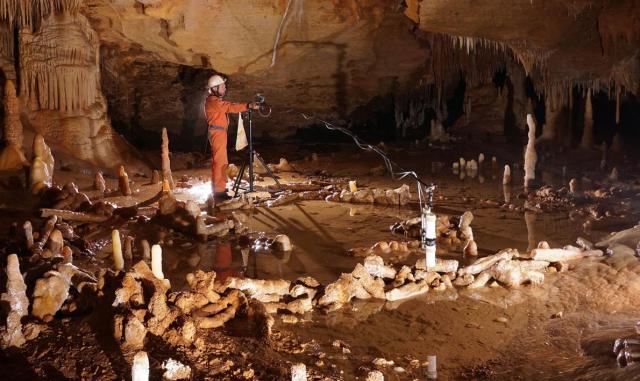
The mysterious structures are built from nearly 400 stalagmites—the cone-shaped rock formations that rise from cave floors as dripping, mineral-rich water accumulates over time.

Hewn to roughly the same length, some of the stalagmites were crafted into a large circular structure measuring nearly 22 feet (6.7 meters) across. Others were aligned in a smaller semicircle, and the rest were stacked in heaps.

Cracked areas of red and black discoloration indicate that fires had been lit atop the stalagmites, and charred bits of bone, including the burnt bone of a bear or large herbivore, were found near the smaller circle.


A 3D reconstruction of the structures in Bruniquel Cave.

Even to a trained eye, the scene looked like it could be the work of early modern humans, who first appeared in Europe about 40,000 years ago. But uranium dating of the stalagmites, as well as dates for a mineral cloak that had grown over them and the bone bits, revealed an age the team didn’t expect.

At around 176,000 years old, the structures vastly predate the arrival of Homo sapiens, not just by a smidge, but by more than 100,000 years.

“These must have been made by early Neanderthals, the only known human inhabitants of Europe at this time.” Stringer says.

Neanderthals thrived for 300,000 years, coexisting with and occasionally breeding with modern humans. Like us, they were big-brained and clever, with a mastery of fire. But scientists argue about how similar the two species really were, and debate whether Neanderthals were capable of symbolic thought and ritual behaviors.

Unlike us, Neanderthals didn’t survive, and the reasons why they vanished from the landscape some 30,000 to 40,000 years ago are still a source of contention.

Until now, anthropologists had thought it unlikely that Neanderthals had mastered the art of subterranean living, which is a bit trickier than traipsing around above ground. The Bruniquel cave could prove otherwise.

“The find is solid, and it is an important documentation of the advanced behaviors of the Neanderthals,” says paleoanthropologist Erik Trinkaus of Washington University in St. Louis.

To craft those enormous stone rings, Jaubert and his colleagues argue, the cave’s occupants needed a reliable source of illumination, some kind of social organization, and the ability to conceive of and construct the patterns, which are made from more than two tons of stalagmites.

“This requires the mobilization of people who choose, who lead, who advise, manufacture—and with continuous light,” he says. “All this indicates a structured society.”

That’s one interpretation, but some scientists say it’s too soon to draw these kinds of conclusions about the site. To begin with, it’s not yet clear how widespread such complex behavior may have been among Neanderthals, or if the structures were built by one person or many.

“We don’t know how many people were involved, if the structures were done in one event or during several events, by one person or by several,” says anthropologist Marie Soressi of Leiden University. “I don’t know what to expect, because such a discovery is very unusual.”

Other scientists question the presumed human origin for the structures and instead suggest they could be the work of hibernating cave bears.

“Who in their right minds builds structures 300 meters underground inside of a cave? Seeking refuge in a cave is a way of avoiding having to make an artificial structure,” says paleoanthropologist John Shea of Stony Brook University. “When bears settle in for the winter hibernation, they push all kinds of litter to the side. This looks like a place where cave bears settled in for a nice nap over and over through time.”

But bear dens are generally smaller than the largest ring, Soressi says, and the animals don’t stack stalagmites so much as excavate hollows and brush things aside. Plus, Jaubert notes, “bears do not make fire.”

If the structures are indeed the work of Neanderthals and not cave bears, their purpose is still a mystery. No one knows what the Neanderthals might have been doing in that cave, or how long they used it. Jaubert and his colleagues refuse to speculate about the structures’ purpose until further work at the site tells more of the story.

In the meantime, it’s hard to resist wondering what our ancient relatives were doing deep inside that cavern, with their fire-lit rings of stone.

“The complex Bruniquel structures are well-dated to within a long cold glacial stage, and at that time the cave might have provided a temporary, more temperate refuge,” Stringer says.

“If there is still-buried debris from occupation, it would help us to determine whether this was a functional refuge or shelter, perhaps roofed using wood and skins, or something which had more symbolic or ritual significance.”

http://news.nationalgeographic.com/2016/05/neanderthals-caves-rings-building-france-archaeology/

Lying feels bad at first but our brains soon adapt to deceiving

By Jessica Hamzelou

Lies have a tendency to snowball, because the more we lie, the more our brains become desensitised to the act of lying. Could this discovery help prevent dishonesty spiralling out of control? It isn’t difficult to think of someone who has ended up in a tangled web of their own lies. In many cases, the lies start small, but escalate.

Tali Sharot at University College London and her colleagues wondered if a person’s brain might get desensitised to lying, in the same way we get used to the horror of a violent image if we see it enough times. Most people feel guilty when they intentionally deceive someone else, but could this feeling ebb away with practice?

To find out, Sharot and her colleagues set up an experiment that encouraged volunteers to lie. In the task, each person was shown jars of pennies, full to varying degrees. While in a brain scanner, each person had to send their estimate to a partner in another room.

The partner was only shown a blurry low-resolution image of the jar, and so relied on the volunteer’s estimate. In some rounds, a correct answer would mean a financial reward for both the volunteer and their partner. But in others, the volunteer was told that a wrong answer from the partner would result in a higher reward for them, but a lower reward for their partner – and the more incorrect the answer, the greater the personal reward. In other rounds, incorrect answers benefited the partner, but not the volunteer.

Sharot found that her volunteers seemed happy to lie if it meant that their partner would benefit. On each of these rounds, the volunteer lied to the same degree. But when it came to self-serving lies, the volunteer’s dishonesty escalated over time – each lie was greater than the one before. For example, a person might start with a lie that earned them £1, but end up telling untruths worth £8.

Brain scans showed that the first lie was associated with a burst of activity in the amygdalae, areas involved in emotional responses. But this activity lessened as the lies progressed. The effect was so strong that the team could use a person’s amygdala activity while they were lying to predict how big their next lie would be.

“When you lie or cheat for your own benefit, it makes you feel bad,” says Sophie van der Zee at the Free University of Amsterdam in the Netherlands. “But when you keep doing it, that feeling goes away, so you’re more likely to do it again.”

“This highlights the danger of engaging in small acts of dishonesty,” says Sharot. Frequent liars are also likely to be better at lying, and harder to catch out, she says. That’s because the amygdala is responsible for general emotional arousal, and all the clues we would normally look for in a liar, such as nervous sweating.

Sharot hopes that her research will help us avoid the spiralling of lies. “If you can understand the mechanism, you might be able to nudge people away from dishonesty,” she says.

One way could be by playing on a person’s emotions to boost the level of activity in the amygdala, says Sharot. “For example, if a government wants people to pay their taxes, they might want to make an emotional case for doing so,” she says.

Van der Zee is working with insurance companies to encourage their customers to file honest claims. In her own research, she has found that people are more likely to lie if they feel they have been rejected, so she is working on ways to reduce the number of failed claims. She has also found that people are more likely to fill in claims forms honestly if they sign their name at the top of the page, before they start filling it in, rather than at the end.

Journal reference: Nature Neuroscience, DOI: 10.1038/nn.4426

https://www.newscientist.com/article/2110130-lying-feels-bad-at-first-but-our-brains-soon-adapt-to-deceiving/