Scientists discover a new human organ – the insterstitium


A newfound organ, the interstitium, resides beneath the top layer of skin, and in tissue layers lining the gut, lungs, blood vessels, and muscles. The organ is a body-wide network of interconnected, fluid-filled compartments supported by a meshwork of strong, flexible proteins.

Using a new way of visualising anatomy, scientists have just discovered a vast new structure in the human body that could be considered an organ in its own right.

The finding, published in the journal Scientific Reports, has important implications for our understanding of how all organs and tissues function, and could reveal previously unknown mechanisms driving diseases such as fibrosis and cancer.

But how could something so significant have gone unnoticed all this time?

It was well known that a layer of tissue lies just below the surface of the skin, and also lines the lungs, the digestive and urinary tracts, and much of the circulatory system. But it was thought this comprised little more than dense, connective tissue.

The new research reveals that it is actually a vast, interconnected system of fluid-filled compartments that extends all over the body.

That contents is extra-cellular, or “interstitial”, fluid. Accordingly, the structure has been dubbed “the interstitium”.

Until now, the interstitium had been hidden in plain sight because the traditional method of preparing microscope slides involves draining away fluid. This had caused the sacs to collapse, leaving only the supportive connective tissue visible.

But recently, researchers led by Neil Theise at New York University in the US began using probe-based confocal laser endomicroscopy, which aims laser light at living tissue and detects reflected fluorescent patterns, providing a different sort of microscopic image. While examining the bile duct of a cancer patient, they found a network of fluid-filled sacks that had never been seen before.

They soon found this network everywhere tissues are distended or compressed as part of normal function — which is quite a lot of the body — and propose that the interstitium may function as a shock absorber.

Its physical structure is certainly quite unusual: the fluid-filled spaces are supported by an extensive lattice of collagen bundles that are lined on only one side by what appear to be a type of stem cell.

These cells may help make collagen, and could aid in wound healing. Similarly, they could contribute to conditions associated with inflammation and ageing.

In addition to cushioning, the interstitium may have another important job. While it was known that interstitial fluid is the major source of lymph fluid, which carries immune cells throughout the body, just how it reaches the lymphatic system was unclear. The new research shows that the interstitium drains directly into the lymph nodes.

The study also shows that cancers, such as melanoma, are able to spread via the interstitium.

“This finding has potential to drive dramatic advances in medicine, including the possibility that the direct sampling of interstitial fluid may become a powerful diagnostic tool,” says Theise.

https://cosmosmagazine.com/biology/meet-your-interstitium

13 percent of us have traces of cocaine or heroin on our fingers

By Rafi Letzter

There’s a lot of cocaine and heroin in the world, and there’s a pretty good chance you’ve got a tiny bit of it on your body right now — even if you’ve never knowingly touched the stuff.

That’s the conclusion of a new paper published in the journal Clinical Chemistry today (March 22), which found that 13 percent of drug-free study participants had traces of the drugs on their fingertips. The participants, residents of the United Kingdom tested at the University of Surrey, didn’t have enough heroin or cocaine on their fingers for it to be visible, and certainly not enough to get them (or anyone) high. But they did have enough cocaine or heroin on their hands to trip very sensitive instruments called mass spectrometers.

But the point of the study wasn’t just to reveal that there’s a whole lot of trace narcotics floating around out there.

Instead, researchers were trying to establish a baseline for how much trace heroin or cocaine would turn up in a non-drug user’s fingerprint. (When a person does a fingerprint test, some of the substances on their fingertips are transferred to the print.) They compared non-drug users’ fingerprints to the fingerprints of recent heroin or cocaine users, in hopes of establishing a level over which they could confidently say the fingerprint belonged to someone who had recently used drugs.

While they did arrive at such a cutoff, they also found that there’s a lot of environmental contamination on people’s fingers — and that it doesn’t go away when study participants wash their hands.

Chemists already knew that trace amounts of cocaine and heroin are everywhere, said Rolf Halden, director of the Biodesign Center for Environmental Health Engineering at Arizona State University.

“Think of cocaine on paper money,” Halden told Live Science. “We know that a lot of currency is contaminated with cocaine.”

Halden would know: His lab collects sewage water samples from all over the world and tests them for traces of drugs. While most people might not admit to using drugs, he can tell how much certain drugs are actually getting used in a given city based on the traces they leave in the sewage system.

Still, Halden said, the fingerprint finding is new and interesting, and could represent a method of quick drug testing that’s less invasive than drawing blood or collecting hair samples.

That said, Halden cautioned that the results would be much more uncertain than those existing methods. Where people live and which things they regularly touch might lead to a wide range of baseline-level drug traces among different people. A bank teller or tollbooth operator, he speculated, might have much more significant drug traces just from touching cash all day.

“If I’m a lawyer and my client tested for drugs this way, this would be an easy way out [of a conviction],” he said. “I predict it could be potentially helpful [for drug testing], but it would not very rapidly replace other types of testing, like bodily fluids.”

While it might surprise readers to learn they have a reasonably good chance of having drugs they’ve never used on their fingertips, Halden said it’s nothing to worry about.

“The levels are way too low to be consequential,” he said.

The reality is that chemists’ instruments are so sensitive that they can detect even the tiniest traces of substances.

“We also can detect a lot of prescription drugs in drinking water,” Halden said. “There [are] a few molecules in there — enough for us to detect them as analytical chemists, but not enough to have a measurable impact on people.”

In other words, no one’s getting high from finger-molecules of old cocaine on their banknotes. And they don’t represent any kind of individual danger to anyone.

That said, Halden added, there just isn’t enough data yet to know if there might be some kind of population-level effect from this kind of widespread contamination. But if it’s there, he said, it’s vanishingly subtle — to the point of having zero measurable effect on any one individual — and people should not worry about it.

https://www.livescience.com/62099-cocaine-heroine-drug-finger-fingerprints.html?utm_source=notification

AI can spot signs of Alzheimer’s disease before people do

by Emily Mullin

When David Graham wakes up in the morning, the flat white box that’s Velcroed to the wall of his room in Robbie’s Place, an assisted living facility in Marlborough, Massachusetts, begins recording his every movement.

It knows when he gets out of bed, gets dressed, walks to his window, or goes to the bathroom. It can tell if he’s sleeping or has fallen. It does this by using low-power wireless signals to map his gait speed, sleep patterns, location, and even breathing pattern. All that information gets uploaded to the cloud, where machine-learning algorithms find patterns in the thousands of movements he makes every day.

The rectangular boxes are part of an experiment to help researchers track and understand the symptoms of Alzheimer’s.

It’s not always obvious when patients are in the early stages of the disease. Alterations in the brain can cause subtle changes in behavior and sleep patterns years before people start experiencing confusion and memory loss. Researchers think artificial intelligence could recognize these changes early and identify patients at risk of developing the most severe forms of the disease.

Spotting the first indications of Alzheimer’s years before any obvious symptoms come on could help pinpoint people most likely to benefit from experimental drugs and allow family members to plan for eventual care. Devices equipped with such algorithms could be installed in people’s homes or in long-term care facilities to monitor those at risk. For patients who already have a diagnosis, such technology could help doctors make adjustments in their care.

Drug companies, too, are interested in using machine-learning algorithms, in their case to search through medical records for the patients most likely to benefit from experimental drugs. Once people are in a study, AI might be able to tell investigators whether the drug is addressing their symptoms.

Currently, there’s no easy way to diagnose Alzheimer’s. No single test exists, and brain scans alone can’t determine whether someone has the disease. Instead, physicians have to look at a variety of factors, including a patient’s medical history and observations reported by family members or health-care workers. So machine learning could pick up on patterns that otherwise would easily be missed.


David Graham, one of Vahia’s patients, has one of the AI-powered devices in his room at Robbie’s Place, an assisted living facility in Marlborough, Massachusetts.

Graham, unlike the four other patients with such devices in their rooms, hasn’t been diagnosed with Alzheimer’s. But researchers are monitoring his movements and comparing them with patterns seen in patients who doctors suspect have the disease.

Dina Katabi and her team at MIT’s Computer Science and Artificial Intelligence Laboratory initially developed the device as a fall detector for older people. But they soon realized it had far more uses. If it could pick up on a fall, they thought, it must also be able to recognize other movements, like pacing and wandering, which can be signs of Alzheimer’s.

Katabi says their intention was to monitor people without needing them to put on a wearable tracking device every day. “This is completely passive. A patient doesn’t need to put sensors on their body or do anything specific, and it’s far less intrusive than a video camera,” she says.

How it works

Graham hardly notices the white box hanging in his sunlit, tidy room. He’s most aware of it on days when Ipsit Vahia makes his rounds and tells him about the data it’s collecting. Vahia is a geriatric psychiatrist at McLean Hospital and Harvard Medical School, and he and the technology’s inventors at MIT are running a small pilot study of the device.

Graham looks forward to these visits. During a recent one, he was surprised when Vahia told him he was waking up at night. The device was able to detect it, though Graham didn’t know he was doing it.

The device’s wireless radio signal, only a thousandth as powerful as wi-fi, reflects off everything in a 30-foot radius, including human bodies. Every movement—even the slightest ones, like breathing—causes a change in the reflected signal.

Katabi and her team developed machine-learning algorithms that analyze all these minute reflections. They trained the system to recognize simple motions like walking and falling, and more complex movements like those associated with sleep disturbances. “As you teach it more and more, the machine learns, and the next time it sees a pattern, even if it’s too complex for a human to abstract that pattern, the machine recognizes that pattern,” Katabi says.

Over time, the device creates large readouts of data that show patterns of behavior. The AI is designed to pick out deviations from those patterns that might signify things like agitation, depression, and sleep disturbances. It could also pick up whether a person is repeating certain behaviors during the day. These are all classic symptoms of Alzheimer’s.

“If you can catch these deviations early, you will be able to anticipate them and help manage them,” Vahia says.

In a patient with an Alzheimer’s diagnosis, Vahia and Katabi were able to tell that she was waking up at 2 a.m. and wandering around her room. They also noticed that she would pace more after certain family members visited. After confirming that behavior with a nurse, Vahia adjusted the patient’s dose of a drug used to prevent agitation.


Ipsit Vahia and Dina Katabi are testing an AI-powered device that Katabi’s lab built to monitor the behaviors of people with Alzheimer’s as well as those at risk of developing the disease.

Brain changes

AI is also finding use in helping physicians detect early signs of Alzheimer’s in the brain and understand how those physical changes unfold in different people. “When a radiologist reads a scan, it’s impossible to tell whether a person will progress to Alzheimer’s disease,” says Pedro Rosa-Neto, a neurologist at McGill University in Montreal.

Rosa-Neto and his colleague Sulantha Mathotaarachchi developed an algorithm that analyzed hundreds of positron-emission tomography (PET) scans from people who had been deemed at risk of developing Alzheimer’s. From medical records, the researchers knew which of these patients had gone on to develop the disease within two years of a scan, but they wanted to see if the AI system could identify them just by picking up patterns in the images.

Sure enough, the algorithm was able to spot patterns in clumps of amyloid—a protein often associated with the disease—in certain regions of the brain. Even trained radiologists would have had trouble noticing these issues on a brain scan. From the patterns, it was able to detect with 84 percent accuracy which patients ended up with Alzheimer’s.

Machine learning is also helping doctors predict the severity of the disease in different patients. Duke University physician and scientist P. Murali Doraiswamy is using machine learning to figure out what stage of the disease patients are in and whether their condition is likely to worsen.

“We’ve been seeing Alzheimer’s as a one-size-fits all problem,” says Doraiswamy. But people with Alzheimer’s don’t all experience the same symptoms, and some might get worse faster than others. Doctors have no idea which patients will remain stable for a while or which will quickly get sicker. “So we thought maybe the best way to solve this problem was to let a machine do it,” he says.

He worked with Dragan Gamberger, an artificial-intelligence expert at the Rudjer Boskovic Institute in Croatia, to develop a machine-learning algorithm that sorted through brain scans and medical records from 562 patients who had mild cognitive impairment at the beginning of a five-year period.

Two distinct groups emerged: those whose cognition declined significantly and those whose symptoms changed little or not at all over the five years. The system was able to pick up changes in the loss of brain tissue over time.

A third group was somewhere in the middle, between mild cognitive impairment and advanced Alzheimer’s. “We don’t know why these clusters exist yet,” Doraiswamy says.

Clinical trials

From 2002 to 2012, 99 percent of investigational Alzheimer’s drugs failed in clinical trials. One reason is that no one knows exactly what causes the disease. But another reason is that it is difficult to identify the patients most likely to benefit from specific drugs.

AI systems could help design better trials. “Once we have those people together with common genes, characteristics, and imaging scans, that’s going to make it much easier to test drugs,” says Marilyn Miller, who directs AI research in Alzheimer’s at the National Institute on Aging, part of the US National Institutes of Health.

Then, once patients are enrolled in a study, researchers could continuously monitor them to see if they’re benefiting from the medication.

“One of the biggest challenges in Alzheimer’s drug development is we haven’t had a good way of parsing out the right population to test the drug on,” says Vaibhav Narayan, a researcher on Johnson & Johnson’s neuroscience team.

He says machine-learning algorithms will greatly speed the process of recruiting patients for drug studies. And if AI can pick out which patients are most likely to get worse more quickly, it will be easier for investigators to tell if a drug is having any benefit.

That way, if doctors like Vahia notice signs of Alzheimer’s in a person like Graham, they can quickly get him signed up for a clinical trial in hopes of curbing the devastating effects that would otherwise come years later.

Miller thinks AI could be used to diagnose and predict Alzheimer’s in patients in as soon as five years from now. But she says it’ll require a lot of data to make sure the algorithms are accurate and reliable. Graham, for one, is doing his part to help out.

https://www.technologyreview.com/s/609236/ai-can-spot-signs-of-alzheimers-before-your-family-does/

Scientists made a startling discovery about identifying ourselves after dosing people with LSD

By Rafi Letzter

Scientists in Switzerland dosed test subjects with LSD to investigate how patients with severe mental disorders lose track of where they end and other people begin.

Both LSD and certain mental disorders, most notably schizophrenia, can make it difficult for people to distinguish between themselves and others. And that can impair everyday mental tasks and social interactions, said Katrin Preller, one of the lead authors of the study and a psychologist at the University Hospital of Psychiatry in Zurich. By studying how LSD breaks down people’s senses of self, the researchers aimed to find targets for future experimental drugs to treat schizophrenia.

“Healthy people take having this coherent ‘self’ experience for granted,” Preller told Live Science, “which makes it difficult to explain why it’s so important.”

Depression, she said, also relates to the sense of self. Whereas people with schizophrenia can lose track of themselves entirely, people with depression tend to “ruminate” on themselves, unable to break obsessive, self-oriented patterns of thought.

But this kind of phenomenon is challenging to study, Preller said.

“If you want to investigate self-experience, you have to manipulate it,” Preller said. “And there are very few substances that can actually manipulate sense of self while patients are lying in our MRI scanner.”

One of the substances that can, however, is LSD. And that’s why this experiment happened in Zurich, Preller said. Switzerland is one of the few countries where it’s possible to use LSD on human beings for scientific research. (Doing so is still quite difficult, though, requiring lots of oversight.)

The experiment itself didn’t sound like the most exciting use of the drug for the test subjects, all of whom were physically healthy and did not have schizophrenia or other illnesses After taking the drug, the subjects lay inside MRI machines with video goggles strapped to their faces, trying to make eye contact with a computer-generated avatar. Once they accomplished this, the subjects then tried to look off at another point in space that the avatar was also looking at. This is the kind of social task, Preller said, that’s very difficult if your sense of self has broken down.

Every study subject tried the task three times: once sober, once on LSD, and once after taking both LSD and a substance called ketanserin. This substance blocks LSD from interacting with a particular serotonin receptor in the brain, which researchers call “5-HT2.”

Previous studies on animals had suggested that 5-HT2 played a key role in LSD’s ability to mess with sense of self. The researchers suspected that blocking the receptor in humans might somewhat reduce the effect of LSD.

But it turned out to more than “somewhat” block the effect: There was no difference between the performance of subjects who took ketanserin and the placebo group.

“This was surprising to us, because LSD interacts with a lot of receptors [in the brain], not just 5-HT2,” Preller said.

But LSD’s most dramatic measurable effects entirely abated when subjects first took ketanserin.

That tentatively indicates that 5-HT2 plays an important role in regulating sense of self in the brain, Preller said. The next step, she added, is to work on drugs that target that receptor and see if they might alleviate some of the symptoms of severe psychiatric illnesses that affect the sense of self.

The paper detailing the study’s results was published today (March 19) at The Journal of Neuroscience.

https://www.livescience.com/62059-schizophrenia-lsd-sense-self.html#?utm_source=ls-newsletter&utm_medium=email&utm_campaign=03202018-ls

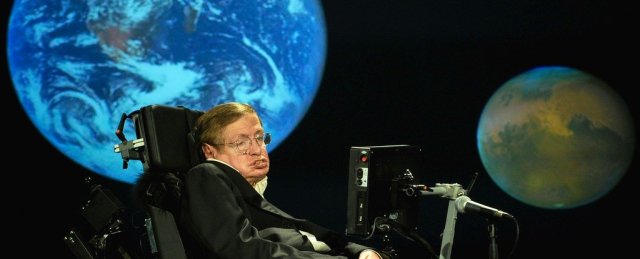
2 Weeks Before Death, Hawking Submitted a Mind-Melting Paper on Parallel Universes, entitled ‘A Smooth Exit from Eternal Inflation”

Stephen Hawking submitted the final version of his last scientific paper just two weeks before he died, and it lays the theoretical groundwork for discovering a parallel universe.

Hawking, who passed away on Wednesday aged 76, was co-author to a mathematical paper which seeks proof of the “multiverse” theory, which posits the existence of many universes other than our own.

The paper, called “A Smooth Exit from Eternal Inflation”, had its latest revisions approved on March 4, ten days before Hawking’s death.

According to The Sunday Times newspaper, the paper is due to be published by an unnamed “leading journal” after a review is complete.

ArXiv.org, Cornell University website which tracks scientific papers before they are published, has a record of the paper including the March 2018 update.

According to The Sunday Times, the contents of the paper sets out the mathematics necessary for a deep-space probe to collect evidence which might prove that other universes exist.

The highly theoretical work posits that evidence of the multiverse should be measurable in background radiation dating to the beginning of time. This in turn could be measured by a deep-space probe with the right sensors on-board.

Thomas Hertog, a physics professor who co-authored the paper with Hawking, said the paper aimed “to transform the idea of a multiverse into a testable scientific framework.”

Hertog, who works at KU Leuven University in Belgium, told The Sunday Times he met with Hawking in person to get final approval before submitting the paper.

https://www.sciencealert.com/stephen-hawking-submitted-a-paper-on-parallel-universes-just-before-he-died

Thanks to Kebmodee for bringing this to the It’s Interesting community.

Russian Scientists Tested Their Asteroid-Nuking Plan with Powerful Lasers

By Rafi Letzter

Russian scientists have a plan to deal with a hypothetical asteroid threat that’s straight out of the movie “Armageddon.”

A team of government scientists has proposed that nuclear weapons well within the power of those already developed could be used to break up incoming asteroids, protecting the planet from a major asteroid strike. They then demonstrated, in a paper published online March 8 in the Journal of Experimental and Theoretical Physics, the effect of a nuclear strike on an asteroid, using scale model “asteroids” and powerful lasers.

Striking a tiny model asteroid with a powerful laser on Earth is obviously not the exact same thing as striking a full-size asteroid with a laser out in space. But there’s a reasonable degree of comparison between the two situations.

MORE
Russian Scientists Tested Their Asteroid-Nuking Plan with Powerful Lasers
This photo of the asteroid Eros was taken during the NEAR Shoemaker mission.
Credit: NASA
Russian scientists have a plan to deal with a hypothetical asteroid threat that’s straight out of the movie “Armageddon.”

A team of government scientists has proposed that nuclear weapons well within the power of those already developed could be used to break up incoming asteroids, protecting the planet from a major asteroid strike. They then demonstrated, in a paper published online March 8 in the Journal of Experimental and Theoretical Physics, the effect of a nuclear strike on an asteroid, using scale model “asteroids” and powerful lasers.

Striking a tiny model asteroid with a powerful laser on Earth is obviously not the exact same thing as striking a full-size asteroid with a laser out in space. But there’s a reasonable degree of comparison between the two situations. [Crash! The 10 Biggest Impact Craters on Earth]

The researchers took careful steps to make sure the scale models were created from the same materials and had similar structures to chondrites (common, stony asteroids). And the immense energy deposited by a pulsed laser onto a single point on the model was reasonably similar to the effect of a nuclear blast on a single point on the asteroid’s surface. They wrote that their experiment showed they could use a a 3-megaton bomb to blast a 656-foot-wide (200 meters) asteroid — 10 times wider than the asteroid that detonated over Russia in 2013 — to harmless bits that would spread out and miss Earth.

The first thermonuclear weapon ever detonated had a strength of about 10.4 megatons, according to the Nuclear Weapon Archive. That bomb was detonated on Elugelab Island, Enewetak Atoll, in the Pacific Ocean in 1952.

There are other methods for diverting incoming asteroids, the researchers acknowledged, like the gravity tug— using the force of gravity to move the space rock to a better orbit. But they require more advanced knowledge of the incoming strike and planning. The advantage of a nuclear strike, they wrote, is that it can work against even surprise asteroids discovered late.

Russia isn’t alone in considering the possibility of a nuclear strike on an asteroid. U.S. government researchers also raised the possibility in a February paper.

https://www.livescience.com/62057-asteroid-nuclear-bomb-russia-laser.html?utm_source=notification

A small daily dose of Viagra could reduce colorectal cancer risk.

A small, daily dose of Viagra significantly reduces colorectal cancer risk in an animal model that is genetically predetermined to have the third leading cause of cancer death, scientists report.

Viagra cut in half the formation of polyps, an abnormal and often asymptomatic clump of cells on the lining of the intestines that may become cancer, says Dr. Darren D. Browning, cancer researcher at the Georgia Cancer Center and Department of Biochemistry and Molecular Biology at the Medical College of Georgia at Augusta University.

Next steps should include a clinical trial for the drug in patients considered at high risk of colorectal cancer, such as those with a strong family history, multiple previous polyps and chronic intestinal inflammation like colitis, Browning says.

Viagra has been used safely for years in a wide range of doses and age groups, from premature infants with pulmonary hypertension to the elderly with erectile dysfunction, he notes.

When placed in the drinking water, Browning’s team found that Viagra reduced polyps in a mouse model with a genetic mutation that occurs in humans, causing them to produce hundreds of polyps starting as teenagers and essentially always resulting in colorectal cancer, says Browning, corresponding author of the study in the journal Cancer Prevention Research.

“Giving a baby dose of Viagra can reduce the amount of tumors in these animals by half,” Browning says.

Viagra is best known for its ability to relax the smooth muscle cells around blood vessels so the vessels can more easily fill with blood, which is how it helps both erectile dysfunction and pulmonary hypertension. But Browning’s lab is showing it also increases levels of the chemical cyclic GMP, which is known to affect the intestinal lining, called the epithelium.

While the details of just how remain unclear, Browning and his team have seen that the results of increased cyclic GMP include suppression of some of the excessive cell proliferation that occurs in the gut and an increase in normal cell differentiation as well as the natural elimination of abnormal cells, through a process called apoptosis.

“When we give Viagra, we shrink the whole proliferating compartment,” says Browning, in an area of our body that directly deals with whatever we put in our mouths and normally experiences high cell turnover “Proliferating cells are more subject to mutations that cause cancer.”

Existing polyps were not affected, more evidence that targeting cyclic GMP signaling appears to be a good prevention strategy in high-risk patients, he says.

Viagra is known to inhibit PDE5, a naturally occurring enzyme in colon cells – and other tissues – that breaks down cyclic GMP so there is more of it available to reduce cell proliferation and improve differentiation into cells like the goblet cells that secret protective mucus.

Guanylyl-cyclase C, or GCC, is the primary source of cyclic GMP in the intestinal lining. Mice like those in his study with the genetic predisposition for polyps, were found to have reduced levels of GCC-activating peptides, which are also commonly lost in human colon cancers.

The mice have mutations in the APC – adenomatous polyposis coli – gene, a known tumor suppressor. Like these mice, people with mutations in the APC gene can develop hundreds of polyps in the colon and rectum and are considered at highest risk for colorectal cancer, says Browning of the inherited disorder called familial adenomatous polyposis. The average age at which individuals develop colon cancer is 39, according to the National Institutes of Health.

The scientists also looked at the prescription drug linaclotide, which is used to treat constipation and irritable bowel syndrome with constipation and, like Viagra, is known to increase cyclic GMP. While linaclotide was also effective at significantly reducing polyp formation, the common side effect of diarrhea at pretty much any dose makes it unlikely that patients would find it tolerable to use long term, even to reduce their cancer risk, Browning says. The low doses of Viagra used by humans and in the lab, on the other hand, have no known side effects, Browning notes.

Browning’s lab published a paper in July in Cancer Prevention Research that showed Viagra cut polyp formation in half in a mouse model of colitis, an inflammation of the colon and risk factor for colorectal cancer. But in this model as well, they found the drug targeted problems from the genetic mutations, although inflammation also was reduced.

He notes that inflammation is the driver in less than 5 percent of colorectal cancers. About 80 percent form spontaneously when cells in this high-cell turnover area divide and develop a mutation that may support uncontrolled proliferation. Mutations occur most often when we consume carcinogens like those found in processed or over-cooked meats.

Humans may have developed advanced social behaviours and trade 100,000 years earlier than previously thought.


Olorgesailie Basin: the dig site spans an area of 65 square kilometres

This is according to a series of papers published today in Science.

The results come from an archaeological site in Kenya’s rift valley. “Over one million years of time” is represented at the site, according to Rick Potts from the Smithsonian Institution, who was involved in the studies.

There are also signs of developments in toolmaking technologies.

Environmental change may have been a key influence in this evolution of early Homo sapiens in the region of the Olorgesailie dig site.


The world turned upside down

Early humans were in the area for about 700,000 years, making large hand axes from nearby stone, explained Dr Potts.

“[Technologically], things changed very slowly, if at all, over hundreds of thousands of years,” he said.

Then, roughly 500,000 years ago, something did change.

A period of tectonic upheaval and erratic climate conditions swept across the region, and there is a 180,000 year interruption in the geological record due to erosion.

It was not only the landscape that altered, but also the plant and animal life in the region – transforming the resources available to our early ancestors.

When the record resumes, the way of life of these early humans has completely changed.

“The speed of the transition is really remarkable,” Dr Potts said. “Sometime in that [gap] there was a switch, a very rapid period of evolution.”

The obsidian road

New tools appeared at this time – small, sharp blades and points made from obsidian, a dark volcanic glass.

This technology marks the transition to what is known as the Middle Stone Age, explained Dr Eleanor Scerri from the University of Oxford.

Rather than shaping a block of rock, into a hand axe, humans became interested in the sharp flakes that could be chipped off. These were mounted on spears and used as projectile weapons.

Where 98% of the rock previously used by people in the Olorgesailie area had come from within a 5km radius, there were no sources of obsidian nearby.

People were travelling from 25km to 95km across rugged terrain to obtain the material, and “interacting with other groups of early humans over that time period”, according to Dr Potts.

This makes the site the earliest known example of such long distance transport, and possibly of trade.


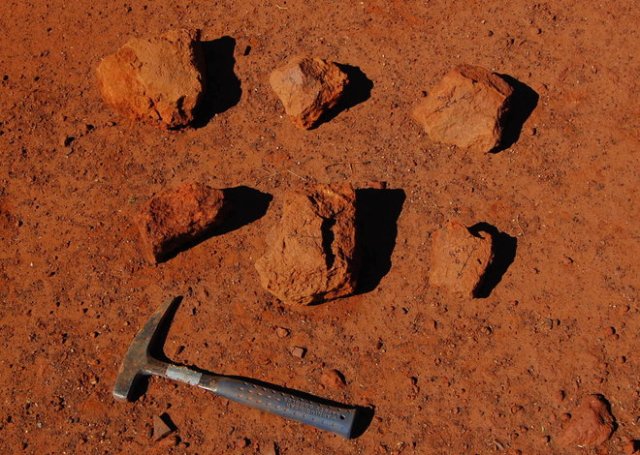
(l to r) Hand axes, obsidian sharps and colour pigments discovered at the site

There is additional evidence that the inhabitants, who would likely have lived in small groups of 20-25 people, also used pigments like ochre. It is unclear whether these were merely practical or had a ritual social application.

Dr Marta Mirazon Lahr from the University of Cambridge said that being able to “securely date” the continuous occupation of the site using argon techniques on volcanic deposits “makes Olorgesailie a key reference site for understanding human evolution in Africa during [this period]”.

Human origins

Dr Scerri, who was not involved in the studies, emphasised that they are valuable in implying that “Middle Stone Age technology emerged at the same time in both eastern and northwestern Africa.”

Prof Chris Stringer from the Natural History Museum agrees.

“This makes me think that the Middle Stone Age probably already existed in various parts of Africa by 315,000 years ago, rather than originating in one place at that time and then spreading,” he said.

While the behaviours exhibited at the Kenya site are characteristic of Homo sapiens, there are as yet no fossils associated with this time period and location.

The oldest known Homo sapiens fossils were discovered in Morocco, and are dated to between 300,000 and 350,000 years old.

http://www.bbc.com/news/science-environment-43401157

Monkeys are exquisitely attuned to the same signals signals about sex and social status upon which many successful advertisements rely.

Any ad executive will tell you that sex sells. But why? Do sexy images stimulate our biological urges, somehow motivating us to buy products? Or do marketers merely exploit and perpetuate our cultural obsession with sexual imagery? Do people want the beauty, wealth and power celebrities have, and use the products they endorse in the hope of achieving these same qualities?

These explanations are plausible, but my colleagues and I have a new one, based on decades of work comparing the behavior and neurobiology of decision-making in monkeys and people: Our brains have been fine-tuned by evolution to prioritize social information, and this laser focus on others profoundly shapes our decisions.

As early as the 1870s, companies like Pearl Tobacco and later, W. Duke & Sons, employed social advertising, showcasing nude or partially exposed women on posters and trading cards. Although the images had no direct link to the products, sales increased. A century and a half later, it seems impossible to escape sexual imagery in advertising. The same is true for celebrities in marketing campaigns—actors, musicians, athletes, even politicians and business leaders. These celebrities often don’t even use the products they advertise, yet the method still seems to work.

Our brains have circuits specialized for identifying, remembering and inferring the mental states of others so we can predict their behavior and make good decisions. In other words, we’re built to deal with people. But we’re not alone in this connection. Many species of monkeys and apes—our closest living relatives—also live in large, complex, dynamic societies. Behavioral studies show that, like us, these primates identify others, track prior encounters, empathize with friends and relatives, and make inferences about individuals’ mental states.

For people and monkeys alike, it’s important to find a good mate, make powerful allies and avoid potential threats. Paying close attention to social cues can improve these choices. In fact, both men and male monkeys are exquisitely sensitive to indications of female fertility. Men rate ovulating women as more attractive, and tip more for lap dances by fertile women. Similarly, male rhesus macaques prefer images of females with artificially reddened faces and hindquarters, coloration that predicts ovulation and sexual receptivity.

Women and female monkeys are also sensitive to clues about male quality, although what we know about that is based on fewer studies. A woman’s preference shifts toward more masculine faces—broader jaw, wider-set but smaller eyes—during ovulation. Female macaques, when ovulating, tend to mate with higher-ranking males and prefer those with reddened faces caused by a testosterone surge. Other studies found that both people and monkeys pay more attention to high-status individuals and are more likely to follow their gaze.

According to economics, we can quantify how much someone values something—coffee, a magazine—by how much he or she will pay for it. In our latest work, we developed an assessment, dubbed the “pay-per-view” test, to measure subconscious value of visual images. In the experiment, monkeys had the option to forego juice or food for a glimpse at a picture of another monkey. People could choose whether to accept a smaller cash reward to peek at a picture of another individual.

Our findings were striking. Male college students paid slightly more money to view an attractive woman than an unattractive one, losing several dollars during the experiment. Female students were much less motivated to see attractive men. Monkeys of both genders valued sex and status, accepting less food or juice to see images of monkey genitalia and faces of high-status males. In contrast, they required extra food or juice to look at faces of low-status males.

Based on these findings, it’s clear that monkeys and humans value information about sex and status so much that it can replace rewards like food, juice and money. Strong parallels between the two suggest shared brain mechanisms at work.

To test this idea, we used fMRI to scan the brains of male students in two circumstances: one, while they viewed female faces of varying attractiveness, the other while money was either deposited or withdrawn from their study stipend. The sight of attractive faces strongly activated a network of brain areas previously implicated in processing rewards—including the orbitofrontal cortex, ventromedial prefrontal cortex, and medial and ventral striatum—and neural activity increased with increasing attractiveness. The same happened with monetary rewards and losses. We believe this network computes economic “utility,” a person’s internal desire for or satisfaction with a good or service, thought to underlie decisions.

To determine the physiological basis of these signals, we measured individual brain cell activity in monkeys. Some fired strongly when male monkeys chose to see female genitalia, a high-status male face, or a large juice reward, but fired less when they chose low-status faces or small juice rewards. Specific brain cells reacted to images of faces and genitals but not juice, indicating the brain’s reward system possesses dedicated hardware for identifying and prioritizing key social information.

Can these discoveries help explain the power of sex and status in advertising? In theory, ads that associate sex or status with specific brands or products activate the brain mechanisms that prioritize social information, and turning on this switch may bias us toward the product.

To test this idea, we exposed male rhesus macaques to logos of household brands like Nike and Pizza Hut paired with a social image (e.g., female genitalia, high-status male face) or the same image with pixels rearranged to make it unrecognizable but retain the same brightness, contrast, and color, salient cues that could draw attention to a stimulus. Monkeys received a sweet treat for touching the screen after the ad, then had the choice between brands paired with a social image or its scrambled version.

Our advertising campaign was remarkably effective. Monkeys developed preferences for brands linked with sex and status. Both males and females preferred logos paired with sexual cues and the faces of high-status monkeys. And the more often male monkeys saw sexual advertisements, the more they preferred the brands. Sound familiar? Even monkeys, it seems, can be persuaded to choose a brand through social advertising.

Given the nearly identical specializations of brain reward circuits to prioritize social information in monkeys and people, is it any wonder that sex and status sell?

https://blogs.scientificamerican.com/observations/what-monkeys-can-teach-us-about-advertising/

An Electro-Blob Under Africa May Be ‘Ground Zero’ for Earth’s Magnetic Field Reversal


Chunks of clay excavated from Iron Age grain bins in South Africa. Early farmers burnt their clay huts and grain storage buildings in times of drought as part of a cleansing ritual, unknowingly locking the magnetic properties of the minerals in the clay into place.

A flip in Earth’s magnetic field may be brewing. And if it is, an electromagnetic blob deep under southern Africa is likely to be ground zero for the change.

New research using clays burned in cleansing rituals by Iron Age farmers finds that over the past 1,500 years, an electromagnetic anomaly in the Southern Hemisphere has waxed and waned, with the magnetic field in the region weakening and strengthening. This weirdness may presage a gradual reversal in the magnetic field, so that magnetic north moves to the South Pole and vice versa. (A flip-flop of this sort last occurred 780,000 years ago.)

The study suggests that the magnetic field under southern Africa may not just be weird today, study co-author John Tarduno, who researches the Earth’s magnetism at the University of Rochester in New York, told Live Science. It may be a longstanding hotspot for changes in the global magnetic field.

WEAKENING FIELD

The planet’s magnetic field is generated by the churning of liquid iron in the core. Without the field, life on the planet would be much different, if not impossible: This invisible shield protects the Earth’s surface from deadly cosmic radiation.

Right now, the field is undergoing a weakening, and no one is sure why. The South Atlantic Anomaly, a region of the magnetic field that stretches from South Africa to Chile, is particularly weak, Tarduno said, so scientists have become interested in figuring out what might be going on in the core underneath that area.

The problem is that before about 160 years or so ago, with the advent of magnetic observatories and (eventually) satellite observations, there weren’t many records of what the magnetic field looked like in the Southern Hemisphere, Tarduno said. Ninety percent of the data that does exist comes from the northern half of the planet. To start to rectify that disparity, Tarduno and his team excavated clays from the Limpopo River Valley of Zimbabwe, South Africa, and Botswana. In times of drought hundreds to thousands of years ago, Bantu-speaking farmers would burn down their clay huts and grain bins in ritualistic ceremonies. Unbeknown to these ancient farmers, the fire heated the magnetic minerals in the clay and locked into place a record of the strength and orientation of the field at that time. Now, researchers can study those properties to find out what the magnetic field was doing at that moment in time.

LOCKED IN CLAY

The excavations unearthed these burnt clays as long ago as A.D. 425, Tarduno said, providing the longest record yet of the magnetic field in southern Africa. The data show that the magnetic field experienced sudden directional shifts between A.D. 400 and 450, and then again between A.D. 750 and 800. Between about A.D. 1225 and 1550, the field noticeably weakened. The first two shifts might also indicate a weakened field, Tarduno said, but more research is needed to determine the magnetic intensity in those time frames. The researchers reported their findings Feb. 15 in the journal Geophysical Research Letters.

What these shifts suggest is that what is going on in the Southern Hemisphere’s magnetic field today may have happened before, Tarduno said.

The field shifts may have to do with underlying processes churning deep beneath the Earth’s surface, Tarduno said. In recent years, scientists have documented a weird patch of magnetic field below southern Africa at the boundary between the core and the mantle, where the polarity of the field is reversed.

“That patch may be largely responsible for the decreasing magnetic field,” Tarduno said.

The patch is like an eddy in a stream, he said. As for what causes the eddy, it may be something odd about the mantle right above the core in that location, he said. The mantle under southern Africa is unusual, and possibly both hotter and denser than surrounding mantle, he said.

“We think that is causing there to be changes in the flow of the iron [in the core] as it enters this region,” Tarduno said.

That could mean that southern Africa is the origin for magnetic field reversals, Tarduno said, though there’s no guarantee that the field will flip now — the weakening could also dissipate, as it has in centuries past.

Even if the field doesn’t reverse, though, the weakening itself could have societal implications, Tarduno said.

“These are not of the nature of disaster movies. That’s not the point,” he said. Instead, a weakening field could let more cosmic radiation hit the Earth, making infrastructure like the power grid more susceptible to geomagnetic storms and even changing atmospheric chemistry so that more UV rays could sneak through, causing increased risk for skin cancer in humans.

“It’s definitely something that we need to keep an eye on,” Tarduno said.

https://www.livescience.com/61958-africa-blob-earth-magnetic-flip.html?utm_source=notification