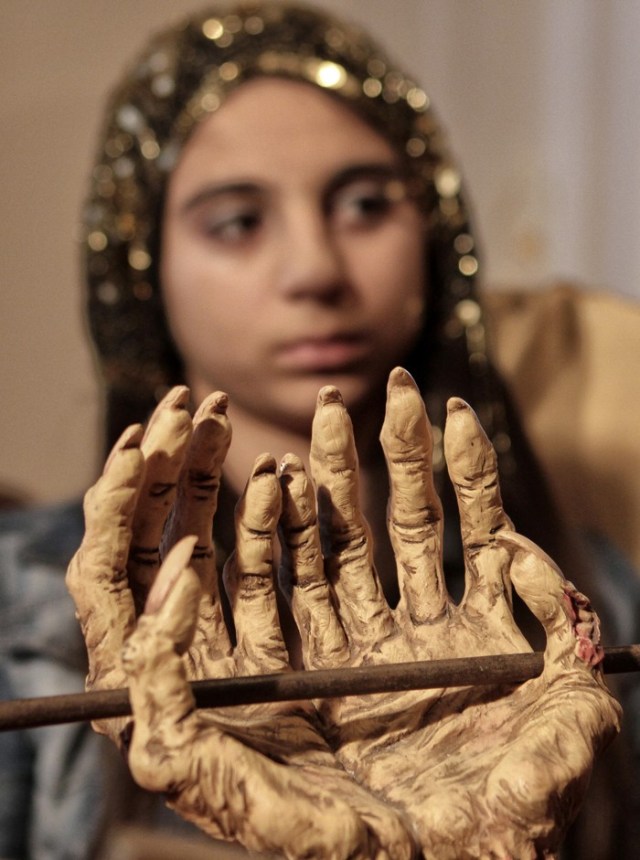
Potions, spells and broomsticks: Witchcraft is often seen in Hollywood films and Halloween parties – and not usually as a form of alternative health care.
Yet in Romania, belief in magic is not regarded as hocus pocus. Many choose to entrust their problems to the supernatural rather that bear the stigma of seeking a psychologist.
Two years ago, Romanian photojournalist Mugur Varzariu set out to capture all facets of today’s Romania, from its active witch culture to the ugly Roma ethnic conflict. Raising awareness through the cross hairs of his camera, he has dedicated himself to projecting a country that transcends its Transylvanian image, and to documenting the different challenges of the Roma.
Call it fate that at a festival in Costesti, Varzariu’s camera lens was drawn to a vibrantly dressed woman – a witch of Roma origin, with a personality and energy to match her colorful attire. A prominent sorceress, Bratara not only performs rituals; she’s also a Roma rights activist.
Witches, or vrajitoares as they are called in their native tongue, are commonly of Roma heritage. Roma, or Gypsies, are a marginalized ethnicity in Romania seen by many as the cause of the country’s problems. Vexed also by witches, many government officials view them as frauds and an embarrassment to the nation.
“I wanted to tell a different story,” Varzariu said. “People in Romania say ‘we hate the Roma’ or ‘we hate the witches and want this practice to be put to an end.’ So I wanted to present the injustice but also to show the good things about the Roma.”
And with that, he set out to do a story on witchcraft. But in the end, he discovered her story, which was more complex and intricate than magic.
With an open mind, Varzariu stood at the entrance of her Bucharest home, he said, recalling the first time she opened the door through to “the universe of magic.”
Bratara allowed Varzariu to capture the mystique of her practices over the course of four months. From hex spells for enemies, to blending tonics that heal ailments, Varzariu explained, she has gained widespread influence.
At first he thought he would only witness sorcery, but she exposed more than just her magic. He saw her community’s pulse – everything from birthdays to exhumations to weddings and wakes – that seemed to transcend the physical plane.
“She is magic. She’s a soul of a large, large family,” he said.
Many people come to Bratara seeking help with everyday problems. A heartbroken girl wishing her ex-boyfriend would take her back received a chant and a stake-pierced-onion, symbolic of love hitting the heart, almost as if mimicking the action of Cupid’s arrow.
“Regardless if it’s true or not, she’s there for them day and night, and I don’t really see any harm in that,” Varzariu said. Especially in a culture where he says people are still afraid to see a shrink because “people will label them as crazy.”
Her activism has landed her a friend in one of the biggest Roma mafiosi in Bucharest. The mafia member accepted Varzariu into his home with a camera only because of her, he says. Despite their sensitive conversation regarding the Roma Justice Court, Bratara’s trust in him allowed for the documentation to take place.
In addition to catering to the needs of her community at the Roma at large, she still manages to make time, and scarves, for her family, such as garments for her nephew’s wedding.
Varzariu set out to do a story on witchcraft, he says, but at the end “it’s her – she is the story.”
“In a way, we live in a matriarchal society. You can sense it in the way women perform today,” he said. “I’m telling you, she would be the leading woman in any society. She’s amazing.”
– Michelle Cohan, CNN
Witch reveals heart of Roma


 It's Interesting