
Virtual Reality Therapy Shows Promise Against Depression

An immersive virtual reality therapy could help people with depression to be less critical and more compassionate towards themselves, reducing depressive symptoms, finds a new study from UCL (University College London) and ICREA-University of Barcelona.

The therapy, previously tested by healthy volunteers, was used by 15 depression patients aged 23-61. Nine reported reduced depressive symptoms a month after the therapy, of whom four experienced a clinically significant drop in depression severity. The study is published in the British Journal of Psychiatry Open and was funded by the Medical Research Council.

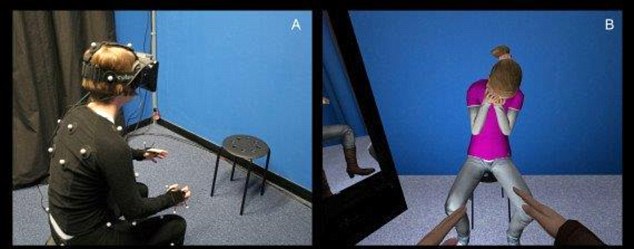
Patients in the study wore a virtual reality headset to see from the perspective of a life-size ‘avatar’ or virtual body. Seeing this virtual body in a mirror moving in the same way as their own body typically produces the illusion that this is their own body. This is called ’embodiment’.

While embodied in an adult avatar, participants were trained to express compassion towards a distressed virtual child. As they talked to the child it appeared to gradually stop crying and respond positively to the compassion. After a few minutes the patients were embodied in the virtual child and saw the adult avatar deliver their own compassionate words and gestures to them. This brief 8-minute scenario was repeated three times at weekly intervals, and patients were followed up a month later.

“People who struggle with anxiety and depression can be excessively self-critical when things go wrong in their lives,” explains study lead Professor Chris Brewin (UCL Clinical, Educational & Health Psychology). “In this study, by comforting the child and then hearing their own words back, patients are indirectly giving themselves compassion. The aim was to teach patients to be more compassionate towards themselves and less self-critical, and we saw promising results. A month after the study, several patients described how their experience had changed their response to real-life situations in which they would previously have been self-critical.”

The study offers a promising proof-of-concept, but as a small trial without a control group it cannot show whether the intervention is responsible for the clinical improvement in patients.

“We now hope to develop the technique further to conduct a larger controlled trial, so that we can confidently determine any clinical benefit,” says co-author Professor Mel Slater (ICREA-University of Barcelona and UCL Computer Science). “If a substantial benefit is seen, then this therapy could have huge potential. The recent marketing of low-cost home virtual reality systems means that methods such as this could potentially be part of every home and be used on a widespread basis.”

Publication: Embodying self-compassion within virtual reality and its effects on patients with depression. Falconer, CJ et al. British Journal of Psychiatry Open (February, 2016)

The future of virtual-reality travel

Glynis Freeman stands on a tower balcony in nighttime London, peering down at the dizzying lights hundreds of feet below.

The distant rumble of city traffic rises up from the streets. A gust of wind brushes her hair. Freeman smiles while swiveling her head in all directions to take in the view.

“That was cool,” she said a few minutes later. “I want to go back to London.”

That’s because Freeman was never physically in London. The Marietta, Georgia, woman was 4,000 miles away in an Atlanta hotel lobby, wearing a headset and trying out a demonstration of new technology that can place people in exotic virtual settings almost anywhere on the planet.

It’s all part of a new experiment by Marriott, the global hotel chain, to let guests sample virtual destinations with the Oculus Rift, a headset whose high-definition, 3-D display immerses wearers in a lifelike interactive world.

“We really want to appeal to the next generation of travelers,” said Karen Olivares, director of global brand marketing for Marriott.

Virtual travel is in its infancy and a long way from being mainstream. But the travel industry is intrigued by its potential, which goes far beyond Google Street View or online “virtual tours” of hotels and resorts.

The idea is not that virtual travel will replace real-world travel, because nobody in the industry would go for that. Instead, the travel industry hopes that people who sample virtual snippets of alluring vacations — say, rafting the Grand Canyon or hiking the Great Wall of China — will be persuaded to splurge on the real thing.

Behind the Oculus Rift

Driving this trend are next-generation systems such as the Oculus Rift and Sony’s Project Morpheus, which promise a leap forward in virtual-reality technology.

The much-hyped Oculus Rift headset looks like something a skier or scuba diver might wear and fits snugly over the wearer’s face, paired with headphones. Its crisp 3D display immerses you in an interactive world — a medieval village or a tropical jungle — which you sometimes can navigate with the help of a game controller.

The goggles come packed with a 100-degree field of view, extending beyond viewers’ peripheral vision. They have an accelerometer, gyroscope and compass to track the position of your head and sync the visuals to the direction where you are looking — allowing Oculus to improve on the sometimes jerky visuals of other virtual-reality systems.

The Oculus Rift was designed to enhance video gaming. But Facebook paid $2 billion for its maker, Oculus VR, in March, seeing the device as a potential future communication platform.

One developer for the Oculus Rift is excited about the technology’s long-term potential to tranform travel.

“I could go for a run in the morning in some exotic beach and in the evening stroll the streets of some city … I could be a virtual storm chaser close to a tornado and even travel deep in the ocean,” the developer wrote in an online forum.

“In fact these experiences will be so real, without risk, and of course cheap that I might actually have second thoughts about traveling … Antarctica without the cold … Jungles without the heat and bugs … And people who will provide (this) content will make millions.”

Virtual journeying

Consumer versions of the Oculus Rift and Project Morpheus — which works in much the same way — aren’t expected on the market until 2015 at the earliest. But that hasn’t stopped the travel industry from tinkering with prototypes.

Thomas Cook, the international travel agency, announced a trial program in August that will allow customers at one of its stores in England to don Oculus Rifts and experience a flight on one of its airplanes or tour a Sentido resort.

And Marriott has been touring U.S. cities this fall with its “Teleporter,” a booth that invites visitors to climb inside, strap on an Oculus Rift and take a virtual tour of Wai’anapanapa Black Sand Beach in Maui and Tower 42 in London.

Viewers watch a 90-second video produced by Framestore, the British creative studio that has done visual effects for “Gravity” and other movies. To make the experiences feel more lifelike, fans in the booths blow soft breezes while misters recreate the feel of ocean spray.

Whether such virtual-reality glimpses inspire someone to take a real trip remains to be seen. But visitors to the booths on a recent weekday in Atlanta came away impressed.

“That was truly amazing. It reminded me of something from ‘Star Trek,’ ” said Lisa Lewis of Monroe, Louisiana. “London has always been a dream destination of mine. And just to get a feel for a place — it was much more than I imagined.”

http://www.cnn.com/2014/10/31/travel/virtual-reality-travel/index.html?c=&page=3