
World’s longest-running science experiment finally ends.

The world’s longest-running laboratory experiment has finally delivered a result – eight months after the man who patiently watched over it unrewarded for five decades died.

Set up in the 1920s to demonstrate to students that objects that appear solid can flow like liquids, the pitch drop experiment at the University of Queensland has captivated many who had waited more than 13 years for the latest globule of the tar-like substance to form and fall.

Pitch is a material hard enough to shatter when hit by a hammer. However put a pile of it in a funnel and the pressure generated from being squeezed through the narrow mouth makes it flow like liquid. Albeit slowly.

To put things in perspective: Australia is moving north at six centimetres a year due to continental drift. The pitch in this experiment is moving 10 times slower than that.

On Thursday, the ninth dollop to fall in 83 years touched down. Until last week, no one had ever seen one land.
Similarly, in 1988, he knew a drop was close, but it happened in the five minutes when he left the room to get a cup of tea.

By 2000 there was a webcam pointed at the pitch. Although in England, Professor Mainstone knew he could watch it live or have it recorded. However, a tropical storm caused a 20 minute power outage right when the pitch landed.

Professor Mainstone died after suffering a stroke last August, aged 78, just months before the ninth blob of pitch fell.

Current custodian Andrew White said given the amount of pitch yet to land in the beaker, the experiment could run for at least another 80 years. He said if the pitch continued to drop at the current rate, the next dollop to land could coincide with the centenary of the experiment in 2027.

Physicist John Mainstone missed all three pitch drops that took place during his custodianship. Having retrieved the experiment from the back of a cupboard, he watched over it for 50 years.

Professor Mainstone once devoted an entire weekend to watching the pitch in 1977 – only to go home exhausted and miss the event by a day.

The experiment has been referenced in popular culture, getting a mention in Nick Earls’ book Perfect Skin. It is recognised by Guinness World Records as the longest-running laboratory experiment, and in 2005 it won an Ig Nobel Prize – “for research that makes you people laugh and think”.

Professor White, a quantum physicist who describes himself as just “four pitch drops old”, thinks the experiment’s appeal is in its touchstone qualities.

“It gives you a connection to deep time that you don’t get in your normal lifetime,” he said.

“In that beaker is the pitch drop from before you were born, from before your parents were born and for some younger people, the pitch drop from before their grandparents were born.”

The experiment was set up in 1927 by Thomas Parnell, the founding professor of physics at Queensland University.

Between 1930 and 1988 the pitch drops fell on average every eight years. Professor White said the drops took longer to form and fall after air-conditioning was installed in the university in the 1980s. They now land, slightly larger, in the beaker every 13 years or so.

A common household material a hundred years ago, pitch was used to waterproof containers including boats and coffins.

Pitch is a viscous elastic material, meaning it can behave either as a solid or a liquid depending on the conditions. A more familiar viscous material is toothpaste – it flows when under pressure. But on a toothbrush it can be held upside down and it won’t flow.

The experiment has delivered a published scientific result. After seven drops, scientists calculated the viscosity of pitch in a 1984 paper published in the Euro-pean Journal of Physics. They found it was 230 billion times that of water.

“It’s hardly a high-yield experiment and we could probably have got that data more quickly in other ways,” Professor White admitted. “But the real value of this is that it gets people to think about the world in a different way.”
http://www.smh.com.au/technology/sci-tech/pitch-err-this-worlds-longestrunning-experiment-finally-drops-20140423-zqy9g.html

Water in faults vaporizes during an earthquake, depositing gold

gold-ed
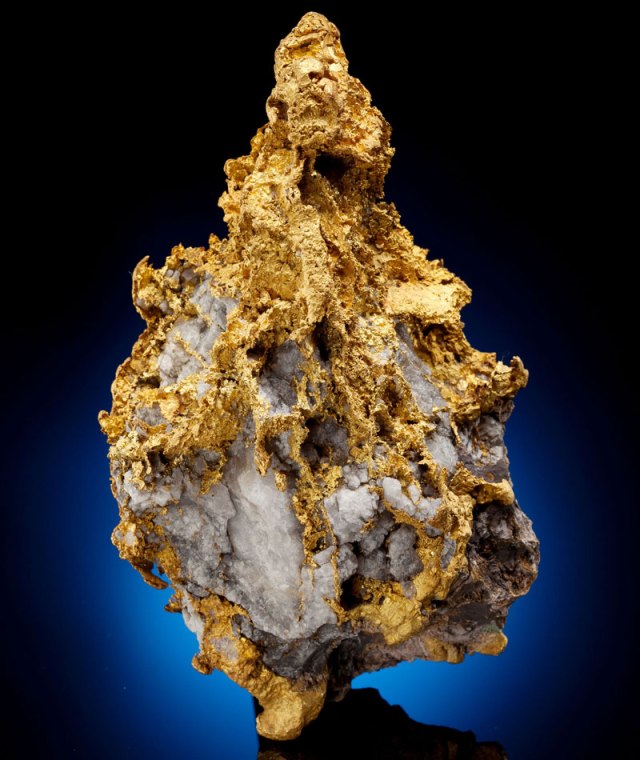
The tyrannosaur of the minerals, this gold nugget in quartz weighs more than 70 ounces (2 kilograms).

Earthquakes have the Midas touch, a new study claims.

Water in faults vaporizes during an earthquake, depositing gold, according to a model published in the March 17 issue of the journal Nature Geoscience. The model provides a quantitative mechanism for the link between gold and quartz seen in many of the world’s gold deposits, said Dion Weatherley, a geophysicist at the University of Queensland in Australia and lead author of the study.

When an earthquake strikes, it moves along a rupture in the ground — a fracture called a fault. Big faults can have many small fractures along their length, connected by jogs that appear as rectangular voids. Water often lubricates faults, filling in fractures and jogs.

About 6 miles (10 kilometers) below the surface, under incredible temperatures and pressures, the water carries high concentrations of carbon dioxide, silica and economically attractive elements like gold.

During an earthquake, the fault jog suddenly opens wider. It’s like pulling the lid off a pressure cooker: The water inside the void instantly vaporizes, flashing to steam and forcing silica, which forms the mineral quartz, and gold out of the fluids and onto nearby surfaces, suggest Weatherley and co-author Richard Henley, of the Australian National University in Canberra.

While scientists have long suspected that sudden pressure drops could account for the link between giant gold deposits and ancient faults, the study takes this idea to the extreme, said Jamie Wilkinson, a geochemist at Imperial College London in the United Kingdom, who was not involved in the study.

“To me, it seems pretty plausible. It’s something that people would probably want to model either experimentally or numerically in a bit more detail to see if it would actually work,” Wilkinson told OurAmazingPlanet.

Previously, scientists suspected fluids would effervesce, bubbling like an opened soda bottle, during earthquakes or other pressure changes. This would line underground pockets with gold. Others suggested minerals would simply accumulate slowly over time.

Weatherley said the amount of gold left behind after an earthquake is tiny, because underground fluids carry at most only one part per million of the precious element. But an earthquake zone like New Zealand’s Alpine Fault, one of the world’s fastest, could build a mineable deposit in 100,000 years, he said.

Surprisingly, the quartz doesn’t even have time to crystallize, the study indicates. Instead, the mineral comes out of the fluid in the form of nanoparticles, perhaps even making a gel-like substance on the fracture walls. The quartz nanoparticles then crystallize over time.

Even earthquakes smaller than magnitude 4.0, which may rattle nerves but rarely cause damage, can trigger flash vaporization, the study finds.

“Given that small-magnitude earthquakes are exceptionally frequent in fault systems, this process may be the primary driver for the formation of economic gold deposits,” Weatherley told OurAmazingPlanet.

Quartz-linked gold has sourced some famous deposits, such as the placer gold that sparked the 19th-century California and Klondike gold rushes. Both deposits had eroded from quartz veins upstream. Placer gold consists of particles, flakes and nuggets mixed in with sand and gravel in stream and river beds. Prospectors traced the gravels back to their sources, where hard-rock mining continues today.

But earthquakes aren’t the only cataclysmic source of gold. Volcanoes and their underground plumbing are just as prolific, if not more so, at producing the precious metal. While Weatherley and Henley suggest that a similar process could take place under volcanoes, Wilkinson, who studies volcano-linked gold, said that’s not the case.

“Beneath volcanoes, most of the gold is not precipitated in faults that are active during earthquakes,” Wilkinson said. “It’s a very different mechanism.”

Understanding how gold forms helps companies prospect for new mines. “This new knowledge on gold-deposit formation mechanisms may assist future gold exploration efforts,” Weatherley said.

In their quest for gold, humans have pulled more than 188,000 tons (171,000 metric tons) of the metal from the ground, exhausting easily accessed sources, according to the World Gold Council, an industry group.

http://www.livescience.com/27953-earthquakes-make-gold.html