
New Solar Plant in Arizona Powers 70,000 Homes Day Or Night

solar power

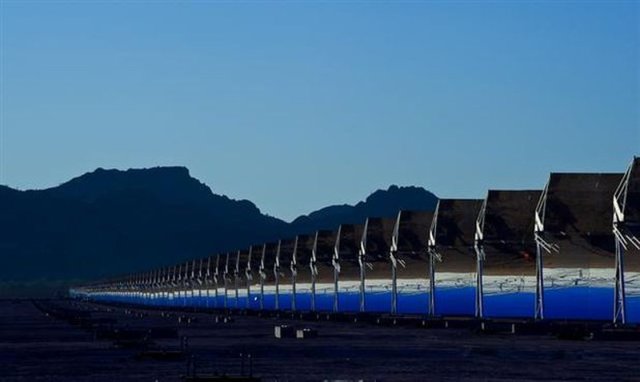
Outside Phoenix, Ariz., on Wednesday, a power company turned on one of the largest solar power plants of its kind in the world. But unlike other solar farms, this plant continues giving power to 70,000 Arizona households long after the sunset.

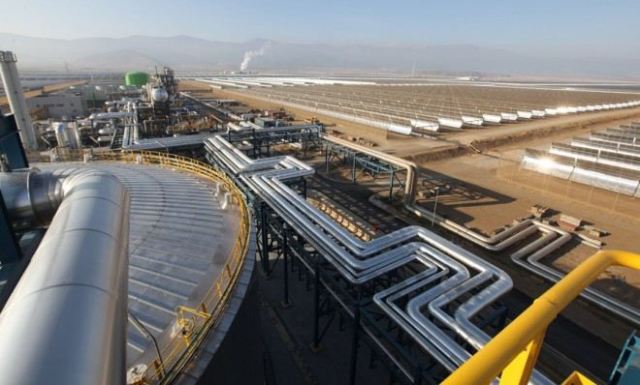
The Solana plant uses 3,200 mirrors that are tilted so they focus the sun’s rays to heat a specially-designed oil. That boils water, which drives turbines and generates electricity. Or, the oil can heat giant tanks of salt, which soak up the energy. When the sun goes down, or when households need more power, the hot salt tanks heat up the oil, which again boils water to drive the turbines.

Whereas conventional solar panels only give power when the sun is up, these giant salt batteries give renewable energy on demand. They can store six hours-worth of energy, which can meet the demands of Arizona customers, according to months of test data.

“That’s the sort of thing you can do with a conventional gas plant that no one had envisioned doing with renewables,” says Patrick Dinkel, vice president of resource management for Arizona Public Service, which is Arizona’s largest utility company.

The company has already bought the power from this plant for the next 30 years, to add to the state’s goal of generating 15 percent of its energy from renewable sources by 2025. The plant does mean higher energy bills for APS customers — an extra $1.28 per month for the first five years, $1.09 per month for the next five, and then 94 cents per month after that, according to the company. Dinkel says the state won’t see a lot more of these plants soon because that would cost too much.

“Right now natural gas wins that race (for cheap power,)” Dinkel says. “The challenge is no one knows what those economics look like in five years.”

The U.S. Department of Energy lent Abengoa Solar, the Spanish company that built that plant as well as Europe’s first solar thermal power plant, $1.4 billion, out of the $2 billion price tag. It’s the same program that financed Solyndra, a solar panel firm that went bankrupt in 2011. But this is a different kind of investment, says Armando Zuluaga, general manager of Abengoa Solar. He points out the company already has a public utility buying their output for the next 30 years, so the government will get its money back with interest.

“There’s no market risk here,” Zuluaga says. “It’s just about getting the plant built.”

This won’t be the last we hear of Abengoa Solar and this technology. The company is building a similar, though smaller plant in the Mojave desert in California, which will come online next year, as well as plants in South Africa.

http://www.npr.org/blogs/thetwo-way/2013/10/11/232348077/in-ariz-a-solar-plant-that-powers-70-000-homes-day-or-night

Thanks to Ray Gaudette for bringing this to the attention of the It’s Interesting community.
Are we on the cusp of a solar energy boom?

Solar_graphsolar

Solar power is getting much easier to store — and at a much cheaper price

The total solar energy hitting the Earth each year is equivalent to 12.2 trillion watt-hours. That’s over 20,000 times more than the total energy all of humanity consumes each year.

And yet photovoltaic solar panels, the instruments that convert solar radiation into electricity, produce only 0.7 percent of the energy the world uses.

So what gives?

For one, cost: The U.S. Department of Energy estimates an average cost of $156.90 per megawatt-hour for solar, while conventional coal costs an average of $99.60 per MW/h, nuclear costs an average of $112.70 per MW/h, and various forms of natural gas cost between $65.50 and $132 per MW/h. So from an economic standpoint, solar is still uncompetitive.

And from a technical standpoint, solar is still tough to store. “A major conundrum with solar panels has always been how to keep the lights on when the sun isn’t shining,” says Christoph Steitz and Stephen Jewkes at Reuters.

But thanks to huge advancements, solar’s cost and technology problems are increasingly closer to being solved.

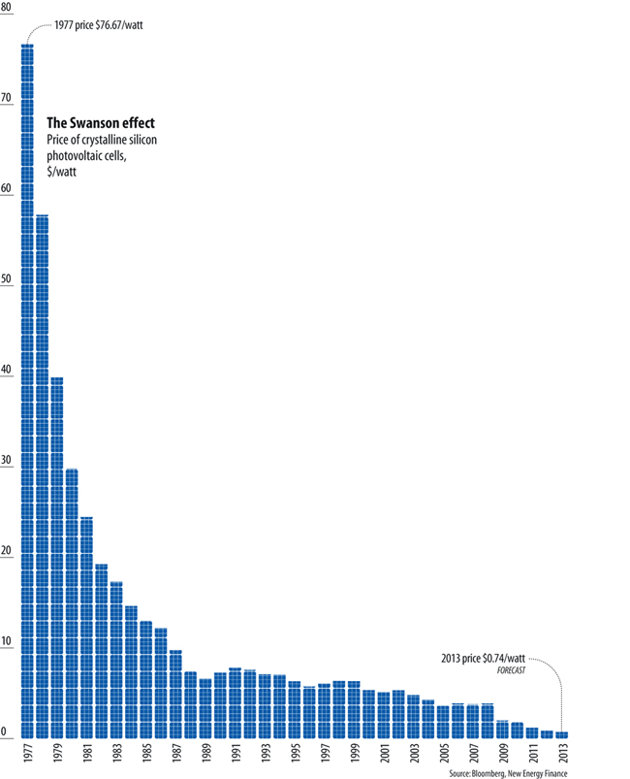
The percentage of light turned into electricity by a photovoltaic cell has increased from 8 percent in the first Cadmium-Telluride cells in the mid-1970s to up to 44 percent in the most efficient cells today, with some new designs theoretically having up to 51 percent efficiency. That means you get a lot more bang for your buck. And manufacturing costs have plunged as more companies have entered the market, particularly in China. Prices have fallen from around $4 per watt in 2008 to just $0.75 per watt last year to just $0.58 per watt today.

If the trend stays on track for another 8-10 years, solar generated electricity in the U.S. would descend to a level of $120 per MW/h — competitive with coal and nuclear — by 2020, or even 2015 for the sunniest parts of America. If prices continue to fall over the next 20 years, solar costs would be half that of coal (and have the added benefits of zero carbon emissions, zero mining costs, and zero scarcity).

Scientists have made huge advances in thermal storage as well, finding vastly more efficient ways to store solar energy. (In one example, solar energy is captured and then stored in beds of packed rocks.)

Lower costs and better storage capacity would mean cheap, decentralized, plentiful, sustainable energy production — and massive relief to global markets that have been squeezed in recent years by the rising cost of fossil fuel extraction, a burden passed on to the consumer. All else being equal, falling energy prices mean more disposable income to save and invest, or to spend.

The prospect of widespread falling energy costs could be a basis for a period of strong economic growth. It could help us replace our dependence on foreign oil with a robust, decentralized electric grid, where energy is generated closer to the point of use. This would mean a sustainable energy supercycle — and new growth in other industries that benefit from falling energy costs.

Indeed, a solar boom could prove wrong those who claim that humanity has over-extended itself and that the era of growth is over.

Thanks to Ray Gaudette for bringing this to the attention of the It’s Interesting community.
http://news.yahoo.com/cusp-solar-energy-boom-075000286.html