
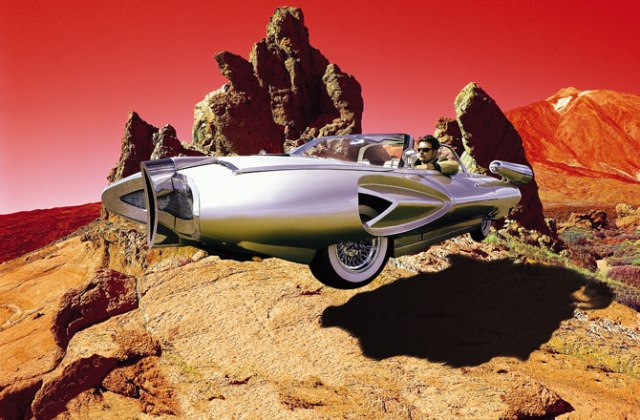
Toyota thinks hover cars may be in our future

If you asked a guy in the 1960s what he thought we’d be driving today, he’d probably think about what he’d seen in a popular TV science-fiction show of the time and say “a hover car.”

But 1960s guy would probably be a little disappointed that what people are actually driving are cars that look a bit like his mid-60s Mustang but a thousand pounds heavier.

Somewhere inside Toyota there’s a team of engineers who still have that 1960s innocence, as Toyota managing officer Hiroyoshi Yoshiki has just revealed the company is working on a real-life hover car, or at least investigating the potential.

According to The Verge (via Jalopnik), the project is underway at one of Toyota’s “most advanced” research and development areas.

Unfortunately, we’re not going to have something approximating the Jetsons’ car, nor even Luke Skywalker’s speeder any time soon. The car won’t so much be hovering in free space as “a little bit away” from the road. This is more likely to mean microns than inches, but the aim is to reduce road friction.

Without turning the car into a giant aircraft wing this probably isn’t a simple process, as friction is rather important to a car’s ability to go, stop and corner. And losing contact with the road entirely needs lots of energy and usually lots of speed, too — think jet aircraft, rather than a Toyota Yaris.

Yoshiki, speaking at Bloomberg’s Next Big Thing Summit in San Francisco, wouldn’t elaborate further on the company’s ideas, so it’s unknown how close such an idea is to reality. Nor did he reveal how long Toyota has worked on the idea — so we’re not expecting flying Priuses any time soon.

Thanks to Da Brayn for bringing this to the attention of the It’s Interesting community.

http://news.discovery.com/autos/future-of-transportation/toyota-thinks-hover-cars-might-be-a-thing-140613.htm

Hacking researchers take control of cars

hack car

Forget car jacking. As cars become increasingly complex, car hacking — taking over a vehicle’s computer-controlled systems — is becoming a very real threat.

At the DEF CON hacking conference this weekend in Las Vegas, two computer software researchers with a grant from the Defense Advanced Research Projects Agency released the code they wrote to carry out attacks on a Toyota Prius and a Ford Escape and provide links to their findings in a 100-page white paper,
Their goal? To help other researchers find and address auto industry security flaws before malicious hackers find ways to prey on unsuspecting drivers.

“The more people we can get on the problem, the better,” Charlie Miller, a Twitter security engineer, told the Herald last night. “Let’s fix it now before anyone’s hurt.”

Sitting inside a Toyota Prius and a Ford Escape with laptops connected to the vehicles’ computer networks, Miller and Chris Valasek, director of security intelligence at IOActive, were able to disable the Ford’s brakes so the car kept moving no matter how hard the driver pressed the pedal. They were also able to force the Toyota to accelerate its engine, brake suddenly at 80 mph and jerk the steering wheel.

“We believe our electronic control systems are robust and secure and we will continue to rigorously test and improve them,” said a spokeswoman for Toyota, adding the company, and the auto industry, is focused on preventing remote hacking into a vehicle’s control systems.

They did not attempt to attack the vehicles remotely, Miller said, because that already had been done in a 2010 study by researchers at the University of Washington and the University of California at San Diego.

In May, the U.S. Department of Homeland Security issued an advisory warning of flaws in the wireless Bluetooth systems in some cars that could be exploited by an outsider to take control of some of the car’s functions.

“As you computerize more aspects of a car, those are more things hackers can control,” Miller said. “The bottom line is you’re safer in a car with no bells and whistles.”

Tiffany Rad, a senior researcher at Woburn-based Kaspersky Lab, which provides protection against cyber threats, said auto manufacturers should be concerned now that Miller and Valasek are making their code public.

“If these two guys can do this, it means to me the bad guys can do it, too, now that it’s public,” Rad said. “It lowers the bar to replicate what they did.”

http://bostonherald.com/business/automotive/2013/08/hacking_researchers_take_control_of_cars

Thanks to Ray Gaudette for bringing this to the It’s Interesting community.