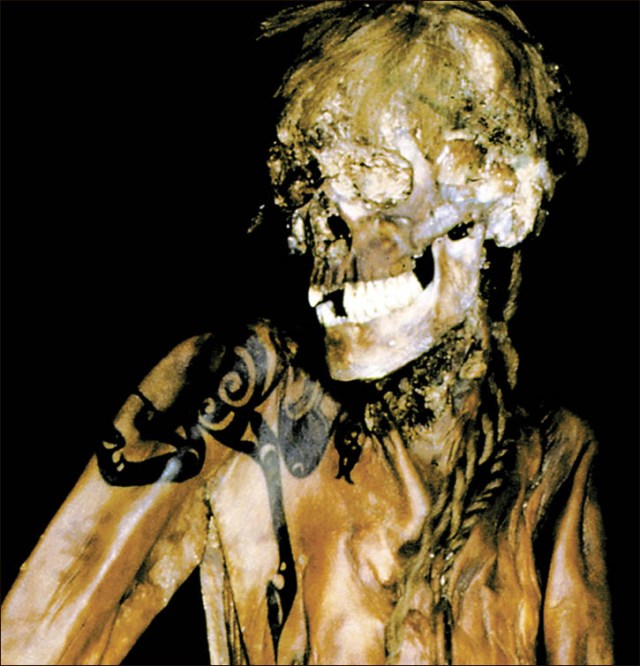

The ancient mummy of a mysterious young woman, known as the Ukok Princess, is finally returning home to the Altai Republic this month.
She is to be kept in a special mausoleum at the Republican National Museum in capital Gorno-Altaisk, where eventually she will be displayed in a glass sarcophagus to tourists.
For the past 19 years, since her discovery, she was kept mainly at a scientific institute in Novosibirsk, apart from a period in Moscow when her remains were treated by the same scientists who preserve the body of Soviet founder Vladimir Lenin.
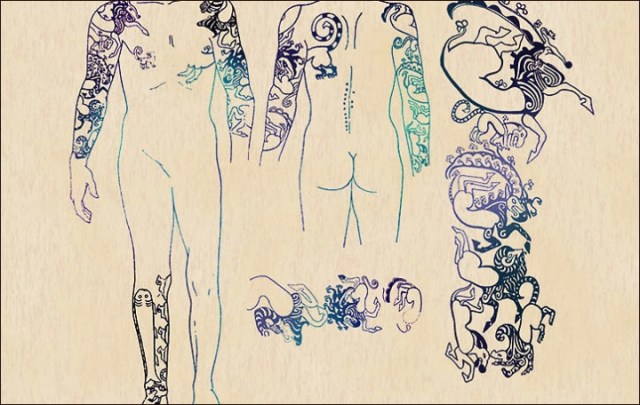
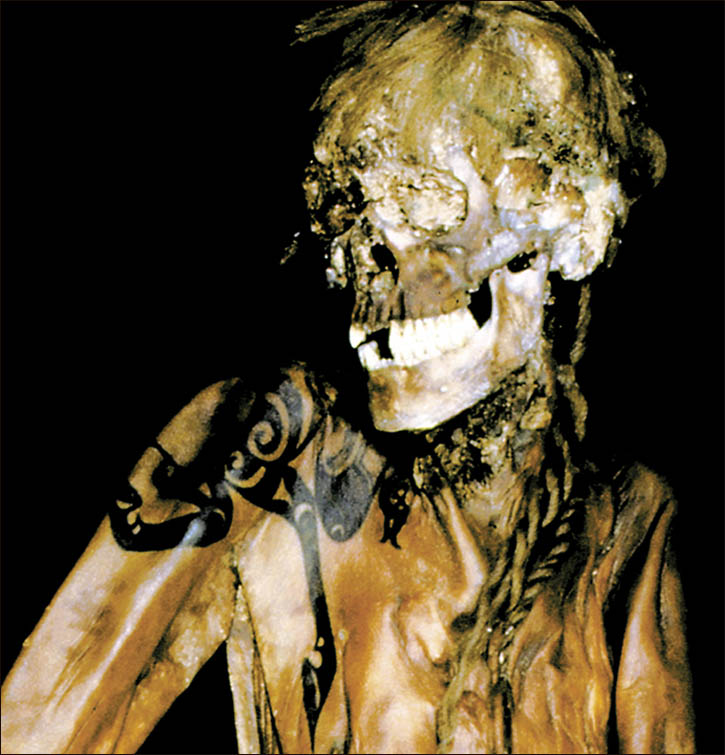
To mark the move ‘home’, The Siberian Times has obtained intricate drawings of her remarkable tattoos, and those of two men, possibly warriors, buried near her on the remote Ukok Plateau, now a UNESCO world cultural and natural heritage site, some 2,500 metres up in the Altai Mountains in a border region close to frontiers of Russia with Mongolia, China and Kazakhstan.
They are all believed to be Pazyryk people – a nomadic people described in the 5th century BC by the Greek historian Herodotus – and the colourful body artwork is seen as the best preserved and most elaborate ancient tattoos anywhere in the world.
To many observers, it is startling how similar they are to modern-day tattoos.
The remains of the immaculately dressed ‘princess’, aged around 25 and preserved for several millennia in the Siberian permafrost, a natural freezer, were discovered in 1993 by Novosibirsk scientist Natalia Polosmak during an archeological expedition.
Buried around her were six horses, saddled and bridled, her spiritual escorts to the next world, and a symbol of her evident status, perhaps more likely a revered folk tale narrator, a healer or a holy woman than an ice princess.
There, too, was a meal of sheep and horse meat and ornaments made from felt, wood, bronze and gold. And a small container of cannabis, say some accounts, along with a stone plate on which were the burned seeds of coriander.
‘Compared to all tattoos found by archeologists around the world, those on the mummies of the Pazyryk people are the most complicated, and the most beautiful,’ said Dr Polosmak.
‘More ancient tattoos have been found, like the Ice Man found in the Alps – but he only had lines, not the perfect and highly artistic images one can see on the bodies of the Pazyryks.
‘It is a phenomenal level of tattoo art. Incredible.’
While the tattoos, preserved in the permafrost, have been known about since the remains were dug up, until now few have seen the intricate reconstructions that we reveal here.
‘Tattoos were used as a mean of personal identification – like a passport now, if you like. The Pazyryks also believed the tattoos would be helpful in another life, making it easy for the people of the same family and culture to find each other after death,’ added Dr Polosmak.
‘Pazyryks repeated the same images of animals in other types of art, which is considered to be like a language of animal images, which represented their thoughts.
‘The same can be said about the tattoos – it was a language of animal imagery, used to express some thoughts and to define one’s position both in society, and in the world. The more tattoos were on the body, the longer it meant the person lived, and the higher was his position.
‘For example the body of one man, which was found earlier in the 20th century, had his entire body covered with tattoos. Our young woman – the princess – has only her two arms tattooed. So they signified both age and status.’
The tattoos on the left shoulder of the ‘princess’ show a fantastical mythological animal: a dear with a griffon’s beak and a Capricorn’s antlers. The antlers are decorated with the heads of griffons. And the same griffon’s head is shown on the back of the animal.
The mouth of a spotted panther with a long tail is seen at the legs of a sheep.
She also has a dear’s head on her wrist, with big antlers. There is a drawing on the animal’s body on a thumb on her left hand.
On the man found close to the ‘princess’, the tattoos include the same fantastical creature, this time covering the right side of his body, across his right shoulder and stretching from his chest to his back.
His chest, arms, part of the back and the lower leg are covered with tattoos. There is an argali – a mountain sheep – along with the same dear with griffon’s vulture-like beak, with horns and the back of its head which has a griffon’s heads and an onager drawn on it.
All animals are shown with the lower parts of their bodies turned inside out. There is also a winged snow leopard, a fish and fast-running argali.
Thanks to Kebmodee for bringing this to the attention of the It’s Interesting community.



 It's Interesting