
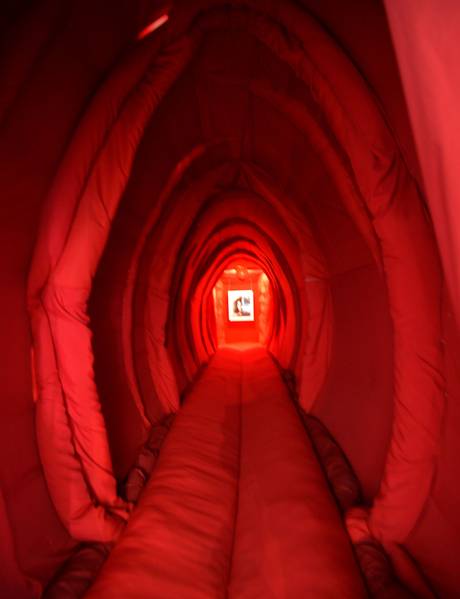
Walk-in screaming vagina installed in previous Johannesburg women’s prison

screaming vagina

A former women’s prison in South Africa which once held Winnie Mandela is now home to a 12m-deep screaming vagina.

Visitors are invited to walk through the artwork, by 30-year-old artist Reshma Chhiba, in a reaction against the former symbol of oppression.

As they do, the scarlet walls ring out with screams and laughter. The “yoni” – the Sanskrit word for vulva, or vagina – is skirted by acrylic wool imitation pubic hair over a tongue-like sponge walkway.

Chhiba said: “It’s a screaming vagina within a space that once contained women and stifled women. It’s revolting against this space… mocking this space, by laughing at it.”

The prison, in the central Johannesburg area of Braamfontein, dates back to 1892, and its Womens’ Prison held Winnie Madikizela-Mandela in 1958, when she was imprisoned for protesting against apartheid segregation, and again in 1976.

The artist said the work also opposes deeply entrenched patriarchal systems, and taboos around the vagina.

“You don’t often hear men talking about their private parts and feeling disgust or shamed,” as women often do, she said.

“And that alone speaks volumes of how we’ve been brought up to think about our bodies, and what I am saying here is that it’s supposed to be an empowering space.”

The artist also said the work aims at respect for the female body, in a country where 65,000 attacks on girls and women are reported annually. Before walking through, visitors have to remove their shoes.

“By talking off your shoes, essentially you are respecting it, making it a divine space, a sacred space,” said Chhiba.

Though the fine art graduate and practising Hindu insisted she “definitely did not make this work for the sake of controversy,” the work has – predictably – sparked a reaction.

Benathi Mangqaaleza, 24-year-old female security guard at the site, which also houses the country’s constitutional court, said: “It’s the most private part of my body. I grew up in the rural areas, we were taught not to expose your body, even your thighs let alone your vagina. I think it’s pornographic, I think they have gone too far.”

Kubi Rama, head of Gender Links, a lobby group promoting gender equality in southern Africa, praised the work, saying: “It is bringing the private into the public, that the woman’s body is not necessarily a private matter.”

http://www.independent.co.uk/arts-entertainment/art/news/walkin-vagina-installed-in-johannesburg-womens-prison-8792192.html

Racism of early Polaroid colour photography explored in art exhibition


Artists spent a month in South Africa taking pictures on decades-old film engineered with only white faces in mind.

Can the camera be racist? The question is explored in an exhibition that reflects on how Polaroid built an efficient tool for South Africa’s apartheid regime to photograph and police black people.

The London-based artists Adam Broomberg and Oliver Chanarin spent a month in South Africa taking pictures on decades-old film that had been engineered with only white faces in mind. They used Polaroid’s vintage ID-2 camera, which had a “boost” button to increase the flash – enabling it to be used to photograph black people for the notorious passbooks, or “dompas”, that allowed the state to control their movements.

The result was raw snaps of some of the country’s most beautiful flora and fauna from regions such as the Garden Route and the Karoo, an attempt by the artists to subvert what they say was the camera’s original, sinister intent.

Broomberg and Chanarin say their work, on show at Johannesburg’s Goodman Gallery, examines “the radical notion that prejudice might be inherent in the medium of photography itself”. They argue that early colour film was predicated on white skin: in 1977, when Jean-Luc Godard was invited on an assignment to Mozambique, he refused to use Kodak film on the grounds that the stock was inherently “racist”.

The light range was so narrow, Broomberg said, that “if you exposed film for a white kid, the black kid sitting next to him would be rendered invisible except for the whites of his eyes and teeth”. It was only when Kodak’s two biggest clients – the confectionary and furniture industries – complained that dark chocolate and dark furniture were losing out that it came up with a solution.

The artists feel certain that the ID-2 camera and its boost button were Polaroid’s answer to South Africa’s very specific need. “Black skin absorbs 42% more light. The button boosts the flash exactly 42%,” Broomberg explained. “It makes me believe it was designed for this purpose.”

In 1970 Caroline Hunter, a young chemist working for Polaroid in America, stumbled upon evidence that the company was effectively supporting apartheid. She and her partner Ken Williams formed the Polaroid Workers Revolutionary Movement and campaigned for a boycott. By 1977 Polaroid had withdrawn from South Africa, spurring an international divestment movement that was crucial to bringing down apartheid.

The title of the exhibition, To Photograph the Details of a Dark Horse in Low Light, refers to the coded phrase used by Kodak to describe a new film stock created in the early 1980s to address the inability of earlier films to accurately render dark skin.

The show also features norm reference cards that always used white women as a standard for measuring and calibrating skin tones when printing photographs. The series of “Kodak Shirleys” were named after the first model featured. Today such cards show multiple races.

Broomberg and Chanarin made two recent trips to Gabon to photograph a series of rare Bwiti initiation rituals using Kodak film stock, scavenged from eBay, that had expired in 1978. Working with outdated chemical processes, they salvaged just a single frame. Broomberg said: “Anything that comes out of that camera is a political document. If I take a shot of the carpet, that’s a political document.”

http://www.guardian.co.uk/artanddesign/2013/jan/25/racism-colour-photography-exhibition

South Africans offered free phone for every 60 rats caught


Alexandra’s discarded piles of rotting food and leaking sewage have become a perfect breeding ground for rats.
 
As it was in medieval Hamelin, so it is today in the South African township of Alexandra: wherever you go, you are never far from a rat.

But residents of the Johannesburg suburb have been offered a deal unavailable in the era of the Pied Piper – a free mobile phone for every resident who catches 60 of the rodents.

Alexandra has just turned 100 years old and was the young Nelson Mandela’s first home when he moved to Johannesburg. Its cramped shacks and illegal rubbish dumps sit in brutal contrast with neighbouring Sandton, dubbed the wealthiest square mile in Africa.

The crumbling structures, leaking sewage and discarded piles of rotting food are a perfect breeding ground for rats, much to the torment of residents. There have reportedly been cases of children’s fingers being bitten while they sleep.

In an attempt to fight back, city officials have distributed cages and the mobile phone company 8ta has sponsored the volunteer ratcatchers.

Resident Joseph Mothapo says he has won two phones and plans to get one for each member of his family. “It’s easy,” he told South Africa’s Mail & Guardian newspaper, wielding a large cage containing rats. “You put your leftover food inside and the rats climb in, getting caught as the trap door closes.”

But there were signs that the PR stunt could backfire, as animals rights activists criticised the initiative on social networks.

On Monday 8ta denied responsibility for the initiative. It said it was a long-time sponsor of a charity called Lifeline, which had taken the decision to hand out phones.

“You will have to ask Lifeline why they decided to use these promotional products,” said Pynee Chetty, an 8ta spokesman. “They do a lot of good community work, including in Alexandra. They used the promotional material to incentivise members of the community. I wasn’t aware this is how they were going to resolve the problem [of rats].”

He added: “We won’t distance ourselves from Lifeline. It is a charity that does a lot of good work and our support for them is steadfast. I don’t want to deny the story. What I’m saying is that it’s not our initiative.”

The Mail and Guardian reported that thousands of rats have been gassed to death by a specialist, Ashford Sidzumo, at the local sports centre. “We record all the people’s details so we can see where the rats are causing the biggest problem,” he was quoted as saying. “We use this to send fumigation teams there.”

Local councillor Julie Moloi told the Mail & Guardian there had been no choice but to carry out the drastic experiment. “We are afraid these rats will take over Alex and it will become a city of rats,” she said.

In another measure, owls have been given to three local schools because of their rat-catching prowess. But wider deployment of the birds may be difficult: Moloi said people kill them because of traditional beliefs that they are to be feared.