

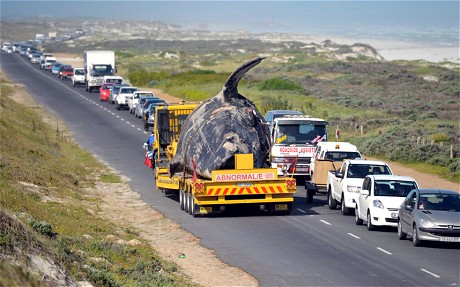

South African council cleaners have used a lorry to move a stranded whale from a beach near Cape Town. Officials pulled the huge mammal through heavy traffic down a busy road along the city’s False Bay coastline. Salvage staff needed an industrial digger to move the 30 metre southern Right Whale, which became stranded on Sunday at Cape Town’s Capricorn beach.
City emergency services spokesman Wilfred Solomons-Johannes confirmed the beach had been closed amid fears deadly Great White sharks had entered shallow waters to feed on the carcase. He said: “The whale was spotted on the beach on Sunday afternoon. “It had become beached and was dead by the time officials could get to it. The animal had several bits of flesh taken out of it, and it appears it had been bitten by sharks.” He added: “We called in the city’s specialist marine rescue team, who used diggers and a lorry to remove the whale.
“It was heaved onto the back of a truck and taken to a landfill site for disposal.”
Mr Solomons-Johannes said experts would examine the dead animal to try to establish how it died. He added: “Samples were taken from the whale and these will be analysed to try to work out what happened to it. We hope to get the results within the next couple of days, which may help to explain why it died.”
City officials closed several beaches around Cape Town on Sunday after sharks were spotted in waters close to the beached whale.
Mr Solomons-Johannes on Tuesday confirmed some had reopened following the removal of the carcase but said Capricorn beach itself would remain closed until further notice. He said: “Capricorn beach remains closed for the next few days until the whale blood and oil has dispersed sufficiently.
“The city is appealing to all water users to be vigilant at this time, obey the shark siren, and to take note of the Shark Spotters’ flags and signage for regular updates on shark sightings. Beach users are advised that the general caution will remain in place until further notice.”
Specialist teams of Shark Spotters were working on several of Cape Town’s beaches to watch for any signs of the deadly animals. The killer beasts are frequent visitors to the waters around the city and have been responsible for a string of attacks on humans.
British man Michael Cohen, 47, narrowly escaped with his life in September 2011 after he was bitten by a shark on a beach near Cape Town. The keen swimmer lost his right leg and part of his left foot after being savaged in the False Bay water.
Zimbabwean tourist Lloyd Skinner was eaten alive by sharks in January 2010 as he swam near the town of Fish Hoek. Shocked holiday-makers watched from the shore as he was pulled underwater, and rescuers later recovered only his goggles.
Southern Right whales are also regularly seen in the sea around Cape Town.
The massive mammals spend most of their time in the deep ocean but move towards the Cape peninsula during winter and spring to mate.
http://www.telegraph.co.uk/earth/wildlife/9596404/South-African-whale-driven-through-streets.html

 It's Interesting