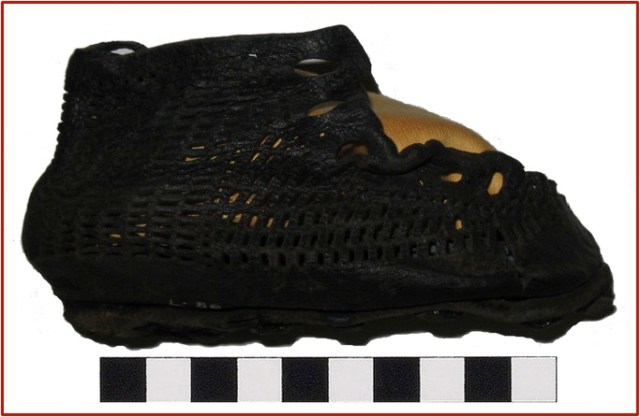
Children and infants living in and around Roman military bases around the first century wore shoes that revealed the kids’ social status, according to new research presented at the annual meeting of the Archaeological Institute of America. The teeny-tiny shoes, some sized for infants, not only reveal that families were part of Roman military life, but also show that children were dressed to match their parent’s place in the social hierarchy, said study researcher Elizabeth Greene of the University of Western Ontario.
“The role of dress in expressing status was prominent even for children of the very youngest ages,” Greene said.
Just as today’s modern kid might rock a pair of shoes covered in their favorite superheroes, or that light up with every step, ancient Roman kids of well-off families wore more decorative shoes than their commoner contemporaries, Greene’s research reveals. Over 4,000 shoes have been found at Vindolanda, a Roman army fort in northern Britain that was occupied from the first to fourth centuries.
In every time period of the fort’s operation, even the very early frontier days, children’s shoes show up in crumbled domestic spaces, official military buildings and rubbish heaps, Greene said.
“We don’t even have a period, not even Period 1, where we’re free of children’s shoes,” she said.
From this pile of footwear, Greene and her colleagues traced what types of children’s shoes were found where. They discovered that the decorations on the shoes corresponded to the places they were uncovered. In the barracks, for example, children’s shoes mimicked the common boot of adult soldiers.
Thanks to wooden tablets found at the site, the researchers know which building housed Flavius Cerialis, the prefect of the Ninth Cohort of Batavians around A.D. 100. Flavius’ family, including his wife, Sulpicia Lepidina, may have had a role in public life around the base, Greene said. Supporting this idea, the house contained an elaborate infant shoe in the exact style of a high-status man’s boot.
The shoe is for a child too young to walk, but it boasts a full set of iron studs on the sole, just as a man’s boot would. The expensive material suggests the shoe was high quality, Greene said. The upper part of the shoe is leather, cut into an elaborate fishnet pattern. Not only does the pattern show off workmanship, it would have revealed colored socks underneath, which the ancient Romans also used to denote status.
Such a shoe for an infant suggests the owner wore formal dress and would have been shown off at parades and similar events, Greene said. Even as a baby, the offspring of the base’s bigwig would have been expected to follow in his footsteps.
Elsewhere around the base, shoes were less elaborate. Sixteen children’s shoes with at least partially intact upper sections were found in the barracks from the period of about A.D. 105 to A.D. 120. Many were the basic “fell boot” of the Roman military, a simple, high-ankle shoe without decoration. Other shoes found around the base were equipped with “carbatina,” the Roman equivalent of Velcro. These simple shoes were worn by men, women and children and were easily laced and slipped on and off, Greene said. The shoes could also be tightened or loosened, extending their use for a growing child.
In the centurion, or officer’s quarters, archaeologists found two carbatina shoes with more-complex patterning than usual, again supporting the notion that higher-status parents dressed their children in nicer shoes.
Only one shoe, an infant’s that was found in the barracks, did not fit this pattern, Greene said. The sandal uses little leather, so may not have been expensive, but it does have decorative triangular tabs and rosette patterns unusual for the shoe of a soldier’s child. Researchers aren’t sure why this one odd shoe was in the barracks. [Photos: Gladiators of the Roman Empire]
On the whole, however, the shoes show that families accompanied soldiers and had a role in military life, even from the earliest days of occupation, Greene said. What’s more, their children were locked into their social class early on.
“Even the infant children of the prefect were held to the expectations of dress according to one’s class,” Greene said.
http://www.livescience.com/26047-roman-kids-shoes-statues.html


 It's Interesting