
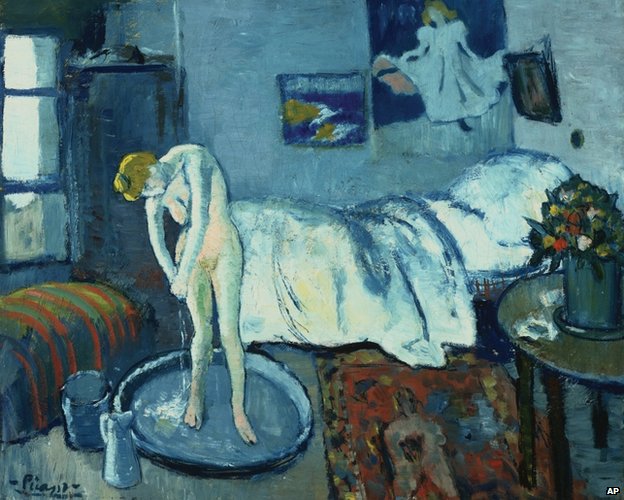
The Blue Room features a nude woman bathing in Picasso’s studio.

Infrared technology revealed it had another image below the surface.

When the image was turned on its side, it revealed a portrait of a man.
A hidden painting has been found by scientists beneath the brush strokes of The Blue Room, a 1901 Picasso artwork.
Art experts and conservators at The Phillips Collection in Washington used infrared technology on the masterpiece, revealing a bow-tied man with his face resting on his hand.
Picasso created both works in Paris during his famous blue period.
“It’s really one of those moments that really makes what you do special,” said conservator Patricia Favero.
Acknowledged as one of the 20th Century’s greatest artists, Pablo Picasso focused on monochromatic paintings in shades of blue and blue-green during his blue period from 1900 to 1904.
The Blue Room has been the subject of exploration since 2008 by experts from the Phillips Collection, National Gallery of Art, Cornell University and Delaware’s Winterthur Museum.
Improved infrared imagery allowed them to see a man wearing a jacket and bow tie, resting his bearded face on his hand with three rings on his fingers.
Technical analysis confirmed the hidden portrait was likely to have been painted just before The Blue Room.
Favero added that, having found the second image back in 2008, they then wanted to know who the man was.
“We’re still working on answering that question,” she said.
Curator Susan Behrends Frank told press agency AP: “When he [Picasso] had an idea, you know, he just had to get it down and realise it,” explaining that the artist had quickly painted over another completed picture when the inspiration took him.
“He could not afford to acquire new canvasses every time he had an idea that he wanted to pursue. He worked sometimes on cardboard because canvas was so much more expensive.”
The Blue Room has been part of the Phillips Collection since 1927.
Conservators suspected back in 1954 it may have had another painting below its surface, as brushstrokes did not match the composition of a woman bathing in Picasso’s studio.
But it was not until the 1990s that an X-ray revealed a “fuzzy image” of something under the main image.
Research on The Blue Room will continue and curators have planned a 2017 exhibition focusing on the painting and the portrait beneath it. It is also part of a tour to South Korea in 2015.
This is not the first time a hidden image has been found beneath a Picasso artwork.
A technical analysis of La Vie at the Cleveland Museum of Art revealed he had reworked the painting’s composition, while a moustached man was found beneath the painting Woman Ironing at Manhattan’s Guggenheim Museum.
 It's Interesting