Whale watchers look the wrong way as huge humpback leaps out of ocean

whale_2416552b

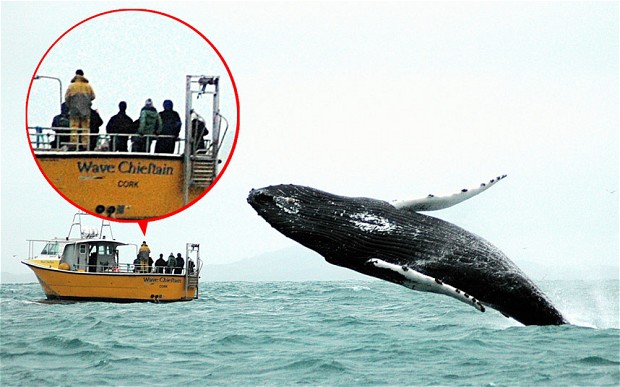
A 45-foot humpback whale leapt above the waves as group of nature lovers gazed the wrong way this past weekend off the Atlantic coast of Ireland.

A cameraman caught the “whale ahoy” moment off Baltimore in west Cork where marine enthusiasts have been cruising the waters hoping to sight a group of five humpbacks that have been feeding on local shoals of sprat and herring for the last two weeks.

The presence of the humpbacks, breaching the waves with their 30-tonne bodies in pursuit of fish, has triggered a mini-tourism boom as people flock to the village to charter local boats in search of the whales.

Simon Duggan, 44, a local photographer and RNLI Lifeboat crew member, took a series of photographs of the humpbacks “bubble feeding” – the hunting technique where whales dive under a shoal of fish, releasing air bubbles to confuse their prey and bunch them together.

After herding and confusing the fish, the whales use their powerful bodies to surge upwards through the shoal with their mouths wide open to scoop up as many sprat or herring as possible.

After taking the picture of the humpback fully breaching the water after hoovering up its prey, a rare and spectacular display of the cetacean’s hunting prowess, Mr Duggan noticed that another boat of whale watchers had missed their moment.

“It happened so fast – the adrenalin was going,” he said. “When I looked at the photo I realised everyone else was looking the wrong way.”

http://www.telegraph.co.uk/earth/wildlife/9719020/Whale-watchers-look-the-wrong-way-as-huge-humpback-leaps-out-of-ocean.html

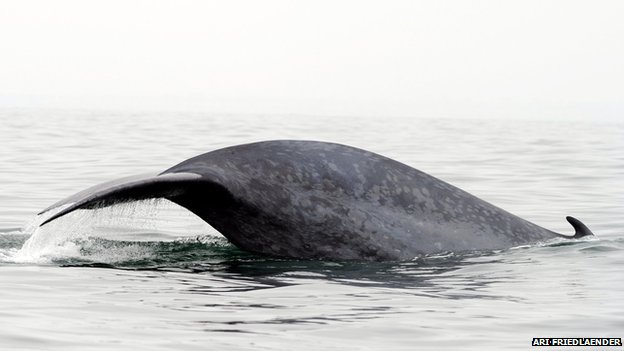
Blue whales perform underwater acrobatics to attack their prey from below


The massive mammals are known for lunge-feeding; gulping up to 100 tonnes of krill-filled water in less than 10 seconds.

Using suction cup tags, US researchers have recorded the surprising manoeuvrability of the giants.

They found that the whales roll 360 degrees in order to orientate themselves for a surprise attack.

The results are published in the Royal Society journal Biology Letters by Dr Jeremy Goldbogen and colleagues for the Cascadia Research Collective based in Washington, US.

“Despite being the largest animals to have ever lived, blue whales still show an impressive capacity to perform complex manoeuvres that are required to efficiently exploit patches of krill,” said Dr Goldbogen.

Blue whales feed exclusively on krill: small crustaceans that have excellent escape responses, requiring the mammals to have efficient foraging strategies to be able to meet their energy demands.

To understand how these giants manage to capture prey, despite their size reducing their mobility, Dr Goldbogen and his team tagged a group of animals off the coast of southern California, US.

Using suction cups to safely attach the acoustic recording tags without harming the animals, the team were able to track the whales’ movements with the help of underwater microphones.

Results revealed that the whales were executing impressive spins below the waves in order to access large patches of krill.

“As the blue whale approaches the krill patch, the whale uses its flippers and flukes to spin 180 degrees so that the body and jaws are just beneath the krill patch,” explained Dr Goldbogen.

“At about 180 degrees, the mouth just begins to open so that the blue whale can engulf the krill patch from below.

As the blue whale engulfs the prey-laden water, it continues to roll in the same direction and completes a full 360 roll and becomes horizontal again ready to target and attack the next krill patch.”

The researchers were able to record video footage of the impressive acrobatics using a video camera worn by another animal to capture natural behaviour.

“We did not expect to see these types of manoeuvres in blue whales and it was truly extraordinary to discover,” said Mr Goldbogen.

Previous research has identified similar behaviour in other rorqual whale species such as humpback whales, but these animals rarely exceed 150 degree turns.

In these smaller whale species the ability to twist and turn was attributed to long fins and tail flukes.

For blue whales however, scientists suggest the extra effort of turning rewards the massive mammals with enormous meals.

They also propose that the acrobatics optimise the animals’ field of view.

“As in all cetaceans, [blue whales’] eyes are positioned laterally, and thus rolling the body should enhance panoramic vision in multiple dimensions,” the study reported.

Dr Goldbogen commented that the results will fuel further research into the complex behaviour of whales, especially regarding predator-prey interactions.

“This extraordinary ability is only a glimpse into the diverse repertoire of manoeuvring behaviours performed by foraging animals,” he told BBC Nature.

“Future tagging work has the potential to reveal many more unique insights into the daily lives of animals in their natural environment.”

http://www.bbc.co.uk/nature/20509831

World’s rarest whale seen for the first time

The world’s rarest whale, previously only known from a few bones, was seen for the first time on a New Zealand beach, according to a new Current Biology paper.

The elusive marine mammal is the spade-toothed beaked whale (Mesoplodon traversii). The good news is that it was seen at all, revealing that it still exists. The bad news is that the sighting was of a mother and her male calf, both of which became stranded and died on the beach.

NEWS: A Whale with a Human Voice

“This is the first time this species — a whale over five meters (about 16.5 feet) in length — has ever been seen as a complete specimen, and we were lucky enough to find two of them,” Rochelle Constantine of the University of Auckland said in a press release. “Up until now, all we have known about the spade-toothed beaked whale was from three partial skulls collected from New Zealand and Chile over a 140-year period. It is remarkable that we know almost nothing about such a large mammal.”

The discovery actually happened two years ago, when the whales live-stranded and died on Opape Beach, New Zealand. It’s only after DNA analysis that the identification of the rare species was made. At first, they were incorrectly identified as being the much more common Gray’s beaked whales.

“When these specimens came to our lab, we extracted the DNA as we usually do for samples like these, and we were very surprised to find that they were spade-toothed beaked whales,” Constantine said. “We ran the samples a few times to make sure before we told everyone.”

BLOG: What Noise Annoys a Blue Whale Most

Constantine suspects that the whales “are simply an offshore species that lives and dies in the deep ocean waters and only rarely wash ashore. New Zealand is surrounded by massive oceans. There is a lot of marine life that remains unknown to us.”

http://news.discovery.com/animals/worlds-rarest-whale-seen-for-the-first-time-121105.html


Thanks to A.R. for bringing this to the attention of the It’s Interesting community.

Captive Beluga Whale Imitated Human Voices

“Who told me to get out?” asked a diver, surfacing from a tank in which a whale named NOC lived. The beluga’s caretakers had heard what sounded like garbled phrases emanating from the enclosure before, and it suddenly dawned on them that the whale might be imitating the voices of his human handlers.

The outbursts — described today in Current Biology and originally at a 1985 conference — began in 1984 and lasted for about four years, until NOC hit sexual maturity, says Sam Ridgway, a marine biologist at National Marine Mammal Foundation in San Diego, California. He believes that NOC learned to imitate humans by listening to them speak underwater and on the surface.

A few animals, including various marine mammals, songbirds and humans, routinely learn and imitate the songs and sounds of others. And Ridgway’s wasn’t the first observation of vocal mimicry in whales. In the 1940s, scientists heard wild belugas (Delphinapterus leucas) making calls that sounded like “children shouting in the distance”. Decades later, keepers at the Vancouver Aquarium in Canada described a beluga that seemed to utter his name, Lagosi.

Ridgway’s team recorded NOC, who is named after the tiny midges colloquially known as no-see-ums found near where he was legally caught by Inuit hunters in Manitoba, Canada, in the late 1970s. His human-like calls are several octaves lower than normal whale calls, a similar pitch to human speech. After training NOC to ‘speak’ on command, Ridgway’s team determined that he makes the sounds by increasing the pressure of the air that courses through his naval cavities. They think that he then modified the sounds by manipulating the shape of his phonic lips, small vibrating structures that sit above each nasal cavity.

“We do not claim that our whale was a good mimic compared to such well known mimics as parrots,” but it is an example of vocal learning nonetheless, the paper concludes. “It seems likely that NOC’s close association with humans played a role in how often he employed his human voice, as well as in its quality.”

Andy Foote, a marine ecologist at the University of Copenhagen who has studied vocal learning in killer whales, agrees that NOC’s calls sound human. Belugas are known as the ‘canaries of the sea,’ because of the wide range of their vocal calls. Killer whales, by contrast, produce a more limited range of sounds that rarely stray from the calls of their group, Foote notes, which could explain why Shamu and other captive orcas have never mimicked human speech.

Those looking to hear NOC for themselves will have to settle for these recordings. He died several years ago.

This article is reproduced with permission from the magazine Nature. NOC’s audio recording and the article was first published on October 22, 2012.

Choreography of submerged whale lunges revealed


Returning briefly to the surface for great lungfuls of air, the underwater lifestyles of whales had been a complete mystery until a small group of pioneers from various global institutions – including Malene Simon, Mark Johnson and Peter Madsen – began attaching data-logging tags to these enigmatic creatures. Knowing that Jeremy Goldbogen and colleagues had successful tagged blue, fin and humpback whales to reveal how they lunge through giant shoals of krill, Simon and her colleagues headed off to Greenland where they tagged five humpback whales to discover how the animals capture and consume their prey: krill and agile capelin. Attaching individual tags behind the dorsal fin on three of the whales – to record their stroke patterns – and nearer the head in the remaining whales – to better measure head movements – the team successfully recorded high resolution depth, acceleration and magnetic orientation data from 479 dives to find out more about the animals’ lunge tactics. Simon, from the Greenland Institute of Natural Resources, Madsen, from Aarhus University, Denmark and Johnsen from the University of St. Andrews, UK, report how whales choreograph their foraging lunges at depth in The Journal of Experimental Biology.

Analysing the ‘ acceleration patterns, Simon saw that as the whales initiated a lunge, they accelerated upward, beating the (flukes) twice as fast as normal to reach speeds of 3m/s, which is not much greater than the whales’ top cruise speeds. However, while the animals were still beating their flukes, the team saw their speed drop dramatically, although the whales never came to a complete standstill, continuing to glide at 1.5m/s even after they stopped beating their flukes. So, when did the whales throw their mouths open during this sequence?

Given that the top speed attained by the whales during the early stages of the lunge were similar to the animals’ cruising speeds and the fact that the whales were beating their flukes much harder than usual to maintain the speed, the team conclude, ‘The implication is that the mouth must already be open and the buccal [mouth] pouch inflated enough to create a higher drag when the high stroking rates… occur within lunges’. In addition, the team suggests that the whales continue accelerating after opening their mouths in order to use their peak speed to stretch the elastic ventral groove blubber that inflates as they engulf water. Once the buccal pouch is fully inflated, the whales continue beating their flukes after closing their mouths to accelerate the colossal quantity of water, before ceasing fluke movement and slowing to a new speed of 1.5m/s. Finally, the animals filter the water and swallow the entrapped fish over a 46s period before resuming beating their flukes as they launch the next lunge.

Considering that and other rorquals were thought to grind to a halt after throwing their jaws wide and that reaccelerating their massive bodies from a stationary start was believed to make lunge feeding extortionately expensive, the team’s discovery that the animals continue gliding after closing their mouths suggests that lunge feeding may be cheaper than previously thought. However, the team concedes that despite the potential reduction in energy expenditure, lunge feeding is still highly demanding – the whale must accelerate the 30 tons of water held in its mouth – although they suggest that the high-speed tactic is essential for the massive hunters to engulf their nimble prey.

More information: Simon, M., Johnson., M. and Madsen, P. T. (2012) Keeping momentum with a mouthful of water: behavior and kinematics of humpback whale lunge feeding. J. Exp. Biol. 215, 3786-3798. jeb.biologists.org/content/215/21/3786.abstract

Whale sculpture made from recycled bags

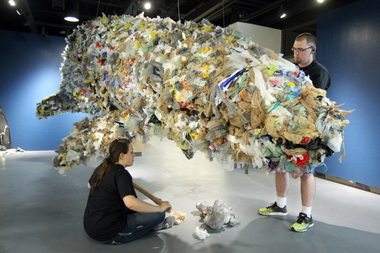
Inspired by the stomach contents of a dead gray whale that washed up in Seattle a couple years ago, an art professor has created a baby whale from recycled plastic bags.

Art professor Marie Weichman told the Kitsap Sun (is.gd/a7rz9H) she got the idea for the exhibit after hearing about the debris found in the stomach a dead gray whale that washed ashore in Seattle in 2010.

That debris included sweatpants, a golf ball, surgical gloves, small towels, bits of plastic and more than 20 plastic bags, according to reports at the time.

The sculpture became a project for art, marine-science and design students. It goes on display Thursday in the college’s Art Building.

http://seattletimes.com/html/localnews/2019324170_recycledwhale03.html

Scientists to sink a dead whale to study zombie worms that eat their bones

Scientists are planning to conduct what would be the first study in UK deep waters of creatures known as “zombie worms” that eat bones of dead whales.

The research would involve sinking a whale carcass, potentially at a location off the coast of Scotland.

Similar work has been done in Sweden, Japan and off California in the US.

Dr Nick Higgs, a researcher at the Natural History Museum, and Dr Kim Last, of the Scottish Association for Marine Science, hope to do the study.

The worms from the Osedax genus were only discovered in 2004.

New discoveries of the creatures are still being made. Scientists are also trying to better understand how the worms find dead whales.

The worms do not have a mouth or gut and use root-like tissue to bore into and eat bones.

Large marine mammals that die and sink to sea floors in deep water become a food source for various forms of wildlife.

Called whale-fall, the layers of blubber, internal organs and bones can provide sustenance for many years.

Studies of what happens to dead whales, dolphins and porpoises have been done in the UK, but only in shallow water where the worms have not yet been found.

Dr Higgs, a researcher in the deep sea who works from London, and Oban-based marine chronobiology investigator Dr Last, have hopes of carrying out the UK’s first deep water investigation.

It would involve sinking a whale that has died in a stranding.

Dr Higgs said it was possible this could be done off Scotland, and with cameras to monitor what happens to the animal.

Deliberately sinking a dead whale is done for scientific studies because it is so rare to find the carcasses at sea.

Dr Higgs said: “We have a good idea of how to do it. It’s pretty straight-forward really.

“You just have to make sure the carcass doesn’t bloat up too much and then attach a large amount of weight to the back of it and let it sink.”

The scientist said sinking stranded whales could be an alternative to cutting them up and incinerating the animals.

Scottish local authorities have spent between £10,000 and £50,000 dealing with dead sperm and pilot whales in this way.

Dr Higgs said: “From what I can gather, sinking would be in order of £10,000 to £15,000.

“I am not saying we should sink every whale that washes up on UK shores, but in some cases it could be cheaper than a disposal costing £50,000 and would also help science.”

http://www.bbc.co.uk/news/uk-scotland-highlands-islands-19517079


16 whales dies in mass beaching in Scotland


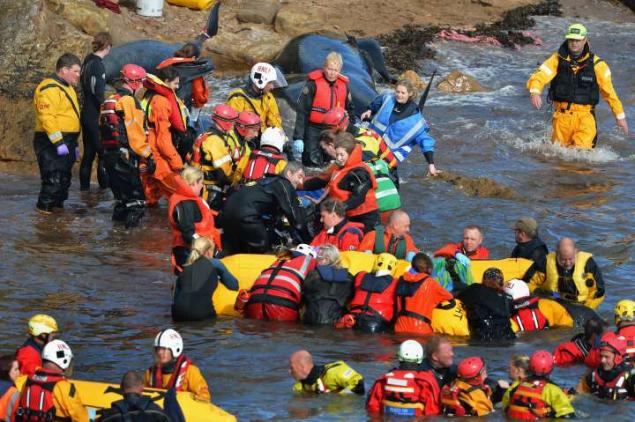
Sixteen whales were killed and ten others saved in a mass beaching on Scotland’s east coast on Sunday, authorities said.

The 20-foot pilot whales became stranded in a small cove in the county of Fife – home to the famed Old Course at St. Andrew’s golf course — at around 7 a.m. local time, The Scotsman newspaper reported.

Volunteers, coast guardsmen, firefighters and local vets scrambled to rescue the poor beasts from the shallow North Sea waters.

“I went down to the beach at about 12 p.m. and I could see all the whales. It was horrible. I have never seen anything like it in my life,” David Galloway, a local fish cutter, told The Scotsman.

“We were told we couldn’t go down on to the beach, but we could see rescuers beside the whales, they were trying to take care of them, trying to keep them moist, he said.

“They were waiting for the tide to come in. It was just horrible.”

The rescue operation drew a large crowd to the windswept beach, prompting the coast guard to urge would-be volunteers to stay away.

The whales may have become stranded after the lead whale got sick or lost its way, officials told the newspaper.

Three of the whales that died were calves.

The ones that were saved were being monitored for 24 hours to make sure they didn’t wash ashore again, BBC reported.

“It is a very rare occurrence in Scotland and very sad,” a coast guard spokeswoman told The Scotsman.

Read more: http://www.nydailynews.com/news/world/16-whales-die-mass-beaching-scotland-article-1.1150716#ixzz25o3LI3u2

8 year old boy finds sperm whale vomit worth over $60,000

A 8-year-old schoolboy could be in the money after discovering a rare piece of whale vomit worth £40,000 ($63,462) on his local beach.

Charlie Naysmith found the ambergris, the technical term for the substance vomited or excreted by sperm whales, while walking along Hengistbury Head, near Bournemouth.

The Daily Mail reports that the lump is potentially worth £40,000 – a pound of ambergris sells for as much as £6,300 ($10,000).

Charlie’s father Alex said that they have contacted the authorities to find out more background on the unusual find:  ‘He is into nature and is really interested in it.
“We have discovered it is quite rare and are waiting for some more information from marine biology experts.”

The substance is sought-after by perfume-makers as it has traditionally been added to fragrances to prolong the scent.

During the time of the Black Plague, it was believed that carrying a ball of ambergris would prevent the spread of the disease, due to the fragrance covering the smell of the air.

Charlie has reportedly said that he is thinking of putting his new-found riches into an animal shelter.

http://www.digitalspy.com/odd/news/a403215/8-year-old-finds-chunk-of-whale-vomit-worth-gbp40000.html

Newly-discovered grapefruit-sized organ helps whales lunge-feed


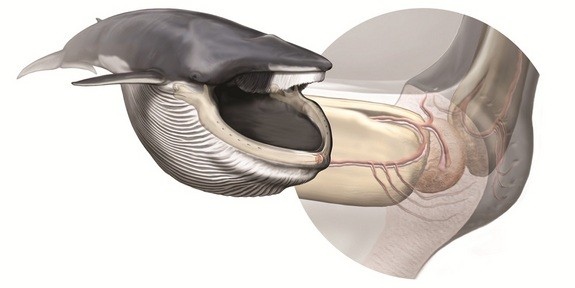
A new sensory organ has been discovered in the jaws of giant whales that may help them “lunge-feed” to swallow huge numbers of crustaceans and small fish.

The grapefruit-sized organ has protrusions filled with nerves and is suspended in a gel-like material.

Scientists believe it responds to jaw rotation when a whale opens and closes its mouth, and expands its vast throat pouch to take in water, but they are still trying to understand precisely how this lunge-feeding mechanism works.

“We think this sensory organ sends information to the brain in order to co-ordinate the complex mechanism of lunge-feeding, which involves rotating the jaws, inverting the tongue and expanding the throat pleats and blubber layer,” said lead researcher Dr Nick Pyenson, from the Smithsonian Institution in Washington, DC.

Rorqual whales, which include blue, fin, minke and humpback whales, feed by lunging forward and gulping more than their own body weight of water.

Millions of krill, tiny crustaceans, and small fish are then filtered out in a process that takes seconds.

Co-author Professor Bob Shadwick, from the University of British Columbia in Canada, said: “In terms of evolution, the innovation of this sensory organ has a fundamental role in one of the most extreme feeding methods of aquatic creatures.

“Because the physical features required to carry out lunge-feeding evolved before the extremely large body sizes observed in today’s rorquals, it’s likely that this sensory organ – and its role in co-ordinating successful lunging – is responsible for rorquals claiming the largest-animals-on-Earth status.

“This also demonstrates how poorly we understand the basic functions of these top predators of the ocean and underlines the importance for biodiversity conservation.”

http://www.iol.co.za/the-star/grapefruit-sized-organ-helps-whales-swallow-big-mouthfuls-1.1304478