South African whale driven through streets

beachedwhale1 beachedwhale2 beachedwhale3


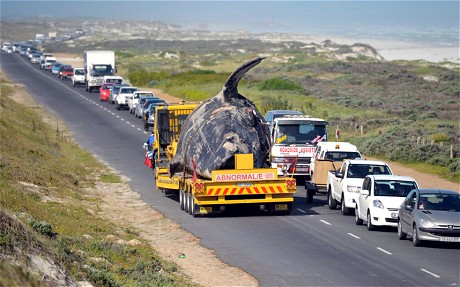
South African council cleaners have used a lorry to move a stranded whale from a beach near Cape Town.  Officials pulled the huge mammal through heavy traffic down a busy road along the city’s False Bay coastline.  Salvage staff needed an industrial digger to move the 30 metre southern Right Whale, which became stranded on Sunday at Cape Town’s Capricorn beach.

City emergency services spokesman Wilfred Solomons-Johannes confirmed the beach had been closed amid fears deadly Great White sharks had entered shallow waters to feed on the carcase.  He said: “The whale was spotted on the beach on Sunday afternoon. “It had become beached and was dead by the time officials could get to it.  The animal had several bits of flesh taken out of it, and it appears it had been bitten by sharks.”  He added: “We called in the city’s specialist marine rescue team, who used diggers and a lorry to remove the whale.

“It was heaved onto the back of a truck and taken to a landfill site for disposal.”

Mr Solomons-Johannes said experts would examine the dead animal to try to establish how it died.  He added: “Samples were taken from the whale and these will be analysed to try to work out what happened to it.  We hope to get the results within the next couple of days, which may help to explain why it died.”

City officials closed several beaches around Cape Town on Sunday after sharks were spotted in waters close to the beached whale.

Mr Solomons-Johannes on Tuesday confirmed some had reopened following the removal of the carcase but said Capricorn beach itself would remain closed until further notice.  He said: “Capricorn beach remains closed for the next few days until the whale blood and oil has dispersed sufficiently.

“The city is appealing to all water users to be vigilant at this time, obey the shark siren, and to take note of the Shark Spotters’ flags and signage for regular updates on shark sightings.  Beach users are advised that the general caution will remain in place until further notice.”

Specialist teams of Shark Spotters were working on several of Cape Town’s beaches to watch for any signs of the deadly animals.  The killer beasts are frequent visitors to the waters around the city and have been responsible for a string of attacks on humans.

British man Michael Cohen, 47, narrowly escaped with his life in September 2011 after he was bitten by a shark on a beach near Cape Town.  The keen swimmer lost his right leg and part of his left foot after being savaged in the False Bay water.

Zimbabwean tourist Lloyd Skinner was eaten alive by sharks in January 2010 as he swam near the town of Fish Hoek.  Shocked holiday-makers watched from the shore as he was pulled underwater, and rescuers later recovered only his goggles.

Southern Right whales are also regularly seen in the sea around Cape Town.

The massive mammals spend most of their time in the deep ocean but move towards the Cape peninsula during winter and spring to mate.

http://www.telegraph.co.uk/earth/wildlife/9596404/South-African-whale-driven-through-streets.html

Live shark mysteriously found on California golf course 4 miles from the coast

It wasn’t raining cats and dogs at a California golf course on Monday – it was raining sharks.

A live leopard shark was discovered thrashing about on the grass at around 4pm at the San Juan Hills golf club in San Juan Capistrano, which is four miles from the coast.

The sea creature was spotted by a startled golf club marshall near the 12th tee box, where a group of golfers had just been playing.

‘Shark falling from the sky, kind of odd,’ said Melissa McCormack, director of club operations at San Juan Hills.

Ms McCormack believes the two-foot-long shark may have been scooped out of the ocean by a predatory bird and dropped onto the golf course.

The creature had two puncture wounds near its dorsal fin and was covered in blood when it was found.

The staffer who came upon the shark picked it up, put it in the back of his golf cart and drove it to the clubhouse.

‘It was just wriggling around. He needed to get to the ocean right away,’ Ms McCormack told The Capistrano Dispatch. ‘Honestly, this is the weirdest thing that’s happened here.’

Golf club: A group of golfers had been playing the tee just before the mysterious shark was discovered at the club, pictured 
Map: The creature had two puncture wounds near its dorsal fin and was covered in blood when it was found at the 12th tee


She and the marshall, Bryan Stizer, gave the shark a quick dip in a bucket of fresh water and salt, as they weren’t sure if the fish would survive if placed in a tank of fresh water.

They then drove the shark out to the nearby ocean.

Still alive, the shark was dropped back into the sea at Baby Beach near Dana Point.

‘I thought he was dead,’ Mr Stizer told The Dispatch.

‘When I dropped him into the water, he just lied (sic) there for a few seconds, but then he did a twist and shot off into the water.’

Leopard sharks, which are light bright in colour with black spots, are a common species in ocean waters around San Juan Capistrano.

Read more: http://www.dailymail.co.uk/news/article-2222473/Live-SHARK-mysteriously-drops-California-golf-course.html#ixzz2AJoHhhh0

Shark Swallows Shark


A shark has been caught on camera making a meal of another shark along Australia’s Great Barrier Reef. Released earlier this month, the pictures show a tasseled wobbegong halfway through swallowing a brownbanded bamboo shark.

Daniela Ceccarelli and David Williamson, from Australian Research Council’s Centre of Excellence for Coral Reef Studies, chanced on the spectacle while conducting a fish census on the fringing reef off Great Keppel Island.

“The  first thing that caught my eye was the almost translucent white of the  bamboo shark,” Ceccarelli said in an email. Expecting to find the front  part of the bamboo shark hidden under a coral ledge, Ceccarelli swam  closer—and the highly camouflaged wobbegong materialized.

“It  became clear that the head of the bamboo shark was hidden in its  mouth,” she said. “The bamboo shark was motionless and definitely dead.”  (Also see shark pictures by National Geographic fans.)

Previous analyses of the shark species’ stomach contents had shown that wobbegongs do eat other sharks. (Related pictures: “Sharks Taught to Hunt Alien Lionfish.”)

“I  doubt that this is the first time such a thing has been seen,” said  Ceccarelli, who added that she does think this is the first published  photograph of a wobbegong swallowing another shark.

http://news.nationalgeographic.com/news/2012/02/pictures/120213-sharks-swallows-whole-great-barrier-reef-animals-science/#/carpet-shark-swallows-bamboo-shark-front_48651_600x450.jpg

Shark Jumps Over Surfer

Orlando Sentinel photographer Jacob Langston was out in the waters of New Smyrna Beach, Florida, making a video of a surfer when another surfer exclaimed, “Dude! Did you see that?!”

Langston’s focus was on his subject in the foreground of his camera — so he didn’t initially see the four-foot spinner shark jumping over another surfer in the water.

It wasn’t until he got back in the office and was editing his video that he realized he had captured the awesome moment in the background.

Shark Vision


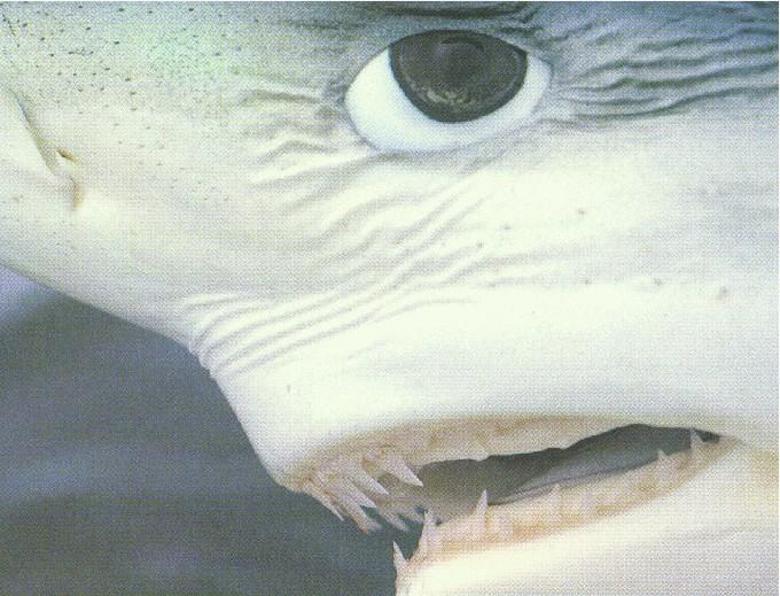
Scientists from Australia have used spectrophotometry to examine the light-sensitive cells in shark eyes.  In contrast to the 3 types of photoreceptors we humans have for red, green and blue, sharks only have one type of photoreceptor, suggesting that they can’t distinguish colors.   Sharks probably visualize their world in terms of assessing contrast against background.  Thus, it may be possible to design swimming gear, boats, and fishing gear that are less likely to catch a shark’s eye.

Read about it here in the news: http://latimesblogs.latimes.com/outposts/2011/01/sharks-are-color-blind-shark-attacks.html

and here is the original scientific article recently published:  http://www.springerlink.com/content/05427357r3uw8q35/

Here are a couple video clips showing shark attacks.  The 1st is of some idiots standing in shark infested water, and the 2nd is a scuba diver attacked by a Great White shark.