Huge new flying frog discovered in Vietnam

new-flying-frog-discovered

A NEW SPECIES OF flying frog has been discovered close to Vietnam’s largest city, surprising researchers.

Dr Jodi Rowely, a biologist from the Australian Museum who led the discovery, was stunned to find the 10cm frog less than 100km from Ho Chi Minh City, one of South East Asia’s largest urban centres with a population of over 9 million people.

“To discover a previously unknown species of frog, I typically have to climb rugged mountains, scale waterfalls and push my way through dense and prickly rainforest vegetation,” says Jodi.

“I certainly didn’t expect to find a new species of frog sitting on a fallen tree in lowland forest criss-crossed by a network of paths made by people and water buffalo, and completely surrounded by a sea of rice paddies,” says Jodi.

New amphibian found near Ho Chi Minh City
The frog is bright green with a white belly and has been named Helen’s tree frog (Rhacophorus helenae) after Jodi’s mother. The discovery was published last month in The Journal of Herpetology.

Jodi said the large frog has likely evaded biologists until now by spending most of its time out of sight, in the canopy of large trees. The frog has webbed hands and feet like parachutes, allowing it to glide from tree to tree.

To date, the species had only been found in two patches of lowland forest close to Ho Chi Minh City. Lowland forests are among the most threatened habitats in the world. In 2011 the Javan Rhino which relied on lowland forests was confirmed extinct in Vietnam.

“The new species is at great risk due to ongoing habitat loss and degradation – the greatest threat to amphibians throughout Southeast Asia – but hopefully it has been discovered just in time to help protect it,” says Jodi.

http://www.australiangeographic.com.au/journal/huge-new-flying-frog-discovered-in-vietnam.htm?_tmc=s1fuf2HtTMTwOjr3WxI17LME68lov6cs-fubIOVdTCg

Rare Frog Sports Thumb-Spikes for Sex and Combat

A rare Japanese frog sports spikes protruding from a set of pseudo-thumbs, a scientist has discovered. The built-in weaponry helps the males grab onto females during sex and duel with competitors over mates, the researcher said.

Unlike most four-toed frogs, the endangered Otton frog (Babina subaspera) has a “fifth finger.” In both males and females, this extra digit encases a sharp spine, but in males, this spike is more prominent, researcher Noriko Iwai from the University of Tokyo found.

Iwai believes the thumb-dagger evolved to allow males to anchor to the female during mating. And field observations in southern Japan’s Amami islands, the frog’s only home, showed that the males indeed jab their spikes into the sides of the females to hold on duringamplexus — a form of pseudocopulation in which the males mount the female and fertilize her eggs as, or soon after, she lays them.


A rare Japanese frog sports spikes protruding from a set of pseudo-thumbs, a scientist has discovered. The built-in weaponry helps the males grab onto females during sex and duel with competitors over mates, the researcher said.

Unlike most four-toed frogs, the endangered Otton frog (Babina subaspera) has a “fifth finger.” In both males and females, this extra digit encases a sharp spine, but in males, this spike is more prominent, researcher Noriko Iwai from the University of Tokyo found.

Iwai believes the thumb-dagger evolved to allow males to anchor to the female during mating. And field observations in southern Japan’s Amami islands, the frog’s only home, showed that the males indeed jab their spikes into the sides of the females to hold on duringamplexus — a form of pseudocopulation in which the males mount the female and fertilize her eggs as, or soon after, she lays them. 

But it appears the frogs also use the spikes for male-to-male combat over females and breeding nests. The researcher found they wrestle with each other in an embrace while stabbing at each other with the spines.

“While the pseudo-thumb may have evolved for mating, it is clear that they’re now used for combat,” Iwai explained in a statement. “The males demonstrated a jabbing response with the thumb when they were picked up, and the many scars on the male spines provided evidence of fighting.”

The spike, however, does not appear to cause lethal injuries during duels. Iwai noted a previous study of another frog with pseudo-thumb spikes, Hypsiboas rosenbergi, found that many males died after being stabbed in the eyes and ear drums by an opponent. Otton frogs don’t appear to jab their rivals in these critical areas, and they have a raised patch on their sides that seems to guard against serious injury, according to the study.

“It seems that the intensity of combat in Otton frogs is finely balanced so as not to result in critical or mortal injuries, yet it remains aggressive enough to establish a clear victor,” Iwai wrote in a paper published Oct. 18 in the Journal of Zoology.

http://www.livescience.com/24078-rare-frog-sports-thumb-spikes-for-sex-and-combat.html

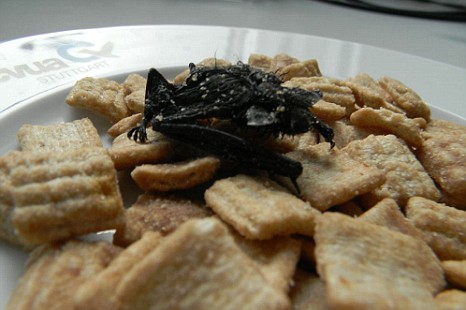
Man finds mummified bat in his breakfast cereal


The hungry German man’s start to the day was completely ruined when he discovered the dead bat in his bowl of cereal at his home in Stuttgart.

He was left feeling more horrified than hungry when he realised the mummified mammal was not a Halloween themed toy.

The incident was reported to health officials who are attempting to establish how the errant bat managed to fly into the box of corn flakes.

They believe the bat may have flown into the plastic packaging by mistake and suffocated to death.

Scientists are investigating whether the bat had flown into the box of Mini-Zimties cereal at the factory or after they had been opened.

Food safety official Jorg Sturmer said: ‘I have never seen anything like it. This really is an unusual case.’

Last month, a live frog was found jumping around a Waitrose salad bag bought by a family in Hampshire.

Read more: http://www.metro.co.uk/weird/917782-man-finds-mummified-bat-in-his-morning-bowl-of-cereal#ixzz2CDalVctB

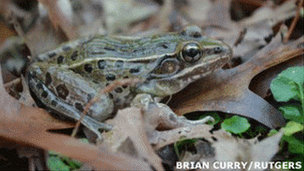
New Frog Species Found in New York City

Scientists say they have found a new type of frog living in New York City.

While new species are usually discovered in remote regions, this so-far unnamed type of leopard frog was first heard croaking on Staten Island.

Jeremy Feinberg of Rutgers University in New Jersey noticed the frogs there had a call he had never heard before.

They look identical to other species, but genetic analysis showed they are a new species of leopard frog that probably once lived in Manhattan.

While studying leopard frogs Mr Feinberg noticed that instead of the long “snore” he was expecting, he heard a short, repetitive croak.

“When I first heard these frogs calling, it was so different, I knew something was very off,” Feinberg said.

The frogs are currently found in Staten Island, mainland New York, and New Jersey, sometimes in sight of the Statue of Liberty.

The research by scientists at the University of California, Rutgers, UC Davis and the University of Alabama has been published online in the journal Molecular Phylogenetics and Evolution.

“For a new species to go unrecognised for all this time in this area is amazing,” said Professor Brad Shaffer, one of the authors from the University of California Los Angeles.

“Many amphibians are secretive and can be very hard to find, but these frogs are pretty obvious, out-there animals,” he said.

“This shows that even in the largest city in the US there are still new and important species waiting to be discovered that could be lost without conservation.”

There are more than a dozen species of leopard frog found from Canada to central America.

http://www.bbc.co.uk/news/world-us-canada-17367664