Reality show snake-handling preacher dies — of snakebite

140216095220-jamie-coots-restricted-story-top

By Ashley Fantz, CNN

A Kentucky pastor who starred in a reality show about snake-handling in church has died — of a snakebite.

Jamie Coots died Saturday evening after refusing to be treated, Middleborough police said.

On “Snake Salvation,” the ardent Pentecostal believer said that he believed that a passage in the Bible suggests poisonous snakebites will not harm believers as long as they are anointed by God. The practice is illegal in most states, but still goes on, primarily in the rural South.

Coots was a third-generation “serpent handler” and aspired to one day pass the practice and his church, Full Gospel Tabernacle in Jesus Name, on to his adult son, Little Cody.

The National Geographic show featured Coots and cast handling all kinds of poisonous snakes — copperheads, rattlers, cottonmouths. The channel’s website shows a picture of Coots, goateed, wearing a fedora. “Even after losing half of his finger to a snake bite and seeing others die from bites during services,” Coots “still believes he must take up serpents and follow the Holiness faith,” the website says.

In February 2013, Coots was given one year of probation for having crossed into Tennessee with venomous snakes. He was previously arrested in 2008 for keeping 74 snakes in his home, according to National Geographic. Tennessee banned snake handling in 1947 after five people were bitten in churches over two years’ time, the channel says on the show site.

On one episode, Coots, who collected snakes, is shown trying to wrest a Western diamondback out of its nook under a rock deep in East Texas. He’s wearing a cowboy hat and a T-shirt that says “The answer to Y2K – JESUS.”

The pastor is helped by his son and a couple of church members.

“He’ll give up, just sooner or later,” one of the members says. “Just be careful. Ease him out.”

The group bags two snakes, which a disappointed Coots says hardly justifies the trip to Texas.

“Catching two snakes the first day, ‘course we’d hoped for more,” Coots says in the video. “We knew that the next day we was gonna have to try to hunt harder and hope for more snakes.”

http://www.cnn.com/2014/02/16/us/snake-salvation-pastor-bite/index.html?c=homepage-t

Thanks to Pete Cuomo for bringing this to the attention of the It’s Interesting community.

Tikker: the wristwatch that focuses you on the ultimate deadline

Tikker

Tick Tock. Tick Tock. Tick Tock.

The seconds left in 2013 are slipping away. And you know what else is slipping away? The seconds left in your life.

Luckily for you, there’s a new product called Tikker, a wristwatch that counts down your life, so you can watch on a large, dot-matrix display as the seconds you have left on earth disappear down a black hole.

Your estimated time of death is, of course, just that, an estimate. Tikker uses an algorithm like the one used by the federal government to figure a person’s life expectancy. But the effect is chilling, a sort of incessant grim reaper reminding you that time is running out.

Tikker’s inventor is a 37-year-old Swede named Fredrik Colting. He says he invented the gadget not as a morbid novelty item, but in an earnest attempt to change his own thinking.

He wanted some sort of reminder to not sweat the small stuff and reach for what matters. He figured imminent death was the best motivator there is. That’s why he calls Tikker, “the happiness watch.” It’s his belief that watching your life slip away will remind you to savor life while you have it.

And, it turns out, there is some evidence for his point of view. A 2009 study showed that thinking about death makes you savor life more. And a 2011 study has shown thinking about death makes you more generous, more likely to donate your blood.

But that’s not the whole story. A whole dark underbelly of research suggests that thinking about our own mortality can bring out the worst in us. The work of Jeff Greenberg, Sheldon Solomon and Tom Pyszczynski — grandfathers of an idea in social psychology called terror management theory — has shown that thinking about death makes us, well, pretty xenophobic. When confronted with our mortality, we cling to those like us and disparage those who are different.

Now, why do you get both positive and negative effects? Well, that’s an open question in science right now. Do both always occur? Does it depend on the person? Does it depend on the way in which you are made to think about death, specifically picturing your own death or thinking about death in a more abstract or subliminal way? No one knows yet.

So whether Tikker will make you happy or, as Solomon quipped to me, “a xenophobic serial killer,” is still unknown. What is known is that the watch will be available in April 2014, and thousands of preorders have already rolled in.

http://kosu.org/2013/12/nothing-focuses-the-mind-like-the-ultimate-deadline-death/

Remembrance diamond from human ashes

humandiamond

An Treviso, Italian man’s 20-year-old son died in a car accident a few months ago and had already been buried. However, his father had his son’s remains exhumed, then cremated and finally had his remains turned into a remembrance diamond.

Corriere del Veneto reports that the owner of a Treviso funeral parlor said the 55-year-old father had visited his parlor to make funeral arrangements for his mother.

At that time, the man found some marketing material for a Swiss company called Algordanza, who offer the bizarre service of transforming human remains into artificial diamonds. From their website, it can be seen that they offer this service in quite a few countries in the world.

Silvia Zanardo, one of the partners of the funeral company, said that they explained the idea to the father and he asked them to help him, which they then did.

The funeral company then exhumed the son’s remains and cremated them, as the first step in the transformation process. After an eight-month waiting period, the father has finally received the diamond.

Apparently Algordanza has been operating in Italy since 2009, creating the “remembrance diamonds.”

Christina Sponza, a marketing representative for the company, explained how it works.

“The human body is formed in part by carbon, the same molecule that makes up the diamond.”

“With the cremation process, you get the carbon graphite. In Switzerland, the graphite is then pressed and held in very high temperatures, which simulate the pressure under which real diamonds are formed.”

“Finally, we deliver to relatives the diamond in a box, a sort of eternal funeral urn.”

The video below gives more detail of the process:

Read more: http://www.digitaljournal.com/news/odd%20news/italian-man-has-son-s-remains-turned-into-a-remembrance-diamond/article/364546#ixzz2oy8oOL89

Sexual frustration shortens the life of the fruit fly

fly-getty

Sexually frustrated fruit flies die earlier, new research suggests.

Scientists made the discovery by genetically modifying male flies to release female sex pheromones. Other males were left nearby and therefore instantly aroused by the pheromones. Some were allowed to mate, but others weren’t.

The findings, published in the journal Science, show that the sexually frustrated flies’ lives were 40 per cent shorter, while those who did mate suffered less stress.

Dr Scott Pletcher, Assistant Professor of Molecular & Integrative Physiology at the University of Michigan, co-authored the research. He told the BBC: “We immediately observed that (the non-mating flies) looked quite sick very soon in the presence of these effeminised males.”

A brain chemical, neuropeptide F (NPF), appeared to play a big role. NPF levels went up once flies were aroused. It would normally go down again upon mating.

But when it stayed high, it caused the stress and apparently the premature deaths.

Dr Pletcher went on: “Evolutionarily we hypothesise the animals are making a bet to determine that mating will happen soon.

“Those that correctly predict may be in a better position, they either produce more sperm or devote more energy to reproduction in expectation, and this may have some consequences [if they do not mate].”

http://www.independent.co.uk/news/science/sexual-frustration-will-give-you-a-shorter-and-more-stressful-life-if-you-are-a-fruit-fly-8972673.html

Thanks to Dr. D for bringing this to the attention of the It’s Interesting community.

Death of an un-loved one

death

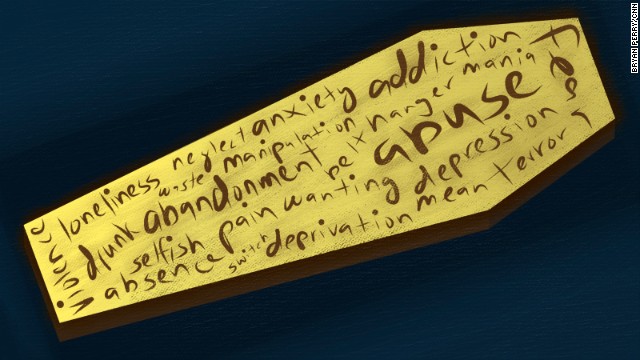
The obituary for Marianne Theresa Johnson-Reddick that appeared in the Reno Gazette-Journal on September 10 started in typical fashion: She was born on January 4, 1935 and died on August 30, 2013. But the announcement, written by two of her adult children, quickly took a grim turn.

While most death notices include a short, factual and sometimes cheery biography of the deceased, this one included a laundry list of Johnson-Reddick’s alleged parental failings and character flaws.

“She is survived by her 6 of 8 children whom she spent her lifetime torturing in every way possible,” the obituary read. “While she neglected and abused her small children, she refused to allow anyone else to care or show compassion towards them.”

The obit was submitted via the paper’s self-service online portal, according to publisher John Maher, and it quickly went viral. Patrick and Katherine Reddick co-wrote the scathing remembrance, and Patrick has gone on to tell publications he sang the Wizard of Oz’s “Ding-Dong! The Witch is Dead” when he learned of his mother’s passing.

The cemetery isn’t always an easy place to bury the hatchet, especially when survivors remember the deceased in an adversarial light. What do “My condolences” or “I’m sorry for your loss” mean to a person who is thinking “Good riddance”? And how do resentful survivors avoid speaking ill of the dead?

Grief experts say people affected by the death of a less-than-loved one often have much more unfinished emotional business, and that business starts with forgiveness of a sort.

The Reddick siblings claimed in the obituary that their motive was “to stimulate a national movement” against child abuse in the United States. “Her surviving children will now live the rest of their lives with the peace of knowing their nightmare finally has some form of closure,” they wrote.

Russell Friedman, executive director of the Grief Recovery Institute, said even the death of a toxic person can’t bring the closure the Reddick siblings mention when grief is unresolved.

“Grieving people tend to create larger-than-life pictures in which they enshrine or bedevil the person who died,” he said.

Friedman says rehashing tough memories in an obituary like Johnson-Reddick’s keeps survivors mired in pain and grief.

“When they’re telling the story of their pain, there’s no recovery. Where is the completion,” he asked. “They’re just confirming the pain that’s built in; the pain becomes their identity. The pain is not freedom; it’s jail.”

Some survivors of heinous abuse agree that holding onto hatred for the dead and publicly shaming them will not close the book on a lifetime of hurt.

Becky Blanton knows what unresolved grief feels like. Her essay detailing alleged physical and sexual abuse at the hands of her father, titled “The Monster,” appeared in the late journalist Tim Russert’s final book “Wisdom of Our Fathers” and outlines how she came to terms with his abuse while he was on his death bed.

Blanton said the only way to overcome pain caused by an instrumental figure in one’s life is to forgive, but the definition of that word is often misunderstood.

Both Blanton and Friedman said forgiveness is about relieving oneself of resentment.

“Forgiveness isn’t about saying, ‘It’s OK,’ or that you ‘accept’ or ‘approve’ what happened,” Blanton said. “Forgiveness is the acknowledgment that what happened, happened, and that you are now ready to set down the baggage, the pain and the fear.”

“There simply is no other way,” Friedman agreed.

Blanton finds that when a person forgives they no longer take action based on feelings of revenge, anger or fear, but instead make decisions based on their own character.

“If I consider myself a good person, a generous person, but then act meanly or selfishly because someone has treated me that way, then I allow their actions to determine my character and my actions,” Blanton said.

Mothers of sex offenders share responsibility, burden of label

Friedman said that without taking the proper steps to grieve and let go, pain can become part of one’s identity.

“(Retribution) does no virtue for you. It will create the illusion that you’ve done something valuable for yourself,” Friedman said.

Resolving that pain comes down to a key phrase: “I remember the time that you did this, and I’m not going to let the memory of that event hurt me anymore.”

There are ways to describe a person of dubious character after death without blasting them in an obit, according to Andrew Meacham, the chief epilogue writer for the Tampa Bay Times.

“Just as people aren’t saintly, they aren’t completely villainous,” he said.

“You don’t have to make somebody out to be a villain, just tell the facts and people can read between the lines,” Meacham explained.

Just as he says he avoids writing biographies in which that person “never met a stranger,” had a “smile that lit up a room” and the rest of those hanky clichés that come out when somebody dies, he also avoids the opposite.

“Had I written (the Johnson-Reddick obit) as a news story, I would want to talk to somebody who knew their mom,” he said. “Not necessarily to sanitize it, but she was a human being after all.”

Meanwhile, trying to console a person who has experienced a loss is tricky — especially if the relationship was contentious. Above all, Friedman recommends being mindful of the words you use.

“I’m sorry for your loss” doesn’t work, Friedman said. “‘I’m sorry’ is a dangerous line if you didn’t know the person who died.”

Friedman suggests instead using open-ended phrases like: “I don’t even know what to say. I can’t imagine what this has been like for you.” Turn the statement into more of a question, giving the person an opening to tell you the truth if they feel up to it.

Blanton agrees.

“‘I’m sorry for your loss,’ doesn’t cut it when a person is a monster,” Blanton said. “Having someone say, ‘I’m so sorry for what he did to you. I wish someone had been there for you’ does wonders.”

Blanton sees where the Reddicks were coming from. They are trying to be heard because they might not have been able to express anger as children (or were too scared to), she said, and they’re doing the best they can with the tools they have.

Her response: “We hear you.”

http://www.cnn.com/2013/09/24/living/death-anger-reddick-obit/?iref=obnetwork

World’s oldest man, Salustiano ‘Shorty’ Sanchez, dies aged 112

Salustiano Sanchez

The world’s oldest man, a gin rummy-playing, one-time sugarcane worker born in Spain, has died at 112 in New York state, a funeral home said on Saturday.

Salustiano “Shorty” Sanchez, recognised by Guinness World Records as the world’s oldest man, died on Friday at a nursing home in Grand Island, New York, the MJ Colucci & Son Funeral Chapels said on its website.

Guinness said in June that Sanchez, who also had been a construction worker, was the oldest man following the death of 116-year-old Jiroemon Kimura of Japan.

Sanchez credited his longevity to eating one banana per day and taking Anacin daily, according to a recent Guinness online profile. He told Guinness that living so long was not a special accomplishment.

Sanchez was born in El Tejado de Bejar, Spain, in 1901 and worked as a sugarcane field worker in Cuba before emigrating to the United States, where he found work in Kentucky coalmines.

Sanchez liked to garden, do crossword puzzles, and play gin rummy every night with friends, according to Guinness.

Sanchez was known for his musical talents as a boy, playing a dulzaina, a Spanish double reed instrument related to the oboe, Guinness said. He went to school until age 10.

Sanchez moved to the Niagara Falls area of New York state in the early 1930s and became a construction worker. He worked for Union Carbide Co for more than 30 years before retiring.

He married his wife, Pearl, in 1934. Sanchez had two children, seven grandchildren, 15 great-grandchildren and five great-great grandchildren, according to Guinness.

With his death, the world’s oldest man is Arturo Licata of Italy at 111. The oldest woman is Misao Okawa of Japan at 115, according to the Gerontology Research Group, which tracks people 110 and older and validates ages for Guinness.

The greatest authenticated age for any human is 122 years, 164 days by Jeanne Louise Calment of France.

http://www.theguardian.com/world/2013/sep/15/worlds-oldest-man-salustiana-sanchez-dies

Pennsylvania Woman Turns up Alive After Her Own New Jersey Funeral

sharolyn-jackson-e1377283273729

Carrie Minney could have sworn the woman in the casket was her 50-year-old daughter.

When Minney and the rest of Sharolyn Jackson’s family attended her viewing, funeral and burial in New Jersey on Aug. 3, they noted that Jackson’s nose looked thinner. But they figured something had happened to it during the embalming process.

The truth is far stranger: The woman they buried that day was not, in fact, their loved one but a lookalike. Jackson showed up at a Philadelphia hospital on Aug. 16, several weeks after she had been reported missing and 13 days after her family thought they had laid her to rest at Colonial Memorial Park in Hamilton, N.J.

“There was really a strong resemblance, a really strong resemblance,” Minney, 69, said Friday in a phone interview from her home in Trenton, N.J. “She looks so much like Sharol they could be sisters.”

Jackson was reported missing around the time that paramedics took a woman who’d been found lying in a Philadelphia street to a hospital, where she died July 20. One of Jackson’s sons and a social worker at Horizon House, where her mother said she had been receiving treatment for drug and mental health problems, viewed pictures of the dead woman’s body and made the identification.

The medical examiner determined the woman died of heat stroke, signed a death certificate and released the body to the family, Philadelphia Department of Health spokesman James Garrow said.

“If someone comes in and they’re a family member and say, ‘That’s my mom,’ that’s generally good enough,” Garrow said.

After Jackson showed up at Pennsylvania Hospital last week, police confirmed her identity through fingerprints. Her son went to the hospital and immediately recognized her.

“He said, ‘That’s my mom. We made a terrible mistake,'” Garrow said.

Philadelphia officials plan to exhume the buried body in hopes of correctly identifying it.

Minney said her daughter remains hospitalized. They’ve spoken only briefly over the phone, and Minney isn’t sure her daughter knows a funeral was held for her.

“I’m still overjoyed,” Minney said. “I got to come down from the joy because somebody else is dead. We don’t know who it is, and it bothers me that somebody else’s daughter is laying in that grave out there.”

http://abcnews.go.com/US/wireStory/pa-woman-turns-alive-funeral-20048307

After cardiac arrest, a final surge of brain activity could contain vivid experience, new research in rodents suggests.

sn-brain

What people experience as death creeps in—after the heart stops and the brain becomes starved of oxygen—seems to lie beyond the reach of science. But the authors of a new study on dying rats make a bold claim: After cardiac arrest, the rodents’ brains enter a state similar to heightened consciousness in humans. The researchers suggest that if the same is true for people, such brain activity could be the source of the visions and other sensations that make up so-called near-death experiences.

Estimated to occur in about 20% of patients who survive cardiac arrest, near-death experiences are frequently described as hypervivid or “realer-than-real,” and often include leaving the body and observing oneself from outside, or seeing a bright light. The similarities between these reports are hard to ignore, but the conversation about near-death experiences often bleeds into metaphysics: Are these visions produced solely by the brain, or are they a glimpse at an afterlife outside the body?

Neurologist Jimo Borjigin of the University of Michigan, Ann Arbor, got interested in near-death experiences during a different project—measuring the hormone levels in the brains of rodents after a stroke. Some of the animals in her lab died unexpectedly, and her measurements captured a surge in neurochemicals at the moment of their death. Previous research in rodents and humans has shown that electrical activity surges in the brain right after the heart stops, then goes flat after a few seconds. Without any evidence that this final blip contains meaningful brain activity, Borjigin says “it’s perhaps natural for people to assume that [near-death] experiences came from elsewhere, from more supernatural sources.” But after seeing those neurochemical surges in her animals, she wondered about those last few seconds, hypothesizing that even experiences seeming to stretch for days in a person’s memory could originate from a brief “knee-jerk reaction” of the dying brain.

To observe brains on the brink of death, Borjigin and her colleagues implanted electrodes into the brains of nine rats to measure electrical activity at six different locations. The team anesthetized the rats for about an hour, for ethical reasons, and then injected potassium chloride into each unconscious animal’s heart to cause cardiac arrest. In the approximately 30 seconds between a rat’s last heartbeat and the point when its brain stopped producing signals, the team carefully recorded its neuronal oscillations, or the frequency with which brain cells were firing their electrical signals.

The data produced by electroencephalograms (EEGs) of the nine rats revealed a highly organized brain response in the seconds after cardiac arrest, Borjigin and colleagues report online today in the Proceedings of the National Academy of Sciences. While overall electrical activity in the brain sharply declined after the last heartbeat, oscillations in the low gamma frequency (between 25 and 55 Hz) increased in power. Previous human research has linked gamma waves to waking consciousness, meditative states, and REM sleep. These oscillations in the dying rats were synchronized across different parts of the brain, even more so than in the rat’s normal waking state. The team also noticed that firing patterns in the front of the brain would be echoed in the back and sides. This so-called top-down signaling, which is associated with conscious perception and information processing, increased eightfold compared with the waking state, the team reports. When you put these features together, Borjigin says, they suggest that the dying brain is hyperactive in its final seconds, producing meaningful, conscious activity.

The team proposed that such research offers a “scientific framework” for approaching the highly lucid experiences that some people report after their brushes with death. But relating signs of consciousness in rat brains to human near-death experiences is controversial. “It opens more questions than it answers,” says Christof Koch, a neuroscientist at the Allen Institute for Brain Science in Seattle, Washington, of the research. Evidence of a highly organized and connected brain state during the animal’s death throes is surprising and fascinating, he says. But Koch, who worked with Francis Crick in the early 1980s to hypothesize that gamma waves are a hallmark of consciousness, says the increase in their frequency doesn’t necessarily mean that the rats were in a hyperconscious state. Not only is it impossible to project any mental experience onto these animals, but their response was also “still overlaid by the anesthesiology,” he says; this sedation likely influenced their brain response in unpredictable ways.

Others share Koch’s concerns. “There is no animal model of a near-death experience,” says critical care physician Sam Parnia of Stony Brook University School of Medicine in New York. We can never confirm what animals think or feel in their final moments, making it all but impossible to use them to study our own near-death experiences, he believes. Nonetheless, Parnia sees value in this new study from a clinical perspective, as a step toward understanding how the brain behaves right before death. He says that doctors might use a similar approach to learn how to improve blood flow or prolong electrical activity in the brain, preventing damage while resuscitating a patient.

Borjigin argues that the rat data are compelling enough to drive further study of near-death experiences in humans. She suggests monitoring EEG activity in people undergoing brain surgery that involves cooling the brain and reducing its blood supply. This procedure has prompted near-death experiences in the past, she says, and could offer a systematic way to explore the phenomenon.

read more here: http://news.sciencemag.org/brain-behavior/2013/08/probing-brain%E2%80%99s-final-moments

Thanks to Kebmodee for bringing this to the attention of the It’s Interesting community.

China Ghost Marriages: Grave-Robbers Sold Corpses As Dead Wives

ghost_marriage_rituals_bbssq

Four people have been jailed in China for digging up corpses to sell as brides for traditional “ghost marriages” — where dead single men are buried with a wife for the afterlife — local reports said.

Marriage is an important part of Chinese society and, while the practice is increasingly rare, it is still kept up by some families whose young adult sons pass away before having a chance to wed.

Normally it is agreed between the families of the dead, but the Xian Evening News said the group “stole female corpses and after cleaning them, fabricated medical files for the deceased and sold them for a high price”.

A court in the northern province of Shaanxi sentenced the four to terms between 28 and 32 months, it said, adding they “took advantage” of the “bad tradition” of ghost marriages in parts of Shaanxi and neighbouring Shanxi province.

Citing the court, the report said the gang made a total of 240,000 yuan ($39,000) from the sales of 10 corpses.

http://www.huffingtonpost.com/2013/03/04/china-ghost-marriages_n_2805262.html?utm_hp_ref=world

New tools for posting to social media sites after death

130221171758-cemetery-headstones-story-top

Death already has a surprisingly vivid presence online. Social media sites are full of improvised memorials and outpourings of grief for loved ones, along with the unintentional mementos the departed leave behind in comments, photo streams and blog posts. Now technology is changing death again, with tools that let you get in one last goodbye after your demise, or even more extensive communications from beyond the grave. People have long left letters for loved ones (and the rare nemesis) with estate lawyers to be delivered after death. But a new crop of startups will handle sending prewritten e-mails and posting to Facebook or Twitter once a person passes. One company is even toying with a service that tweets just like a specific person after they are gone. The field got a boost last week when the plot of a British show “Black Mirror” featured similar tools, inspiring an article by The Guardian.

“It really allows you to be creative and literally extend the personality you had while alive in death,” said James Norris, founder of DeadSocial. “It allows you to be able to say those final goodbyes.”

DeadSocial covers all the post-death social media options, scheduling public Facebook posts, tweets and even LinkedIn posts to go out after someone has died. The free service will publish the text, video or audio messages directly from that person’s social media accounts, or it can send a series of scheduled messages in the future, say on an anniversary or a loved one’s birthday. For now, all DeadSocial messages will be public, but the company plans to add support for private missives in the future.

DeadSocial’s founders consulted with end of life specialists while developing their service. They compare the final result to the physical memory boxes sometimes created by terminally ill parents for their children. The boxes are filled with sentimental objects and memorabilia they want to share.

“It’s not physical, but there are unseen treasures that can be released over time,” Norris said of the posthumous digital messages.
Among the early beta users, Norris observed that younger participants were more likely to make jokes around their own deaths, while people who were slightly older created messages more sincere and emotional. He’s considered the potential for abuse but thinks the public nature of messages will be a deterrent. The site also requires members to pick a trusted executor, and there is a limit of six messages per week.

“I don’t think that somebody would continually be negative and troll from the afterlife,” Norris said optimistically. “Nobody really wants to be remembered as a horrible person.”

The UK-based startup will only guarantee messages scheduled for the next 100 years, but in theory you can schedule them for 400 years, should your descendants be able receive Facebook messages on their Google corneas. The company has only tested DeadSocial with a group of beta members, but it will finally launch the service for the public at the South by Southwest festival in March. Fittingly, the event will take place at the Museum of the Weird.

For those interested in sending more personal messages — confessions of love, apologies, “I told you so,” a map to buried treasure — there’s If I Die. This company will also post a public Facebook message when you die (the message goes up when at least three of your appointed trustees tell the service you’ve died), but it can also send out private messages to specific people over Facebook or via e-mail.

Though If I Die has attracted a number of terminally ill members, the company’s founders think it could be appeal to a much wider audience.

“Somebody that knows he’s about to die gets time to prepare himself; the big challenge is when it happens unexpectedly,” said Erez Rubinstein, a partner at If I Die.

The Israeli site launched in 2011 and already has 200,000 users. Most have opted to leave sentimental goodbyes, and written messages are more common than videos, according the company. So far, the service is entirely free, but it plans to launch premium paid options in the future.

“It’s an era where most of your life and most of your presence is digital, and you want to have some control over it. You want to be in charge of how you are perceived afterward,” Rubinstein said.

A more extreme version of this type of control lies at the heart of _LivesOn, a new project with the catchy tag line “When your heart stops beating, you’ll keep tweeting.”

Still in the early stages, _LivesOn is a Twitter tool in development at Lean Mean Fighting Machine, an advertising agency in the United Kingdom. The agency is partnering with the Queen Mary University to create Twitter accounts that post in the voice of a specific person, even after he or she has died.

When people sign up, the service will monitor their Twitter habits and patterns to learn what types of content they like and, in the future, possibly even learn to mimic their syntax. The tool will collect data and start populating a shadow Twitter account with a daily tweet that the algorithm determines match the person’s habits and interests. They can help train it with feedback and by favoriting tweets.

“It’s meant to be like a twin,” said Dave Bedwood, a partner at Lean Mean Fighting Machine.

In the short term, Bedwood and his team said it will serve as a nice content-recommendation engine. But eventually, in the more distant future, the goal is to have Twitter accounts that can carry on tweeting in the style and voice of the original account.

The people behind the project warn against expecting Twitter feeds fully powered by artificial intelligence, or worrying about Skynet, any time soon.

“People seem to think there’s a button you can press, and we’re going to raise all these people from the dead,” joked Bedwood, who has seen a huge spike in interest in the project over the past week. “People have a real faith in what technology can do.”

Artificial Intelligence is still a long way from being able to simulate a specific individual, but recreating the limited slice of personality reflected in a Twitter feed is an interesting place to start.

The _LivesOn service is hoping to roll out to a limited number of test users at the end of March. As with the other services, _LivesOn will require that members choose an executor. At this point, it’s as much a thought experiment as an attempt to create a usable tool.

All these companies see the potential for technology to change how people think about death. Goodbye messages can help people left behind through the grieving process, but composing them can also be comforting to people who are uncomfortable with or afraid of death.

“We shy away from death. It reaches us before we approach it,” DeadSocial’s Norris said. “We’re using tech to soften the impact that death has and dehumanize it. It allows us to think about death in a more logical way and detach ourselves from it.”

The prospect of artificial intelligence, even in 140-character bursts, can also be comforting to people who see it as a way to live on.

“The afterlife is not a new idea, it’s been around for quite a long time with all the different versions of heaven and hell,” Lean Mean Fighting Machine’s Bedwood said. “To me this isn’t any stranger than any one of those. In fact, it might be less strange.”

http://www.cnn.com/2013/02/22/tech/social-media/death-and-social-media/index.html?hpt=hp_c2