D.C. will hide once-banned books throughout the city this month

bors_bannedbooks

By Perry Stein

If you enter just the right business or library this month, you may stumble upon a hidden book that was censored or challenged at one point. And if you find it, it’s yours for the keeping.

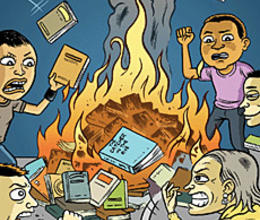
The D.C. public library system is hiding several hundred copies of books — which were once banned or challenged — in private businesses throughout all eight wards to celebrate Banned Books Week. The “UNCENSORED banned books” scavenger hunt kicked off Sept. 6 and will run through the month.

Each book is wrapped in a cover that explains why that book was banned or challenged. For example, J.D. Salinger’s “Catcher in the Rye” will say “Anti-White” because in 1963, parents of high school students in Columbus, Ohio, asked the school board to ban the novel for being “anti-white.”

Other challenged or banned books included in the scavenger hunt: “The Color Purple,” “Slaughterhouse Five,” “A Separate Peace,” “One Flew Over the Cuckoo’s Nest” and “Native Son.”

D.C. public libraries will dole out clues about the books’ whereabouts on its social media accounts throughout the month with the hashtag #UncensoredDC. People who find a book are encouraged to post a picture of it on social media with that hashtag.

Winners at least 21 years old have a chance to win free tickets to “UNCENSORED: The Cocktail Party” as part of a fundraiser for the D.C. Public Library Foundation.

The city’s library system will host banned-book-related events at 25 neighborhood libraries throughout the month.

“This year’s theme is ‘Diversity,’ which will celebrate literature written by diverse writers that has been banned or challenged, as well as explore why diverse books are being disproportionately singled out,” the library system wrote in a release explaining the festivities. “It’s estimated that more than half of all banned books are by authors of color, or contain events and issues concerning diverse communities, according to the American Library Association’s Office for Intellectual Freedom.”
‘Depraved’ sex acts by penguins censored 100 years ago are now being published

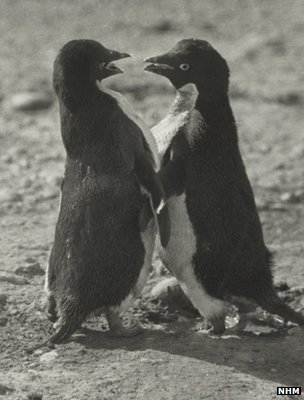
Accounts of unusual sexual activities among penguins, observed a century ago by a member of Captain Scott’s polar team, are finally being made public.

Details, including “sexual coercion”, recorded by Dr George Murray Levick were considered so shocking that they were removed from official accounts.

However, scientists now understand the biological reasons behind the acts that Dr Levick considered “depraved”.

The Natural History Museum has published his unedited papers.

Dr Levick, an avid biologist, was the medical officer on Captain Scott’s ill-fated Terra Nova expedition to the South Pole in 1910. He was a pioneer in the study of penguins and was the first person to stay for an entire breeding season with a colony on Cape Adare.

He recorded many details of the lives of adelie penguins, but some of their activities were just too much for the Edwardian sensibilities of the good doctor.

He was shocked by what he described as the “depraved” sexual acts of “hooligan” males who were mating with dead females. So distressed was he that he recorded the “perverted” activities in Greek in his notebook.

On his return to Britain, Dr Levick attempted to publish a paper entitled “the natural history of the adelie penguin”, but according to Douglas Russell, curator of eggs and nests at the Natural History Museum, it was too much for the times.

“He submitted this extraordinary and graphic account of sexual behaviour of the adelie penguins, which the academic world of the post-Edwardian era found a little too difficult to publish,” Mr Russell said.

The sexual behaviour section was not included in the official paper, but the then keeper of zoology at the museum, Sidney Harmer, decided that 100 copies of the graphic account should be circulated to a select group of scientists.

Mr Russell said they simply did not have the scientific knowledge at that time to explain Dr Levick’s accounts of what he termed necrophilia.

“What is happening there is not in any way analogous to necrophilia in the human context,” Mr Russell said. “It is the males seeing the positioning that is causing them to have a sexual reaction.

“They are not distinguishing between live females who are awaiting congress in the colony, and dead penguins from the previous year which just happen to be in the same position.”

Sexual coercion

Only two of the original 100 copies of Dr Levick’s account survive. Mr Russell and colleagues have now published a re-interpretation of Dr Levick’s findings in the journal Polar Record.

Mr Russell described how he had discovered one of the copies by accident.

“I just happened to be going through the file on George Murray Levick when I shifted some papers and found underneath them this extraordinary paper which was headed ‘the sexual habits of the adelie penguin, not for publication’ in large black type.

“It’s just full of accounts of sexual coercion, sexual and physical abuse of chicks, non-procreative sex, and finishes with an account of what he considers homosexual behaviour, and it was fascinating.”

The report and Dr Levick’s handwritten notes are now on display at the Natural History Museum for the first time. Mr Russell believes they show a man who struggled to understand penguins as they really are.

“He’s just completely shocked. He, to a certain extent, falls into the same trap as an awful lot of people in seeing penguins as bipedal birds and seeing them as little people. They’re not. They are birds and should be interpreted as such.”

https://mail.google.com/mail/?shva=1#inbox/137d4ea2cdc8413a

Thanks to Kedmobee for bringing this to the attention of the It’s Interesting community.


College Student Kicked Out for Writing ‘Hot For Teacher’ Essay


An Oakland University student says he’s considering legal action after he was kicked out of an English class for writing a “Hot for Teacher” essay.

Joe Corlett, 56, of Lake Orion, Mich., admits his writings during a fall 2011 Advanced Critical Writing class contain sexual fantasies about the instructor.

And his handwritten entry, which is now in the hands of a free-speech activist group, uses the title “Hot for Teacher” — a reference to a song on Van Halen’s 1984 album about a student fantasizing about a racy teacher.

“Then there’s Miss (teacher), English 380,” Corlett wrote, explaining his thoughts of dropping the class. “She walks in and I say to myself, ‘Drop, (expletive), drop.’ Kee-rist, I’ll never learn a thing. Tall, blonde, stacked, skirt, heels, fingernails, smart, articulate, smile. I’m toast but I’ll stay. I’ll (screw) up my whole Tuesday-Thursday class thing if I drop. I’ll search for something unattractive about her. No luck yet.”

Corlett said the entries were part of a diary-type assignment with no limitations.

“I asked and she said, ‘No, no topical restrictions,’ ” Corlett said.

Corlett said university officials banned him from campus for 2012’s spring, summer and fall semesters. He was allowed to enroll in two online courses this semester.

He’s waiting to hear whether he’ll be able to continue his education online, he said.

Oakland University spokesman Ted Montgomery said the school could not comment on the matter because it involves student conduct. The instructor could not be reached.

Corlett now has an “incomplete” grade for that class. A university student conduct committee also found him guilty in January of sexual harassment and intimidation charges after a hearing with four professors and two students. He wants that decision reversed.

Corlett has enlisted the help of the Foundation for Individual Rights in Education, a nonprofit education foundation based in Philadelphia that defends individual rights on campus.

“I want to be reinstated,” Corlett said. “I want my lawyer fees paid. I want to be made whole.”

Corlett’s lawyer, Brian Vincent of Lansing, Mich., said the situation comes down to the right to free speech.

“Obviously he’s got a wild sexual imagination in some instances, but it’s not harmful,” Vincent said.

http://www.usatoday.com/news/education/story/2012-02-15/hot-for-teacher-essay-michigan-oakland/53106370/1?csp=obnetwork

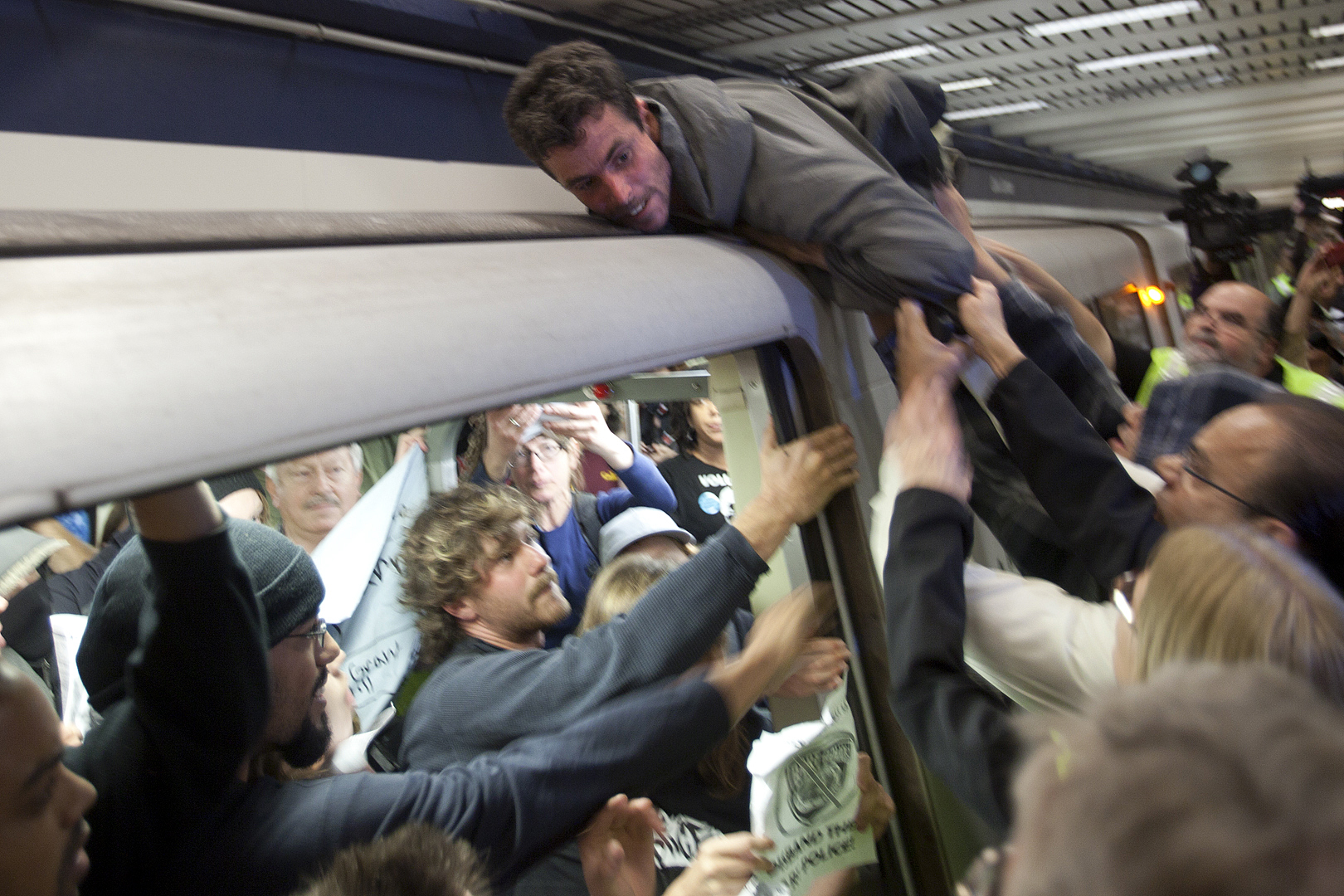
San Francisco Bay Area Rapid Transit (BART) Shuts Down Wireless Data to Stop Protest.

BART’s shut-off of subterranean cell phone service in its downtown San Francisco stations may have prevented a protest Thursday, but it sparked accusations Friday that the action stifled free speech and smacked of the kind of government intrusion employed by Middle East dictators.

“All over the world, people are using mobile devices to protest oppressive regimes, and governments are shutting down cell phone towers and the Internet to stop them,” said Michael Risher, a staff attorney for the American Civil Liberties Union of Northern California. “It’s outrageous that in San Francisco, BART is doing the same thing.”

BART officials acknowledged Friday afternoon that they had switched off the transit system’s underground cell phone network, which runs from Balboa Park Station through the Transbay Tube, from 4 to 7 p.m. Thursday to prevent protesters from coordinating plans to stop trains.

A cluster of groups under the “No Justice, No BART” banner said on websites that they planned to protest the fatal July 3 shooting of a knife-wielding man, Charles Blair Hill, by BART police. Protesters briefly shut down the Civic Center, Powell Street and 16th Street Mission stations July 11. Trains ran through the stations without stopping.

“Organizers planning to disrupt BART service stated they would use mobile devices to coordinate their disruptive activities and communicate about the location and number of BART Police,” the transit agency said. “A civil disturbance during commute times at busy downtown San Francisco stations could lead to platform overcrowding and unsafe conditions for BART customers, employees and demonstrators.”

Contrary to some speculative reports, BART did not jam wireless signals or ask cell phone providers to shut down towers near stations. BART owns and controls the wireless network strung through its subways, and BART police ordered it switched off, after receiving permission from BART interim General Manager Sherwood Wakeman, former general counsel for the transit district.

Benson Fairow, BART’s deputy police chief, said he decided to switch off the service out of concern that protesters on station platforms could clash with commuters, create panicked surges of passengers, and put themselves or others in the way of speeding trains or the high-voltage third rails.

“It was a recipe for disaster,” he said. “The fact that they started to conspire to commit illegal actions on the station platform was our concern. I asked myself: If my wife, mother or daughter was on that platform, would I want them to be in that situation?”

Civil libertarians questioned the constitutionality of BART’s decision and predicted legal action, or at least serious investigation by the Federal Communications Commission.
Read more: http://www.sfgate.com/cgi-bin/article.cgi?f=/c/a/2011/08/12/BAEU1KMS8U.DTL#ixzz1Uxu0YPTW